How to Visit the Alentejo From Lisbon
Disclosure: This article contains affiliate links. If you buy through them, we may earn a commission at no extra cost to you. Read our full disclosure.
Picture this: you’re on your fourth day in Lisbon. You’ve done the trams, the miradouros and more pastéis de nata than you’ll admit. Now you want the Portugal of cork oaks, whitewashed hilltop villages and long lunches. Then you open a map and realise the Alentejo is huge, and public transport into it is thin. This guide covers how to get there, where to go and how to plan it.
Getting From Lisbon to the Alentejo: Your Transport Options
My first trip into the Alentejo was a mess. I assumed it worked like a day trip to Sintra: hop on a train, wander around, hop back. I got to Évora easily enough. Then I wanted to see Monsaraz, and I spent a frustrating hour at the bus station learning that “a bus” sometimes means one departure in the morning and one in the late afternoon. Many people get caught by this. The gateway towns are easy to reach. The countryside beyond them takes planning.
The Alentejo covers roughly a third of mainland Portugal, so think of it as a collection of destinations. The best way in depends on which part you want to see. For the bigger picture of the region, see The Alentejo: Plains, Wine, and Hilltop Towns.
Taking the Train From Lisbon
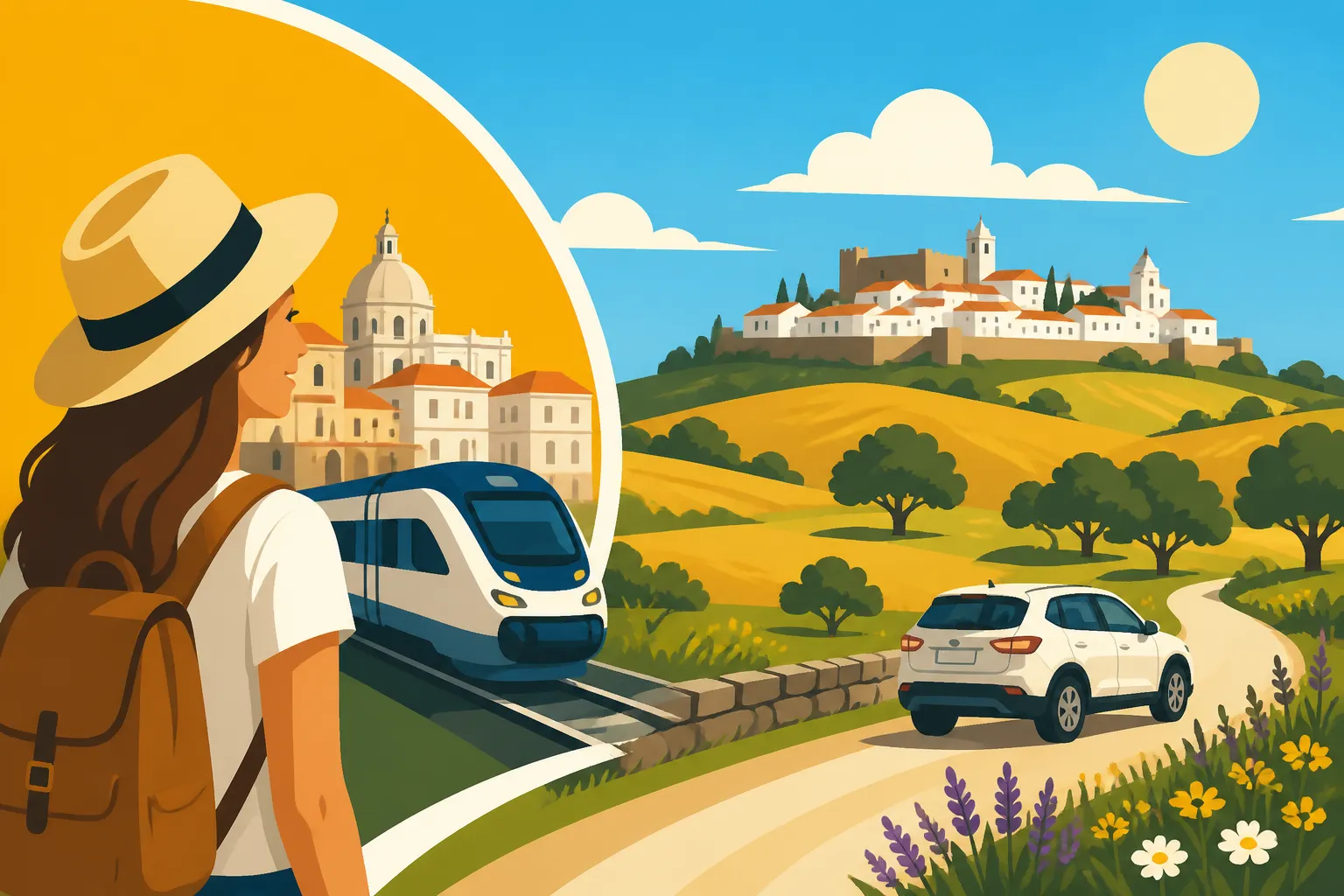
Comboios de Portugal (CP) runs Intercidades trains from Lisbon to Évora. They usually start at Lisboa Oriente and call at Entrecampos and Sete Rios. Then they cross the 25 de Abril Bridge, stop at Pragal on the south bank, and run on through Pinhal Novo and Vendas Novas into the plains. The bridge crossing alone is worth taking the train for. You get the Tagus, the Cristo Rei statue and the whole city skyline out of the window.
The train is comfortable, reliable and relaxing. You can read, nap or watch the landscape slowly flatten into wheat fields and scattered cork trees. Évora station is a short walk or a quick taxi ride outside the old city walls. That’s fine if you pack light, but annoying with a big suitcase on hot cobblestones. Trains also serve Beja, sometimes with a change. Daily departures are limited, so check the timetable before you build a day around them.
Buy your ticket on the CP website or app, or at the station. Intercidades seats are assigned, and weekend and holiday trains can fill up. Book ahead if you’re travelling on a Friday afternoon or a Sunday evening. How to Buy CP Train Tickets in Portugal and Save Money covers fare types and discounts. If you’d like to compare train and bus times side by side, Omio lists both on one search screen. That helps when you’re deciding between an early train and a later bus.
Riding the Rede Expressos Bus
The bus is the unsung hero of Alentejo travel. Rede Expressos coaches leave from the Sete Rios bus terminal, next to the Jardim Zoológico metro station. Some routes also leave from Oriente. Buses serve many more towns than the train. Évora, Estremoz, Beja, Elvas, Portalegre, Reguengos de Monsaraz and many smaller places are on the network.
For Évora, the bus is often as quick as the train and runs more often. The Évora bus terminal is a little closer to the walled centre than the train station. The coaches are modern, air-conditioned and comfortable. Book online, and pick a seat if the option is offered on busy routes.
The catch is onward travel. Getting from Lisbon to a district capital is easy. Getting from that capital to a tiny village like Monsaraz, Marvão or Mértola is another story. Local buses often run around school timetables, so services thin out in school holidays and at weekends. Some routes run one or two times a day. You can absolutely plan a car-free trip, but build it around the main towns and accept that you’ll lose some flexibility. How to Use Rede Expressos Buses in Portugal walks through booking and the main terminals.
Renting a Car and Driving South
I’ll be honest. If you want to feel the Alentejo, the real magic is behind the wheel. The region is all about the in-between places: a roadside café in a village you can’t pronounce, a dirt track to a megalithic stone circle, a winery with a long lunch on its terrace. A car makes all of that possible.
The drive itself is easy. From central Lisbon, you can cross the 25 de Abril Bridge on the A2, or take the long Vasco da Gama Bridge on the A12. Then join the A6 east towards Évora and Spain. Portuguese motorways in this region are smooth and often nearly empty compared with anything near Lisbon. Once you leave the motorway, the national roads are generally well kept. They are also narrow, and you’ll share them with tractors, cyclists and the odd flock of sheep.
Tolls catch many visitors out. The motorways south of Lisbon mostly have traditional toll booths where you can pay by card or cash. Rental cars usually come with an electronic toll device as an option, which saves a lot of hassle. Ask the rental desk exactly how tolls are billed before you drive away. How to Rent a Car in Portugal Without Toll Surprises covers the different systems, and Renting a Car in Portugal: Tolls, Insurance, and Driving Tips goes deeper on insurance excess and what to check at pickup.
Joining an Organised Day Tour
If driving abroad makes you nervous, or you only have one free day, a guided tour is a perfectly good choice. Many Lisbon operators run day trips to Évora. These often add a winery visit, the Cromeleque dos Almendres stone circle, or a stop at Monsaraz. Platforms like GetYourGuide let you compare group sizes, inclusions and reviews in one place. Read the itinerary carefully. Some tours give you very little free time in Évora, while others take a slower pace.
Tours solve the transport problem neatly. They take you to rural sites with no public transport, and a guide fills in the history you’d otherwise miss. The downside is the fixed schedule. You’ll eat where the group eats and leave when the group leaves. Tours suit first-time visitors and solo travellers. They suit people who want to linger less well.
Comparing Your Options at a Glance
| Option | Best For | Main Advantage | Main Drawback | Reaches Small Villages? |
|---|---|---|---|---|
| CP Intercidades train | Évora or Beja day trips, relaxed travellers | Scenic bridge crossing, comfortable seats | Limited departures, stations outside town walls | No, gateway towns only |
| Rede Expressos bus | Budget travellers, multi-town trips | Wide network, frequent Lisbon to Évora service | Rural connections sparse, especially weekends | Sometimes, with careful timing |
| Rental car | Wine routes, villages, coast, stargazing | Total freedom, reach remote sites | Tolls, parking in old towns, driving fatigue | Yes |
| Guided day tour | One-day visitors, non-drivers | Rural stops handled for you, local guide | Fixed schedule, less time at each stop | Yes, on set itineraries |
Choosing Which Alentejo to Visit
“Visiting the Alentejo” can mean very different trips. A friend of mine came back from a weekend “in the Alentejo” raving about surf and seafood. Another came back talking about marble quarries and medieval castles. They had both been to the same region. The Alentejo has distinct sub-regions, and picking one makes everything easier.
Évora and Its Surroundings
Évora is the obvious first stop, and it deserves its reputation. The whole historic centre is a UNESCO World Heritage Site. Inside the walls you’ll find the Roman Temple, the cathedral with its rooftop views, the Capela dos Ossos (Chapel of Bones), and a maze of lanes that feel nothing like Lisbon. Évora is a university city, so it has life after dark that many small Alentejo towns lack.
Just outside the city sits the Cromeleque dos Almendres. It’s a field of standing stones older than Stonehenge, reached by a dirt road through cork oaks. It’s one of my favourite places in Portugal, especially in the late afternoon. Nearby you’ll also find the Menir dos Almendres and a few dolmens if you have a car. Évora also has well-known wine producers right on its doorstep. For a deep dive into the city, see Évora City Guide: Roman Ruins and Alentejo Charm. If you’re doing Évora alone as a day trip, How to Visit Évora From Lisbon goes into timing and logistics in more detail.
Évora works brilliantly as a base. If you stay a few nights, you can do day trips to Arraiolos, which is famous for hand-embroidered rugs. You can also visit the marble towns, or head south-east to Monsaraz and the Alqueva lake.
Monsaraz, Alqueva, and the Marble Towns
Monsaraz is the village everyone falls in love with. It’s a tiny walled settlement on a hilltop, with whitewashed houses, slate lanes and a castle. It looks out over the huge Alqueva reservoir and across to Spain. Day-trippers thin out in the evening, and the silence up there is extraordinary. The Alqueva area is also part of a certified dark sky reserve, which is why so many people go stargazing nearby. See How to Stargaze in the Alentejo’s Dark Sky Reserve if you want to plan a night under the stars.
Close by, Reguengos de Monsaraz is the heart of an important wine area. Herdade do Esporão is one of the region’s best-known estates, with tastings and a restaurant. Book ahead, especially at weekends. How to Visit a Winery (Quinta) in Portugal explains how tastings usually work and what to expect.
North of Évora lies the marble triangle of Estremoz, Borba and Vila Viçosa. Here, even doorsteps and pavements are made of local marble. Estremoz has a hilltop castle and a lively Saturday market. Vila Viçosa has the grand Ducal Palace of the Bragança family. The landscape around them is dotted with huge open quarries, which look startling the first time you see them. Further north still, Marvão and Castelo de Vide in the Serra de São Mamede feel almost alpine. Marvão perches on a granite crag with views that seem to stretch forever.
The Alentejo Coast
Many visitors don’t realise the Alentejo has a coastline at all, and it’s one of the wildest in Europe. Comporta and Melides attract a stylish Lisbon crowd to rice fields, dunes and endless sandy beaches. Further south, Vila Nova de Milfontes, Almograve and Zambujeira do Mar sit along the cliffs of the Costa Vicentina natural park. The Rota Vicentina hiking trails, especially the Fishermen’s Trail, follow the cliff edge. For more on this stretch, see The Costa Vicentina: Wild Beaches and Cliffs.
Getting to the coast is a different trip from heading to Évora. By car, you drive south on the A2. Alternatively, you can drive to Setúbal and take the car ferry across the Sado estuary to the Tróia peninsula, then continue down towards Comporta. The ferry is a lovely way to start a beach weekend, and you might spot dolphins in the estuary. Rede Expressos buses do serve Milfontes and some coastal towns. Once you’re there, though, the beaches spread out, and a car or a bike makes life much easier.
Be warned: the Atlantic here is cold and powerful. Strong currents are common, so swim at beaches with lifeguards in summer and respect the flags.
Planning Your Trip: Day Trip, Weekend, or Slow Escape
The most common regret I hear is “I wish I’d stayed longer.” A day trip to Évora is very doable, and many people love it. But the Alentejo rewards slowness more than almost anywhere else in Portugal. Here is how I’d shape trips of different lengths.
A One-Day Évora Trip Without a Car
This plan works by train or bus from Lisbon.
- Take an early morning train from Oriente or Entrecampos, or a morning Rede Expressos coach from Sete Rios. Book your return trip at the same time so you’re not stranded.
- Walk or take a short taxi into the walled centre and head to Praça do Giraldo, the main square. Have a coffee and get your bearings.
- Visit the cathedral and climb to the roof terrace while it’s still cool.
- Walk to the Roman Temple and the gardens beside it. The views over the plains from there are lovely.
- Have a long lunch. This is not optional in the Alentejo. Many kitchens serve lunch in a fairly tight window, so don’t leave it too late.
- Spend the afternoon at the Capela dos Ossos and the Church of São Francisco, then wander the back streets and the old aqueduct, where houses are built right into the arches.
- Return to the station or terminal with time to spare. Taxis can be hard to find right when you need one.
If you want to add the stone circles, look for a local tour from Évora itself, or book a full-day tour from Lisbon that includes them.
A Weekend Road Trip Through the Interior
If you have two or three days and a car, this is the route I suggest to friends visiting me.
- Leave Lisbon in the morning and drive the A6 to Évora. Explore the centre and spend the night there.
- On day two, drive out early to the Cromeleque dos Almendres before the tour buses arrive.
- Continue south-east to Monsaraz through Reguengos de Monsaraz, with a winery lunch or tasting on the way.
- Explore Monsaraz in the late afternoon. Stay the night in or near the village, and step outside after dark to see the stars.
- On day three, loop north through Estremoz and Vila Viçosa for marble, castles and market stalls. Then take the motorway back to Lisbon.
How to Plan a Portugal Road Trip Itinerary can help you extend this into a longer loop, perhaps continuing to the Algarve.
Where to Stay in the Alentejo
Accommodation here is one of the best parts of the experience. Beyond normal hotels, the Alentejo is famous for its montes and herdades. These are country estates and farmhouses converted into guesthouses, often with pools, olive groves and a host who cooks dinner. There are also historic pousadas, including one inside a former convent in Évora and one within the castle walls at Estremoz.
Booking.com is handy for comparing these rural stays. Use the map view, though, because a “near Évora” listing can be a long drive down dirt roads. Read recent reviews for mentions of air conditioning, road access and whether dinner is served. In remote places that last point matters, because the nearest restaurant may close early. Accommodation in Portugal: Hotels, Guesthouses, and Pousadas explains the different types of stay in more depth.
What to Eat and Drink
Alentejo food is hearty, rustic and built around bread, olive oil, pork, lamb and wild herbs like coriander and pennyroyal. Some dishes to look for:
- Açorda alentejana, a garlicky bread soup with coriander and a poached egg, much better than it sounds.
- Carne de porco à alentejana, pork and clams cooked together, a surprisingly perfect pairing.
- Ensopado de borrego, a rich lamb stew served over slices of bread that soak up the sauce.
- Porco preto, the prized black Iberian pork, usually grilled as secretos or plumas and served simply with potatoes or salad.
- Migas, fried breadcrumbs with garlic and pork, often served as a side.
- Sericaia, a cinnamon egg pudding often eaten with a sweet Elvas plum.
The wines are generous and fruity, the olive oils are excellent, and regional cheeses from Serpa and Évora are worth seeking out at markets. For more on what to order, see Portuguese Regional Dishes Every Visitor Should Try.
Practical Tips for Travelling in the Alentejo
This is where I share the things I learned the hard way, so you don’t have to.
Beating the Heat and Picking Your Season
The Alentejo summer is intense. Inland temperatures in July and August regularly reach the high thirties and sometimes go well past that. The plains offer very little shade.
If you visit in summer, plan sightseeing for the morning and evening. Use the hottest hours for a long lunch, a siesta or a pool. Carry water everywhere, wear a hat, and park in the shade whenever you can. The coast is the exception, because Atlantic breezes keep things far more bearable.
Spring is my favourite time. The fields are green and full of wildflowers, the storks are nesting on every church tower, and the temperature is perfect for walking. Autumn brings the grape harvest and comfortable days. Winter is quiet, cool and sometimes damp, and old stone guesthouses can be chilly inside. Ask whether your room has heating before you book.
Opening Hours, Lunch Breaks, and Quiet Sundays
Life in the Alentejo moves at its own pace, and you’ll enjoy it more if you accept that early. Smaller shops and some sights close for a long lunch break in the middle of the day. Many museums and monuments close one day a week, often Monday. Village restaurants may stop serving lunch earlier than you’d expect and may only reopen in the evening. On Sundays, small towns can feel almost deserted outside church and lunchtime.
Check opening days for anything you’ve set your heart on, especially wineries, which often want visits booked ahead. Don’t plan to “grab something quick” at four in the afternoon in a small village. The café may only have toasties and cakes until dinner. That’s part of the charm once you stop fighting it.
Driving, Fuel, and Money in Rural Areas
A few practical notes for drivers:
- Fill up when you can. Petrol stations get sparse in the deep interior, especially on Sundays and evenings.
- Park outside walled villages. Places like Monsaraz and Marvão have car parks outside the walls, and the lanes inside are tiny.
- Watch for wildlife and farm animals on rural roads, especially at dusk.
- Carry some cash. Most places take cards, but small cafés, market stalls and village shops sometimes don’t.
- Download offline maps. Mobile signal can drop in valleys and remote areas.
If you decide a car isn’t for you, the Alentejo is still very rewarding. Base yourself in Évora, and use local tours or taxis for the countryside. How to Get Around Portugal Without a Car has broader advice on car-free travel across the country.
Respecting the Rhythm of Rural Life
The Alentejo has a reputation within Portugal for being slow, and locals joke about it with affection. In my experience, the people are warm, generous and happy to chat, even with limited English. A “bom dia” when you walk into a café goes a long way. So does patience when service is unhurried.
Many villages have ageing populations, and tourism is still fairly gentle compared with the Algarve or Lisbon. Keep noise down at night, don’t fly drones over people’s homes, and stay on paths at archaeological sites. Visitors are welcome here because the place hasn’t been overrun. Treat it gently, and it will give you some of your best memories of Portugal.
If you want more history on the road, How to See Roman Ruins in Évora and Beyond covers Roman and prehistoric sites in the area.
Disclaimer
This article is for general informational purposes only and does not constitute professional advice. Laws, prices and regulations vary by location and change over time. Consult a qualified professional for guidance on your specific situation.