How to Find Local Romarias and Festivals in Portugal
Disclosure: This article contains affiliate links. If you buy through them, we may earn a commission at no extra cost to you. Read our full disclosure.
If you have ever driven into a hilltop village in the Minho and found it already folding away its stalls, you know the problem. Portugal’s best romarias and local festas are rarely advertised in English, and most never appear on the big event sites. This guide shows you where festival dates are actually published, how to search for them in Portuguese, and how to plan your visit.
What Romarias and Local Festas Actually Are
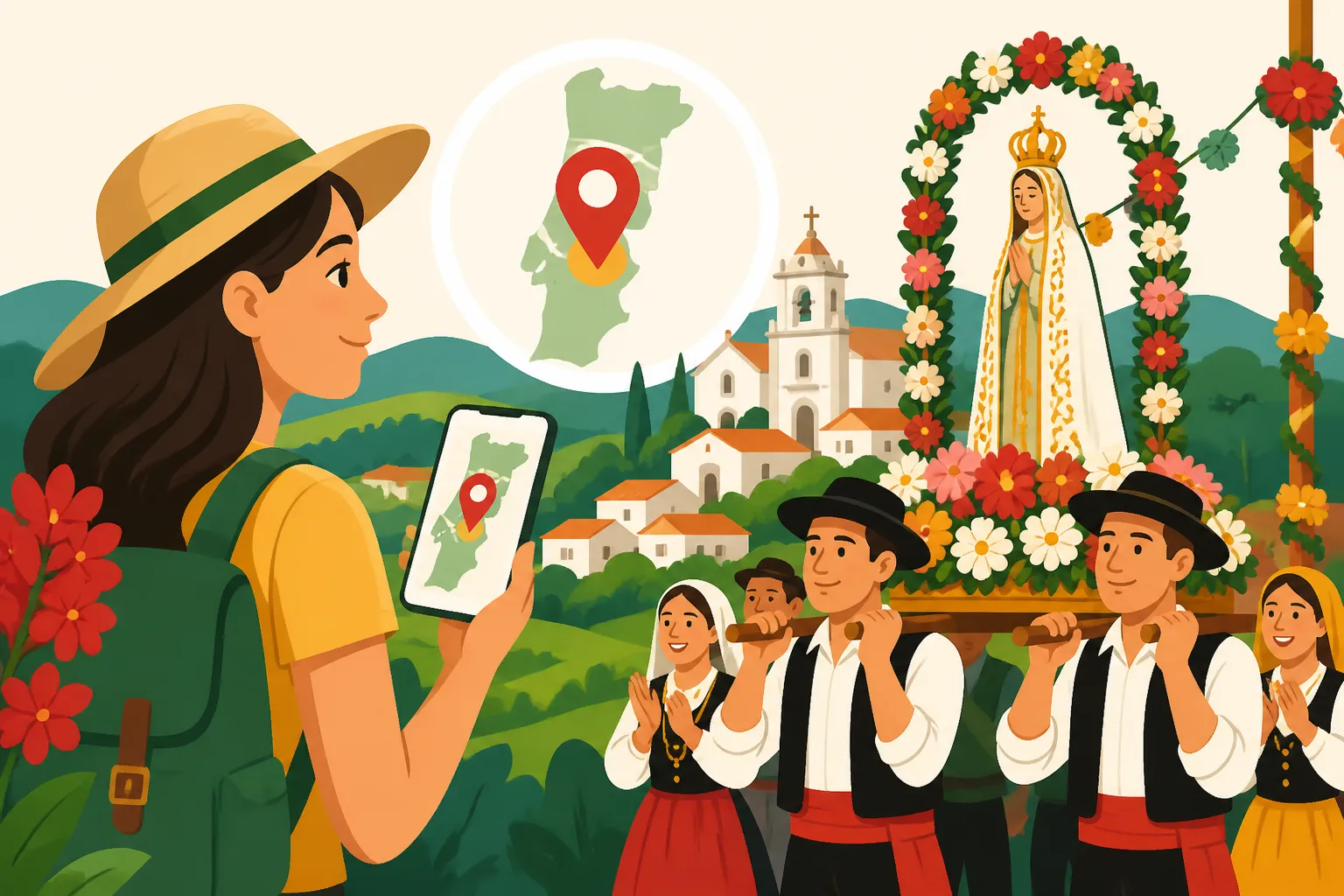
In my first summer in Portugal I kept hearing fireworks at eight in the morning. They were not New Year rockets but sharp, single bangs echoing off the hills. I assumed someone was celebrating a wedding. It took a neighbour, sweeping her doorstep in a housecoat, to explain that the village down the valley was announcing its festa. Those morning foguetes tell the whole parish that the party has started. I had been living within earshot of a festival for three days and had no idea where it was or when the procession would pass.
That is the essence of the frustration. Portugal holds hundreds of these events, possibly thousands if you count every parish chapel’s yearly celebration. Yet the information lives in local channels, written in Portuguese, often printed on paper. The big national festivals in Lisbon and Porto get international coverage. The intimate village romaria, with its brass band and procession of saints on flower-covered platforms, does not. For a wider view of how these events fit into the national calendar, see Festivals, Holidays, and Traditions in Portugal.
Romaria, Festa, Arraial: The Words You Need for Searching
Before you can find anything, you need to know what to type. A romaria is technically a pilgrimage to a shrine, usually a chapel or sanctuary dedicated to a saint or a title of the Virgin Mary. Over centuries the pilgrimage picked up a secular party around it: food stalls, music, dancing, fairground rides and fireworks. Today the word covers both halves. The Romaria de Nossa Senhora d’Agonia in Viana do Castelo is the most famous, but small versions happen in parishes all over the north.
A festa is the broader term. When you see “Festas em Honra de São (saint’s name)” on a poster, you are looking at a patron saint celebration. The phrase “em honra de” (in honour of) is gold for searching, because it appears on almost every official programme. An arraial is the open-air party part: the strings of coloured lights, the grilled sardines or febras, the stage with a conjunto (local band) playing pimba or folk music until the small hours. In Lisbon in June, “arraial” is the word everyone uses for the neighbourhood street parties.
A few more terms will help you read programmes and posters:
- Procissão: the religious procession, usually on the main day, carrying statues (andores) through the streets.
- Missa solene or missa campal: the formal Mass, sometimes held outdoors.
- Zés Pereiras or bombos: the bass-drum groups that march through town, especially in the Minho.
- Gigantones e cabeçudos: giant figures and big-headed costumed characters that dance in the parades.
- Fogo de artifício: the fireworks display, often around midnight on the main night.
- Quermesse or tômbola: a charity raffle, usually run by the parish committee.
- Comissão de festas: the organising committee, normally local volunteers.
- Tasquinhas: temporary food stalls or tavern tents.
The Rhythm of the Festival Year
The festival year in Portugal has a clear shape once you see it. Winter has a quieter string of very old traditions in Trás-os-Montes, where masked young men take part in the Festas dos Rapazes around Christmas and New Year. Carnival brings the Caretos of Podence, men in fringed suits and tin masks. Spring is led by Easter and Holy Week, then the pilgrimage season to Fátima opens in May. June belongs to the Santos Populares: Santo António, São João and São Pedro. July, August and early September are the peak of the romaria season, when almost every parish in the north and centre has its weekend.
There is a social reason why August is so packed. It is the month when emigrants come home from France, Switzerland, Luxembourg and further afield. Many villages schedule their festa for the weeks when their scattered families are back, because those families fund and fill the celebration. That makes mid-August, around the Assumption holiday on 15 August, the densest stretch of the year. If you want to see five festas in five days, that is your window.
The table below sketches some of the better-known events by season. Exact dates move each year, often tied to a weekend or to the Easter calendar, so treat the timings as a guide and confirm the programme before you travel.
| Festival | Place | Typical Timing | What Makes It Special |
|---|---|---|---|
| Festas dos Rapazes | Villages of Trás-os-Montes | Around Christmas and New Year | Ancient masked rituals, bonfires, music |
| Caretos de Podence | Podence, Macedo de Cavaleiros | Carnival | Fringed costumes and tin masks running through the village |
| Festa das Cruzes | Barcelos | Early May | Flower carpets, processions, big fair |
| Senhor Santo Cristo dos Milagres | Ponta Delgada, São Miguel | Spring, weeks after Easter | One of the largest religious events in the Azores |
| Fátima pilgrimages | Fátima | 12 and 13 May, and other months through October | Candlelit processions and huge crowds of pilgrims |
| Santo António | Lisbon | Around 12 and 13 June | Neighbourhood arraiais and the marchas populares |
| São João | Porto and Braga | Night of 23 to 24 June | All-night street party, fireworks over the Douro |
| Festas do Espírito Santo | Azores islands | Pentecost and through the summer | Crowned processions and shared community soup |
| Festas Gualterianas | Guimarães | Around the first weekend of August | Historic parades and a lively town festival |
| Romaria d’Agonia | Viana do Castelo | August | Gold jewellery, traditional dress, sawdust street carpets |
| São Bento da Porta Aberta | Terras de Bouro, near Gerês | Summer, with peaks in July and August | Mountain pilgrimage with a crowded sanctuary |
| Senhora dos Remédios | Lamego | Late August into early September | Baroque stairway, processions with ox carts |
| Feira de São Mateus | Viseu | Late summer into September | Long-running fair with concerts and food |
| Nossa Senhora da Nazaré | Nazaré | September | Seaside procession and fair |
Some festivals have a much longer cycle. The Festa dos Tabuleiros in Tomar, where young women carry towering trays of bread and paper flowers on their heads, only takes place every few years. If it falls during your trip, rearrange everything else around it. For the headline events by month, Portugal’s Biggest Festivals: A Year-Round Calendar gives a broader overview, while Local Romarias and Religious Festivals in Portugal goes deeper into the faith side.
Where Festival Information Really Lives
Here is the honest truth after years of chasing festas: the internet will give you maybe half of what is going on, and that half will be the bigger events. The other half lives on a lamp post, on a church door, or in the head of the woman running the café. The trick is to use all the channels together, starting broad online and getting more local as you go.
Câmara Municipal and Junta de Freguesia Channels
Portugal is divided into municipalities (concelhos), each run by a Câmara Municipal, and those are split into parishes (freguesias), each with its own Junta de Freguesia. For festival hunting, these two levels are your best friends. Most Câmaras publish an Agenda Cultural or Agenda de Eventos on their website, often as a monthly PDF. The bigger festas, especially those the municipality helps fund, will be in there with dates, times and the full programme.
Honestly, many Câmara websites are clunky, slow and hard to navigate on a phone. The Facebook page of the same Câmara is often far more up to date. Small Juntas de Freguesia may have no proper website at all but will post the poster for their festa on Facebook a few weeks ahead. Search Facebook for “Junta de Freguesia de (parish name)” and look at recent posts. The festa committee itself often has a page too, usually called something like “Festas de (village name)” or “Comissão de Festas (saint’s name)”.
A practical example: say you are staying near Ponte de Lima in August. The Câmara of Ponte de Lima will list the big town events, including the long-running Feiras Novas in September. But the small parish festas in the surrounding hills, each with its own chapel and procession, are more likely to show up on individual Junta pages. Spend twenty minutes checking the neighbouring parishes and you might find three festas within a short drive that weekend.
Posters, Church Boards and the Café Counter
The printed cartaz (poster) is still the main way village festas announce themselves. In the weeks before a festa, you will see them taped to café windows, pharmacy doors, bakery counters and lamp posts. They follow a recognisable design: a picture of the saint or the chapel, the words “Festas em Honra de”, the dates in large type, and then a list of bands, the procession time and the fireworks. If you are driving around rural Portugal in summer, stop and photograph every one you see. I keep an album on my phone just for festa posters.
Church notice boards are the second source. The parish priest often covers several villages, and the board at the main church lists Masses across all of them. When a village has its festa, the Mass schedule changes, and you will see a missa solene followed by procissão listed for a particular Sunday. That is a quiet but reliable clue, especially for tiny celebrations that never make it online at all.
Then there is the café. Portuguese village life runs through the café counter, and nobody knows the festa calendar better than whoever is serving the bicas. A simple question works wonders: “Há alguma festa por aqui este fim de semana?” (Is there any festa around here this weekend?) Even if your Portuguese is shaky, people are usually delighted that a foreigner wants to come to their festa and will tell you which hill, which road and which night is best. If you need help with those phrases, see Survival Portuguese for Travelers: Key Phrases to Learn First.
Regional Tourism Offices and Online Agendas
Each region of Portugal has its own tourism body, and many towns keep a Posto de Turismo (tourist information office) in the centre. The regional bodies, such as Turismo do Porto e Norte, Turismo Centro de Portugal, Visit Alentejo, Visit Algarve, Visit Madeira and Visit Azores, publish event listings that cover the larger festivals. The local Posto de Turismo is often far more useful in person than its website suggests. Staff usually have a stack of programmes and posters behind the desk and will know which nearby festas are worth the trip.
National culture listings and city agendas, such as the Agenda Cultural de Lisboa, are excellent for urban festivals but weak for rural ones. National newspapers also run “what’s on this summer” features that pick out the big romarias. Regional newspapers, like those serving the Alto Minho or the Beiras, cover smaller events in much more detail and often print the full programme.
Here is how the different sources compare in practice:
| Source | What You Will Find | Best For | Main Drawback |
|---|---|---|---|
| Câmara Municipal website | Official agenda, often as a PDF | Town festas and municipal events | Slow to update, hard to read on a phone |
| Câmara and Junta Facebook pages | Posters, last-minute changes, photos | Village festas and schedule updates | Requires searching each parish separately |
| Festa committee pages | Full programme, band line-up | Precise times for processions and fireworks | Pages appear and disappear year to year |
| Printed posters | Dates, bands, procession times | Discovering festas you never knew existed | Only visible if you are already nearby |
| Church notice boards | Mass and procession times | Tiny chapel festas with no online presence | Religious schedule only, no party details |
| Posto de Turismo | Programmes, staff tips, maps | Planning a few days in one area | Opening hours can be limited at weekends |
| Regional tourism websites | Major festivals by region | Long-range trip planning | Few small village events |
| Regional newspapers | Full programmes, local news | Detailed coverage of the summer season | Mostly in Portuguese, sometimes paywalled |
If you are based in a city and only want something nearby, How to Find Free Festival Events in Portuguese Cities covers the urban side of this search.
A Step-by-Step Method for Finding a Festival Near You
After a few summers of trial and error, I settled on a routine that rarely fails. It works whether you are planning months ahead from abroad or sitting in a guesthouse wondering what to do on Saturday night.
Searching in Portuguese Like a Local
English searches like “festivals near Braga” will return the same handful of big events every time. Portuguese searches dig far deeper. Follow these steps:
- Choose the area by concelho, not just by the nearest big city. Festivals are organised at municipal and parish level, so knowing the concelho name matters more than knowing the nearest airport.
- Search for “festas (concelho name) (month)” and “agenda cultural (concelho name)”. For example, “festas Arcos de Valdevez agosto”.
- Search for “festas em honra de” along with the town name. This phrase appears on nearly every official festa programme.
- Search “romaria” with the region, such as “romaria Minho agosto” or “romarias Trás-os-Montes”.
- Add “programa das festas” to any festa name you find, to pull up the detailed schedule.
- Move to Facebook and search for the Junta de Freguesia of each parish nearby, then for “Festas de (village name)”.
- Cross-check the date with a second source, such as a poster photo, the Câmara agenda or a call to the Posto de Turismo.
- Note the main day, the procession time and the fireworks time separately, because they are often on different evenings.
Step seven is the one people skip, and it is the one that saves trips. Festa pages sometimes stay online with the previous year’s programme, and if you only glance at the dates you can show up a week late. Always check that the poster you are reading is for the right year, and look for a recent post confirming it.
A Week in the Minho: How It Plays Out
Let me give you a realistic scenario. Imagine you have rented a house near Viana do Castelo for a week in mid-August. You already know about the Romaria d’Agonia because it is famous. But you want the smaller festas too, the ones without the crowds.
On your first morning, you walk into the café and see three posters on the window: one for a festa in a parish up the Lima valley, one for a festival in a fishing village on the coast, and one for a chapel celebration on a hilltop with “Missa Campal” and “Arraial com o conjunto (band name)”. You photograph them all. At the Posto de Turismo in Viana, the staff hand you the full Agonia programme and point out the best night for the sawdust carpets and the best morning for the procession of women in traditional gold jewellery and red dress.
That evening you check Facebook for the hilltop parish and find the committee page, with a post from two days ago confirming the times. Over the next week you see the grand Viana procession, a quiet coastal celebration where fishermen carry the saint to the boats, and a hilltop arraial where you are the only foreigners and the whole village insists you try the rojões. None of the small two appeared on any English website. This is the kind of week that makes people fall in love with northern Portugal, and Portugal’s Most Beautiful Villages (Aldeias) to Visit can help you pick a base with festas all around it.
Reading a Programa das Festas
Once you have the programme, you need to decode it. Festa programmes usually run over three to five days, often Thursday to Monday, with each day listed by time. Here is what to look out for:
- Alvorada com foguetes: early morning fireworks announcing the day. Loud and short; you do not need to be there.
- Arruada or desfile de Zés Pereiras: the drum groups marching through the streets, often mid-morning. Very photogenic and great fun.
- Missa solene followed by procissão: usually late morning or afternoon on the main Sunday. This is the spiritual heart of the event.
- Arraial or baile: the evening party with a live band, starting late and going past midnight.
- Sessão de fogo de artifício: the fireworks show, usually near midnight, sometimes over water.
- Encerramento: the closing, often the last night, sometimes with a final display.
Portuguese festa schedules use the 24-hour clock, and things often start later than printed. A band listed for 22h00 may come on stage well after. The procession, by contrast, tends to leave closer to time because it follows the Mass. If you only have one slot, go for the procession on the main day and stay for the evening arraial. That gives you both faces of the festa: the devotional and the joyful.
If your dates overlap with a public holiday, remember that shops, banks and some transport services shift their hours. How to Plan Travel Around Portuguese Holidays explains how to work around that.
Getting There, Staying Over, and Fitting In
Finding the festa is only half the challenge. The other half is getting to a village with one bus a day, finding a bed when every room is taken by returning emigrants, and knowing how to behave when the saint comes down the street.
Transport to Small-Town Festivals
The big urban festivals are easy. São João in Porto and Santo António in Lisbon are served by metro, trains and buses running extra services. For more on Porto’s night, see How to Celebrate São João in Porto, and for Lisbon’s June parties, Santos Populares: Lisbon and Porto’s June Street Parties.
Rural festas are another story. Many villages are linked to their district town by regional buses that thin out sharply at weekends and stop entirely in the evening, which is exactly when the arraial gets going. Before you commit, check both the outbound and return times. A comparison platform like Omio can help you see train and long-distance bus options between bigger towns in one place, which is useful for the first leg, say from Lisbon to Viana do Castelo or from Porto to Lamego. For the last leg into the hills, you will usually need the regional operator’s own timetable, and Buses in Portugal: Rede Expressos and Regional Networks walks through how those networks work.
For most rural festas, a car is the realistic choice. Be aware that roads into a village on festa night are often closed or jammed, and parking spreads into fields and verges. Arrive early, park where locals park, and walk the rest. Remember that you will be leaving late at night on dark, winding roads, so plan who is driving before anyone orders a glass of vinho verde. If you are hiring, How to Rent a Car in Portugal Without Toll Surprises covers the electronic toll systems that catch many visitors out.
Another option is a guided day trip. Tour platforms such as GetYourGuide sometimes list day trips from Porto into the Minho or the Douro that can coincide with festival periods, which takes the driving and logistics off your hands. Check the tour description carefully to see whether it actually includes time at the festa or simply passes through the region.
Accommodation When the Whole Town Is Full
In smaller towns, the festa weekend is the busiest of the entire year. Guesthouses fill with returning families, and the few hotels raise rates and sell out. For a major romaria like Agonia in Viana or the Senhora dos Remédios in Lamego, book as early as you can. A site like Booking.com is useful here because you can filter for free cancellation and book a room the moment you know the dates, then cancel if your plans change. Searching a wider radius, a neighbouring town or a rural turismo de habitação manor house, often turns up rooms when the centre is full.
For small village festas, you rarely need to stay in the village itself. Base yourself in a nearby town and drive in for the evening. This also gives you the flexibility to visit two or three festas over a long weekend. If you are travelling on short notice, How to Find Last-Minute Accommodation in Portugal has more tactics for snagging a room.
Keep some cash with you on festa days. Many stalls at village festas, especially the parish charity stands and the small food tents, still prefer cash, and the nearest ATM may be in the next town with a queue in front of it. See Cash vs Card in Portugal and Using Multibanco for how the local ATM network works.
Etiquette at Processions and Arraiais
Portuguese festas are generous and welcoming, but the religious parts deserve respect. When the procession passes, step back to the edge of the street and let it go by. Local people may make the sign of the cross or bow their heads as the statue of the saint passes. You do not need to copy them, but stay quiet, take off your hat and put your drink down. Do not step into the procession for a photo, and never walk across the sawdust or flower carpets laid in the street. Families may have spent the whole night making them.
If you go into the church or chapel during the festa, dress modestly. Shoulders covered and no beachwear is the general rule. How to Dress for Churches and Religious Sites in Portugal explains the norms in more detail. Outside, at the arraial, anything goes within reason. People dance in couples, children run between the tables, grandparents sing along with the band, and you will be expected to join in if anyone pulls you onto the floor.
Buy from the parish stalls. The quermesse raffle and the committee’s own bar fund the festa, and buying a ticket or a drink is a small way of saying thank you. Try the local food, which varies by region: grilled sardines and caldo verde in many places, rojões and papas de sarrabulho in the Minho, bifanas almost everywhere. Learn to say “Boas festas” or simply “Que festa bonita” (What a beautiful festa). People notice the effort.
Finally, expect noise and late nights. Fireworks can go off at dawn, drums march through the streets in the morning, and the band may play past two in the morning. If you are renting nearby, this is part of the deal. The same neighbour who explained the foguetes to me that first summer told me, with a shrug, that the saint only comes out once a year. After a few summers, I started to think she was right, and these days I am the one telling newcomers which hill to drive up on which Saturday.
Disclaimer
This article is for general informational purposes only and does not constitute professional advice. Laws, prices and regulations vary by location and change over time. Consult a qualified professional for guidance on your specific situation.