Buses in Portugal: Rede Expressos and Regional Networks
Disclosure: This article contains affiliate links. If you buy through them, we may earn a commission at no extra cost to you. Read our full disclosure.
You’ve just landed in Lisbon, the train to Lagos means a change of trains, and the coach terminal at Sete Rios looks like controlled chaos. Most Portugal travellers hit this wall. This guide explains how Rede Expressos and the regional bus networks work, how to book, which terminals to use, and how to avoid getting stranded in a village on a Sunday afternoon.
Why Buses Matter So Much in Portugal
Where the Train Network Stops Short
I assumed the trains would cover everything when I first arrived. They don’t. The main CP rail spine linking Braga, Porto, Coimbra, Lisbon and Faro is excellent. Once you leave that spine, rail coverage gets thin very quickly. Large parts of the interior, the Alentejo hill towns, the Silver Coast and the western Algarve either have no station or have one several kilometres outside the town centre.
Buses fill those gaps. Want to reach Nazaré, Óbidos, Peniche, Tomar’s surrounding villages, Monsaraz or the Costa Vicentina beaches? A coach is often the only public option, and sometimes the fastest one. If you’re weighing rail against road for a particular trip, see Trains in Portugal: CP Routes, Alfa Pendular, and Booking for the rail side of the decision.
The Cultural Role of the Autocarro
In much of rural Portugal the bus, or autocarro, is a lifeline as much as a convenience. Students travel home on it, older residents ride it to the district hospital, and village shops get small parcels through it. That shapes the timetable. Routes are often built around school hours and market days, not tourist sightseeing.
So the bus that seems to leave at an absurdly early hour isn’t badly planned. It was designed to get a teenager to secondary school in the district capital. Understanding that logic has saved me a lot of frustration, and it helps you predict when services will exist and when they won’t.
Rede Expressos: The National Intercity Coach Network
What Rede Expressos Actually Is
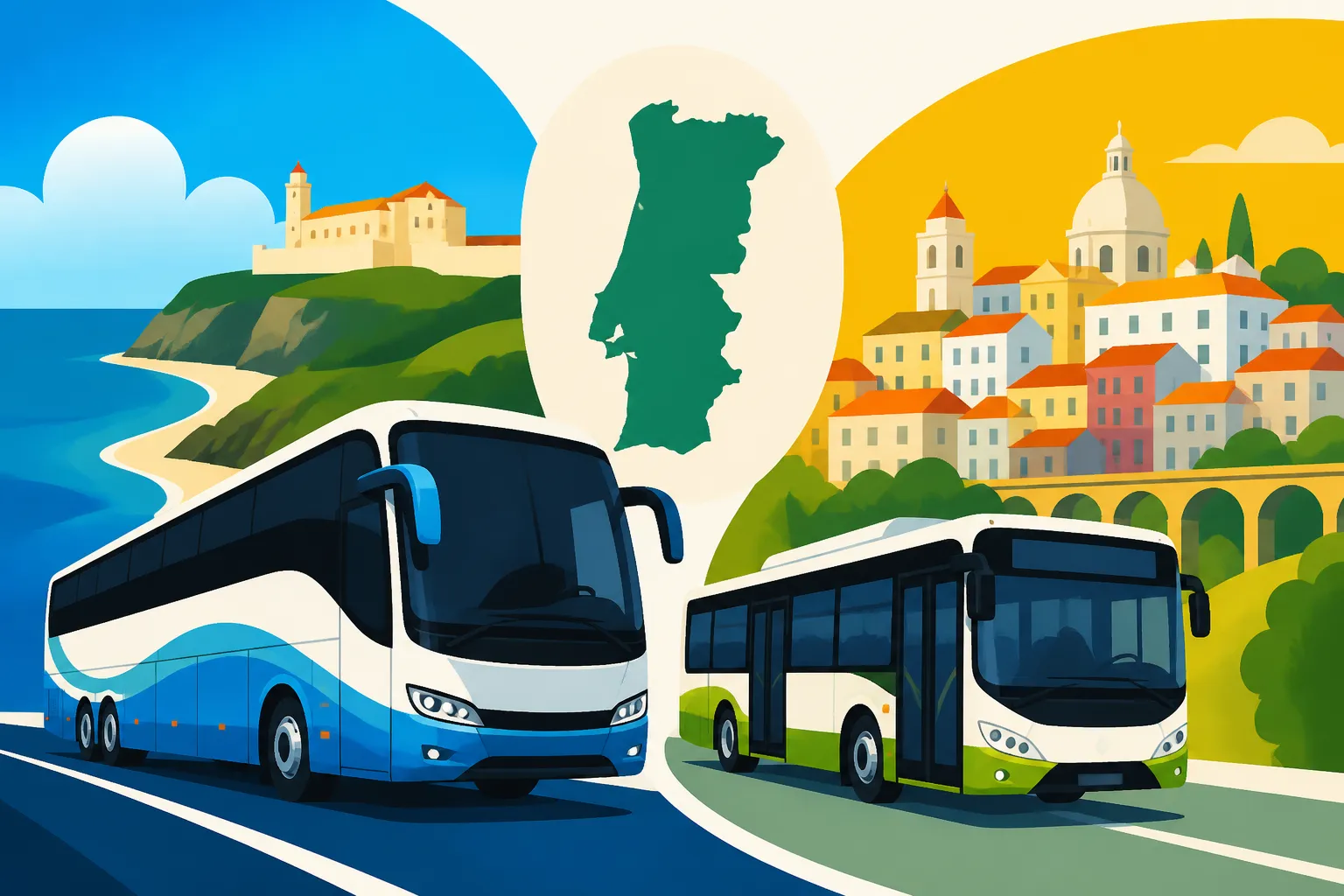
Rede Expressos is the main national long-distance coach brand. It links Lisbon, Porto and the Algarve with dozens of mid-sized towns across the mainland. It works as a network: several partner operators run under the same brand, timetable and ticketing system. That’s why the coach you board may have a different company name painted on the side than the one on your ticket. Nothing is wrong. Your seat is still valid.
The coaches are generally modern and air-conditioned, with assigned seating, reclining seats and a luggage hold underneath. Many have charging sockets and onboard Wi-Fi. Wi-Fi quality varies a lot, so don’t plan a video call on the A2 motorway. Long journeys usually include a short stop at a service area or a town terminal, where you can stretch your legs and grab a coffee.
Main Terminals You Need to Know
In Lisbon, the key hub is the Sete Rios terminal, beside the Jardim Zoológico metro station on the blue line. Most Rede Expressos departures to the Algarve, Alentejo and north leave from here. Some routes also stop at the Gare do Oriente transport hub on the red line, which is handy if you’re staying near Parque das Nações or coming straight from the airport. For the metro connections, see Getting Around Lisbon: Metro, Trams, and the Famous 28.
In Porto, intercity coaches use the intermodal terminal in the Campanhã area near the main railway station, which connects to the metro and local buses. In the Algarve, Faro’s bus station sits near the marina and the old town, within walking distance of many guesthouses. Lagos, Portimão, Albufeira and Tavira all have their own stations. Some are central, while others sit on the edge of town, so check the walking distance before you book accommodation. For moving around Porto once you arrive, see Getting Around Porto: Metro, Buses, and Funiculars.
Express Versus Stopping Services
Two coaches can cover the same route in very different times. Express services run motorway-heavy with few stops. Other departures wind through every intermediate town, picking up and dropping off along the way. Lisbon to Lagos can feel quick on one departure and like a slow regional tour on the next.
When you search, compare the scheduled journey times next to each other, not just the departure times. I arrived later than the second coach would have, after touring several small towns first. Lesson learned.
Regional and Local Bus Networks
How Regional Networks Are Organised
Below the national level, Portugal’s buses are run by a patchwork of regional operators. Each serves a district or metropolitan area under its own brand. In the Algarve, Vamus Algarve runs the local and coastal routes linking towns like Faro, Olhão, Loulé and Albufeira. In the Alentejo, Rodoviária do Alentejo covers many towns and villages. Further north, groups such as Transdev and Rodonorte run large parts of the interior network.
Around Lisbon, Carris Metropolitana operates the suburban and inter-municipal buses across the metropolitan area, including routes to Sintra, Cascais, Mafra, Ericeira and the Setúbal Peninsula. These buses accept the Navegante card, the same card you use for the Lisbon metro. That makes them easy to use even if your Portuguese is minimal.
Timetables, School Terms and Sunday Gaps
Here’s where newcomers get caught out. Regional timetables are usually split into categories. Dias úteis means weekdays, sábados means Saturdays, and domingos e feriados means Sundays and public holidays. Many printed and online timetables also separate período escolar, the school term, from férias escolares, the school holidays.
During school holidays, including much of summer, rural services can drop sharply because the students they were built around aren’t travelling. On Sundays and holidays, some village routes stop entirely. Picture this: you take a morning bus to a gorgeous Alentejo hill town on a Sunday in August, assuming there will be an afternoon bus back. There isn’t. The nearest taxi is in the next town, and you spend a very expensive hour arranging a ride home. Always confirm the return journey before you leave, especially on weekends and around festivals. How to Plan Travel Around Portuguese Holidays covers the holiday calendar in detail.
Paying on Regional Buses
On many regional and local buses, you can still buy a single ticket from the driver as you board. Have small notes and coins ready, because drivers on rural routes may not be able to break a large note. Some operators also offer contactless payment or app-based tickets, while others have their own rechargeable cards. Each network is different, so check the operator’s own site before you travel.
On Carris Metropolitana and other metropolitan networks, loading your Navegante card before boarding is usually cheaper and quicker than paying the driver. Tap the card on the validator every time you board. Inspectors do check, and claiming you didn’t know the system rarely gets you out of a fine.
Comparing Your Bus Options
Rede Expressos, FlixBus and Regional Operators Side by Side
Rede Expressos isn’t the only long-distance option. FlixBus runs a growing number of domestic routes between major cities, along with international connections to Spain and beyond. Spanish operator Alsa also links parts of Portugal with Spanish cities. Competition has made the main corridors, especially Lisbon to Porto and Lisbon to the Algarve, well served.
| Option | Best For | Booking Style | Seat Assignment | Coverage Shape |
|---|---|---|---|---|
| Rede Expressos | Intercity trips and mid-sized towns | Online, app or terminal ticket office | Assigned seat | Broadest national network on the mainland |
| FlixBus | Major city pairs and trips to Spain | Online or app | Varies by booking | Strong on main corridors, thinner inland |
| Regional operators such as Vamus Algarve or Rodoviária do Alentejo | Village hops and short local journeys | Often paid on board or by card | Unassigned | Dense within a region, sparse on weekends |
| Carris Metropolitana | Lisbon suburbs, Sintra, Cascais, Setúbal | Navegante card or on-board ticket | Unassigned | Lisbon metropolitan area only |
| City buses such as Carris in Lisbon or STCP in Porto | Getting around inside a city | Contactless, city transit card or driver | Unassigned | Within city limits |
Bus Versus Train on Key Routes
Between Lisbon and Porto, the Alfa Pendular and Intercidades trains are usually faster and more comfortable, but coaches often win on flexibility and sometimes on fare. For the Algarve, the train serves Faro and Tavira well. For Lagos, the coach is often more direct than changing trains along the way. For Nazaré, Peniche and most of the Silver Coast, the coach is effectively the only practical public option.
A metasearch platform like Omio is handy here. You can compare coach and train departures for the same journey on one screen, which helps when you’re trying to judge whether a cheaper coach is worth an extra hour. I still book directly with the operator when I can, because changes and refunds are easier to sort out face to face at a terminal. For the wider picture of all transport modes, see Getting Around Portugal: Trains, Buses, Flights, and Car Hire.
When a Bus Is the Wrong Choice
Some trips simply don’t work well by bus. The Douro Valley’s quintas, the remote beaches of the Costa Vicentina, and caves and cliffs reachable only by boat are all difficult or impossible to visit on public transport in a single day. Spending a day off chasing infrequent connections is exhausting.
For those cases, an organised day trip booked through GetYourGuide can be the sensible answer. The transport and timing are handled for you, and you avoid the risk of missing the last bus back. Treat it as a tool for specific gaps, not a replacement for the bus network. If you want to explore car-free over a longer trip, How to Get Around Portugal Without a Car goes deeper into stitching routes together.
Step-by-Step: Booking and Riding a Rede Expressos Coach
Booking Your Ticket
Booking is straightforward once you’ve done it once. The process looks like this:
- Open the Rede Expressos website or app and enter your departure and destination towns. Spell them the Portuguese way, for example Évora or Nazaré.
- Choose your date and compare departures, paying attention to the journey duration as well as the departure time.
- Check whether any discounts apply, such as youth, senior or return-trip reductions. Eligibility rules and current figures are on the operator’s own pages.
- Select your seat if the system offers a choice. Window seats on the left side heading south from Lisbon give lovely views of the plains.
- Pay by card and save the ticket. It usually arrives as a PDF or in-app QR code, which the driver scans.
- Take a screenshot of the QR code in case mobile data fails at the terminal.
If you prefer buying in person, the ticket offices at Sete Rios, Campanhã and Faro handle bookings. Queues can be long at peak times. Learning a few phrases helps a lot at rural offices, where English is less common. See Survival Portuguese for Travelers: Key Phrases to Learn First for the essentials, including how to ask “a que horas parte o autocarro para” followed by your destination.
Peak Times and Selling Out
Coaches on popular routes can sell out, especially on Friday evenings and Sunday afternoons when students and workers travel to and from home. Long weekends, the summer holidays, and festival periods such as the Santos Populares in June are particularly busy. A Sunday evening coach from the Algarve back to Lisbon in August may be full days in advance.
My rule: if you’re travelling on a Friday, Sunday or the day before a public holiday, book ahead. Midweek travel outside summer is much more relaxed, and you can often buy a ticket on the day without trouble.
Boarding, Luggage and Etiquette
Arrive at the terminal at least fifteen to twenty minutes before departure. Departure screens list the platform, called the cais. At busy terminals, platforms sometimes change at short notice, so keep an eye on the screen and listen for announcements. If unsure, show your ticket to a driver or staff member and ask “é este?” which means “is it this one?”
For luggage, the driver opens the hold beneath the coach. You then either hand your suitcase to the driver or place it inside yourself, depending on how the driver organises loading at that stop. Keep valuables, medication, documents and chargers in a small bag at your seat. Remember which side your bag went in, because at intermediate stops you’ll need to tell the driver you’re getting off so the hold can be reopened for you.
Once on board, take your assigned seat, keep phone calls quiet, and use headphones for anything with sound. Portuguese passengers tend to be calm and courteous on coaches, and loud conversations stand out. A simple “bom dia” to the driver as you board goes a long way.
Practical Tips From Years of Riding Portuguese Buses
Staying Safe and Keeping Your Belongings Secure
Buses in Portugal are generally safe. Busy terminals and crowded urban buses do attract opportunistic pickpockets, though, particularly in Lisbon and Porto. Keep your phone out of your back pocket, wear your backpack on the front in crowded spaces, and don’t leave a bag unattended at the terminal café while you grab a pastry. For a broader look at the tricks to watch for, see Avoiding Pickpockets and Scams in Portugal.
At smaller stations, the main risk is confusion rather than crime. Unmarked bus stops, called paragens, can be just a pole by the road. On rural routes, raise your hand clearly as the bus approaches, or the driver may assume you’re simply waiting for someone and drive past.
Choosing Where to Stay Around Bus Connections
Where you sleep matters more when you’re relying on buses. Staying within walking distance of a central bus station saves taxi rides with luggage, especially for early departures. In Faro, Lagos and Évora, plenty of guesthouses are close to the station. When I plan a bus-based trip, I search for accommodation on Booking.com and filter by distance to the bus station rather than the old town, then check reviews for comments about walking routes and hills.
This matters most in hilltop towns. A guesthouse marked as close on a map can involve a steep cobbled climb that feels very different with a heavy suitcase. If you’re exploring the interior, The Alentejo: Plains, Wine, and Hilltop Towns explains which towns are well connected and which ones really need an overnight stay.
Building a Realistic Bus Itinerary
The best bus itineraries in Portugal use the network’s strengths. Ride Rede Expressos between regional hubs, then use local buses or short walks for day trips from there. A classic pattern is Lisbon to Évora by coach, a day exploring, then onward to the coast. For that first leg, see How to Visit Évora From Lisbon.
In the south, Faro or Lagos make sensible bases, with Vamus Algarve buses linking beach towns along the coast. Remember that coastal services thin out in winter and on Sundays. The Algarve for Travelers: Beaches, Towns, and Cliffs helps you decide which towns suit a car-free stay. Before your first trip, read How to Use Rede Expressos Buses in Portugal for a focused walkthrough of the booking platform.
Dealing With Delays and Missed Connections
Coaches are usually reliable, but motorway traffic around Lisbon and Porto, roadworks, and summer congestion near the Algarve can cause delays. Never plan a tight connection between a coach and a last regional bus or the final train of the evening. Build in a buffer, and know your fallback: a taxi rank, a ride-hailing app that works in that town, or a guesthouse nearby.
If a coach is cancelled or seriously delayed, speak to staff at the ticket office or contact the operator directly. Keep your ticket and any receipts. If things go badly wrong, you can request the Livro de Reclamações, Portugal’s official complaints book, which operators must provide. Ticket offices take formal complaints seriously, and calmly asking for the book often resolves an issue faster than arguing.
The more you ride Portugal’s buses, the more the system makes sense. It’s built for the people who live here, and that’s exactly why it gets you to places most visitors never see.
Disclaimer
This article is for general informational purposes only and does not constitute professional advice. Laws, prices and regulations vary by location and change over time. Consult a qualified professional for guidance on your specific situation.