Getting Around Portugal: Trains, Buses, Flights, and Car Hire
Disclosure: This article contains affiliate links. If you buy through them, we may earn a commission at no extra cost to you. Read our full disclosure.
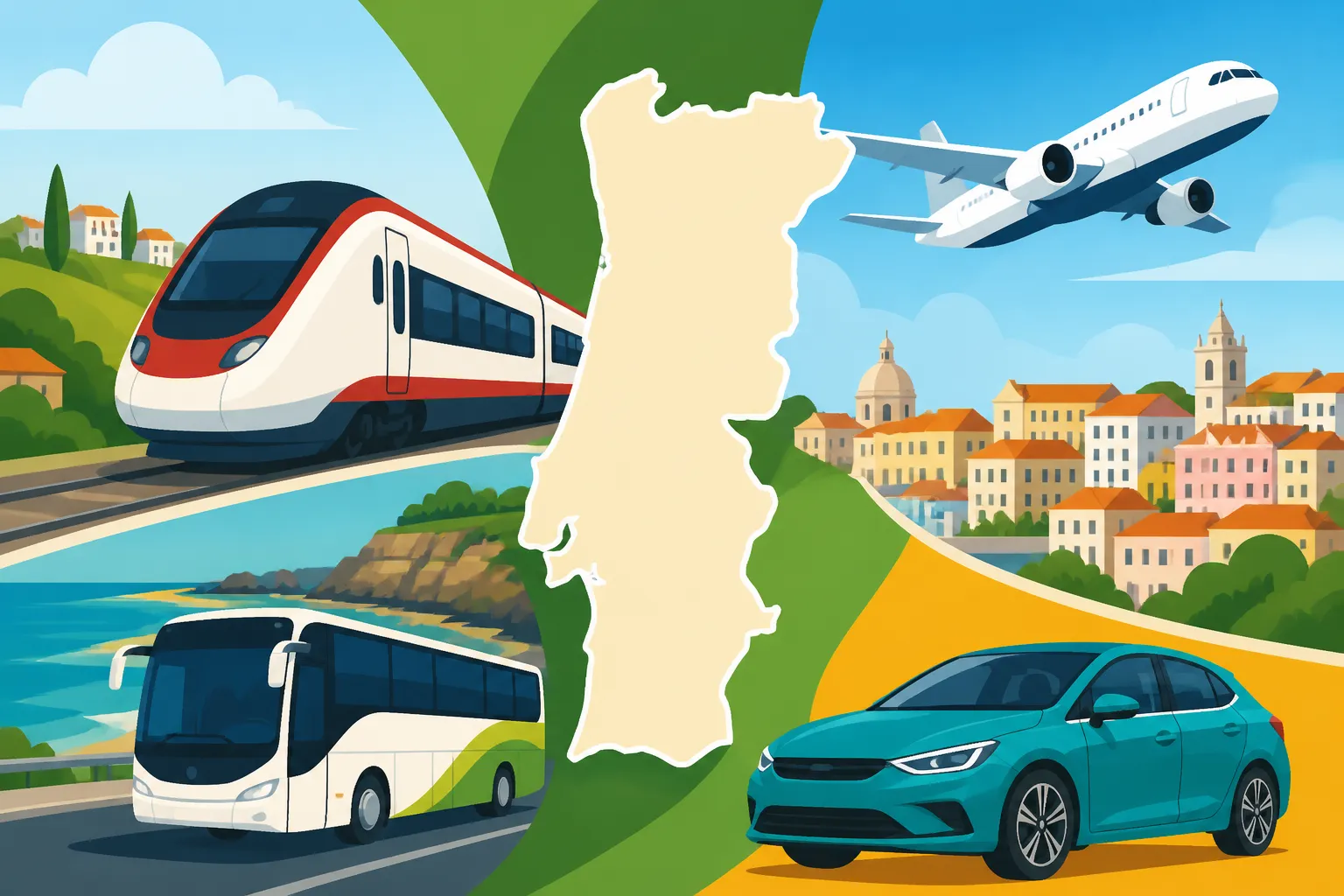
Picture this: you land at Lisbon airport with a plan to see Porto, the Douro Valley and the Algarve. Then you discover the train you wanted is sold out, the bus leaves from a terminal nowhere near your hotel, and the rental desk is asking about tolls you never knew existed. This guide explains how trains, buses, flights and car hire in Portugal actually work, so you can choose well.
How Portugal’s Transport Network Really Fits Together
I have lived here long enough to have made almost every transport mistake possible. The good news is that the system makes sense once you understand its shape, and the shape is unusual.
The Coastal Spine and the Quiet Interior
Most of Portugal’s population, and almost all of its fast transport, sits along a narrow coastal strip running from Braga in the north, through Porto, Aveiro, Coimbra and Lisbon, down to the Algarve. This corridor is where the best trains run, where buses leave every hour, and where motorways are smooth and fast. If your trip stays on this spine, you can travel comfortably without ever touching a steering wheel.
Move inland and the picture changes quickly. The interior regions, such as Trás-os-Montes, the Beiras and much of the Alentejo, have small populations and thinner timetables. Many railway branch lines closed decades ago, and some rural bus routes exist mainly to carry schoolchildren. That means one or two departures a day, usually timed around the school calendar rather than tourist schedules.
This is the frustration I hear most from visitors. On a map, Évora looks close to Monsaraz, and Viseu looks close to the Serra da Estrela. On a timetable, they can be a full day apart. Knowing this early is the single most useful thing you can do. It tells you where to rely on public transport and where hiring a car is simply the realistic choice.
The islands follow their own logic again. Madeira and the Azores are reached by air. Once you arrive, you are dealing with local buses, taxis, hire cars and, in the Azores, seasonal ferries between some islands. Treat each archipelago as its own small transport world and the planning becomes far easier.
Choosing a Mode by Trip Type
Before you book anything, match the type of journey to the mode that suits it. Here is the framework I give friends who come to visit.
| Trip Type | Best Option | Why | Main Drawback |
|---|---|---|---|
| Lisbon to Porto, Coimbra or Aveiro | Train | Fast, comfortable, city-centre stations | Popular departures sell out at busy times |
| Lisbon to the Algarve | Train or bus | Direct services to Faro, frequent buses to many towns | Western Algarve towns may need a change |
| Small towns in the Alentejo or interior | Bus or hire car | Buses reach places trains no longer serve | Sparse timetables, especially at weekends |
| Douro Valley wine estates | Train plus taxi, tour, or hire car | Scenic railway along the river | Estates are often far from stations |
| Rural villages and remote beaches | Hire car | Total flexibility | Tolls, parking and narrow roads |
| Madeira and the Azores | Flight | No practical alternative | Weather can delay island flights |
| Getting around Lisbon or Porto | Metro, tram, bus, walking | Dense networks, rechargeable transit cards | Steep hills and crowded tourist trams |
If you want to compare train and bus options side by side for a single route, a search tool like Omio is handy. It pulls together operators that otherwise each have their own websites, so you can see at a glance whether the train or the coach is quicker for your day. I still double-check the operator’s own site before travelling, especially for timetable changes.
Train Travel With Comboios de Portugal
The national rail operator is Comboios de Portugal, almost always called CP. For most visitors, CP trains are the most pleasant way to cover longer distances along the coast. You get legroom and big windows, and stations sit in or close to city centres. For a deeper look at routes, see Trains in Portugal: CP Routes, Alfa Pendular, and Booking.
Alfa Pendular, Intercidades, Regional and Urbanos
CP runs several distinct service types, and confusing them is the root of many booking mistakes. The names appear on departure boards, tickets and the CP app, so it pays to learn them.
| Service | What It Is | Seat Reservation | Typical Use |
|---|---|---|---|
| Alfa Pendular | CP’s fastest tilting train, fewest stops | Included and assigned | Braga, Porto, Coimbra, Lisbon, Faro |
| Intercidades | Long-distance intercity train, more stops | Included and assigned | Main lines plus routes such as Guarda, Covilhã, Beja and Évora |
| Regional and InterRegional | Slower trains stopping at most stations | No assigned seats | Douro Line, Algarve Line, smaller towns |
| Urbanos | Commuter trains around Lisbon, Porto and Coimbra | No assigned seats | Sintra, Cascais, Braga, Guimarães, Aveiro |
Alfa Pendular and Intercidades tickets come with a numbered carriage and seat. You do not need a separate reservation step, but you must sit where your ticket says. Train staff check tickets on board, and a conductor will politely move you if you have taken someone else’s seat. Regional and urban trains work on a first-come basis. On busy summer weekends that can mean standing on the Cascais or Sintra lines.
Lisbon has several main stations, and this trips people up constantly. Santa Apolónia and Oriente handle many northbound long-distance trains. Southbound trains to the Algarve leave from Oriente and also stop at Entrecampos. Sintra trains leave from Rossio, and Cascais trains from Cais do Sodré. In Porto, long-distance trains use Campanhã, while the beautiful tiled São Bento station handles many urban and regional services. These include trains to Braga, Guimarães and the Douro.
Booking Tickets Step by Step
For the long-distance trains, booking ahead is worth it. Advance-purchase discounts exist on Alfa Pendular and Intercidades, and popular departures do sell out around holidays and summer weekends. Check CP’s own site or app for current fares and promotions, as the discount structure changes from time to time.
Here is the process I follow every time:
- Download the CP app or open the CP website and set the language to English.
- Enter your departure and arrival stations, being specific about which Lisbon or Porto station you mean.
- Filter by service type if you want only Alfa Pendular or Intercidades.
- Compare fare options, as advance and flexible fares have different change and refund rules.
- Choose your seat if the option is offered, and enter passenger names as they appear on your ID.
- Pay by card and save the ticket with its QR code to your phone, and screenshot it in case your data drops.
- On travel day, check the departure board for your platform, which may appear only shortly before departure.
- Board your assigned carriage and keep ID handy, as conductors sometimes ask for it alongside the ticket.
Regional and urban trains are simpler. You can usually buy at station machines or ticket windows just before travel. In Lisbon and Porto, many commuter lines run on rechargeable transit cards that you tap at the station gates. If there is no gate, look for a validation machine on the platform. Travelling without a valid, validated ticket can earn you a fine on the spot, and tourists sometimes argue with inspectors. It never ends well.
Regular Lisbon to Porto travellers should read How to Take the Train From Lisbon to Porto. It covers the differences between departure stations and the best side of the train for views.
Scenic Lines Worth Taking Slowly
Some of Portugal’s best railway experiences happen on the slow trains. The Douro Line from Porto runs along the river through Peso da Régua and Pinhão to Pocinho. The stretch beyond Régua, where the line hugs the water beneath terraced vineyards, is one of the loveliest train rides in Europe. Sit on the right-hand side heading upstream for the river views.
The Algarve Line is less dramatic but very practical. It runs along the coast from Lagos to Vila Real de Santo António, stopping in Portimão, Albufeira, Loulé, Faro, Olhão and Tavira. One quirk is that some Algarve stations sit a fair distance from the town centre they are named after, so check before you assume you can walk. Long-distance trains from Lisbon reach Faro directly. For Lagos and the western Algarve, you usually change at Tunes onto a regional train.
The Sintra and Cascais lines are short commuter routes, but they are scenic in their own way. The Cascais line in particular runs right along the Tagus estuary and the Atlantic coast. You pass Belém, beaches and fishing harbours on the way, so it is a sightseeing trip in itself, especially in the late afternoon light.
If you love slow travel, see How to Plan a Portugal Itinerary by Train. It explains how to stitch these lines into a full route.
Long-Distance and Regional Buses
Buses are the unsung heroes of Portuguese travel. They reach towns the railway abandoned, often cost less than the train, and run surprisingly comfortable coaches on the main intercity routes. Many expats I know actually prefer the bus for certain journeys. For a fuller breakdown, see Buses in Portugal: Rede Expressos and Regional Networks.
Rede Expressos, FlixBus and the Regional Operators
Rede Expressos is the biggest national coach network. It connects Lisbon and Porto with a long list of towns across the mainland, including many in the interior where trains do not reach. FlixBus also runs intercity routes within Portugal and international services into Spain and beyond. On the busiest corridors, these two companies compete directly, which keeps choice healthy.
Below the national networks sits a patchwork of regional operators. The Lisbon metropolitan area has Carris Metropolitana for suburban buses. In the Algarve, regional buses link coastal towns with inland villages. In the north and centre, a mix of companies serves towns around Braga, Viseu, Coimbra and beyond. Each has its own timetables, ticketing and website, which is where the frustration starts for newcomers.
Long-distance tickets on Rede Expressos and FlixBus can be bought online, through their apps, or at terminal ticket offices. Coaches assign seats on many routes, and luggage goes in the hold, sometimes with a luggage tag handed to you. Regional buses are usually paid on board or with a local card. Carry some small change, because not every driver can break a large note.
Finding the Right Terminal
Bus terminal locations vary more than train stations do. In many small and mid-sized towns, the bus station or main stop is right in the centre, a short walk from the main square. In the big cities, the main coach terminals sit outside the historic core and connect to the centre by metro.
In Lisbon, the main Rede Expressos terminal is at Sete Rios, beside the Jardim Zoológico metro station. Many coaches also call at the Oriente station complex, which has its own metro stop. In Porto, intercity coaches use the intermodal terminal at Campanhã, next to the railway station and the metro. None of these terminals sits in the old town, so plan a short metro ride on top of your coach journey.
Here is how I find my departure point without stress:
- Check the exact terminal name on your ticket, not just the city name.
- Search that terminal name in your map app and note the nearest metro or train stop.
- Allow extra time on your first visit, as large terminals have many bays.
- Look for the departure screens, which show the bay or platform number for each coach.
- Arrive early enough to stow luggage, since drivers load the hold before boarding.
When the Bus Beats the Train
For some routes, the bus is clearly the better choice. Lisbon to Évora is a good example, because frequent coaches drop you close to town. Lisbon to Nazaré, Óbidos, Peniche or Fátima is another, since the railway either does not reach these places or the stations are inconvenient. In much of the interior, the coach is the only public transport option at all.
The train wins on the coastal spine. It is faster between Lisbon, Coimbra and Porto, smoother for working or reading, and free of motorway traffic. The bus also has a weekend weakness. Regional services can thin out dramatically on Saturdays and almost vanish on Sundays and public holidays, which surprises many first-time visitors.
My practical rule is to check both modes for every leg. A search through Omio gives a quick overview. Then confirm on the operator’s site, especially for regional buses, whose timetables are not always fully listed on aggregators.
Domestic Flights and Reaching the Islands
Flying within mainland Portugal is rarely necessary, but flying to the islands is unavoidable. For more detail on both, see Domestic Flights and Ferries to Portugal’s Islands.
Mainland Flights: Rarely Worth It
TAP Air Portugal operates flights between Lisbon, Porto and Faro. On paper, a flight looks faster than the train. Once you add travel to the airport, security and boarding, the city-centre-to-city-centre time is often similar to the train. The train is also usually less hassle and kinder to the environment.
There is also a small regional air route linking Bragança, Vila Real, Viseu, Cascais and Portimão, operated with small propeller aircraft. It exists mainly to connect the remote north-east with the rest of the country. For most visitors it is a curiosity rather than a practical option, but it can save real time if you are heading to Trás-os-Montes.
Where mainland flights do make sense is when you are connecting to an international flight. If you are flying home from Lisbon but spending your last days in Porto, a short connecting flight can be easier than an early-morning train. Just compare the total door-to-door time before you decide.
Madeira and the Azores
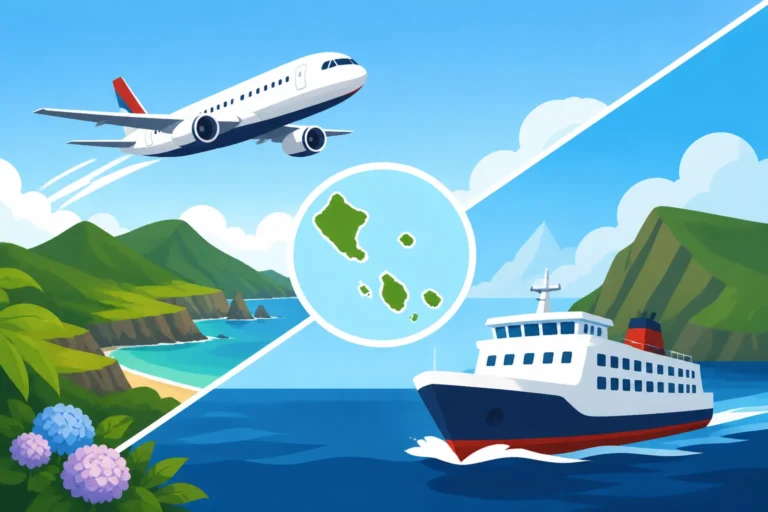
Madeira and the Azores are reached by plane from the mainland. TAP Air Portugal flies to both archipelagos, Azores Airlines connects the Azores with the mainland and some international destinations, and low-cost carriers also serve Funchal and Ponta Delgada. There is no regular year-round passenger ferry between the mainland and the islands, so plan on flying.
Funchal airport in Madeira is famous for its runway built partly on columns over the sea. Its position means strong winds can cause diversions or delays. It is wise to leave a buffer day before any onward international connection when visiting Madeira. The same advice applies to the Azores, where Atlantic weather is changeable and flights are sometimes disrupted.
Once you arrive, getting around needs its own plan. Madeira has a decent bus network around Funchal and along the coast. For the levada trails and the mountain interior, many people hire a car, take taxis or join guided tours. In the Azores, especially São Miguel, a hire car gives you the freedom to reach crater lakes and hot springs on your own schedule.
Inter-Island Hops and Ferries
Within the Azores, SATA Air Açores runs inter-island flights connecting all nine islands. In the warmer months, Atlânticoline runs ferries between some islands. The central group of Faial, Pico and São Jorge has the most useful connections, and these short crossings are easy to build into an island-hopping trip.
In Madeira, the Porto Santo Line ferry connects Funchal with the neighbouring island of Porto Santo, known for its long sandy beach. Flights also link the two islands. The crossing can be rough, so pack seasickness tablets if you are prone to it.
For island-hopping, I suggest this order of planning:
- Fix your arrival and departure islands first, as these determine your international or mainland flights.
- Check whether ferries run between your chosen islands during your travel dates, since many routes are seasonal.
- Book inter-island flights for any legs without a ferry.
- Leave slack in the schedule for weather, especially at the start and end of the season.
- Arrange hire cars or transfers on each island separately, as most rentals cannot leave the island.
Hiring a Car in Portugal
For rural Portugal, the Alentejo, the Douro estates, the Costa Vicentina and the islands, a hire car opens doors that public transport keeps firmly shut. It also introduces its own set of puzzles. For a longer look, see Renting a Car in Portugal: Tolls, Insurance, and Driving Tips.
Picking Up the Car: Gearboxes, Deposits and Insurance
Manual gearboxes are the default in Portuguese rental fleets. Automatics exist but are fewer and usually cost more, and they run out first in summer. If you cannot drive a manual, book an automatic well ahead and confirm it in writing. Learning clutch control on a steep cobbled street in Lisbon or Porto is nobody’s idea of a holiday.
Rental companies usually place a security deposit hold on a credit card at pickup. Many will not accept debit cards for this, so bring a credit card in the main driver’s name. Basic rental prices normally include mandatory third-party cover. Damage cover usually comes with an excess, and the desk will offer extra cover to reduce it. Read exactly what each option covers, because tyres, glass and the underside of the car are often treated separately.
Comparison sites, including the car rental section of Booking.com, help you compare suppliers at airports like Lisbon, Porto and Faro in one search. Whatever you book, inspect the car carefully before driving off. Here is my routine:
- Walk around the car and photograph or film every panel, wheel and bumper, including existing scratches.
- Check the fuel level and the fuel policy, and note whether the car takes petrol, which is gasolina, or diesel, which is gasóleo.
- Ask whether a toll device is fitted and how tolls will be charged.
- Confirm the emergency phone number and what to do if you break down.
- Ask whether you may cross into Spain, as some companies charge extra or require notice.
Check your own licence requirements before travel. Some non-EU licences need an International Driving Permit alongside them, and your rental company can tell you its own rules.
Tolls Without Stress
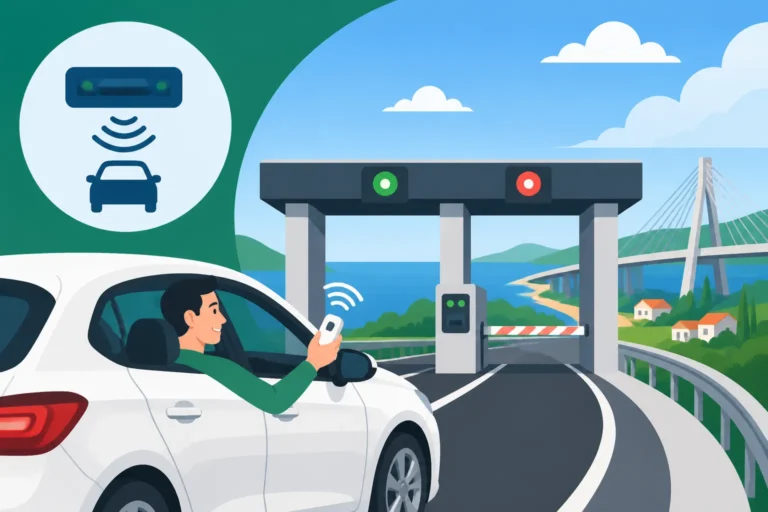
Portugal’s motorways, the autoestradas marked with an A, are mostly tolled. There are two kinds of toll road. Traditional toll plazas have booths where you take a ticket on entry and pay on exit by card or cash. Electronic-only toll roads have no booths, just overhead gantries that read a transponder or photograph your number plate. Gantries are signed with phrases like “Portagem eletrónica” or “Electronic toll only”.
Electronic-only tolls are where tourists get caught. Without a transponder, the toll is linked to the number plate. For a hire car, the rental company receives the bill later and charges it to your card, often with an administration fee on top. The simplest fix is to accept the Via Verde transponder that most rental companies offer for a daily fee. It works at both kinds of toll and lets you use the dedicated green Via Verde lanes at plazas. Check the rental company’s own terms for current charges.
If you drive your own foreign-registered car into Portugal, look into the systems that link a payment card to your plate at the border. Alternatively, you can arrange a temporary transponder. See How Do Tolls Work in Portugal for Rental Cars? for a deeper walkthrough of how charges are processed after you return the car.
Remember that you can often avoid tolls entirely by using national roads, marked with an N or IC. These roads are slower and pass through towns, but they are free and much more scenic. On a relaxed Alentejo road trip, I often choose them deliberately.
Driving Culture, Parking and City Restrictions
Portuguese drivers can feel assertive, particularly on motorways, where fast cars sit close behind anyone in the left lane. Keep right unless overtaking and you will avoid most tension. Roundabouts are everywhere. Use the outer lane if you are taking the first exit and signal as you leave. Speed cameras are common on approaches to towns, and some traffic lights turn red automatically if you are travelling too fast.
Cities are where a car becomes a liability. Lisbon and Porto have steep, narrow streets, trams sharing the road, one-way systems and very limited parking. In Lisbon, on-street parking is managed by EMEL with paid zones, and some historic streets restrict access to residents and authorised vehicles. My strong advice is to pick up your hire car on the way out of the city and return it on the way back in, rather than keeping it during your city days.
Rural roads bring different challenges. Douro Valley roads twist above the river with few barriers. Madeira’s mountain roads are steep and include tunnels and sharp hairpins. Alentejo roads are long and straight but sometimes shared with tractors and livestock. Drive slowly, fill up when you see a petrol station in remote areas, and keep a paper map or offline maps for spots with patchy signal.
Getting Around Inside Cities
Long-distance transport gets you to a city. Getting around once you are there needs a separate plan.
Lisbon
Lisbon has four metro lines, a network of buses and historic trams run by Carris, several funiculars and elevators, ferries across the Tagus, and suburban trains. Most visitors use a rechargeable Navegante card, which you load with single trips or with prepaid credit. The prepaid-credit option, known as zapping, works across metro, buses, trams, trains and ferries. Keep the card after your first purchase, because reusing it saves the cost of a new card.
Tram 28 is the famous one, rattling through Graça, Alfama and Baixa. It is also packed with tourists and a well-known spot for pickpockets. Ride it early in the morning or in the evening, keep bags in front of you, or try other scenic routes that are quieter. Lisbon’s hills are real, so mix public transport with walking downhill wherever possible. Your knees will thank you.
For the full picture, see Getting Around Lisbon: Metro, Trams, and the Famous 28. It covers which lines reach the airport, Belém and the ferry piers.
Porto
Porto runs on the Andante card, a rechargeable card used on the metro, many buses and some urban trains. The system is divided into zones, and the fare depends on how many zones you cross. Every time you board, you must validate your card at the reader, including on the metro platform before you get on. Inspectors do check, and forgetting to validate counts as travelling without a ticket.
The metro runs underground through the centre and above ground further out, and is very useful for reaching the airport, Campanhã station and the beaches at Matosinhos. Historic trams, the Guindais funicular and plenty of walking cover the rest. Porto is just as hilly as Lisbon, with steep climbs from the riverside Ribeira up to the city centre.
Day trips from Porto are easy by urban train. You can reach Braga, Guimarães and Aveiro from São Bento or Campanhã. See Getting Around Porto: Metro, Buses, and Funiculars for station-by-station tips, and How to Visit the Douro Valley From Porto if wine country is calling.
Ride-Hailing and Taxis
Ride-hailing apps are widely used in Lisbon, Porto, the Algarve and the islands. Bolt and Uber both operate, and prices fluctuate with demand, so it pays to compare the two apps before booking. They are particularly handy late at night, from bus terminals outside the centre, or when you are hauling luggage up a hill.
Traditional taxis are black with a green roof or beige, and they wait at ranks outside stations, airports and major squares. They run on a meter with set supplements for luggage and night hours. Check the meter is switched on when you start. In smaller towns, taxis are often the only way to cover the last stretch from a railway station to a guesthouse, so save a local taxi number when you arrive.
See Using Bolt vs Uber in Portugal: Which ride-hailing app is cheaper? for a closer comparison of how the two apps behave in different cities.
Building a Multi-Modal Itinerary
The best Portuguese trips rarely use just one mode of transport. They combine trains for the coast, buses for the gaps, and a hire car or tour for the countryside. If you would rather skip driving altogether, see How to Get Around Portugal Without a Car.
Sample Route: Lisbon, Porto and the Douro
Here is a route I have recommended many times to friends visiting for the first time:
- Spend your Lisbon days on foot, by metro and by tram, with a suburban train day trip to Sintra or Cascais.
- Take an Alfa Pendular or Intercidades train from Lisbon to Porto, booked ahead.
- Explore Porto with the Andante card and plenty of walking.
- Take the regional train along the Douro Line from São Bento towards Peso da Régua or Pinhão.
- Visit wine estates by taxi, on a guided tour, or with a hire car collected in Régua or back in Porto.
- Return to Porto by train and fly home from Porto, or take the train back to Lisbon.
The weak point of this route is the Douro estates, many of which sit high above the river and far from any station. If you do not want to drive after wine tastings, a guided day tour solves the problem neatly. Platforms such as GetYourGuide list Douro tours from Porto that include transport, tastings and sometimes a river boat trip. Compare a few, because some focus on large estates and others on small family producers.
Where you sleep matters too. Staying near São Bento or Campanhã in Porto, or near Oriente or Santa Apolónia in Lisbon, makes early departures far easier. When I search on Booking.com, I filter by distance to the station rather than just the old town. That way, a dawn train does not start with a frantic taxi ride.
Sample Route: The Algarve Without Getting Stuck
The Algarve is where travellers most often feel stranded, because its towns are spread out and its best beaches hide down dirt tracks. A smart approach combines the train and bus for town-to-town travel with a hire car for a few days of beach-hopping.
Take the train from Lisbon to Faro, or change at Tunes for Lagos. Use the Algarve Line and regional buses to hop between towns such as Tavira, Olhão, Faro and Lagos. Then hire a car for two or three days to explore the cliffs around Lagos, the wild beaches of the Costa Vicentina, or inland villages like Monchique. Remember that the main Algarve motorway, the A22, uses electronic-only tolls, so sort out your transponder at pickup.
In high summer, coastal roads around Albufeira and Lagos get congested and beach car parks fill early. Set off in the morning, and consider staying somewhere you can walk to a beach. In winter, the opposite problem appears. Some seasonal bus routes reduce or stop, and many tourist services close, so check timetables carefully outside the main season.
Strikes, Sundays and Summer Crowds
Three things disrupt Portuguese transport more than anything else. The first is strikes. Rail workers, metro staff and other transport unions do occasionally strike, and CP may run only minimum services on those days. Strikes are usually announced in advance in the Portuguese press and on CP’s website, so check the news a few days before any important journey.
The second is weekends and holidays. Many regional buses and some trains run reduced timetables on Saturdays, Sundays and public holidays. A route with several departures on a weekday might have one, or none, on a Sunday. If you are heading anywhere rural, plan those legs for weekdays whenever you can.
The third is peak season. July and August bring full trains, busy motorways towards the Algarve, long queues for hire cars at Faro airport, and crowded city trams. Book long-distance trains and automatic cars well in advance. Travel early in the day, and keep a little flexibility in your plans.
Portugal rewards travellers who slow down. Once you understand how the coastal spine, the quiet interior and the islands each work, getting around becomes part of the pleasure. Picture yourself watching the Douro from a train window, or sharing a sunny bus terminal café with locals. Those moments become memories rather than chores.
Disclaimer
This article is for general informational purposes only and does not constitute professional advice. Laws, prices and regulations vary by location and change over time. Consult a qualified professional for guidance on your specific situation.