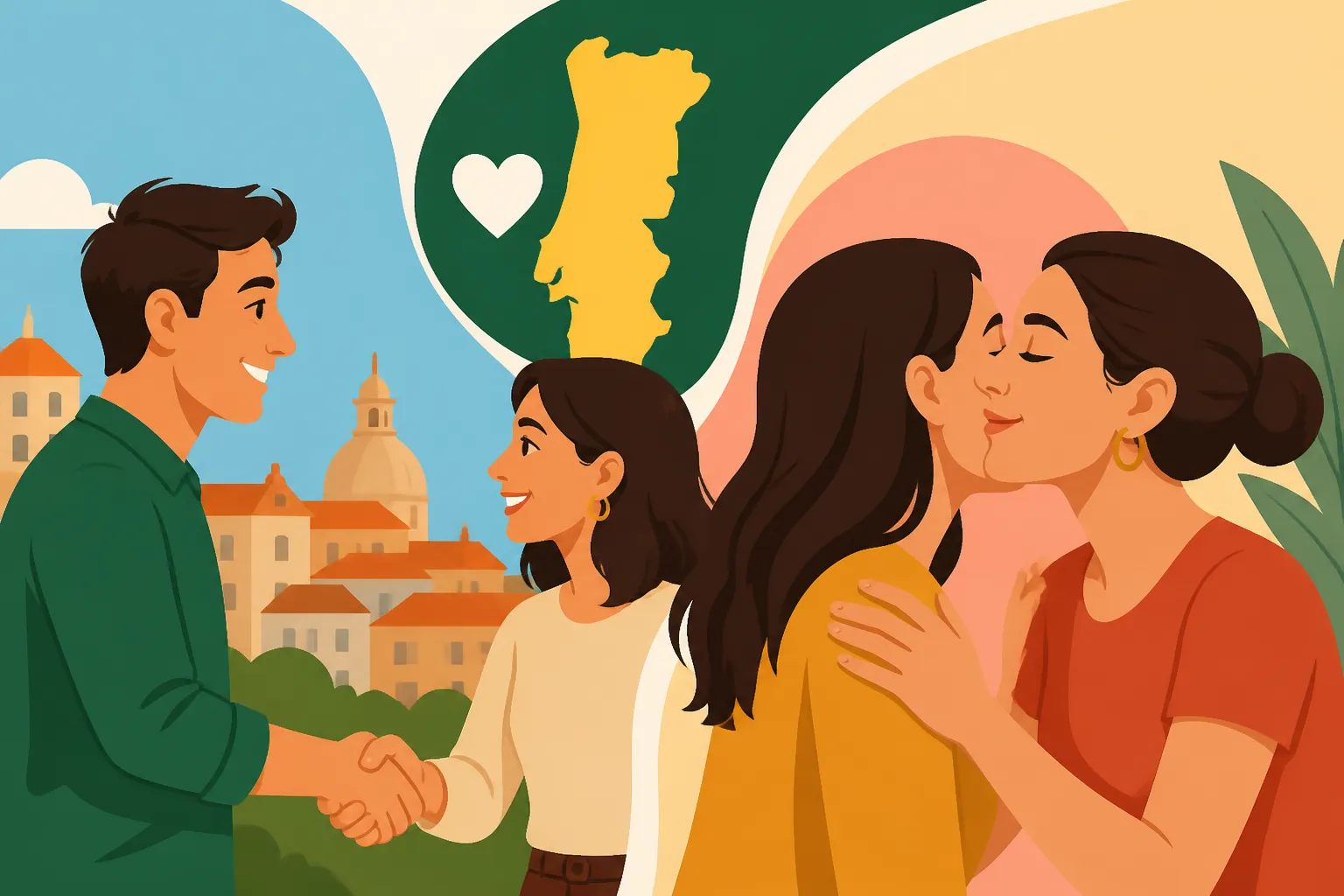
How to Greet People in Portugal: Handshakes and Kisses
Oh, the Portuguese greeting! It sounds simple, doesn't it? "Just a handshake or a kiss." But for many expats landing in Portugal, it quickly becomes a minefield of awkward hesitations, missed cheeks, and that eternal question: which cheek first? Believe me, I've been there, frozen in a social dance-off, wondering if I'm about to accidentally hug my new landlord. This guide is here to clear the air, quite literally, on the unspoken rules of greeting people in Portugal, helping you navigate those initial interactions with confidence and grace.
The Ubiquitous Two Kisses Do Not Forget the Dois Beijinhos
Let's dive straight into the one that causes the most confusion and, let's be honest, a few embarrassing moments: the dois beijinhos, or two little kisses. This isn't a romantic gesture; it's a standard social greeting, but it comes with a particular set of unwritten rules that are crucial for expats to grasp. Get it wrong, and you might just leave someone hanging, or worse, lean in for a kiss when a polite nod was all that was expected!
Who Kisses Whom Navigating Gender and Relationship Dynamics
The dois beijinhos is primarily a greeting between women, and between women and men. It’s almost always two kisses, one on each cheek. Now, here's the kicker: typically, it starts with the right cheek first (your right, their left). But don't stress too much about getting this perfectly right every single time, as many Portuguese are used to foreigners fumbling a bit. The important thing is the intention to offer two cheeks. You’re not actually kissing their skin; you’re lightly touching your cheek to theirs while making a small "kissing" sound with your lips in the air. Think of it as an air kiss with a cheek press.
For women, it's pretty standard to greet other women and men with dois beijinhos in most social settings, whether they're old friends or new acquaintances. When a woman greets another woman, it’s automatic. When a woman greets a man, it's also generally expected. However, when men greet other men, it’s usually reserved for very close family members (like a father and son, or uncles) or extremely intimate friendships. It’s definitely not a general social or professional greeting for two men meeting for the first time. Understanding these gendered dynamics is your first step to avoiding that awkward lean-in or pullback. It's all about context and relationship, a subtle dance you pick up over time. If you're ever in doubt, observe what others are doing – it's often the best guide.
When and Where to Kiss Social vs Professional Settings
This is where many expats get tripped up. The dois beijinhos is firmly rooted in social interactions. Think family gatherings, meeting friends for coffee, a birthday party, or even a casual dinner at someone's home. If you're introduced to a new friend of a friend at a social event, expect the beijinhos. It's a warm, personal gesture that signals friendliness and acceptance into a social circle. This personal touch is a beautiful part of Portuguese culture, reflecting a society that values close relationships.
However, the professional world is a different beast entirely. In formal or business settings, the dois beijinhos is almost universally avoided, especially for initial introductions. Imagine meeting a new client, your boss for the first time, or a government official at the AIMA office to renew your residence permit – absolutely no beijinhos here! The same goes for meeting a doctor or a bank manager. These are environments where professionalism and a certain distance are maintained. Even if you work with Portuguese colleagues, you might start with handshakes and only transition to beijinhos after you've developed a very close, personal rapport and spent significant time together outside of work. Rushing to offer a kiss in a professional setting can come across as overly familiar or even disrespectful. The key is to distinguish between the warmth of personal connection and the decorum of professional conduct.
The Awkward Dance Avoiding the Misstep
We've all been there: you go in for a kiss, and they offer a handshake. Or worse, you go for the handshake, and they're leaning in with puckered lips. It's a moment of pure expat panic, a silent film playing out in slow motion. The best way to avoid this social misstep is to read the room and, when in doubt, start with a more formal greeting and let the other person lead. For instance, when meeting someone new at a social gathering, a warm "Olá, muito prazer" (Hello, nice to meet you) while subtly gauging their body language is a safe bet. If they lean in, follow suit. If they extend a hand, take it.
One common scenario involves a group setting. Often, you'll be introduced to several people at once. Observe how the first few people greet each other. Is it handshakes all around for the men, and kisses for the women, or mixed? Mimic what you see. Don't be afraid to take a split second to assess before committing to a handshake or a cheek. The Portuguese are generally very understanding of foreigners navigating their customs. A slight hesitation isn't seen as rude; it's often seen as thoughtfulness. So, take a breath, make eye contact, and let the cues guide you. It's a learning curve, and even after years, I still have the occasional moment of "did I just do that right?" It’s part of the charming chaos of integrating into Portuguese culture.
The Firm Handshake The Go-To for Formality
While the dois beijinhos gets all the attention for its perceived complexity, the handshake is your reliable, steadfast companion in many social situations, particularly if you're a man or in a formal environment. It's the universal sign of respect and often the easiest greeting to fall back on when uncertainty looms.
Professional and Formal Encounters The Standard
This is your default. In any professional environment – job interviews, client meetings, government appointments, visiting the conservatória for official documents – a firm handshake is the unequivocal standard for both men and women. There’s no ambiguity here. It conveys respect, professionalism, and maintains appropriate boundaries. If you're attending a business conference or meeting someone who holds a position of authority, offer a handshake. This applies whether you're dealing with a lawyer to help with your D7 Passive Income Visa Portugal application or meeting a new colleague at a Lisbon tech startup. It’s also the default when meeting service providers, like your bank manager at Millennium bcp or a real estate agent from a local agency.
When you shake hands, make sure it's a firm, confident grip, accompanied by direct eye contact. A weak or limp handshake can be misinterpreted as disinterest or lack of confidence. The handshake in these contexts is a brief, business-like gesture, not meant to linger. It’s a clean, clear way to acknowledge someone and set a professional tone. This simplicity is often a relief for expats after wrestling with the beijinhos. So, when in doubt, especially in a new or formal situation, remember: shake hands, make eye contact, and keep it professional.
Men Greeting Men The Default
For men in Portugal, the handshake is the primary form of greeting almost across the board. Whether you’re meeting another man for the first time at a casual dinner party, being introduced by a friend, or encountering a new acquaintance, a handshake is the expected gesture. As mentioned earlier, dois beijinhos between men is generally reserved for very close family or exceptionally intimate friendships, and even then, it’s not as universally practiced as it is between women or mixed-gender pairs.
So, if you're a man and you're introduced to another man, extend your hand. Don't hesitate or linger, just a confident shake. This practice helps clarify any potential awkwardness from the start. Even among male friends who see each other regularly, a handshake is a common way to greet each other, particularly in public or if they haven't seen each other in a while. While a casual pat on the back might accompany a handshake among friends, the handshake itself remains the core physical greeting. It’s straightforward, reliable, and removes much of the guesswork.
Handshakes and the Respect Factor
Beyond just being a formal or gender-specific greeting, the handshake in Portugal carries a significant weight of respect. A good, firm handshake with direct eye contact signals sincerity and esteem. It's a non-verbal cue that says, "I respect you, and I value this interaction." This is particularly important when you're navigating new relationships, whether personal or professional.
Consider a scenario where you're meeting your partner's parents for the first time. As a man, a respectful handshake with the father (and potentially the mother, though she might opt for beijinhos) is paramount. It's about establishing trust and showing your good intentions. For women, while beijinhos are common, a handshake can sometimes be offered in very formal initial interactions with men, especially if they are senior or if the setting is extremely traditional. The person who is higher in status or older often has the prerogative to initiate the preferred greeting, so pay attention. Ultimately, mastering the art of the Portuguese handshake is about more than just physical contact; it's about conveying genuine respect in a culture that highly values politeness and personal connection.
Other Greeting Nuances and How to Adapt
Beyond the primary handshakes and kisses, there are other nuances to Portuguese greetings that can help you integrate more smoothly. Sometimes it’s about what you say, other times it’s about observing and adapting. Remember, no one expects you to be perfect, but showing effort goes a long way.
The Hug O Abraço A Sign of Deep Affection
While less common for initial greetings, the abraço (hug) is a powerful sign of affection and close connection in Portugal. You won't typically hug someone you've just met or even someone you know casually. Hugs are reserved for family members you haven't seen in a while, very close friends, or during emotionally charged moments like celebrations or condolences. It’s a warm, often hearty, full-body embrace that truly expresses connection.
If you find yourself being hugged by a Portuguese friend or family member, it means they genuinely care about you and consider you part of their inner circle. It’s a beautiful cultural expression, but definitely don't lead with it unless you have a very established relationship. You might see a casual pat on the back accompany a handshake for men, but this is distinct from a full hug. Always wait for the other person to initiate a hug. If they open their arms, respond warmly. It’s a moment of connection that usually feels very natural once it happens.
The Verbal Greeting More Than Just Olá
Don’t underestimate the power of a good verbal greeting! "Olá" (hello) is certainly useful, but incorporating more specific greetings tailored to the time of day demonstrates effort and respect. You'll hear "Bom dia" (Good morning) until around lunchtime, "Boa tarde" (Good afternoon) throughout the afternoon, and "Boa noite" (Good evening/night) once it gets dark. Using these shows you're paying attention and trying to speak their language, which is always appreciated. Even if your Portuguese is limited, a well-timed "Bom dia" can open doors.
Beyond the time-specific greetings, adding a polite follow-up like "Tudo bem?" (All good? / How are you?) or "Como está?" (How are you?) is very common. It’s not always a deep inquiry into your well-being; sometimes it’s just a rhetorical pleasantry. You can respond with "Tudo bem, obrigado/a" (All good, thank you) or "Estou bem" (I'm well). Don't launch into a detailed account of your day unless you know the person well and they seem genuinely interested. These verbal exchanges, combined with your physical greeting, form the complete package of a polite Portuguese interaction.
Observing and Mirroring Your Best Strategy
When you're first arriving in Portugal, especially in different regions or social circles, the best strategy is often to simply observe and mirror. Pay attention to how people around you are greeting each other. Are the women kissing? Are the men shaking hands? Is there a mix? The Portuguese are excellent at non-verbal cues. If you watch carefully, you'll start to pick up on the rhythm and expectations.
This mirroring technique works wonders in almost any social situation. If you’re at a party and see people greeting with two kisses, go for the two kisses when it’s your turn. If you’re introduced to a group of men and they’re all shaking hands, then a handshake is your cue. It’s much safer to follow suit than to try and impose your own greeting style. People will understand if you're a bit slower to react while you're learning. This observant approach also allows you to soak in the cultural nuances, which is a fantastic skill to develop as an expat. You'll notice subtle differences between, say, Lisbon, Porto, or the more rural areas.
When in Doubt, Revert to Formal
If you've observed, you've tried to mirror, and you're still utterly stumped, the safest bet is always to revert to a more formal, universally accepted greeting. For men and women alike, a polite verbal greeting like "Olá, muito prazer" combined with a firm handshake is rarely, if ever, offensive. It shows respect and confidence without overstepping any boundaries. No one will fault you for being too polite.
This is particularly true in situations where you might encounter a diverse group of people, or if you're unsure of someone's social standing or relationship to the group. It's better to be slightly more formal initially and then gradually warm up as you get to know people better. Portuguese culture values politeness and good manners, so a slightly formal approach is always better than an overly casual one that might cause discomfort. Over time, you'll develop an instinct for these interactions, but until then, lean on the handshake and a sincere verbal greeting.
| Situation | Typical Greeting | Notes |
|---|---|---|
| Woman to Woman (Social) | Dois Beijinhos (two kisses, right cheek first) | Standard, expected, even for new acquaintances. |
| Woman to Man (Social) | Dois Beijinhos (two kisses, right cheek first) | Standard, expected, even for new acquaintances. |
| Man to Man (Social) | Handshake (firm, direct eye contact) | Default for friends and new acquaintances. Kisses only for very close family/friends. |
| Professional/Business | Handshake (firm, direct eye contact) | Universal for both genders, formal, respectful. Avoid beijinhos here. |
| Very Close Friends/Family | Dois Beijinhos (mixed genders), Hugs, Handshakes (men) | Can be a mix depending on intimacy. Hugs common for deep affection. |
| Service Industry | Verbal greeting (Bom dia/tarde/noite), possibly a Handshake if appropriate | Politeness is key. Don't expect beijinhos with shopkeepers, waiters, etc. |
| Group Introductions | Observe and Mirror | Watch how the first few people greet each other and follow suit. When in doubt, handshake and verbal. |
Navigating greetings in Portugal can feel like learning a whole new social choreography, but it's a wonderfully authentic part of integrating into the culture. You'll stumble, you'll laugh, and eventually, you'll master the delicate art of the dois beijinhos and the confident handshake. It’s all part of the journey. For more insights on blending into daily life, you might want to read about Portuguese Coffee Culture and Restaurant Etiquette: Ordering Like a Local or even Portuguese greeting etiquette: When to use Beijinhos vs Handshakes, which dives even deeper. And if you're wondering about making friends, check out Making Friends and Networking in Portugal: Expat Groups and Meetups.
Ultimately, the Portuguese appreciate the effort you make to understand and respect their customs. So keep practicing, stay open, and soon those awkward moments will be replaced by natural, warm interactions. You'll be air-kissing like a local in no time!
Disclaimer
The information provided in this guide is for general informational purposes only and is subject to change. While we strive to offer accurate and up-to-date advice based on common practices, cultural norms can vary by region and individual. Always exercise good judgment and respect local customs.