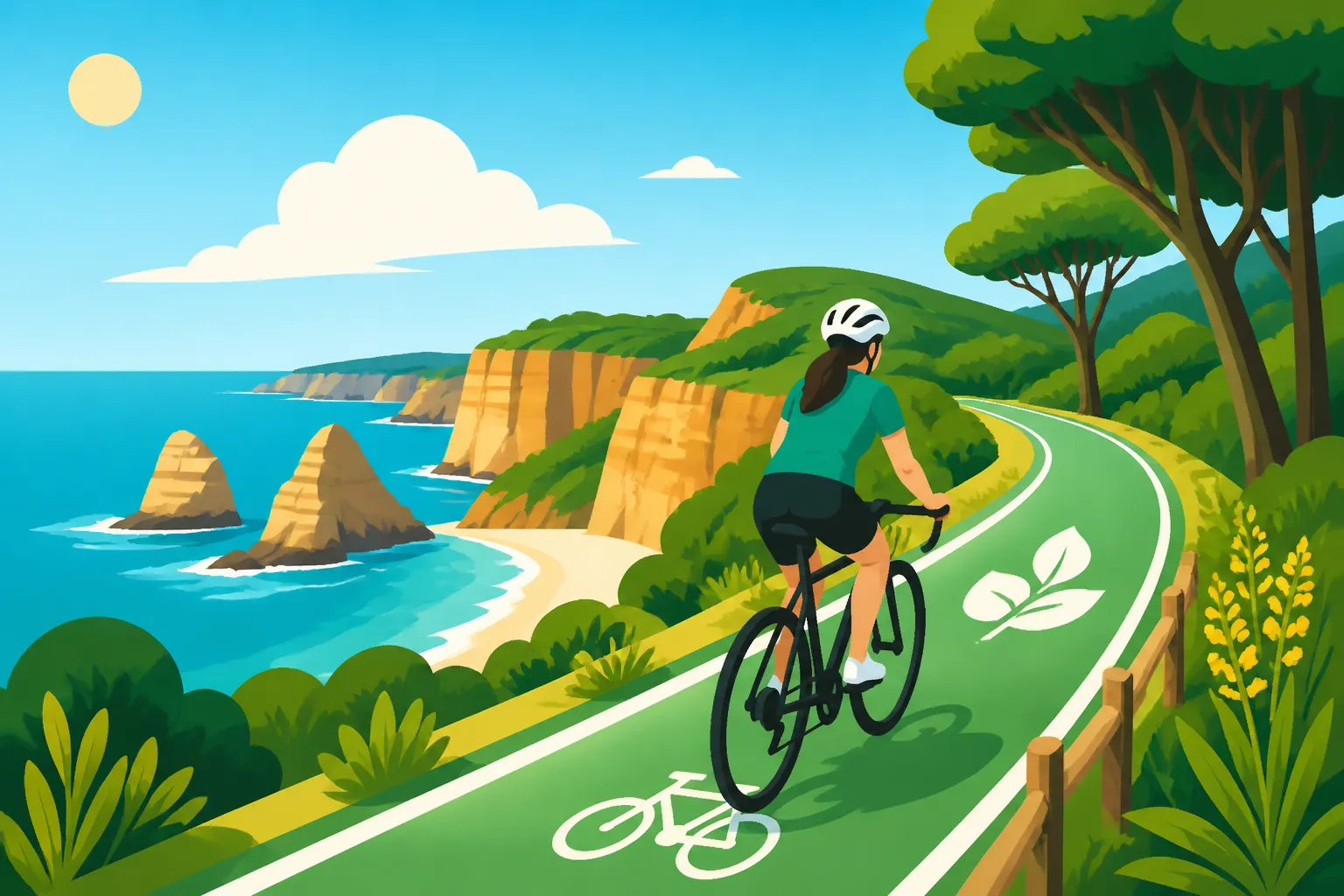
Cycling and the Ecovias of Portugal
Disclosure: This article contains affiliate links. If you buy through them, we may earn a commission at no extra cost to you. Read our full disclosure.
Picture this: you rent a bike in Viseu, follow a sign for the “ecopista,” and an hour later you’re at a crossroads with no café, no water, and no idea whether the route ends 5 km or 50 km ahead. This guide explains how Portugal’s ecovias and ecopistas work, which routes are worth your legs, and how to plan the logistics.
What the Ecovias and Ecopistas Actually Are
Old Railway Lines Turned Into Greenways
My first ride on an ecopista surprised me. I had braced for the steep, cobbled hills I knew from Lisbon. Instead I found a smooth, gently graded path through pine forest. Old stations had been turned into cafés, and the tunnels were cool enough that I wanted a jacket in July. The reason is simple. Most ecopistas follow narrow-gauge railway lines that closed in the late twentieth century. Trains cannot handle steep gradients, so the routes the engineers chose a century ago now give cyclists long, forgiving slopes instead of brutal climbs.
That history shapes the whole experience. You get bridges over river gorges, cuttings through granite, and a station building every so often. Many of those stations now hold a café, a bike shop, a small museum, or nothing but a ruin and a bench. On a railway-based ecopista you will rarely face a sharp climb. You will, however, face long false flats where you climb slowly for an hour without quite noticing, until your legs tell you.
Ecovia Versus Ecopista: The Naming Muddle
Portuguese signage uses two words, and they overlap. “Ecopista” usually means a greenway built on a disused railway line. “Ecovia” is broader. It covers any signed cycling and walking route, which might mix dedicated paths, quiet rural roads, riverside boardwalks, and stretches shared with traffic. The Ecovia do Litoral in the Algarve is the classic example. It is a signed coastal route, not a continuous off-road path, and some sections run on roads with cars.
This matters when you plan. If you book a family day out with young kids, a railway ecopista is the safer bet because you are separated from motor traffic for most of the way. If you are an experienced rider happy to share a quiet road now and then, an ecovia opens up much more of the country. When in doubt, look at the municipal or regional tourism page for the route. It will usually say how much of the route is dedicated path.
Who Manages Them and Why It Matters
Responsibility is split between Infraestruturas de Portugal, the state company that owns the old railway corridors, and the câmaras municipais, the town councils whose land the routes cross. In practice, the quality can change as you cross a municipal boundary. You might ride on beautiful fresh tarmac in one concelho, then on rougher compacted gravel in the next, with different signs and different rest-stop facilities.
I learned this the hard way when a bridge section was closed for maintenance with only a small notice taped to a post. Before any big ride, check the Infraestruturas de Portugal page for that ecopista and the council websites for the towns along the way. Closures, resurfacing works, and detours are usually posted there, often only in Portuguese. A translation app on your phone is enough to read them.
The Dão and Vouga Corridor: Central Portugal’s Flagship Ride
Ecopista do Dão From Santa Comba Dão to Viseu
If you ride one ecopista in Portugal, make it this one. According to Infraestruturas de Portugal, as of October 2026, the Ecopista do Dão runs from Santa Comba Dão to Viseu and is 49.2 km long. It follows the old Dão railway line through the heart of the Dão wine region, past vineyards, granite villages, and mixed pine and oak forest. The surface is mostly tarmac, and its gentle gradient makes it a favourite with families and riders who are getting back into cycling.
A typical scenario: you start in Santa Comba Dão in the morning and ride towards Viseu. Most of the way is a gradual climb, because Viseu sits higher than the Dão valley. You stop for a coffee and a pastel in Tondela, and roll into Viseu by mid-afternoon. Many riders prefer to go the other way, from Viseu down to Santa Comba Dão, because the overall descent makes the day feel effortless. Either way works. Just remember that the return trip, if you are doing an out-and-back, will feel very different from the outward leg.
Old station buildings along the route have been given new uses, and the stretches near the towns are lovely for a short evening ride. If you are based in Viseu for a few days, you do not need to ride the whole line in one go. Ride a section, turn around when you feel like it, and save the rest for another day.
Ecopista do Vale do Vouga From Sernada do Vouga to Viseu
The Ecopista do Vale do Vouga is the Dão’s bigger, wilder sibling. As of October 2026, Infraestruturas de Portugal lists it at 76.8 km on the old line from Sernada do Vouga to Viseu. That makes it longer than the 49.2 km Ecopista do Dão. It runs through the Vouga valley, with river views, old viaducts, and a more remote, forested feel. Towns are further apart, and there are stretches where you see more cows than people.
I tell friends to treat the Vouga route with a bit more respect. The scenery is outstanding, but services can be thin between villages. If you set off with one small bottle of water on a hot afternoon, you will regret it. Carry more water than you think you need, pack snacks, and know where the next village with a café is before you leave the last one.
The terrain also rolls a little more in places, and you can feel the climb up towards Viseu. Fit leisure riders handle it comfortably over a day or two. Families with small children usually do better choosing a scenic section than trying to ride the whole valley.
Riding the Full 126 km Route Over Several Days
The big news for cyclists came on 6 October 2023, when the Vouga route was inaugurated as a link to the Dão. Since then the two ecopistas have formed one continuous 126 km cycling and walking route, meeting at Viseu. In practice, you can ride from Sernada do Vouga to Viseu, spend the night, and carry on down to Santa Comba Dão the next day. That is a genuine multi-day bike trip, almost entirely away from car traffic.
| Section | Start and end | Length as of October 2026 | Character |
|---|---|---|---|
| Ecopista do Vale do Vouga | Sernada do Vouga to Viseu | 76.8 km | Remote river valley, viaducts, fewer services |
| Ecopista do Dão | Viseu to Santa Comba Dão | 49.2 km | Wine country, gentle gradient, more towns |
| Combined corridor | Sernada do Vouga to Santa Comba Dão via Viseu | 126 km | Continuous greenway since 6 October 2023 |
Here is the three-day plan I would suggest for a relaxed rider:
- Day one: start at Sernada do Vouga and ride the lower Vouga valley, stopping for the night in one of the villages or small towns along the route.
- Day two: finish the Vouga section up to Viseu, arriving early enough to walk the historic centre and see the cathedral square.
- Day three: ride the Ecopista do Dão from Viseu down to Santa Comba Dão, enjoying the gentle overall descent through the vineyards.
- Day four, optional: rest in Santa Comba Dão or take a wine tasting at a local quinta before heading home.
Strong riders can compress this into two days. However, part of the joy is stopping at viewpoints and lingering over lunch, and you lose that when you race. For more context on the wider region, see Central Portugal: Coimbra, Serra da Estrela, and the Silver Coast.
Other Ecovias Worth Planning a Trip Around
Northern Routes: Minho, Tâmega and Guimarães
The north has a cluster of excellent railway greenways, and they pair beautifully with a stay in Porto or Braga. The Ecopista do Minho follows the Minho river between Valença and Monção, with Spain visible on the opposite bank. It is flat, green, and shaded in parts, and it ends in Alvarinho wine territory. That makes it one of my favourite “ride, then long lunch” days anywhere in the country.
The Ecopista do Tâmega runs from Amarante towards Arco de Baúlhe along the old Tâmega railway. It has more of a climb if you ride up the valley, and the reward is lush countryside and stone villages that see few foreign visitors. Closer to the city, the Ecopista de Guimarães heads from Guimarães towards Fafe. It is a handy half-day outing if you are already in town to see the castle and the old centre.
These northern routes get rain, so pack a light waterproof even in late spring. The landscape is green for a reason. If you are building a wider trip, see Northern Portugal: Porto, the Douro, and the Minho and Braga and Guimarães: The Cradle of Portugal for ideas on where to base yourself.
The Ecovia do Litoral in the Algarve
The Ecovia do Litoral is a different beast. It runs along the Algarve from the Cabo de São Vicente area in the west to Vila Real de Santo António at the Spanish border. It is part of the EuroVelo 1 Atlantic Coast Route, and it is a signed route rather than a single dedicated path. Expect a mix of cycle lanes, dirt tracks, boardwalks, and stretches on roads.
The eastern section, between Faro and Vila Real de Santo António, is the most rewarding for casual riders. It is flat, with lagoon views across the Ria Formosa, flamingos if you are lucky, and towns like Olhão and Tavira for lunch. The western end is hillier and more exposed, with spectacular cliffs and fewer facilities. If you are tempted, How to Cycle the Ecovia do Litoral in the Algarve goes into much more detail on stages and signage.
Many visitors in the Algarve prefer a guided e-bike or ride along the Ria Formosa rather than navigating alone. GetYourGuide lists cycling tours in the region, which is useful if you want someone else to handle the route and the bike. Check the provider’s own page for inclusions and current prices before you book.
Comparing the Main Routes at a Glance
| Route | Region | Start and end | Surface and terrain | Best for |
|---|---|---|---|---|
| Ecopista do Dão | Centro | Santa Comba Dão to Viseu | Mostly tarmac, gentle gradient | Families, first multi-day trip |
| Ecopista do Vale do Vouga | Centro | Sernada do Vouga to Viseu | Mixed surface, rolling valley | Confident riders, remote scenery |
| Ecopista do Minho | Norte | Valença to Monção | Flat riverside path | Easy day ride, wine lunch |
| Ecopista do Tâmega | Norte | Amarante to Arco de Baúlhe | Steady valley climb | Rural scenery, quiet villages |
| Ecopista de Guimarães | Norte | Guimarães to Fafe | Greenway near town | Half-day outing from the city |
| Ecovia do Litoral | Algarve | Cabo de São Vicente area to Vila Real de Santo António | Mixed paths and shared roads | Coastal touring, Ria Formosa |
For the routes without distances in this table, check the municipal or regional tourism page for the current length and any closures. Sections are sometimes extended or resurfaced. If you also enjoy exploring on foot, see Hiking in Portugal: Trails and How to Prepare, because several ecopistas are equally pleasant as walking routes.
Getting There, Bikes and Logistics
Reaching Trailheads by Train and Bus
Here is the frustration nobody warns you about: many of the best ecopistas exist precisely because the trains stopped running. That means the trailheads are often far from any working railway station. Viseu, the hub of the Dão and Vouga corridor, has no train service at all. You reach it by bus or by car, which can feel absurd when you are standing on what was once a railway line.
For the central routes, most people take a long-distance bus to Viseu from Lisbon, Porto, or Coimbra, then plan the ride as a one-way trip with a transfer back. For the Minho and the Algarve, regional trains do serve towns close to the routes, though the rules for carrying bicycles vary by train type and change from time to time. Check Comboios de Portugal for the current bike policy on the specific service before you travel. When I am juggling buses and trains across operators, I find Omio handy for comparing routes and times in one place, then I confirm the details with the operator itself.
For the full picture, see Trains in Portugal: CP Routes, Alfa Pendular, and Booking and Buses in Portugal: Rede Expressos and Regional Networks. A tip from experience: long-distance buses do not always guarantee space for a full-size bike. Ask the operator in advance, or plan to rent at your destination instead.
Renting or Bringing a Bike
On the Dão and Vouga corridor, bike rental businesses operate in and around Viseu and the towns along the route. Several offer one-way rentals with a vehicle shuttle back to your starting point. That service solves the biggest headache of linear routes, which is getting yourself and the bike back to where you began. E-bikes are widely available and make a real difference on the long, gentle climbs towards Viseu.
If you bring your own bike, think about tyres. Tarmac sections suit almost anything, but compacted gravel stretches and the mixed surfaces of the Ecovia do Litoral are far more comfortable on wider tyres. A touring or gravel bike is ideal. A skinny-tyred road bike will cope, but you will feel every stone.
Before you set off, run through this short checklist:
- Confirm whether your rental includes a lock, a repair kit, and a pump, and ask whether the shop offers roadside help if you puncture far from town.
- Check that the saddle height is properly adjusted before you leave the shop, because a bad fit becomes painful over a full day.
- Ask about the shuttle schedule and where exactly you need to be for pickup, as well as how late you can arrive.
- Save the shop’s phone number in your contacts, and write the address of your accommodation somewhere offline.
Where to Sleep Along the Routes
Accommodation along the central ecopistas runs from small guesthouses and rural tourism properties, called turismo rural, to hotels in Viseu and the larger towns. In the quieter Vouga valley, options can be limited, so book ahead, especially for weekends and holidays. I usually check Booking.com to see what is open along the route on my dates, then message the host to ask whether they have safe overnight storage for bicycles. The good ones always do, and some even have a hose for washing off mud.
In the Minho, staying in Valença or Monção works well, and wine estates with rooms make for a memorable night. In the eastern Algarve, Tavira is a lovely base for rides along the Ria Formosa, though summer prices and crowds are a different story from winter. See Accommodation in Portugal: Hotels, Guesthouses, and Pousadas for a broader look at your options.
Practical Riding Tips From Someone Who Has Bonked on a Greenway
Seasons and Weather
Spring and autumn are the sweet spots for almost every ecopista. The Dão and Vouga valleys can be seriously hot in July and August, and inland central Portugal can feel like an oven on an exposed stretch in the early afternoon. In summer, start early, take a long lunch in the shade, and do the last section in the late afternoon. The locals have been living this way for generations, and it works.
Winter riding is possible, especially in the Algarve, where mild days make the Ecovia do Litoral pleasant when the rest of Europe is grey. The northern and central routes can be wet and chilly from late autumn, and some unpaved sections get muddy. Summer also brings wildfire risk inland. Check local alerts before heading into forested areas, and respect any closures. For a month-by-month view, see When Is the Best Time of Year to Visit Portugal?.
Water, Food and the Café Stop Culture
One of the great joys of cycling in Portugal is the village café. Even a tiny hamlet often has a small bar or tasca where you can get an espresso, a sandwich, a bottle of water, and a bit of curious conversation. Owners are usually delighted to see cyclists, and a “bom dia” goes a long way. Do not count on these places being open, though. Many close for a long lunch, on a fixed weekly rest day, or for weeks in August.
On the Vouga section in particular, I always carry at least two full bottles, plus emergency snacks like nuts, a banana, and a sweet pastry from the morning bakery. Some old station buildings have water points, but they are not guaranteed to be working. Cash is still useful in small villages. Card machines are common, but not universal, and a rural café whose terminal is down is not unusual.
Safety, Road Crossings and Etiquette
Ecopistas are shared with walkers, runners, dog walkers, and sometimes local farmers moving between fields. Ring your bell well in advance, slow down when passing, and give older walkers plenty of room. Portuguese walkers are generally friendly, but some are not used to bikes approaching silently from behind. Where an ecopista crosses a road, the old level crossings now have barriers or chicanes. Slow right down, because drivers on rural roads do not always expect cyclists to appear.
On the mixed-surface ecovias, especially in the Algarve, you will share some stretches with traffic. Wear bright clothing, use lights in tunnels and at dusk, and stay predictable. Helmets are strongly recommended whatever the legal position on your route. For anything more serious, the European emergency number 112 works throughout Portugal. Save your accommodation address and your insurance details on your phone. See Emergency Medical Care in Portugal: Calling 112 and Going to the Hospital and Travel Insurance for Trips to Portugal so you know your cover before you clip in.
Disclaimer
This article is for general informational purposes only and does not constitute professional advice. Laws, prices and regulations vary by location and change over time. Consult a qualified professional for guidance on your specific situation.