Emergency Medical Care in Portugal: Calling 112 and Going to the Hospital
It is 1 a.m. in a rented flat in Arroios. Your partner has crushing chest pain, and you realise you have no idea how to say “third floor, left door” in Portuguese, let alone which hospital to go to. This guide covers calling 112, using the SNS 24 line, getting through an emergency room, and paying for it.
Knowing Which Number to Call in Portugal
Emergencies get messy when you dial the wrong thing first. Portugal has a clear split between true emergencies and urgent-but-not-dying problems. Once you understand that split, every other decision gets easier.
112: The Free European Emergency Number
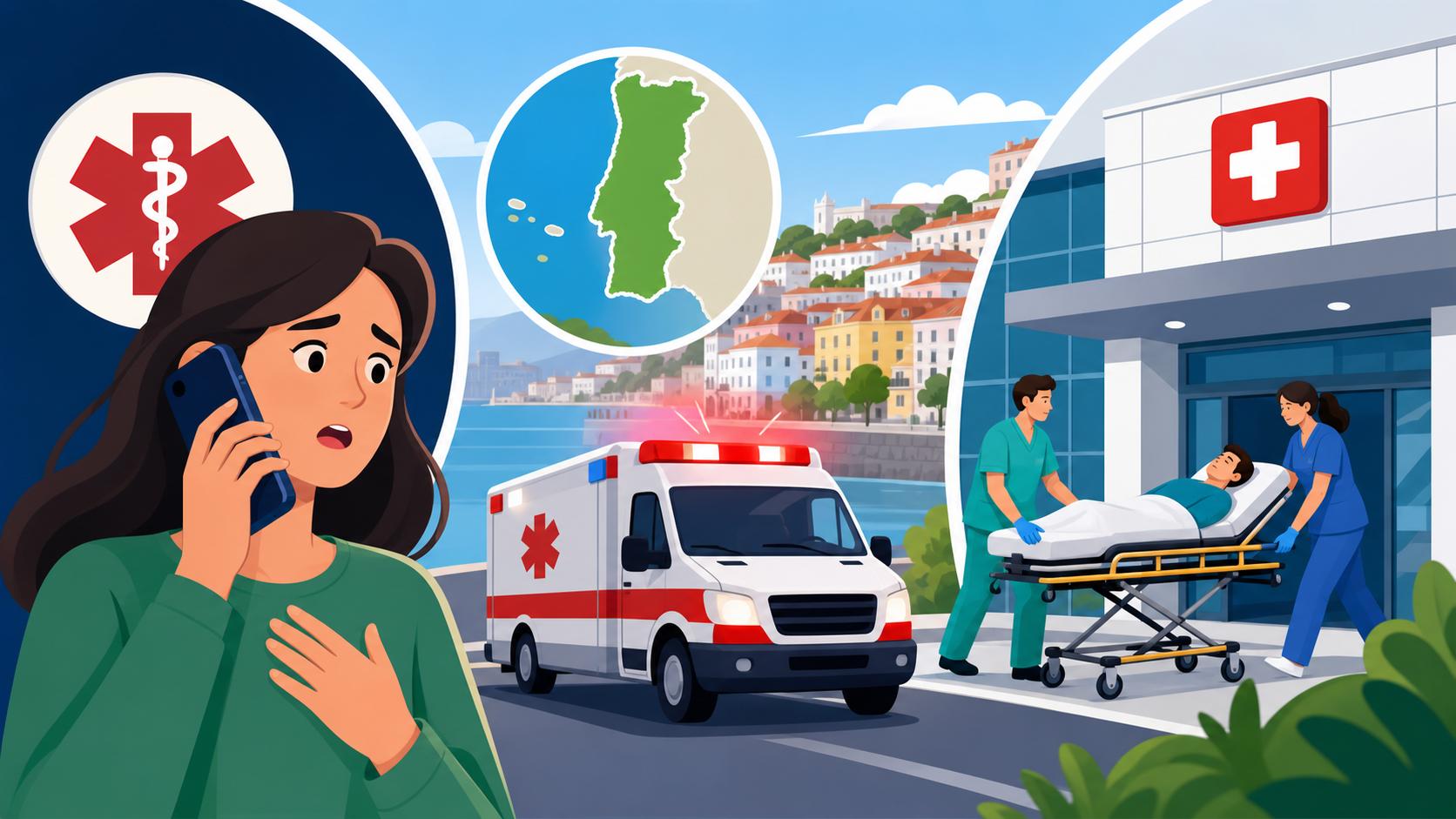
The number 112 is the free European emergency number. It works from any phone in Portugal, including a foreign mobile on roaming, and the call costs nothing. Use it when someone’s life or safety is at immediate risk. Examples include chest pain spreading to the arm or jaw, sudden slurred speech or a drooping face, severe breathing difficulty, heavy bleeding, unconsciousness, a serious car accident, a seizure that will not stop, or a fall from height.
When you dial 112, an operator first works out what kind of help you need. Medical calls go to INEM, the Instituto Nacional de Emergência Médica. Its doctors and nurses decide what to send. Police and fire calls are routed separately, so do not worry about choosing the “right” emergency service. One number covers all of them.
I have called 112 twice in my years here: once for a neighbour who collapsed on the stairs, and once on the A2 near Setúbal after a crash ahead of us. Both times the call was calm and quick. The operator stayed with me until help was organised. The fear of “doing it wrong” turned out to be much bigger than the reality.
SNS 24 on 808 24 24 24: The Line That Saves You a Wasted Night
For everything that feels urgent but not life-threatening, Portugal wants you to call the SNS 24 line first, also known as Linha Saúde 24. As of October 2026, the number is 808 24 24 24. Clinical calls are answered 24 hours a day, every day. Administrative, non-clinical questions are handled from 8:00 to 22:00 every day. The call costs the same as a call to a landline.
A nurse triages you over the phone. Depending on your answers, they may give home-care advice, tell you to see a pharmacist, book you into a health centre, or refer you straight to a hospital emergency department. That referral matters. The public system is increasingly built around “call first, then go”. Arriving with an SNS 24 referral can affect both how you are received and whether a user fee applies. For a deeper look at the service, read SNS 24 Helpline (808 24 24 24): Triage, Advice, and Sick Notes.
Picture a child with a fever of the kind that worries you at 11 p.m., or a stomach bug that has lasted two days, or a sprained ankle after a night out in Bairro Alto. These are classic SNS 24 cases. Calling first often saves you four hours on a plastic chair in a crowded urgência.
Pharmacies, Health Centres and Private Urgent Care
Below the hospital level there are three more options. Pharmacies, marked by a green cross, can handle minor problems, and a rota system keeps one open overnight in every area. If you need one at an odd hour, see What is a Farmácia de Serviço and how to find one open at 2 AM.
Your local Centro de Saúde, or health centre, may offer same-day or open-consultation slots for registered users. Private hospitals such as CUF, Hospital da Luz and Lusíadas run their own urgent care departments, usually called atendimento permanente. Anyone can walk in, and you pay or claim through insurance.
| Situation | Best First Step | Why |
|---|---|---|
| Chest pain, stroke signs, unconsciousness, severe bleeding, serious accident | Call 112 | Free, immediate dispatch through INEM |
| Fever, vomiting, minor injury, worrying but stable symptoms | Call SNS 24 on 808 24 24 24 | Nurse triage 24 hours a day, possible hospital referral |
| Mild cold, allergy, small cut, medication question | Pharmacy | Fast advice, no appointment |
| Non-urgent issue you can wait on until tomorrow | Centro de Saúde | Continuity with your family doctor if you have one |
| Urgent but stable, and you have insurance or can pay | Private atendimento permanente | Usually shorter waits, English more widely spoken |
How to Call 112 Like You Have Done It Before
Panic shrinks your vocabulary, and that is true even in your native language. A little rehearsal makes a huge difference.
What Happens When the Call Connects
The operator will usually answer in Portuguese. Say “English, please” clearly and early. In the big cities and the Algarve, English is often available. Even in more remote areas, operators are trained to work through language barriers. The page Calling 112: Do Portuguese emergency dispatchers speak fluent English? goes into what to realistically expect.
Expect questions in roughly this order:
- Where are you? The exact address or location comes first, because help cannot be sent without it.
- What happened? Describe the emergency in plain words.
- How many people are affected, and are they conscious and breathing?
- What is your phone number, in case the call drops?
- Instructions to follow, such as starting CPR, putting the person in the recovery position, or unlocking the front door.
Do not hang up until the operator tells you to. If you are guided through CPR, put the phone on speaker and keep going until someone takes over. That is exhausting, but it is exactly what the operator needs you to do.
Giving a Portuguese Address Dispatchers Can Actually Use
Portuguese addresses have their own grammar, and ambulance crews rely on it. A typical flat address looks like this: street name, door number, floor, then side. For example, “Rua Morais Soares, 45, 3.º Esquerdo” means number 45, third floor, left-hand door. “Direito” means right, and “rés-do-chão” means ground floor. Add the parish or neighbourhood and the nearest landmark, such as a church, a café or a metro station.
Rural addresses are harder. Many villages in the interior use a lugar or a house name rather than a clear number. Some Algarve villas sit at the end of unnamed dirt tracks. If you live somewhere like that, save your GPS coordinates in your phone. Write down directions in Portuguese from the nearest main road, and keep them taped to the fridge. On a 112 call, you can also offer to send someone to the road to wave the ambulance in.
Tourists in Airbnbs or hotels should take a photo of the full address the day they arrive. Saying “it’s the yellow building near the miradouro” at 3 a.m. is not something you want to do.
Language Survival on the Phone
A few phrases go a long way. “Preciso de uma ambulância” means I need an ambulance. “Ele não respira” or “Ela não respira” means he or she is not breathing. “Está inconsciente” means unconscious. “Dor no peito” means chest pain. “Acidente de carro” means car accident. “Muito sangue” means a lot of blood. “Estou grávida” means I am pregnant.
If your Portuguese is shaky, speak slowly in simple English and use these keywords. Do not try to construct perfect sentences. Dispatchers deal with frightened callers all day, and short, clear facts help them most. For hospital-level language support beyond the phone call, Navigating the public health system if you only speak English (Translation tips) covers apps and practical tactics.
Ambulances, INEM and Getting to the Hospital
The ambulance system here is a patchwork of organisations working under one coordinating body. Knowing who is who stops you from being confused when a fire-brigade vehicle pulls up for a heart problem.
Who Turns Up: INEM, Bombeiros and VMER
INEM coordinates medical emergencies through its dispatch centres, known as CODU. What arrives depends on the case and on what is nearest. It may be an INEM ambulance. It may be a crew from the local Bombeiros Voluntários, the volunteer fire brigades that run a large share of ambulances across the country. It may be a Cruz Vermelha (Red Cross) unit. For the most serious cases, a VMER may come: a fast car carrying an emergency doctor and nurse. In remote areas or for major trauma, a medical helicopter can be sent.
Do not be alarmed if a fire-brigade ambulance arrives for a medical call. That is completely normal, especially outside Lisbon and Porto. Crews are trained in emergency care, and they will take the patient to the hospital chosen by the dispatch centre. That is usually the nearest public hospital with the right specialty, and you generally cannot redirect it to a private hospital of your choice.
Bring the patient’s passport or residence card, health number if they have one, a list of medications and a phone charger, if you can grab them in seconds. Do not delay the crew to pack a bag. A family member can bring things later.
When to Drive Yourself or Take a Taxi
For a true emergency, call 112 rather than driving. An ambulance crew starts treatment immediately and alerts the hospital in advance. Driving yourself through Lisbon traffic with someone having a stroke wastes precious minutes, and you will be too stressed to drive safely.
For stable urgent problems, such as a deep cut that needs stitches, a suspected broken wrist or an SNS 24 referral to go to the hospital, a taxi, a Bolt or Uber, or a friend’s car is perfectly reasonable. Before you leave, check which hospital handles your area and which entrance is the emergency department. Large campuses like Hospital de Santa Maria in Lisbon or Hospital de São João in Porto can be confusing in the dark. Look for signs saying “Urgência”.
Inside a Portuguese Public Emergency Room
This is where newcomers feel the most frustration, and honestly, some of it is justified. Public urgências can be crowded, loud and slow, especially in winter. The care itself, however, is generally competent and serious.
Choosing the Right Urgência
Public hospitals usually have separate emergency departments for different groups. The Urgência Geral is for adults. The Urgência Pediátrica is for children and teenagers. The Urgência Obstétrica e Ginecológica is for pregnancy and gynaecological emergencies. Not every hospital has all of them. In Lisbon, for example, children are often seen at Hospital Dona Estefânia. Maternity emergencies have historically been concentrated at places like Maternidade Alfredo da Costa.
In recent years, some emergency departments, particularly obstetric and paediatric ones, have had to close on rotating days or weekends because of staffing shortages. That is maddening when you are already stressed. This is exactly why calling SNS 24 or 112 first is so useful: they know which departments are open right now. For a full rundown of how these departments work, see Emergency Rooms (Urgências) in Portugal: Triage Colors and Wait Times.
Check-In, Paperwork and the Pulseira
At the front desk, the administrative staff will ask for identification and your Número de Utente, the SNS user number, if you have one. Residents who have not registered yet should see Registering with the Centro de Saúde: Getting Your SNS Número de Utente. Visitors can present a passport and, if they are from the EU or EEA, their European Health Insurance Card. Have your address and a phone number ready, and tell them if you arrived with an SNS 24 referral.
You will then be called for triage. A nurse checks your vital signs, asks about symptoms and fastens a coloured wristband, the pulseira, to your arm. That colour decides your place in the queue. It is not about who arrived first.
Take note of a few practical habits. Bring a charger, water, a snack if the patient is allowed to eat, and something warm, because waiting areas can be cold at night. Usually one companion is allowed to stay with the patient, and children and elderly or dependent patients have a right to be accompanied. Keep an eye on the screens and listen for your name, which may be pronounced in creative ways.
Manchester Triage Colors and Why You Are Still Waiting
Portuguese public hospitals use the Manchester Triage System. It sorts patients by clinical urgency, not by arrival time.
| Wristband Colour | Meaning | What It Feels Like From the Waiting Room |
|---|---|---|
| Red | Emergent, immediate threat to life | Taken in straight away, often before you see them |
| Orange | Very urgent | Seen quickly, ahead of most of the room |
| Yellow | Urgent | A real wait is possible on busy nights |
| Green | Standard, less urgent | Expect long waits behind more serious cases |
| Blue | Non-urgent | Longest waits, and you may be redirected to primary care |
If you are wearing green and watching people who arrived after you go in first, it is not discrimination or bad luck. The system is doing its job: your condition is judged safe to wait. If symptoms worsen while you wait, such as new pain, fainting, breathing changes or confusion, go back to the triage desk at once and say so. You can be re-triaged. The colours are explained in more detail in Understanding the Manchester Triage System colors in Portuguese emergency rooms.
Waiting times vary hugely by hospital, day and season. The flu peak and summer in the Algarve are notoriously busy. Many SNS hospitals publish live waiting-time estimates on the SNS portal, which is worth checking for non-critical visits.
Paying for Emergency Care: SNS, EHIC and Private Insurance
Money is the last thing you want to think about in a crisis. A little understanding beforehand prevents nasty surprises afterwards.
Public Hospital Costs for Residents and Visitors
For residents registered with the SNS, emergency care in public hospitals is heavily subsidised. User fees, called taxas moderadoras, have been largely abolished. However, a fee can still apply in some cases, typically when you walk into an emergency department without a referral from SNS 24, your health centre or INEM, and you are not admitted. Exemptions exist for several groups. The amounts and rules change, so check the SNS website for the current position. To understand what an uninsured or unregistered visit can involve, read How much does an emergency room visit cost without private insurance?.
Visitors from the EU, EEA and Switzerland should carry their EHIC. It gives access to necessary public care on the same terms as residents. UK visitors use the GHIC in a similar way. The page Using the European Health Insurance Card (EHIC) in Portugal explains how it works in practice.
Non-EU tourists, and residents who have not yet registered with the SNS, will normally be treated in an emergency regardless. Afterwards, however, they may receive an invoice at the hospital’s full rates. Keep every document the hospital gives you, including the discharge letter, known as the nota de alta, and the receipts. Your travel or health insurer will ask for them.
Private Hospitals and the Insurance Question
Private urgent care at groups such as CUF, Hospital da Luz and Lusíadas is popular with expats. Waits are usually shorter, rooms are calmer and English is more commonly spoken. To see how these networks are organised, read Hospital da Luz and CUF: Navigating Portugal’s Biggest Private Hospitals.
The catch is cost. Without insurance, you pay for the consultation, tests, imaging and any treatment, and a “quick check” for chest pain can grow into a significant bill once scans are involved. With a Portuguese policy from an insurer like Médis or Multicare, you usually pay a co-payment at network hospitals. Check your policy for what applies to urgent care, because coverage, co-payments and exclusions vary between plans.
International policies are another route. Cigna Global, for example, is used by many expats, especially those who travel often or are still in the gap between arriving and joining the SNS. With plans like that, read how emergency admissions must be notified, whether direct billing is possible at your chosen hospital, and whether evacuation or repatriation is included. Check the provider’s own policy documents for current terms and costs.
Keep one rule in mind: a private hospital is a choice you make when you are stable enough to choose. In a real emergency, 112 sends you to the nearest appropriate public hospital, and private insurance does not change that. Large private hospitals do have their own emergency units, but they generally do not receive patients brought in by the INEM system.
Special Situations Expats Run Into
General advice only goes so far. These are the scenarios I hear about over and over in expat groups and at dinner tables.
Children and Pediatric Emergencies
Parents new to Portugal often feel helpless the first time a child spikes a fever at night. Unless the child is struggling to breathe, unresponsive, having a seizure or showing a rash that does not fade under pressure, start with SNS 24. The nurses there are used to anxious parents. They will tell you clearly whether to go in, and if so, which paediatric emergency department is open.
Bring the child’s vaccination record, called the boletim de vacinas, and any medication they take. Also bring something comforting, because paediatric waits can still be long for green-band cases. If you go private, check in advance which private hospitals near you have a dedicated paediatric emergency unit, as not all of them do.
Dental, Mental Health and Pregnancy Emergencies
Dental pain is a classic gap. Public hospitals deal with serious facial infections or trauma, but routine dental emergencies are mostly handled by private clinics, and some offer extended or weekend hours. See Emergency dentist in Porto or Lisbon: What to do for severe tooth pain for practical options.
For a mental health crisis involving immediate danger to yourself or someone else, call 112. For distress that is serious but not immediately dangerous, SNS 24 can connect callers with psychological support. Larger hospitals have psychiatric emergency services, and the dispatch centre or SNS 24 will direct you to the right one. Being far from home, without your usual support network, makes these moments especially hard. Reaching out is the right call.
If you are pregnant, ask your obstetric team early which emergency department you should use, and save that information in your phone. With temporary closures in some areas, the SNS 24 line is the fastest way to confirm where to go on a given night. For bleeding, severe pain or reduced foetal movement, do not wait. Call.
Rural Living and Island Life
Living in a schist village in the Beiras or a farmhouse in the Alentejo is wonderful until you realise the nearest hospital emergency department may be a long drive away. Some smaller towns have a basic emergency service, but serious cases are transferred to larger regional hospitals. Living in rural Portugal: How far is the nearest hospital usually? goes into this in detail and is worth reading before you buy rather than after.
In rural areas, the local Bombeiros are often the heart of emergency response. Get to know your local station. Many expats also keep a well-stocked home first-aid kit. Some order items such as oral rehydration salts, electrolyte powders and basic dressings from iHerb to top up what the local pharmacy has. For a full list, see What to pack in a first-aid kit when moving to a rural Portuguese village.
On Madeira and the Azores, the main hospitals are Hospital Dr. Nélio Mendonça in Funchal and Hospital do Divino Espírito Santo in Ponta Delgada. These islands have their own regional health services. Serious cases on smaller islands may need an air transfer. Island emergency numbers still start with 112, but plan around ferry and flight schedules if you live on a smaller island.
Preparing Before Anything Goes Wrong
The best emergency is the one you were ready for. Half an hour of preparation now spares you a great deal of panic later.
Building Your Emergency File
Make a single note on your phone, and print a copy for the fridge, containing:
- Your full Portuguese address, written the way a dispatcher needs it, plus GPS coordinates if you live rurally.
- 112 and SNS 24 on 808 24 24 24, saved as contacts.
- Each family member’s Número de Utente, passport or residence card numbers, blood type if known, and allergies.
- A list of regular medications with doses, written in generic names because brand names differ between countries.
- Chronic conditions and past surgeries, briefly translated into Portuguese.
- Your insurer’s emergency phone line and policy number.
- The nearest public adult, paediatric and obstetric emergency departments, plus your preferred private urgent care unit.
If you are going in for planned surgery later, note that interpreter support can be arranged in advance. See Requesting a medical interpreter for a major hospital surgery in Portugal for that process.
Practical Kit and Apps
Download the SNS 24 app, which is linked to your user number once you are registered. It lets you access some services and records. Keep a translation app with offline Portuguese downloaded, because hospital basements often have no signal. A small “hospital bag” in the cupboard with a charger, a spare power bank, copies of IDs, a warm layer and some cash has saved me more than once.
Think about insurance before you need it. If your SNS registration is still pending or you are on a visa path that requires private cover, compare options carefully. Some people use a Portuguese policy, while others prefer an international plan such as Cigna Global for its cross-border flexibility. Whatever you choose, read the emergency and hospitalisation sections of the policy, not just the headline benefits.
Finally, top up your household supplies at a steady pace rather than in a crisis. Pharmacy staff here are knowledgeable and helpful. Some expats also use iHerb for vitamins or familiar non-prescription items they cannot find locally. Prescription medication, however, should always come through a Portuguese doctor and pharmacy.
Portugal’s emergency system is not perfect. The waits can test anyone’s patience, and the language gap feels enormous when you are frightened. But once you know the logic, it becomes far less intimidating: 112 for danger, 808 24 24 24 for everything urgent but stable, triage colours that put the sickest first, and a little paperwork ready in your bag.
Disclaimer
This article is for general informational purposes only and does not constitute professional advice. Laws, prices and regulations vary by location and change over time. Consult a qualified professional for guidance on your specific situation.