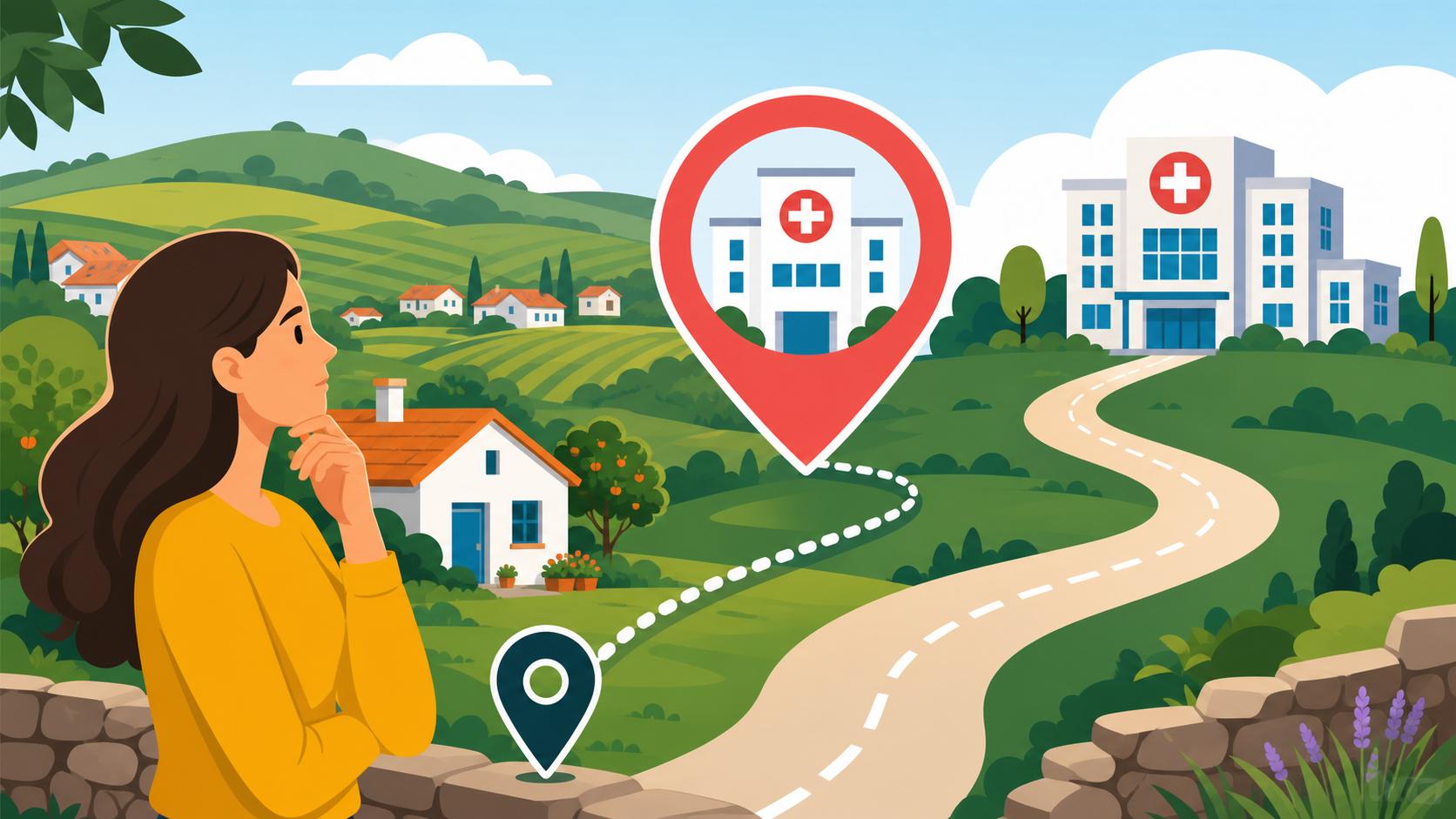
Living in rural Portugal: How far is the nearest hospital usually?
Moving to an abandoned schist village or a sprawling Alentejo cork farm sounds like a romantic dream until you realize the nearest 24-hour emergency room is two mountain ranges away. I remember the panic of my first winter in central Portugal when a simple high fever felt like a crisis because I didn't know the local triage system. This guide maps out exactly what to expect regarding hospital proximity and emergency response when you choose a life off the beaten path.
Understanding the Geography of Healthcare in the Portuguese Interior
When you move to rural Portugal, you quickly learn that the word "hospital" has a very specific meaning. In the city, you might have three major hospitals within a ten-minute Uber ride. In the countryside, you are likely looking at a tiered system of care. Most small villages have a Posto de Saúde (a tiny medical post) or a larger Registering with the Centro de Saúde: Getting Your SNS Número de Utente in the nearest municipality (Concelho). These are excellent for routine checkups, but they are not where you go for a broken bone at 3 AM.
The reality of living in regions like the Alentejo or the Beiras is that the nearest full-service public hospital—one with a 24-hour Urgências (Emergency Department)—is usually located in the district capital. Depending on how deep into the "freguesia" you have tucked yourself, you could be anywhere from 20 to 75 minutes away from a major medical hub. This distance is often measured not in kilometers, but in the time it takes to navigate winding, unlit N-roads or narrow cobblestone streets where a tractor might be blocking your only exit.
The National Health Service, or SNS, does a remarkable job of covering the territory, but the concentration of specialized equipment like MRIs or neonatal units is strictly urban. If you are managing a chronic condition, you need to factor in these travel times. Many expats who didn't realize that while their village has a pharmacy, it might only be a "Farmácia de Serviço" once every two weeks, requiring a long drive to the next town for a midnight inhaler. This is why many veteran rural residents maintain comprehensive coverage through Using Cigna Global or Allianz for international expat healthcare in Portugal to ensure they can access private hubs if they are closer than the public ones.
Average Distances and Response Times by Rural Region
Proximity to care varies wildly depending on which part of the Portuguese interior you call home. The Alentejo is the most challenging due to its sheer scale. It is the largest region in Portugal but the most sparsely populated. Here, you might be 60 kilometers away from the nearest hospital in Beja, Évora, or Portalegre. Because the land is flat, the drive is fast, but 60 kilometers is still 60 kilometers when time is of the essence.
In the North and Central regions, such as the Serra da Estrela or the Douro Valley, the distances are shorter as the crow flies, but the terrain is mountainous. A 15-kilometer drive to a hospital in Covilhã or Castelo Branco can take 40 minutes in the winter if there is ice or heavy fog. You have to be realistic about your driving comfort levels. Living in a remote "quinta" requires a level of self-sufficiency that most city dwellers find jarring at first.
Below is a breakdown of what typical distances look like in popular rural expat hubs:
| Rural Hub Location | Primary Hospital Hub | Est. Drive Time (Standard) | Est. Drive Time (Winter/Night) |
|---|---|---|---|
| Castelo de Vide (Alentejo) | Portalegre | 25 Minutes | 35 Minutes |
| Mértola (Lower Alentejo) | Beja | 45 Minutes | 55 Minutes |
| Arganil (Central Portugal) | Coimbra | 55 Minutes | 70 Minutes |
| Monchique (Algarve Interior) | Portimão | 30 Minutes | 45 Minutes |
| Fundão (Cova da Beira) | Covilhã | 20 Minutes | 35 Minutes |
While these times might seem manageable, they represent the time it takes for you to drive. If you are calling for help, the logistics change. This is why understanding Emergency Medical Care in Portugal: Calling 112 and Going to the Hospital is the first thing you should do after unpacking your boxes. You need to know that the ambulance service (INEM) often partners with local firefighters, the Bombeiros Voluntários, who are the true backbone of rural Portuguese life.
The Role of Bombeiros and SNS 24 in Rural Safety
In the interior, the local Bombeiros are your best friends. They aren't just there to put out forest fires; they provide the majority of emergency medical transport. In a small village, the firefighters know the roads better than any GPS. However, because they are often volunteers or work with limited fleets, there can be a wait. If you live in a particularly remote area, it is common practice to drop by the local station, introduce yourself, and ensure they know how to find your property. Many rural properties don't have standard addresses, so giving them a "ponto de referência" (landmark) is vital.
For non-life-threatening issues, the SNS 24 Helpline (808 24 24 24): Triage, Advice, and Sick Notes is an absolute lifesaver for rural expats. Instead of driving an hour to a hospital only to sit in a waiting room for six hours, you call SNS 24. They have English-speaking nurses who can triage your symptoms over the phone. If they determine you need a doctor, they can often book you a priority slot at the nearest Centro de Saúde, saving you the stress of a long hospital trek.
I’ve had moments where the peace of the countryside felt like isolation during a medical scare. One thing that helped mitigate that anxiety was having a robust first-aid setup. Knowing What to pack in a first-aid kit when moving to a rural Portuguese village is essential because the nearest pharmacy might be closed for the "siesta" or the weekend. I personally keep my pantry stocked with staples from iHerb to ensure I have high-quality supplements and over-the-counter essentials that aren't always easy to find in a tiny village apothecary.
Practical Strategies for Managing Health in the Interior
Self-reliance is the name of the game when you live in rural Portugal. You cannot rely on the "just-in-time" delivery of services that you get in Lisbon or Porto. The first strategy is to build a relationship with your local pharmacist. In rural areas, pharmacists often act as semi-doctors; they can give advice on minor ailments and are deeply embedded in the community. Learn about Pharmacies and Medication in Portugal: Prescriptions and OTC Drugs to understand what they can and cannot do for you without a doctor’s note.
Secondly, consider your transport. A reliable car is not a luxury in the interior; it is medical equipment. If you live at the end of a dirt track that turns into a mud pit in November, you need a vehicle that can handle it. Expats have been known to get stranded because their stylish city car couldn't make it up the hill to the main road during a storm. If you cannot drive yourself in an emergency, you are entirely dependent on the response time of the Bombeiros.
Thirdly, look into private health options as a backup. While the SNS is the primary provider in the interior, some larger rural towns have private clinics that offer specialist appointments once or twice a week. Having Private Health Insurance in Portugal: Costs, Coverage, and Best Providers allows you to skip the long public queues for non-emergencies. Brands like Cigna Global are particularly popular with rural expats because they offer international portability and access to a wide network of private specialists who might be located in the nearest large city, like Coimbra or Viseu.
Finally, do not underestimate the power of "vizinhos" (neighbors). In the city, you might not know the person living across the hall. In the Portuguese countryside, your neighbors will know when you haven't opened your shutters by 10 AM. Building these social bonds is a key part of your safety net. They are the ones who will drive you to the hospital if your car won't start, and they are the ones who know the "shortcut" that the ambulance driver might miss.
Balancing the Dream with Medical Reality
Living in the interior offers a quality of life that is hard to match—clean air, zero noise pollution, and a cost of living that makes early retirement a reality. But the "hospital question" is one you must answer honestly before you buy that ruins-to-renovate project. If you have a condition that requires frequent specialist visits, you might want to look at "semi-rural" areas—villages that are within 20 minutes of a district capital like Évora or Tomar.
For those who are generally healthy, the distance to a hospital is a manageable risk, provided you are prepared. This means having your NIF and SNS numbers ready, knowing your way to the nearest ER in the dark, and keeping your medicine cabinet well-stocked. It is wise for newcomers to spend their first few weeks researching Healthcare in Portugal for Expats: The Complete 2026 Medical Guide and actually driving the route to the nearest hospital just to get a feel for the turns and the timing.
The peace of the countryside is much sweeter when you know exactly what to do when things go wrong. It took me a year to stop checking the GPS for the nearest hospital every time I felt a sniffle. Now, I trust the system—and my neighbors—and I keep my iHerb orders and my Cigna Global policy active just in case. Rural Portugal isn't just a place to live; it's a place where you learn to take care of yourself and your community in a way that the city never demands.
Disclaimer
The information provided in this guide is for educational and informational purposes only and does not constitute professional medical or legal advice. Healthcare infrastructure, hospital availability, and emergency response times in Portugal can change due to government policy or regional administrative shifts. Always verify the location of your nearest medical facilities and emergency contact numbers upon arrival in your local area. The author is an expat sharing personal experiences and research, not a licensed medical professional or government official.