How much does an emergency room visit cost without private insurance?
Waking up with a sharp pain at 3 AM is terrifying enough without the added stress of wondering if a hospital visit will drain your relocation fund. I remember standing in the fluorescent light of a Lisbon ER hallway, clutching my passport and praying my lack of private insurance wouldn't cost me a month's rent. This guide clarifies the actual out-of-pocket costs for emergency care in Portugal so you can focus on healing rather than your bank balance.
The Reality of Public Hospital Costs in Portugal
The first thing you need to understand is that the Portuguese public health system, known as the Serviço Nacional de Saúde (SNS), is not "free" for everyone in every situation, but it is heavily subsidized. If you are a legal resident and have gone through the process of Registering with the Centro de Saúde: Getting Your SNS Número de Utente, your costs are remarkably low. However, for those caught between visas, tourists, or expats who haven't yet secured their residency papers, the price tag shifts significantly.
In the public system, the costs are traditionally governed by what are called "taxas moderadoras." These are small co-payments intended to discourage the unnecessary use of emergency services for minor issues. While the government has recently moved to abolish many of these fees for primary care consultations, they still apply to emergency room visits unless you have a specific exemption or a referral.
If you walk into a public hospital's Urgência (Emergency Department) without a referral from a primary care doctor or the SNS 24 helpline, you can expect to pay a base fee. For a resident with an SNS number, this fee usually hovers between €14 and €18. If you require specialized tests, such as an X-ray or blood work, additional small fees might be tacked on, though these are capped. For a non-resident or someone without a social security connection, the "full cost" of the service is billed, which can range from €100 to €250 just for the initial triage and consultation.
Understanding the Manchester Triage System and Billing
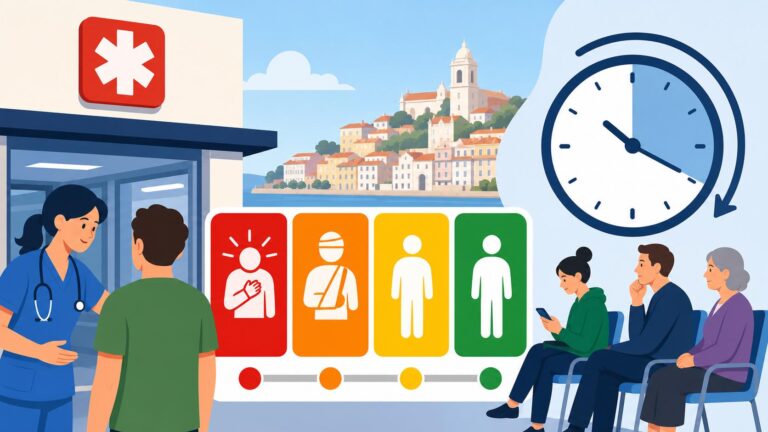
Portugal uses the Manchester Triage System to determine the urgency of your case. When you arrive at the ER, a nurse will evaluate you and assign a color-coded wristband. This isn't just about how long you will wait; it can also influence how the hospital perceives the necessity of your visit.
The Color Codes and Their Implications
The colors range from Red (immediate life-threatening) to Blue (non-urgent). If you are assigned a Green or Blue wristband, it means the hospital considers your condition manageable via a local health center rather than an emergency ward. In some cases, if you arrive with a non-urgent issue, you may be charged the full rate because the visit wasn't deemed a true "emergency."
Many expats get frustrated after waiting six hours with a "Green" wristband only to be hit with a bill they didn't expect. It is vital to understand that the Emergency Medical Care in Portugal: Calling 112 and Going to the Hospital system prioritizes based on clinical risk. If you are a non-resident and your case is triaged as non-urgent, the hospital may bill you for the full administrative and clinical cost of the session, which is significantly higher than the standard resident co-payment.
Why You Should Call SNS 24 First
One of the best "hacks" for navigating the public system is calling the SNS 24 Helpline (808 24 24 24): Triage, Advice, and Sick Notes before heading to the hospital. If the nurse on the phone determines you need emergency care, they will issue a referral. This referral often waives the "taxa moderadora" or at least ensures you are processed as a legitimate emergency case. This is a crucial step for expats trying to keep costs down while waiting for their private insurance to kick in.
Public vs Private Emergency Room Costs
When the public system is overwhelmed—and let’s be honest, wait times in Lisbon and Porto can be grueling—many expats look toward private hospitals like Hospital da Luz and CUF: Navigating Portugal's Biggest Private Hospitals. Here, the billing structure is entirely different. Without insurance, a private ER is significantly more expensive than the public option.
| Service Type | Public SNS (Resident) | Public SNS (Non-Resident) | Private Hospital (No Insurance) |
|---|---|---|---|
| Initial ER Consultation | €14 – €18 | €100 – €180 | €120 – €160 |
| Basic Blood Tests | Included in base/Small fee | €30 – €80 | €100 – €250 |
| X-Ray / Basic Imaging | Included in base/Small fee | €50 – €120 | €150 – €300 |
| Specialist On-Call | No extra charge | Variable | €50 – €100 extra |
| Overnight Observation | Minimal daily fee | €200 – €500 per night | €600 – €1,200+ per night |
As you can see, the Public vs Private Healthcare in Portugal: Which One Should Expats Choose? debate often comes down to a balance of time versus money. In a private ER, you are paying for the speed of service and the comfort of the facilities. However, if you don't have a plan from a provider like Cigna Global, those costs escalate rapidly once the doctors start ordering "análises" (blood tests) or CT scans.
Hidden Costs and Diagnostic Fees
It is rarely just the "entrance fee" that catches people off guard. When you are in an emergency situation, the doctor won't stop to ask if you can afford the specific lab test they are ordering. In a public hospital, as a resident, these are covered by the Taxas Moderadoras: Co-payments and Costs in the Public Health System, but as a non-resident, every single vial of blood and every minute of oxygen has a price code attached to it.
For instance, if you arrive at a public ER in the Algarve as a tourist without Using the European Health Insurance Card (EHIC) in Portugal, you are essentially a "private patient" in a public building. You might be asked to pay an upfront deposit—sometimes €100 or €200—before even seeing a doctor. If your treatment requires an IV drip, specialized medication, or an ultrasound, the final bill could easily climb toward €500 or more.
In the private sector, the billing is even more granular. You will see a line item for the nurse's time, the sterile gloves used, and even the bandages. This is why many veteran expats suggest that if you are not in a life-threatening situation and don't have insurance, the public system is still your safest bet financially, provided you have the patience for the wait times.
Administrative Requirements and Payment
One of the most confusing parts of the Portuguese ER experience is the "check-out" process. Unlike some countries where you are billed weeks later, Portuguese hospitals often expect payment—or at least a formal acknowledgment of the debt—immediately.
The Role of the Número de Utente
If you have your residency but haven't yet received your physical card, having your How to get your Número de Utente online without visiting the health center confirmation can save you hundreds of euros. Without this number, the hospital's computer system defaults to the "International/Private" rate. Always carry a digital copy of your NIF and your SNS number registration, even if it’s just a paper printout from the Centro de Saúde.
Dealing with Large Bills
If you are hit with a massive bill that you cannot pay on the spot, most public hospitals have a "Gabinete do Utente" or an administrative office where you can discuss a payment plan. Portuguese bureaucracy is famous for being slow, but it can also be surprisingly human. If you explain your situation and show that you are in the process of gaining residency, they may sometimes adjust the billing to the resident rate retroactively, though this is never a guarantee.
For those who find themselves frequently worried about these costs, investing in an international plan like Cigna Global can provide peace of mind, especially during those first few months when you are still navigating the SNS registration. It allows you to skip the public wait times and go straight to the CUF price list 2026: How much is a private consultation without insurance without the fear of a four-figure bill.
Alternatives to the Emergency Room
Before rushing to the ER for something like a bad flu or a minor cut, consider that Portugal has several "middle-ground" options that are much cheaper.
- SAP (Serviço de Atendimento Permanente): Many local health centers have "Permanent Care" units. These are essentially urgent care centers for non-life-threatening issues. The cost is the same as a standard GP visit (usually €5 or less for residents), and the wait times are often shorter than a major hospital ER.
- Private Urgent Care: Some smaller private clinics offer urgent care consultations that are cheaper than a full hospital ER visit. You might pay €70-€90 for a flat-fee consultation.
- Home Kits: For minor issues, I always keep a well-stocked medicine cabinet. Buying essentials like high-quality bandages, antiseptic, and thermometers from iHerb can save you an unnecessary trip to the hospital for a minor scrape or a mild fever.
- SNS 24 App: Use the app to check your symptoms. It can often provide you with a "self-care" guide that is legally recognized if you later need a sick note for work.
Navigating the Language Barrier in Emergencies
Another "cost" of the ER is the stress of not being understood. While many doctors in major cities speak English, the administrative staff and triage nurses might not. This can lead to misunderstandings about your insurance status or your medical history.
It is advisable to have a small card in your wallet that lists your allergies, current medications, and your NIF/SNS numbers in Portuguese. Being able to clearly state "Eu sou residente" (I am a resident) or "Eu tenho seguro" (I have insurance) can change the trajectory of your admission process. If you feel you aren't being treated fairly or were billed incorrectly, don't be afraid to ask for the "Livro de Reclamações" (the yellow complaint book). In Portugal, this is a powerful tool that requires a formal response from the management.
Summary of Costs for Expats
To put it simply, if you are a resident with an SNS number, an ER visit will likely cost you less than a fancy dinner—usually under €20. If you are a tourist or a "pre-resident" without insurance, you should budget at least €200 to €500 for a visit that includes diagnostics.
The transition period while you wait for your Health Insurance Requirements for the D7 and D8 Visa Application to be processed is the most vulnerable time. During this window, any trip to the ER is an out-of-pocket expense. This is why having a backup plan, whether it's a dedicated emergency fund or a flexible international policy like Cigna Global, is part of being a prepared expat in Portugal.
Emergency Medical Care Disclaimer
This article is for informational purposes only and does not constitute medical or legal advice. Healthcare laws and "taxas moderadoras" in Portugal can change frequently based on government policy. Always consult the official SNS (Serviço Nacional de Saúde) website or your insurance provider for the most current pricing and regulations. In a medical emergency, always call 112 immediately.