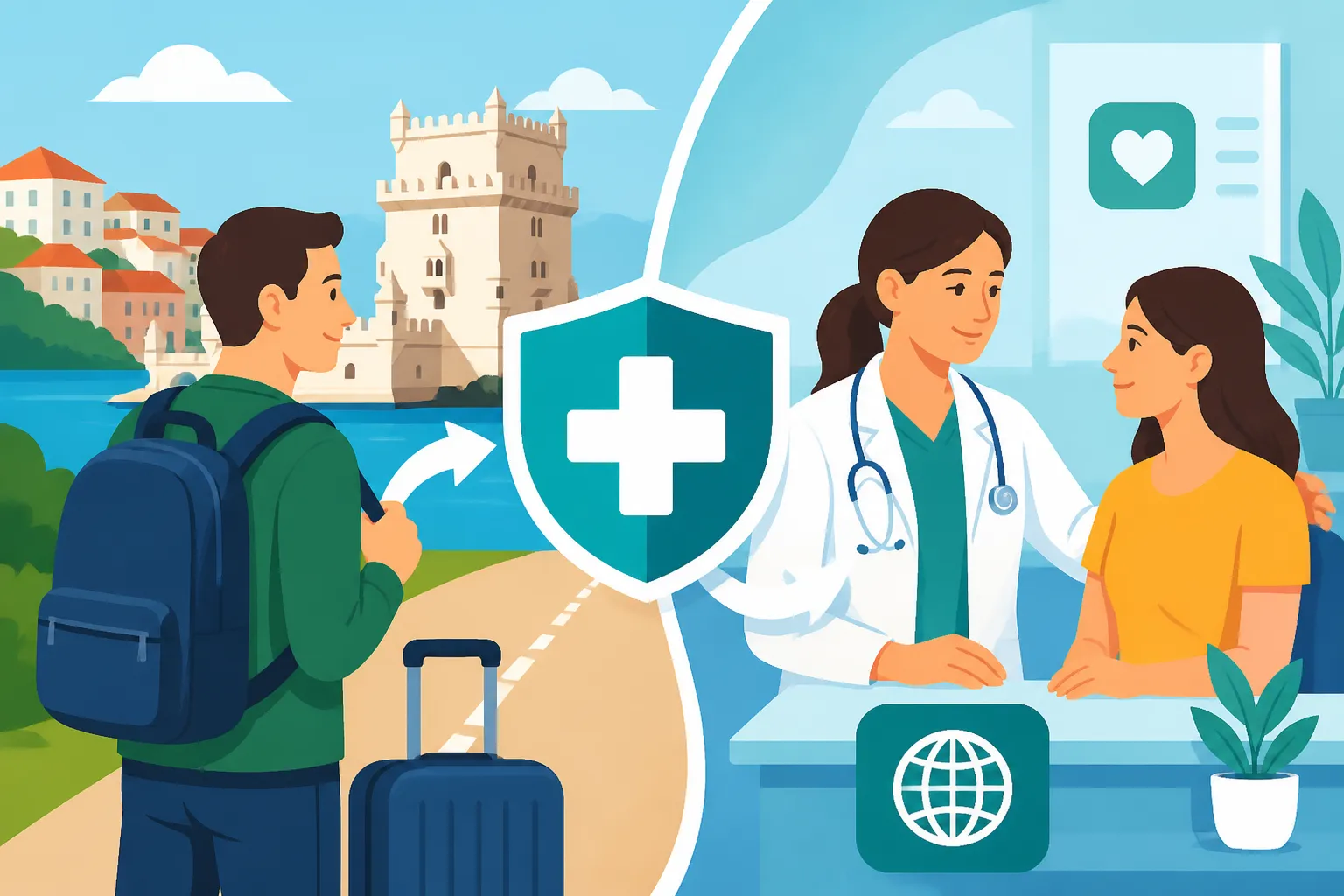
Cross-Border and EHIC/GHIC Healthcare in Portugal
Disclosure: This article contains affiliate links. If you buy through them, we may earn a commission at no extra cost to you. Read our full disclosure.
You arrive in sunny Lisbon or the breezy Algarve, ready for your new life, only to realize your home health coverage doesn’t work the same way across borders. I remember standing in a local clinic in 2021, blue card in hand, trying to explain my situation while the receptionist just pointed at a long queue of locals. This guide simplifies the maze of EHIC/GHIC usage, cross-border healthcare rights, and the administrative steps needed to stay protected in Portugal.
Understanding the EHIC and GHIC Framework in Portugal
The European Health Insurance Card (EHIC) and its post-Brexit cousin, the Global Health Insurance Card (GHIC), are your primary lifelines when you first arrive in Portugal as a visitor or a short-term resident. However, there is a massive amount of confusion regarding what these cards actually do. They are not a "get out of jail free" card for all medical expenses; rather, they are designed to give you access to the Portuguese public health system (SNS) under the same conditions as a local resident.
The Scope of Coverage Emergency vs Routine Care
In the eyes of the Portuguese healthcare system, the EHIC/GHIC covers "state-provided healthcare that becomes necessary during a temporary stay." This definition is intentionally broad but holds specific limitations. If you have a sudden asthma attack, a broken bone from a cobblestone mishap in Alfama, or a high fever, the card is your ticket to the public hospital. It covers "necessary care," meaning the doctor determines you cannot wait until you return home to receive treatment.
However, many expats fall into the trap of thinking they can use these cards for elective surgeries or routine screenings. If you are specifically Using the European Health Insurance Card (EHIC) in Portugal to get a long-standing back issue treated with physiotherapy, you might be disappointed. The system is designed for unforeseen circumstances. If you are moving here for the long term, you will eventually need to transition into the residency-based system to handle chronic issues or preventative care.
How to Use Your Card at a Portuguese Public Hospital
When you walk into a public hospital's emergency room (Urgências), the first thing they will ask for—after your ID—is your EHIC or GHIC. You must present the physical card or a valid Provisional Replacement Certificate (PRC) if you lost the original. Once scanned, you are entered into the system as a "transient" patient. This allows the Portuguese state to bill your home country later, rather than charging you the full commercial rate upfront.
Be prepared for the Manchester Triage System. This is a color-coded system where a nurse assesses the urgency of your case. A red or orange wristband gets you in immediately, but a green or blue one might mean a six-hour wait. Waits of several hours are common for minor ailments, even though many patients present their cards at reception. It’s a slow process, but it works. If you are looking for a faster experience, you might want to look into Finding Doctors and Specialists in Portugal: English-Speaking Medical Care within the private sector, where these cards are unfortunately not accepted.
Common Pitfalls When Your EHIC or GHIC is Refused
The most frequent reason for refusal isn't the card itself, but where you try to use it. These cards are strictly for the public system. If you walk into a shiny, modern private clinic like CUF or Hospital da Luz and flash your GHIC, they will kindly ask for your credit card instead. Many newcomers get stuck with a €150 bill for a simple consultation because they didn't realize the clinic was private.
Another pitfall is card expiration. It sounds obvious, but when you are busy moving houses and setting up a NIF, checking the tiny date on your blue card falls to the bottom of the list. If the card is expired, the SNS system will treat you as a non-resident, non-EU national, which could lead to an "invoice for the full cost of treatment." Always ensure your home country's address is updated in their records, or the card might be considered invalid if they attempt to verify your residency status.
Registering for Public Healthcare as a Cross-Border Resident
If you are living in Portugal but still working for a company in another EU country, or if you are a pensioner receiving a state pension from abroad, you fall into the "cross-border" category. This is an administrative middle ground that requires more than just a blue card. You need to formally bridge the gap between your home country's social security and Portugal's SNS.
Obtaining the Numero de Utente for Residents
Once you have your residence certificate (CRUE for EU citizens or an AIMA card for others), your next goal is Registering with the Centro de Saúde: Getting Your SNS Número de Utente. This number is your "golden ticket" to the public system. For cross-border residents, you cannot simply show up and ask for one; you need to prove that you are covered by another state’s social security system if you aren't yet paying into the Portuguese one.
This process often involves visiting your local Centro de Saúde with your NIF, proof of address (the Atestado de Morada from your Junta de Freguesia), and your residence permit. In 2026, many centers are allowing digital submissions, but in more traditional areas, you’ll still need to wait at 8:00 AM for a ticket. Without this number, even with an EHIC, you are essentially a ghost in the system, making it nearly impossible to book a routine appointment with a family doctor.
The Role of the S1 Form for Retirees and Dependents
For retirees from the UK or EU, the S1 form is absolutely critical. This document proves that your home country will remain responsible for your healthcare costs even though you live in Portugal. When you present an S1 to the Portuguese Social Security office (Segurança Social), they register you in their database, which then allows the Centro de Saúde to issue a permanent Número de Utente.
This is a life-saver for those with chronic conditions. It grants you full access to the SNS as if you had worked in Portugal your whole life. Many newcomers go through this, and the peace of mind it brings—knowing they can get their monthly prescriptions at subsidized rates—is worth the three months of back-and-forth paperwork. If you are in this category, you should also read up on Finding an English-Speaking General Practitioner (Médico de Família) to ensure your ongoing care is managed in a language you’re comfortable with.
Cross Border Workers and the SNS Frontalier Rules
A "frontalier" or cross-border worker is someone who lives in Portugal but works in another country (common for those living near the Spanish border or digital nomads with specific EU contracts). In this case, you usually pay social security in the country where you work. You are entitled to healthcare in both countries. To make this work in Portugal, you’ll need to register your "S1" equivalent or prove your employment status.
The complexity here is that the Portuguese authorities might occasionally ask why you aren't paying Segurança Social locally. Having a clear contract and your NIF linked to your foreign employment is essential. If the bureaucracy feels too heavy, many in this situation opt for a hybrid approach: using the public system for emergencies but keeping a plan like Cigna Global to cover specialized care or faster diagnostics in the private sector.
Private Alternatives for Non EU Citizens and Digital Nomads
For those who don't have access to an EHIC or GHIC—such as Americans, Canadians, or digital nomads from outside the EU—the cross-border healthcare conversation looks very different. Without these reciprocal agreements, you are essentially "uninsured" in the eyes of the Portuguese state until you become a tax resident and start contributing to the local system.
Why the EHIC is Not a Substitute for Full Insurance
Even for those who do have an EHIC, relying on it solely is a risky strategy for a long-term move. The EHIC does not cover private healthcare, nor does it cover medical repatriation. If you are seriously injured and want to be flown back to your home country for specialized surgery, the EHIC will not pay a cent. It also doesn't help you skip the notorious wait times of the public system.
Many expats find that while the SNS is fantastic for life-saving emergencies, it can be frustrating for "quality of life" issues, like a knee replacement or a dermatological check-up. This is where having a secondary layer of protection becomes vital. Plans from providers like SafetyWing are particularly popular with the nomad crowd because they handle the "cross-border" aspect seamlessly, covering you in Portugal and when you travel back home or to other countries.
International Plans for Global Expats
For families and high-net-worth individuals, a comprehensive international policy is often the preferred route. Providers like Cigna Global offer modular plans that allow you to choose your level of coverage. This is especially useful if you spend six months in Portugal and three months in the US or UK. You can maintain a consistent relationship with your insurance provider without having to navigate a new local policy every time you cross a border.
These international plans often include "out-patient" care, which means you can visit a private GP, get your blood tests done at a private lab, and have the costs reimbursed. Given that Private Health Insurance in Portugal: Costs, Coverage, and Best Providers can range from very basic to all-encompassing, international plans fill the gap for those who want "Gold Standard" care without the geographic restrictions of local Portuguese insurers like Médis or Multicare.
Navigating the Private Hospital Networks
If you have private insurance or are paying out-of-pocket because your cross-border card isn't accepted, you will likely end up at Hospital da Luz and CUF: Navigating Portugal's Biggest Private Hospitals. These facilities are world-class. Most of the doctors speak fluent English, and you can often book an appointment within 48 hours via an app.
When using these hospitals, it’s important to understand that they operate independently of the SNS. Your EHIC/GHIC is irrelevant here. If you have a plan from Cigna Global, you can often use their direct-billing network, meaning the hospital bills the insurer directly and you only pay a small co-payment. For those using SafetyWing, you typically pay upfront and submit your receipts for reimbursement. It’s a different workflow, but the speed of service is a major relief when you’re dealing with a painful health issue.
Costs and Co-payments in the Cross-Border System
One of the biggest shocks for foreigners is that "public" doesn't always mean "free." Portugal uses a system of small co-payments known as Taxas Moderadoras. Even if you have a valid EHIC or are registered with an S1, you may still be asked to pay a few Euros for certain services.
Understanding the 2026 Fee Structure
The Portuguese government has significantly reduced Taxas Moderadoras in recent years, but they haven't vanished entirely for everyone. Generally, if you go to a primary care consultation at your Centro de Saúde, the fee is now zero for most residents. However, emergency room visits that do not lead to an admission can still incur a small fee (usually around €15–€20).
| Service Type | Public (SNS) with EHIC/S1 | Private (Out of Pocket) |
|---|---|---|
| GP Consultation | €0 – €5 | €40 – €80 |
| Specialist Visit | €0 – €10 | €70 – €120 |
| Emergency Room | €15 – €20 | €120 – €250 |
| Blood Tests | Highly Subsidized | €30 – €150 |
| MRI / CT Scan | Subsidized (Long Wait) | €200 – €500 |
As you can see, the price difference is stark. For a deep dive into these costs, check out our guide on Taxas Moderadoras: Co-payments and Costs in the Public Health System. Knowing these numbers helps you budget for your first few months before your local insurance kicks in.
Exemptions Who Pays and Who Doesnt
Not everyone has to pay these fees. If you are pregnant, a child under 18, or someone with a documented low income, you are exempt. For cross-border residents, the rules can be a bit murky. Generally, if your S1 is registered, you are treated with the same exemption rules as a Portuguese citizen.
If you are a digital nomad using an EHIC, you will likely be asked to pay the standard "resident" co-payment rate. It’s a nominal amount, but it is wise to carry some cash or having MB Way set up, as some smaller health centers have "broken" card machines more often than they’d like to admit.
Comparing Public Costs vs Private Consultation Fees
If you find yourself without a valid EHIC or a registered S1, the public hospital is required by law to treat you, but they will send you a bill for the "Commercial Rate." This can be surprisingly expensive—sometimes more than the private sector. Bills for emergency appendectomies in the public system have reached €3,000 for non-residents.
This is why having a plan from SafetyWing or Cigna Global is so important for those in the "waiting period" of residency. It ensures that you aren't hit with a massive bill while your paperwork is being processed by AIMA or the Social Security office. Once you have your local residence and NIF, you can decide if the public system’s low costs outweigh the convenience of private care.
Pharmacies and Prescriptions for Cross-Border Visitors
Getting your medication is the most common cross-border hurdle. Whether you are bringing a three-month supply from home or trying to fill a foreign prescription at a local Farmácia, there are rules you must follow to avoid being overcharged or turned away.
Using Foreign Prescriptions in Portugal
Can you use a prescription from a doctor in France, Germany, or the UK in a Portuguese pharmacy? The answer is "mostly yes," but with a catch. Under EU law, a prescription issued by a doctor in one EU country is valid in all other EU countries. However, it must contain specific information: the patient's full name, the date of issue, the doctor’s details, and—critically—the "common name" of the medicine (the active ingredient), not just the brand name.
For UK citizens using a GHIC, the rules are slightly more complex post-Brexit, but most Portuguese pharmacists are accommodating if the prescription is clear and in English. However, you will likely have to pay the full price of the medication. Only prescriptions issued by the Portuguese SNS are eligible for the deep subsidies (comparticipação) that locals enjoy. If you need long-term medication, you should use the SNS 24 Helpline (808 24 24 24): Triage, Advice, and Sick Notes to find out how to get a local equivalent.
The Subsidized Medicine System Comparticipação
The Portuguese government subsidizes essential medicines based on their necessity. Life-saving drugs (like insulin) might be 90% or 100% subsidized, while lifestyle drugs are less so. To access these prices, the prescription must be digital and linked to your Número de Utente.
When you go to the pharmacy, you just show your ID or the paper "receipt" with a barcode provided by your Portuguese doctor. If you are a cross-border resident with an S1, your subsidized rate is automatically calculated. This is why getting that registration done is so important—it can turn a €60 monthly bill for blood pressure medication into a €6 bill. For more on this, see Pharmacies (Farmácias) in Portugal: Green Crosses and After-Hours Service.
Finding a Farmacia de Servico for Emergencies
If you need medication at 3:00 AM on a Sunday, you need to find a Farmácia de Serviço. In every town, pharmacies rotate a "on-call" schedule. You can usually find a list posted in the window of any pharmacy or check the SNS 24 website.
Be aware that there is often a small "service fee" (usually around €2.50 to €5.00) for using a pharmacy outside of regular hours. Also, in the middle of the night, the pharmacy won't let you inside; you’ll talk to the pharmacist through a small secure window. It’s a very traditional system, but it’s incredibly reliable once you know what to look for.
Practical Tips for Navigating Cross Border Medical Care
Beyond the paperwork and the cards, there is the reality of navigating a foreign medical system. From language barriers to emergency protocols, these "on-the-ground" tips will save you hours of frustration.
Language Barriers and Translation Apps
While many doctors in major cities like Lisbon, Porto, and the Algarve speak English, the administrative staff and nurses in smaller Centros de Saúde often do not. I have found that having a translation app like DeepL ready on my phone is essential. More importantly, I always carry a printed list of my current medications and any allergies translated into Portuguese.
In an emergency, if you call Emergency Medical Care in Portugal: Calling 112 and Going to the Hospital, you can ask for an English speaker, but there may be a delay while they transfer you. Learning a few key phrases like "Dói aqui" (it hurts here) or "Tenho uma alergia" (I have an allergy) goes a long way in building rapport with the staff.
What to Do in a Medical Emergency (112)
The emergency number in Portugal is 112. This is a centralized European number that works even if your phone has no SIM card or is locked. If you are a cross-border visitor, 112 is the only number you need. They will dispatch an ambulance (INEM) if necessary.
One thing expats often miss is the difference between a hospital and a Centro de Saúde. For minor issues—a bad cold, a small cut, or a prescription renewal—go to the Centro de Saúde. For life-threatening issues, go to the Hospital. If you aren't sure, call the SNS 24 line (808 24 24 24). They have English-speaking nurses who can "triage" you over the phone and tell you exactly where to go. This is a brilliant service that prevents you from wasting hours in a crowded ER.
Document Checklist for Every Hospital Visit
Never leave home for a medical appointment without your "Expat Medical Kit." Bureaucracy is the national sport in Portugal, and having the right paper at the right time is the only way to win. I keep a dedicated folder (physical and a scanned version on my phone) containing:
- Passport / National ID
- Residence Permit (CRUE or AIMA card)
- NIF Document
- EHIC / GHIC card (if not yet a full resident)
- S1 Form (if applicable)
- Recent prescriptions and a list of chronic conditions
- Proof of private insurance (from Cigna Global or SafetyWing)
If you have all of these, even the most stern-faced receptionist will find it hard to turn you away. Cross-border healthcare in Portugal is accessible and high-quality, but it rewards the prepared. Take the time to get your registration done early, and you can focus on enjoying the Portuguese lifestyle instead of worrying about "what if."
Disclaimer
This guide is provided for informational purposes only and does not constitute legal or professional medical advice. Healthcare regulations in Portugal and the EU are subject to change. Always verify current requirements with official government sources or a qualified healthcare consultant.