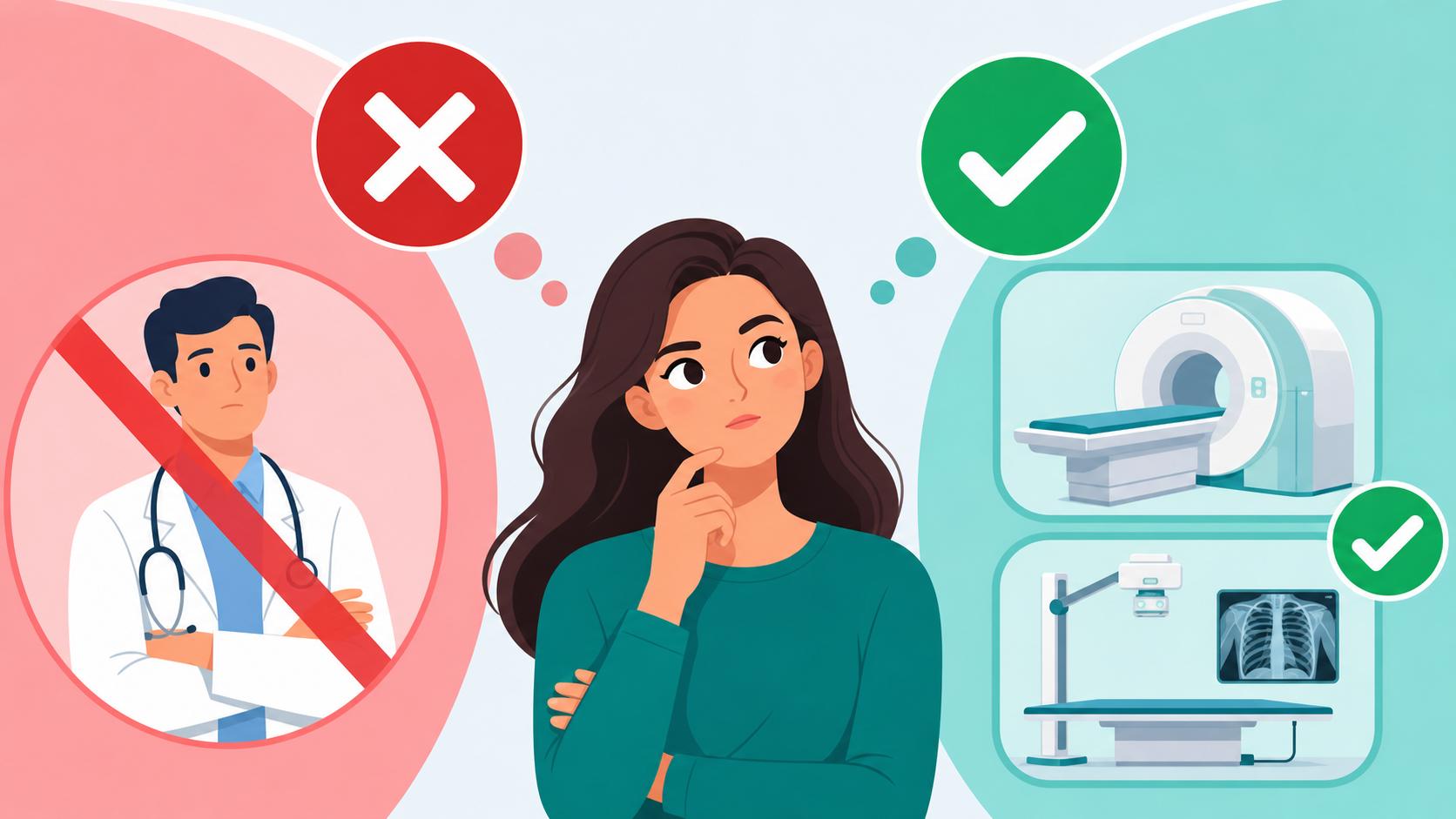
Can I get an MRI or X-ray without a doctor’s referral in the private system?
You twisted your knee on the calçada and you’re sure something is torn. Or you’ve had a cough for six weeks and just want a chest X-ray. So you call a private clinic in Lisbon or Porto, ready to pay, and they ask for your “prescrição médica.” This guide explains why that happens, the fastest legal ways to get the scan, and what to expect afterwards.
The Short Answer: Private Clinics Almost Always Want a Prescription
I remember the first time this happened to me. I had a stiff, swollen shoulder after a weekend of moving furniture up four flights of stairs in Graça. I phoned a well-known imaging clinic, explained in my best halting Portuguese that I wanted an MRI, and offered to pay cash. The receptionist was polite but firm: “Precisa de uma requisição do médico.” You need a doctor’s request. I hung up thinking it was bureaucracy for its own sake. It isn’t. Once you understand the logic, it becomes much easier to get through quickly.
In Portugal’s private system, the general rule is that diagnostic imaging is booked against a medical prescription. That applies to X-rays (radiografia or RX), CT scans (TAC), MRIs (ressonância magnética or RM), mammograms (mamografia) and, at most places, ultrasounds (ecografia). The private sector moves faster than the public one. It does not drop the requirement for a doctor to decide that the exam is needed.
Why X-rays and CT Scans Need a Doctor’s Sign-Off
X-rays, CT scans and mammograms use ionizing radiation. Portugal follows EU radiation protection rules, and a core principle of those rules is “justification.” Every medical exposure to radiation has to be justified by a qualified professional, who weighs the benefit to you against the risk. A clinic that X-rays anyone who walks in and asks would struggle to show that each exposure was justified. That is why the receptionist won’t budge, however nicely you ask or however much cash you offer.
There’s a practical side too. A radiographer doesn’t just “take a picture of your back.” They need to know which views to capture, which area matters, and what the referring doctor suspects. A request saying “lumbar spine, suspected disc herniation, pain radiating to the left leg” produces a far more useful exam than a vague “my back hurts.”
Imagine a hypothetical case. Sarah, a retiree in Tavira, falls on her wrist and wants an X-ray straight away. If it’s an acute injury with obvious swelling or deformity, the correct move is not to hunt for an imaging clinic at all. It’s to go to an urgent care service, public or private, where a doctor examines her and orders the X-ray on the spot. Emergency departments do this all the time. Emergency Rooms (Urgências) in Portugal: Triage Colors and Wait Times walks through what that visit looks like.
Is an MRI or Ultrasound Any Different
MRI uses magnets and radio waves, not radiation, so the strict radiation justification rule doesn’t apply in the same way. In practice, though, most Portuguese clinics still ask for a prescription for an MRI, for several reasons:
- An MRI protocol depends on the clinical question. Imaging a knee for a meniscus tear is set up differently from imaging a brain for migraines.
- Some MRIs use a contrast agent. The clinic may want to know about your kidney function, allergies and medical history first, and sometimes asks for a recent blood test.
- Implants, pacemakers, metal fragments and certain devices have to be screened for safety. A referring doctor helps flag these.
- The radiologist writes the report for a doctor, not for you. Without a clinician to interpret it in context, the result can cause more anxiety than it resolves.
Ultrasound is the grey area. A handful of private clinics will occasionally do certain ultrasounds on request, or as part of a check-up package where their own doctor sees you first. It is not something to count on, and it varies from one clinic to the next. If you ask, ask directly on the phone: “É possível fazer a ecografia sem prescrição médica?” Expect a “no” more often than a “yes.”
What Counts as a Valid Referral in a Portuguese Clinic
This catches people out. In Portugal, a valid request is usually a written exam prescription from a doctor registered with the Ordem dos Médicos, the Portuguese medical council. It might be:
- An SNS exam request issued by your médico de família at the Centro de Saúde
- A prescription from a private GP or specialist at a hospital like CUF, Lusíadas or Hospital da Luz
- An electronic prescription issued after a telemedicine consultation with a Portuguese-registered doctor
What about a referral from your doctor back home in the UK, the US or Canada? Some private clinics will accept a foreign request, especially if it’s clear, recent, in English and on letterhead. Others won’t, because they can’t verify the prescriber. Phone ahead. It also helps to have the request translated or at least clearly labelled with the body area and clinical question.
The Fastest Legal Routes to Your Scan
Once you accept that a prescription is the gatekeeper, the real question is how to get one quickly. Here are the routes I and many expats I know have used, from the most common to the most situational.
Route One: A Private GP or Specialist Consultation
This is the most reliable path. Book a consultation, explain your symptoms, and if the doctor agrees imaging is warranted, they write the request. Many private hospitals let you book the scan in the same building, sometimes on the same day if there’s availability.
Take a hypothetical case. Tom, a software developer in Porto, has had lower back pain for three weeks. He books an orthopaedic consultation at a private hospital through its app, sees the doctor, and leaves with an MRI request. Because the hospital has its own imaging department, he books the MRI at the front desk on his way out. The consultation is an extra cost, but it gets him a properly targeted exam and a doctor who will read the report with him afterwards.
One tip from experience: if you suspect a specialist issue, such as a knee, shoulder or spine problem, it’s often worth booking the relevant specialist (ortopedista) directly rather than a general practitioner first. In the private system you can usually do this without a GP gatekeeper, which is one of its biggest advantages. Specialist Referrals: The Process in Public SNS vs Private Clinics explains how that differs from the public route. If you’re not sure where to start, Hospital da Luz and CUF: Navigating Portugal’s Biggest Private Hospitals breaks down the two largest networks.
Route Two: Telemedicine Prescriptions
Telemedicine has been a lifesaver for expats in Portugal, especially if you live outside the big cities or don’t yet speak much Portuguese. Several private hospital groups and insurers run video consultations, and independent platforms connect you with Portuguese-registered doctors who speak English.
For straightforward cases, a telemedicine doctor can often issue an exam prescription electronically. A persistent cough where a chest X-ray is the obvious first step is one example. A follow-up scan of something already diagnosed is another. You then take that prescription to any imaging clinic that accepts it. For a broader look at how these services work, see Telehealth and Online Doctors: Using TravelDoctores and Doctorsa.
Be realistic, though. A video doctor can’t palpate your abdomen or test your knee’s stability. For musculoskeletal injuries or anything where a physical exam matters, they may decline to order an MRI and suggest an in-person visit instead. That’s good medicine, not obstruction.
Route Three: Using an SNS Exam Request at a Contracted Clinic
Here’s the route many newcomers don’t know exists. If you’re registered with the SNS and have a médico de família, your family doctor can issue an exam request. You can often use it at a private clinic that holds a contract with the SNS, known as a “convencionado.” Big imaging networks such as Affidea and Joaquim Chaves Saúde have locations across the country that work under this arrangement for many exams.
The result is a private-sector environment for the scan itself, while the request and the cost structure follow public system rules. Not every exam is covered this way, and MRI coverage through the SNS can be more restricted than X-ray or ultrasound. Ask your family doctor and the clinic exactly what the request allows.
The catch, of course, is getting the family doctor appointment in the first place. If you don’t have one assigned yet, What to do if you don’t have a family doctor but need a public consultation covers your options.
Comparing the Routes
| Route | Who writes the request | Best for | Main drawback |
|---|---|---|---|
| Private GP or specialist visit | Private doctor in person | Injuries, pain, anything needing a physical exam | You pay for the consultation as well as the scan |
| Telemedicine consultation | Portuguese-registered doctor by video | Simple, clear-cut cases and follow-up imaging | Doctor may refuse imaging without an in-person exam |
| SNS request at a convencionado | Your médico de família | Lower cost through the public system | Depends on getting a family doctor appointment |
| Urgent care or emergency visit | Emergency doctor on site | Acute injuries, suspected fractures, severe symptoms | Waiting times and triage priority |
| Foreign doctor’s referral | Your doctor abroad | Continuing care you started before moving | Acceptance varies by clinic, so always phone first |
How Insurance Changes the Picture
Health insurance doesn’t remove the prescription requirement. If anything, it adds a layer, because the insurer also wants to see that the exam was medically justified before it pays.
Portuguese Insurers and Pre-Authorization
With domestic plans such as Médis, Multicare or AdvanceCare-administered policies, routine imaging like X-rays and many ultrasounds is often handled at the clinic counter. You show your insurance card and the prescription. Higher-cost exams such as MRI and CT frequently need prior authorization: the clinic or you submit the doctor’s request to the insurer, and the insurer approves it before the scan.
The details vary between policies, including which exams need pre-approval, how much you co-pay at network clinics, and whether out-of-network imaging is reimbursed. Read your policy conditions or call the insurer’s line before you book. Médis, Multicare, and AdvanceCare: Comparing Top Private Insurers compares how the main providers structure this.
One more thing to check if your policy is new: many Portuguese plans have waiting periods before certain services are covered, and imaging can be among them. Waiting periods (Períodos de Carência) in Portuguese health insurance policies explains how these work, so a newly signed policy doesn’t leave you with a surprise bill.
International Expat Plans
Plenty of expats, especially those who first came on a D7 or D8 visa, hold international health insurance instead of a Portuguese policy. Cigna Global is one of the names I hear most often in expat circles here. With international plans, the shape is usually similar: imaging must be ordered by a doctor, and advanced scans often need pre-authorization through the insurer’s own process before you book.
The practical difference is paperwork. With an international insurer, you may need to send the Portuguese doctor’s prescription, sometimes translated, along with the clinic’s quote. Some international plans offer direct billing with certain large private hospitals in Portugal. Others work on a pay-first, claim-later basis. If you’re with Cigna Global or a similar provider, call or message them before the scan, confirm whether the specific exam needs approval, and ask whether the clinic you’ve chosen is one they settle with directly. Don’t book first and hope for the best.
A hypothetical example: Maria, a remote worker in Cascais, gets an MRI request from a private orthopaedist and books the scan for the next morning. She remembers her international policy only that evening, discovers the MRI needed pre-approval, and has to reschedule. A ten-minute call before booking would have avoided the whole thing.
Paying Out of Pocket
If you have no insurance, or your plan won’t cover the exam, you can pay privately. You’ll still need the prescription. What you’re really choosing is where to have the scan done. Prices vary between clinics, between cities, and between exams with and without contrast. Ask for a quote (“orçamento”) when you call. Many clinics will give you a self-pay price over the phone or on their website if you tell them the exact exam on the prescription.
Keep every invoice with your NIF on it. Healthcare expenses can matter for your Portuguese tax return, and if you later claim from an insurer, you’ll need the itemised invoice and the prescription. For more on handling invoices and claims, see Navigating Medical Billing and Insurance Reimbursements in Portugal.
Step-by-Step: Booking Your Scan and Getting the Results
Once you have your prescription, the process is fairly predictable. Here’s how I’d approach it.
Before You Book
- Read the prescription carefully. Note the exact exam name, the body area, whether contrast is requested, and any clinical notes. The clinic will ask you for this information.
- Decide how you’re paying: SNS request at a convencionado, Portuguese insurance, international insurance, or self-pay.
- If you’re insured, confirm whether the exam needs pre-authorization and whether the clinic is in your network.
- Call or use the clinic’s app to book. Give the exam name exactly as written on the prescription.
- Ask about preparation. Some abdominal ultrasounds need fasting or a full bladder. Some contrast exams need a recent blood test. Some MRIs need you to remove all metal and fill out a safety questionnaire.
- Ask when and how the report will be delivered. This varies by exam and by clinic, so ask at the point of booking.
If your Portuguese is still basic, don’t panic. Most larger private clinics in Lisbon, Porto and the Algarve have staff who manage in English, and you can always ask for someone who does: “Fala inglês?” For smaller towns, Navigating the public health system if you only speak English (Translation tips) has practical phrases that also work in private clinics.
On the Day
Bring your prescription (the original paper if you have one, or the electronic code), your ID or residence card, your NIF, your insurance card and any approval letter from the insurer. If you’ve had previous scans of the same area, bring those too, including any from abroad. The radiologist can compare them, which makes the new report more meaningful.
For an MRI, you’ll fill out a safety form covering implants, surgeries, pregnancy and claustrophobia. Be honest. If you’re claustrophobic, say so when you book, not when you’re lying on the table. Some clinics can suggest options, and your doctor may be able to prescribe something to help you relax. For contrast exams, tell them about kidney problems, allergies and diabetes medication.
For X-rays and CT scans, you’ll be asked whether there’s any chance you’re pregnant. That’s the radiation justification rule at work again, and it’s asked every time.
Getting and Understanding Your Report
This is where expectations need adjusting. You’ll usually get two things: the images and the written report (relatório) from the radiologist. How long the report takes depends on the type of exam and on the clinic. Ask for the delivery time when you book or when you check in, rather than assuming.
To give one concrete example: as of October 2026, CUF’s exam results page says the time for a result to be ready varies by type of exam and asks patients to check the delivery time when booking or at admission. Results are sent by email and made available in the My CUF app. Other private groups and imaging networks have their own apps and portals, and many will also hand you a printed copy or a disc of images if you ask.
The report is written in Portuguese medical language, and it’s addressed to your doctor. Resist the urge to paste every line into a translation app at midnight and spiral. Words that sound alarming in translation are often routine descriptive terms. Take the report back to the doctor who ordered the exam. That is exactly why the prescription system exists.
If the follow-up involves something like a vitamin D deficiency picked up alongside a bone density scan, your doctor may suggest supplements. Some expats buy these at a local farmácia, and others order them from iHerb. Either way, take the dose your doctor recommends rather than guessing, and remember that parcels from outside the EU can involve customs charges.
If your scan was done through the SNS, a convencionado or a public hospital, some results and records may also be visible in your SNS online area. Accessing your medical records in Portugal: Using the SNS Portal do Utente explains how to find them. Keep your own copies regardless. If you ever change doctors, insurers or countries, having your imaging history in a folder saves a lot of hassle.
A Few Hard-Won Lessons
- Ask the doctor to write the clinical question clearly on the request. A specific question gets a specific answer from the radiologist.
- Book the follow-up consultation at the same time as the scan, especially if you’re self-paying. That way the report doesn’t sit unread.
- If a clinic refuses your foreign referral, don’t argue. A quick telemedicine or in-person consultation with a Portuguese doctor is usually the fastest fix.
- Never accept a “scan without prescription” offer from an unlicensed provider or an informal contact. Legitimate imaging in Portugal is done in licensed facilities, with a doctor behind the request.
- For anything sudden or severe, such as a suspected fracture, chest pain or a head injury, skip the booking process and go to urgent care, or call 112.
Getting an MRI or X-ray in the private system is rarely as instant as walking in with a credit card. With the right prescription route, it can still be remarkably fast, and far less frustrating once you know the doctor’s request is the key that unlocks everything else.
Disclaimer
This article is for general informational purposes only and does not constitute professional advice. Laws, prices and regulations vary by location and change over time. Consult a qualified professional for guidance on your specific situation.