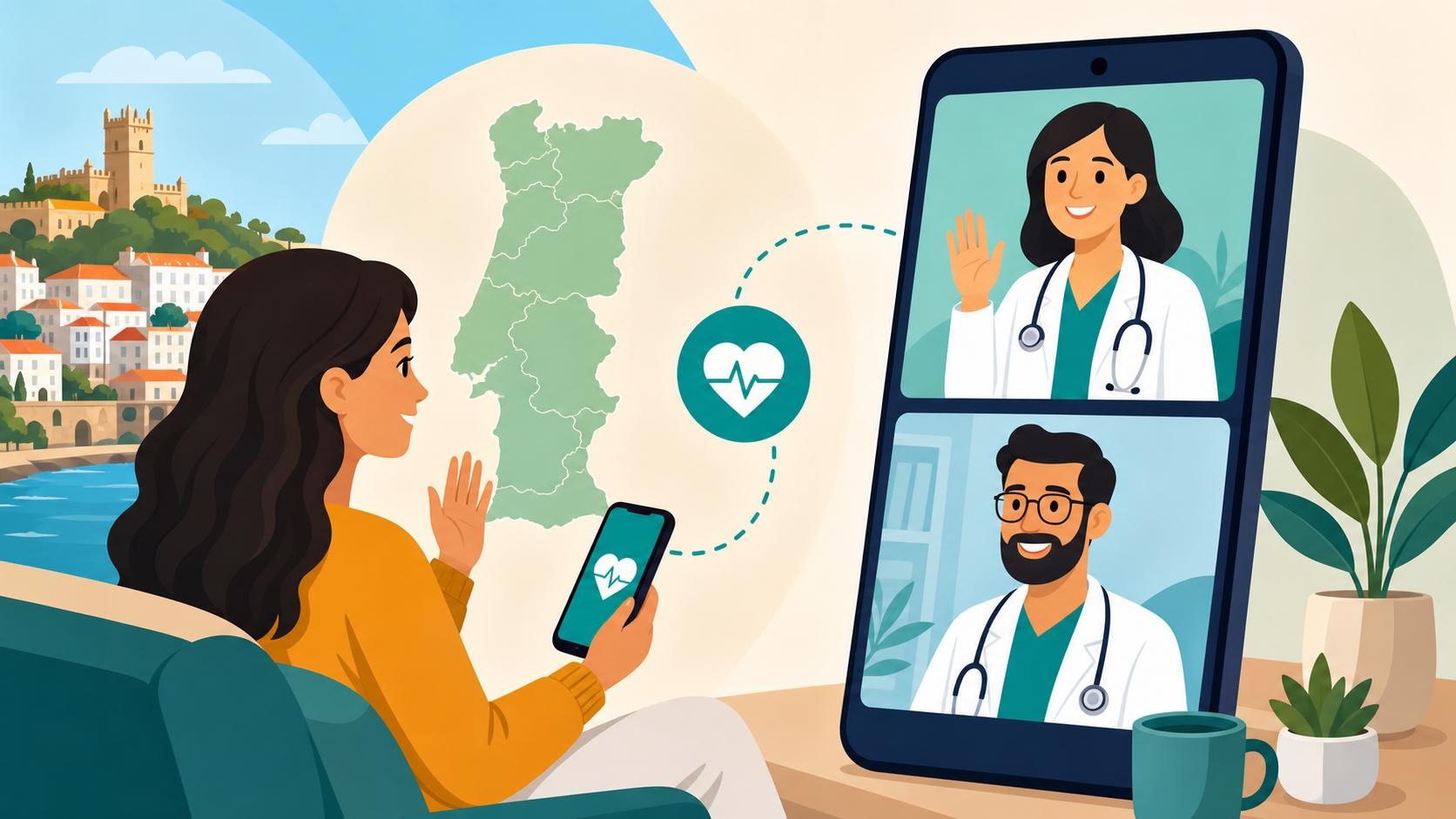
Telehealth and Online Doctors: Using TravelDoctores and Doctorsa
Your throat is on fire on a Sunday night in Lagos, your Centro de Saúde has no family doctor for you, and the queue at the urgências looks like a four-hour ordeal. Telehealth can fill that gap. This guide explains how online doctor platforms such as Doctorsa and TravelDoctores work in Portugal, and how to handle prescriptions, payment and paperwork after the call.
Why Telehealth Matters So Much for Expats in Portugal
I spent my first few months in Portugal in a strange medical limbo. I had a NIF and a rental contract. I was waiting on residency paperwork. I had no número de utente and no idea who to call when a sinus infection flattened me. Many expats go through some version of that limbo, and it is the reason online doctors have become so popular here.
The Gap Between Arriving and Being Registered
The Portuguese public system, the SNS, is genuinely good once you are inside it. Getting inside takes time. You register at your local Centro de Saúde, get your utente number, and then hope to be assigned a médico de família. Each step involves documents, counters and the occasional “volte amanhã.” In the weeks or months in between, you are technically able to use some public services. In practice you can feel locked out, especially if your Portuguese is still at the “bom dia” stage.
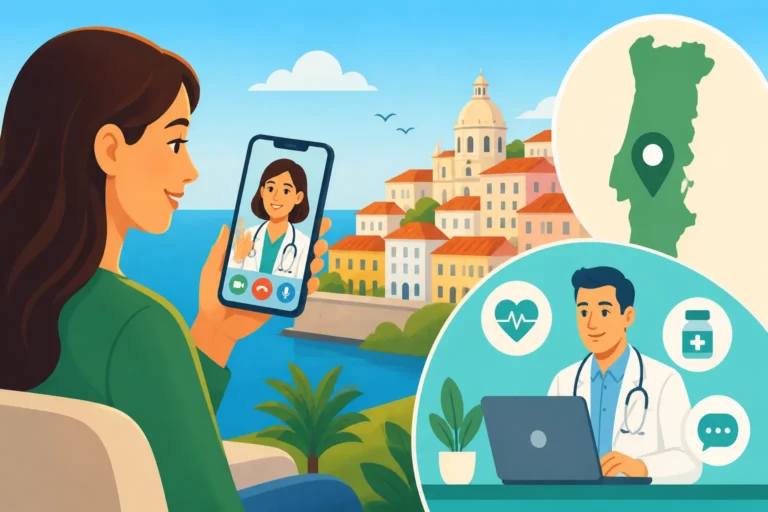
That gap is where telehealth earns its keep. A video consultation with a licensed doctor who speaks your language can deal with the everyday ailments that otherwise ruin a week: a urinary tract infection, conjunctivitis, a flare-up of eczema, a stomach bug picked up from a dodgy marisqueira, or simply needing an expert to say whether a symptom is worth worrying about. For a broad picture of how the public and private pieces fit together, see Public vs Private Healthcare in Portugal: Which One Should Expats Choose?.
Tourists face a sharper version of the same problem. You have no public registration at all, you may be staying in a short-term rental in Alfama or a villa outside Tavira, and the nearest hospital may be a confusing taxi ride away. If you are visiting and wondering whether the public route is open to you, Can tourists walk into a Centro de Saúde if they feel sick? covers that situation in detail.
When Your Centro de Saúde Cannot See You
Even once you are registered, the SNS has well-known capacity problems in some regions. Parts of Greater Lisbon and the Algarve in particular have more patients than family doctors. You might be registered as a utente but listed “sem médico de família,” which means you have no named GP. You can still get consultations through other routes, but booking them can feel like a part-time job.
Picture this. You are a remote worker in Almada and you wake up with a painful, swollen eye. You call your Centro de Saúde at opening time, the line is busy, and when you finally get through the receptionist explains in rapid Portuguese that there are no slots today. Your options are the hospital emergency department, a private clinic, or a video call from your sofa within the hour. For something like conjunctivitis, the video call is often the most sensible choice.
None of this means telehealth replaces the SNS. It works best as a pressure valve. Use it for the quick, common, low-risk problems, and keep the public system for continuity of care, chronic conditions and anything serious. If you are stuck without a family doctor, the guide What to do if you don’t have a family doctor but need a public consultation walks through the public alternatives.
What a Video Consultation Can and Cannot Handle
Before you book anything, be clear about what a doctor can realistically do through a phone screen. A good online doctor can take a detailed history, look at a visible rash or an inflamed eye, review your existing medication and allergies, give advice, issue a prescription where appropriate, and tell you plainly when you need to be seen in person. That last point matters more than people expect.
What a video call cannot do is listen to your chest, feel your abdomen, take blood or run an X-ray. If you describe crushing chest pain, sudden weakness on one side of the body, severe difficulty breathing, heavy bleeding or a head injury with confusion, a responsible online doctor will tell you to hang up and call 112. That is the system working properly, not failing. For how emergencies are handled here, read Emergency Medical Care in Portugal: Calling 112 and Going to the Hospital.
There is also a middle ground of problems that might need an examination: ear pain in a toddler, a sprained ankle that could be a fracture, abdominal pain that will not settle. In these cases some platforms offer an in-person visit to your home or hotel instead of a video call, which is where services like Doctorsa become particularly useful.
How Doctorsa Works for Expats and Visitors
Doctorsa is an online booking platform built around travelers and international residents. It connects you with doctors who can see you by video or, depending on location, in person at your accommodation. It is aimed at people who do not want to deal with a foreign health system in a foreign language, which describes a lot of us during our first year in Portugal.
Booking a Consultation Step by Step
The process is designed to be quick, and that is a relief when you feel awful. The general flow looks like this:
- Open the Doctorsa website or app and choose your location in Portugal, for example Lisbon, Porto or an Algarve town.
- Select the type of consultation you need, either a video call or an in-person visit where it is offered in your area.
- Browse available doctors, paying attention to the languages they speak and their specialty.
- Pick an available time slot and enter your details, including a short description of your symptoms.
- Pay through the platform at the time of booking, using the card details requested.
- Join the video call at the scheduled time, or wait for the doctor to arrive at your address.
- Receive any prescription, medical report or invoice afterward through the channel the platform uses.
Pricing depends on the type of visit, the time of day and whether the doctor travels to you. Home and hotel visits generally cost noticeably more than video consultations, and out-of-hours care usually carries a premium. Check the current figures on Doctorsa’s own booking page before you confirm, because the price is normally shown at checkout.
Video Calls Versus Home and Hotel Visits
The video option suits problems where seeing you and talking to you is enough: a sore throat with no breathing trouble, a suspected UTI, a rash, a medication question, travel-related diarrhoea that is not settling. You need a stable connection, a quiet space and decent light so the doctor can actually see what you are describing. If you are staying somewhere with patchy Wi-Fi, a local SIM or eSIM can save the appointment. Mobile Data and eSIMs for Travel in Portugal explains the options.
The in-person option suits people who are too unwell to travel, parents with a feverish child at night, older relatives visiting from abroad, and anyone where an examination could change the diagnosis. A doctor arriving at your hotel in Chiado with a medical bag, an otoscope and a stethoscope is often far less stressful than a night in a hospital waiting room. If you are curious how house calls fit into Portuguese medicine more broadly, Do Portuguese doctors make house calls (Médico ao Domicílio)? covers the traditional and private options.
Pros and Cons of Using Doctorsa
From my experience and from friends who have used it, these are the main trade-offs:
- Speed is the big advantage. You can often book a same-day consultation without phoning anyone.
- Language matching is straightforward, and that matters when you need to describe symptoms precisely.
- In-person visits at your accommodation are a real lifeline for families and less mobile travelers.
- Costs are paid out of pocket up front, which can add up if you use it often.
- Availability varies by region. Cities and tourist hubs are better covered than the rural interior.
- It is episodic care. The doctor will not know your history next time unless you bring your records.
How TravelDoctores Works and Where It Fits
TravelDoctores operates in a similar space: helping visitors and international residents reach a doctor quickly without navigating the public system. The core idea is the same as any traveler-focused medical platform. You describe what is wrong, you are matched with an available doctor, you pay privately, and you get advice and, where appropriate, treatment.
The Booking Experience
Booking typically follows a familiar pattern:
- Visit the TravelDoctores site and select the kind of help you need.
- Provide your location in Portugal and your contact details.
- Describe your symptoms and any relevant medical history, medication or allergies.
- Choose or confirm the consultation format offered for your area.
- Complete payment as requested by the platform.
- Attend the consultation and save every document you receive afterward.
Coverage areas, visit types, opening hours and prices can all change, and the specifics differ between platforms. Read the TravelDoctores pages on what is offered where you are staying before you rely on it. If you are planning a stay somewhere quieter than Lisbon or Porto, confirm availability before you arrive rather than in the middle of a fever.
Matching Language and Specialty
The biggest practical benefit of any traveler-focused platform is seeing someone who speaks your language fluently. My European Portuguese is decent now, but describing “a dull ache that radiates when I lie on my left side” is a level of nuance I still prefer to handle in English. A misunderstanding in a medical consultation can mean a wrong medication or a missed warning sign.
When booking, look at the language listed for each doctor and, where available, their specialty. A general practitioner is fine for most short-term problems. If you have a specific need, such as a child’s earache or a skin issue, it is worth checking whether a pediatrician or dermatologist is available. For mental health needs, a general online consultation can help in a crisis. Ongoing support usually works better with a dedicated therapist; see Finding a therapist in Portugal who understands expat culture shock.
Pros and Cons of Using TravelDoctores
These are the trade-offs to weigh:
- It is built for people without SNS access, so it works on day one of a trip or a move.
- The process does not require a Portuguese phone number or any public registration.
- Being matched with a doctor who speaks your language reduces the risk of miscommunication.
- You pay privately, and the cost structure depends on the visit type and timing.
- Coverage may be uneven outside major urban and tourist areas.
- As with any one-off consultation, follow-up depends on you keeping your own records.
Comparing Your Online Doctor Options in Portugal
Doctorsa and TravelDoctores are not your only remote options. Depending on your status, you may also have the public SNS 24 service and whatever virtual care comes bundled with your insurance. Knowing which to try first saves money and frustration.
Side-by-Side Comparison of Remote Care Routes
| Option | Who it suits best | Language | Prescriptions | Cost shape |
|---|---|---|---|---|
| SNS 24 helpline | Residents and visitors who need triage and guidance | Primarily Portuguese, with some English support depending on availability | Triage and referral rather than routine prescribing | Call charged at the same rate as a landline call |
| Doctorsa | Tourists, new arrivals and families wanting fast private care | Doctors listed by spoken language | Doctor decides case by case | Private fee paid at booking, higher for in-person and out-of-hours visits |
| TravelDoctores | Travelers and international residents without SNS access | Language shown when matching doctors | Doctor decides case by case | Private fee paid to the platform, varies by visit type |
| Insurer virtual doctor | Expats with an international or Portuguese private health plan | Depends on the insurer’s service | Depends on the insurer’s partner doctors | Often included in or added to the policy, check your documents |
| Private clinic in person | Anyone needing an examination, tests or imaging | Varies, larger hospital groups often have English-speaking staff | Full prescribing | Private consultation fee, possibly reimbursed by insurance |
SNS 24 as the Public Baseline
Before paying anyone, remember that Portugal has its own national health line. As of October 2026, the SNS 24 helpline number is 808 24 24 24. Clinical triage runs 24 hours a day, and calls cost the same as a call to a landline. A trained professional assesses your symptoms and directs you to the right level of care: self-care at home, a health centre appointment, or the emergency department.
For residents, SNS 24 is often the smartest first call. Being triaged through the line can make your path into the public system smoother, and the advice is free beyond the cost of the call. The full guide to the service is at SNS 24 Helpline (808 24 24 24): Triage, Advice, and Sick Notes.
The main limitation for newcomers is language. You may reach someone comfortable in English, but that is not guaranteed, and the menu prompts are in Portuguese. If you are struggling, have a few key phrases ready, or keep a friend with good Portuguese on standby. Private platforms solve the language problem, but you pay for the convenience.
Insurer-Linked Virtual Doctors
If you hold private health insurance, check your policy before booking anything else. Many international and Portuguese plans now include some form of remote consultation, either through their own app or through a partner. International plans such as Cigna Global may offer virtual doctor access depending on the plan and options you chose, so look in your policy documents or member app for how to reach it and whether any cost applies.
This route can be much cheaper for you than a separate private platform, because you are already paying premiums. The catch is that insurer services sometimes have their own booking systems, language limits or rules about which doctors you can see. If you are weighing international cover in general, Using Cigna Global or Allianz for international expat healthcare in Portugal compares how those plans work for people living here.
If your insurance does not include telehealth, you may still be able to claim back the cost of a Doctorsa or TravelDoctores consultation as an out-of-network expense. That depends entirely on your policy wording, so keep every invoice. The process for claiming is explained in Navigating Medical Billing and Insurance Reimbursements in Portugal.
Prescriptions, Pharmacies, and Paperwork After the Call
The consultation is only half the job. What happens next, getting the medicine and keeping the paperwork in order, is where expats tend to get tripped up. Here is how it works in practice.
How Electronic Prescriptions Work in Portugal
Portugal uses electronic prescriptions, known as receita sem papel. Instead of a paper slip, you typically receive a text message or email with a prescription number and access codes. You show those codes at any pharmacy, and the pharmacist dispenses the medication. It is efficient once you know the system, and it works without any app. The details are covered in Prescriptions in Portugal: The Receita Sem Papel System.
Whether an online doctor can issue a Portuguese electronic prescription depends on their registration. A doctor licensed to practise in Portugal can generally prescribe through the Portuguese system. A doctor registered elsewhere may only be able to give you a foreign prescription or a written recommendation, which Portuguese pharmacies may not accept. Before you pay, ask the platform directly whether its doctors issue prescriptions that Portuguese pharmacies can dispense.
Before prescribing, the doctor should ask about your current medication, allergies, pregnancy status and existing conditions, and check for interactions and contraindications. If the doctor on your call does not ask these questions, volunteer the information anyway. Have a list of everything you take, including supplements. Some antibiotics and other medicines interact with common supplements, and many expats order those from abroad through sites like iHerb, so mention them too.
Getting Medication at a Portuguese Pharmacy
Portuguese pharmacies, marked by the green cross, are staffed by highly trained pharmacists. They are often your best first stop for minor problems, before any doctor. Many medicines that are freely available elsewhere are kept behind the counter here, and prescription-only rules are taken seriously.
Antibiotics are the big example. You cannot simply ask for amoxicillin because you recognise a familiar infection. A doctor has to prescribe it, and this is exactly where an online consultation helps. A short video call can lead to a legitimate prescription for a straightforward infection. The reasons behind the rules are explained in Antibiotics rules in Portugal: Why you absolutely need a doctor’s prescription.
If your consultation happens late at night, you will need a pharmacy that is open. Every area has a rota of duty pharmacies, the farmácias de serviço, that stay open outside normal hours. A notice on the door of any closed pharmacy usually lists the nearest one on duty. For the practical steps, see What is a Farmácia de Serviço and how to find one open at 2 AM. If you are arriving with an existing prescription from home, Can I use a US or UK medical prescription at a Portuguese pharmacy? explains what will and will not be accepted.
Receipts, Reimbursement, and Sick Notes
After any private consultation, ask for a proper invoice, a fatura, that includes your NIF if you have one. In Portugal, health expenses linked to your NIF can count toward deductions on your annual tax return, and an invoice without your NIF is much harder to use. It is also the document your insurer will want if you claim.
Ask for a short written medical report as well, especially if you have a chronic condition or expect to follow up later. A summary of your symptoms, the diagnosis and any treatment makes the next doctor’s job easier, whether that is a family doctor at the Centro de Saúde or a specialist at a private hospital.
Sick notes for employers are a separate issue. If you work for a Portuguese employer and need time off, your employer and Segurança Social will need specific documentation. Short absences can be covered by a self-declaration of illness through SNS 24, subject to its conditions. Longer absences usually require a formal certificate. Before booking a private online consultation for this purpose, ask the platform whether its doctors can issue documentation your employer accepts. The full process is set out in How to get a sick note (Baixa Médica) from a doctor for your employer.
Real-World Scenarios and Practical Tips
General advice only goes so far. Here are two situations I have either lived through or watched friends handle, and how telehealth fits into each.
Scenario One: A Tourist With a Urinary Tract Infection in the Algarve
Sarah is on holiday in Albufeira with her partner when the familiar burning starts on the second evening. She knows exactly what it is because she has had UTIs before. She has no Portuguese health registration and no wish to spend her holiday in a hospital corridor.
She books a video consultation through a traveler-focused platform, describes her symptoms in English, and confirms she is not pregnant and has no fever or back pain. The doctor agrees that a simple UTI is likely, prescribes an appropriate treatment through the Portuguese system, and tells her to seek in-person care if she develops a fever or flank pain. She walks to the nearest pharmacy, shows her codes, and is back at dinner within the evening.
The lesson is that for a well-understood, low-risk problem in an otherwise healthy adult, a video consultation is fast and appropriate. The warning signs the doctor gave her, fever and back pain, were the whole point of seeing a professional rather than guessing.
Scenario Two: A New Arrival Whose Medication Is Running Out
Tom arrives in Porto on a D8 visa with a two-month supply of his blood pressure medication and assumes he will sort out a local GP quickly. Seven weeks later he is still waiting for his utente number, and his pills are nearly gone.
He books an online consultation, explains his history, and shares his existing prescription and recent blood pressure readings. The doctor can bridge the gap with a short-term prescription, provided they are licensed in Portugal and comfortable that his condition is stable. The doctor also recommends he push forward with SNS registration, because long-term monitoring of a chronic condition belongs with a regular doctor.
The lesson is to plan ahead. Telehealth is an excellent bridge, but a bridge needs two ends. Start your SNS registration early, carry a printed summary of your medical history, and see Managing Chronic Illnesses: Diabetes and Hypertension Care in Portugal for setting up ongoing care.
Making the Most of a Video Consultation
Whichever platform you use, a few habits make online consultations far more useful:
- Write down your symptoms before the call, including when they started and what makes them better or worse.
- Have your medication list, allergies and any relevant medical history in front of you.
- Take your temperature beforehand if you have a thermometer, and note the reading.
- Sit somewhere quiet with good light, and test your camera and microphone first.
- Have your NIF ready so the invoice can be issued correctly.
- Ask directly how any prescription will be sent and whether Portuguese pharmacies can dispense it.
- Ask what warning signs should make you seek in-person care, and write them down.
- Save every document you receive in one folder on your phone.
One final thought from someone who has been there. Being sick in a country where you do not yet speak the language is lonely and frightening in a way people at home rarely understand. Telehealth does not fix the SNS waiting lists or the paperwork, but it does mean you are never completely on your own. Keep a platform such as Doctorsa or TravelDoctores bookmarked, save the SNS 24 number in your phone, know where your nearest duty pharmacy is, and you will handle the next Sunday night sore throat with far less panic than I did.
Disclaimer
This article is for general informational purposes only and does not constitute professional advice. Laws, prices and regulations vary by location and change over time. Consult a qualified professional for guidance on your specific situation.