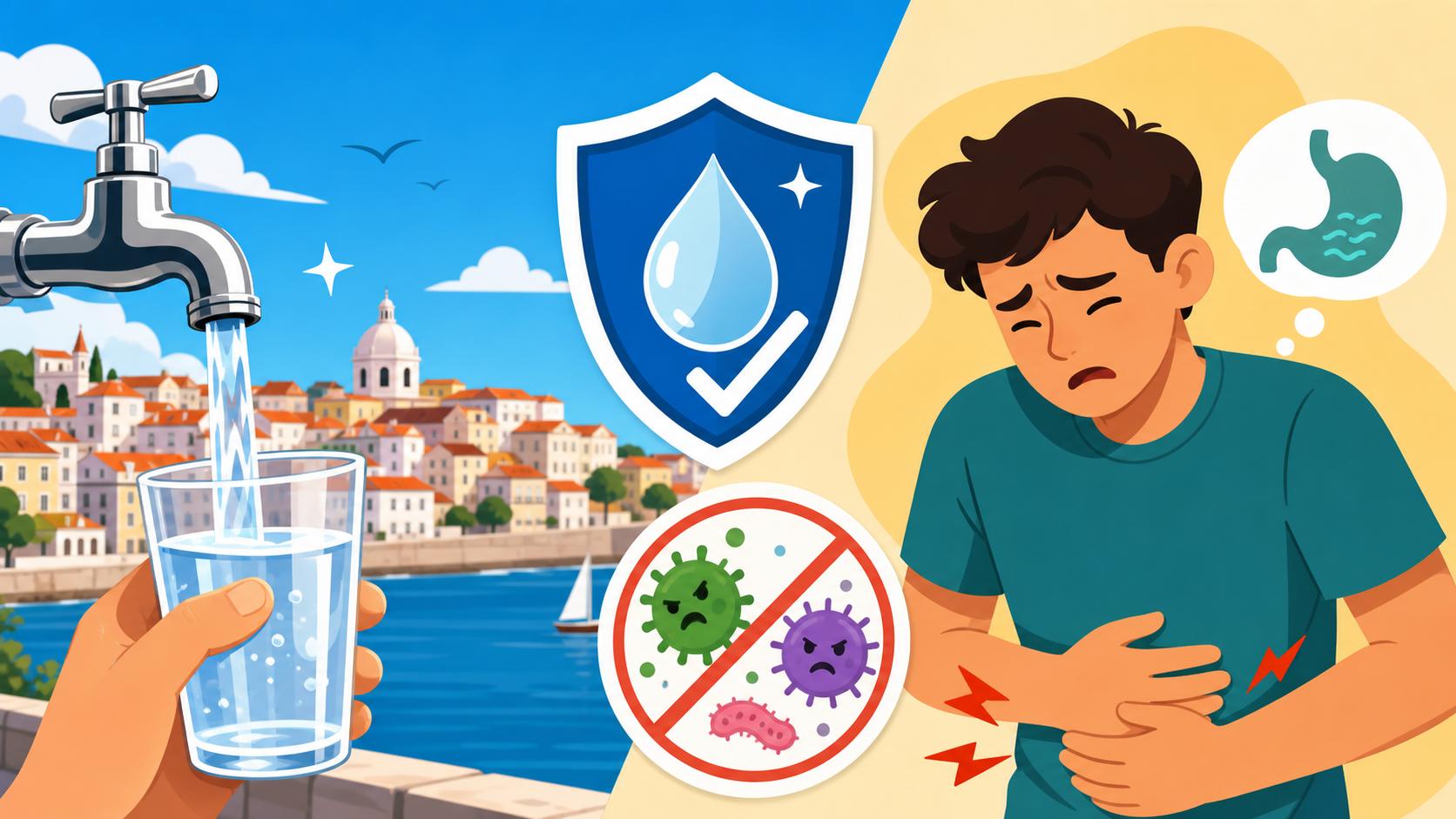
Water safety and stomach bugs: Do expats get sick from Portuguese tap water?
The fear of spending your first week in a beautiful new Lisbon apartment huddled in the bathroom is a real anxiety for many newcomers. I remember my first month in the Silver Coast, strictly using bottled water for everything—even ice—because I was terrified of the local tap. This guide settles the debate on Portuguese water safety once and for all, explaining why stomach bugs happen and how to protect your gut health.
The Official Verdict on Portuguese Tap Water
When you first arrive in Portugal, usually under the stress of completing your Health Insurance Requirements for the D7 and D8 Visa Application, the last thing you want to worry about is whether the water coming out of your kitchen sink is going to ruin your week. The objective, data-driven answer is that Portuguese tap water is safe to drink. According to ERSAR (Entidade Reguladora dos Serviços de Águas e Resíduos), the regulatory body that oversees water and waste services, the percentage of "safe water" (water that meets all legal quality standards) in Portugal has consistently stood at over 99% for years. This places Portugal on par with most other Western European nations.
However, "safe" and "palatable" are two very different things. While the water is free from dangerous pathogens like cholera or dysentery, it is treated with chlorine to ensure it stays sterile as it travels through miles of piping. In many urban areas, particularly in older parts of Lisbon or Porto, the chlorine scent can be quite strong. For an expat who is used to well water or highly filtered mountain water from back home, this chemical profile can be off-putting. Furthermore, the mineral content—specifically the hardness of the water—varies wildly across the country, which is often the true culprit behind the "stomach bugs" expats report during their first few months of residency.
If you are particularly sensitive to chemical tastes or have a history of digestive issues, you might find yourself initially reaching for bottled water. While this is a fine temporary solution, it is worth looking into long-term filtration options. For those who want to ensure their health is managed by professionals who understand international standards, many expats choose to maintain a policy with Cigna Global to ensure they have access to the best private diagnostics if digestive issues become chronic.
Why Expats Often Suffer from The Change
It is a common story in expat Facebook groups: "I drank the tap water in my new rental and now I’ve been sick for three days." Is it the water quality? Usually, it is a phenomenon known as "the change of environment." Even when water is bacterially safe, your gut microbiome is a delicate ecosystem finely tuned to the specific mineral balance and microbial "signature" of your home country. When you move to Portugal, you are introducing a different concentration of calcium, magnesium, and sodium into your system.
This mineral shift can act as a mild laxative. If you are moving from a "soft water" area to a "hard water" area like the Algarve, the high magnesium content can trigger significant digestive upset that feels exactly like a stomach bug. Furthermore, the transition period of moving is inherently stressful. Stress, combined with new food oils, different types of wine, and a new mineral profile in the water, creates a perfect storm for the "Portuguese tummy."
In most cases, this is not a medical emergency, but it can be incredibly inconvenient. If you do find yourself feeling under the weather, you can visit a local apothecary for relief. Learning about Pharmacies and Medication in Portugal: Prescriptions and OTC Drugs is essential for every newcomer, as the pharmacists here are highly trained and can often provide over-the-counter solutions for "viajante" (traveler) stomach issues without you needing a doctor’s appointment. To proactively support your gut during this transition, many of us order high-quality probiotics from iHerb to help reinforce our internal defenses against the shift in local water chemistry.
Infrastructure and the Problem of Old Piping
While the water leaving the treatment plant is world-class, the journey it takes to reach your glass can be problematic. Portugal is famous for its historic charm, but that charm often includes plumbing that hasn't been updated in fifty years. In neighborhoods like Alfama in Lisbon or Ribeira in Porto, the internal pipes of many "renovated" buildings may still be made of galvanized steel or, in very rare cases, lead.
If the water sits in these old pipes overnight, it can pick up a metallic taste or even sediment. This is why some expats report getting sick while their neighbors in a new-build apartment complex are perfectly fine. It’s not the city’s water; it’s the building’s delivery system. If you are concerned about the pipes in your building, it is standard practice to let the water run for 30 to 60 seconds in the morning before using it for drinking or cooking.
For those living in rural areas, you might not be on the municipal grid at all. Many country homes rely on a "furo" (a borehole or well). If you are using well water, the 99% safety statistic from ERSAR does not apply to you. You are responsible for your own testing. I highly recommend taking a sample to a local laboratory (laboratório de análises clínicas) once a year to check for agricultural runoff or bacterial contamination. If you are navigating the system for the first time and aren't sure where to go, Finding Doctors and Specialists in Portugal: English-Speaking Medical Care can help you find a practitioner who can recommend local labs for water testing.
| Region | Water Hardness | Typical Source | Known Issues |
|---|---|---|---|
| Lisbon | Medium/Hard | Surface water & Aquifers | Chlorine taste in older districts |
| Porto | Soft | Surface water (Douro) | Very little mineral buildup |
| Algarve | Very Hard | Aquifers & Desalination | High calcium; scale buildup in kettles |
| Alentejo | Medium | Reservoirs/Dams | Seasonal taste changes in summer |
| Madeira | Soft | Mountain springs (Levadas) | Generally considered the best tasting |
Managing Gut Health and Prevention Strategies
To avoid the frustration of a stomach bug, you should treat your transition to Portuguese water as a gradual process. Start by using a high-quality charcoal filter jug (like Brita) or installing an under-sink reverse osmosis system. This removes the heavy chlorine scent and many of the minerals that can cause digestive distress. Many expats find that after six months, they can transition away from filters as their bodies adapt, but others prefer the peace of mind that filtration provides.
Supplementation is also your friend. Using iHerb to source specific strains of probiotics like Saccharomyces boulardii can be a game-changer for preventing traveler-style diarrhea. This is something I wish I had known before I spent my first Portuguese Christmas feeling miserable. Additionally, keep an eye on your hydration levels. The Portuguese sun is stronger than many realize, and what feels like a "stomach bug" is sometimes actually mild heatstroke or dehydration.
If your symptoms persist for more than 48 hours, or if you develop a fever, you should not try to tough it out. You should immediately call the SNS 24 Helpline (808 24 24 24): Triage, Advice, and Sick Notes. This is a free service where nurses can speak to you in English and tell you if you need to go to the hospital. If you have private insurance like Cigna Global, you can often bypass the long waits at the public hospital and go directly to a private clinic like CUF or Hospital da Luz. Understanding the difference in service is key, so make sure to read up on Public vs Private Healthcare in Portugal: Which One Should Expats Choose? to decide which path is right for your family.
Long-term Adjustment and Medical Support
Over time, most expats stop noticing the water at all. You’ll find yourself ordering a "copo de água" (glass of tap water) at a café without a second thought. But during that first year, having a safety net is vital. Whether it’s knowing How to find a Farmácia de Serviço and how to find one open at 2 AM for a late-night electrolyte run or having your Registering with the Centro de Saúde: Getting Your SNS Número de Utente paperwork finished, preparation is the best cure for anxiety.
If you do end up in a situation where you need professional medical intervention due to a severe stomach infection (which is rare but possible if you consume contaminated well water), knowing how to handle the administrative side is just as important as the medicine. Make sure you are familiar with Navigating Medical Billing and Insurance Reimbursements in Portugal so you aren't hit with unexpected costs during a health crisis.
For the vast majority of us, the "stomach bug" mystery is simply a combination of new minerals, different food, and the stress of a massive life move. By using a filter, taking your probiotics from iHerb, and perhaps keeping a high-quality international insurance plan like Cigna Global in your back pocket, you can focus on enjoying the stunning views and incredible culture of Portugal rather than staring at the walls of your bathroom. If an emergency does strike, remember that Emergency Medical Care in Portugal: Calling 112 and Going to the Hospital is there for everyone, regardless of their residency status.
Disclaimer
This guide is provided for informational purposes only and does not constitute professional medical advice, diagnosis, or treatment. Always seek the advice of your physician or another qualified health provider with any questions you may have regarding a medical condition. Water quality can change based on local council maintenance; always check with your local Camara Municipal for the most recent water quality reports in your specific area. Use of the mentioned brands like Cigna Global or iHerb is at the discretion of the reader.