Portuguese greeting etiquette: When to use Beijinhos vs Handshakes
Disclosure: This article contains affiliate links. If you buy through them, we may earn a commission at no extra cost to you. Read our full disclosure.
Walking into a dinner party in Lisbon and freezing because you do not know whether to lean in for a kiss or extend a hand is a rite of passage for every newcomer. I remember my first week in Porto when I nearly head-butted a neighbor because I leaned the wrong way. This guide breaks down the nuances of Portuguese greeting etiquette to save you from social awkwardness and help you navigate these beautiful, albeit confusing, cultural waters.
Understanding the Foundation of Portuguese Social Interaction
The first thing you will notice when you step off the plane and activate your Airalo eSIM to find your way to your new home is that the Portuguese are a deeply warm but fundamentally polite people. Greetings are not just a "hey" as you pass someone in the hallway; they are a vital social lubricant that acknowledges the person’s presence and status. In many ways, the greeting is more important than the conversation that follows. It sets the tone for the entire interaction, whether you are meeting a potential landlord to discuss Portuguese lease contracts (Contrato de Arrendamento): What to Look For or simply acknowledging a clerk at the supermarket.
There is a subtle hierarchy at play in Portuguese society that influences how you say hello. While the younger generation is moving toward a more casual approach, the traditional standards of respect remain strong. You will often hear people addressed as "Senhor" or "Senhora" followed by their last name, or even their professional title like "Doutor" or "Engenheiro." This level of formality is closely tied to the physical greeting. You wouldn't typically offer two kisses to someone you are addressing with such formal titles unless you have a long-standing personal relationship. Understanding these boundaries is a key part of Expat life hacks: Never rush a coffee, and other daily cultural adjustments that will make your transition much smoother.
Physicality in Portugal is more pronounced than in Northern Europe or North America, but it is highly regulated by unspoken rules. Eye contact is essential; looking away while shaking hands or kissing is seen as dismissive or untrustworthy. You should also be prepared for a certain amount of "close talk." Portuguese people tend to stand a bit closer to one another than Americans or Brits might be comfortable with. This proximity is a sign of engagement and friendliness, not an invasion of personal space. If you find yourself in a Lisbon Neighborhood Guide: Best Areas for Expats and Digital Nomads meeting neighbors for the first time, embracing this closeness will help you blend in much faster.
The Art of the Beijinhos: Two Kisses or One
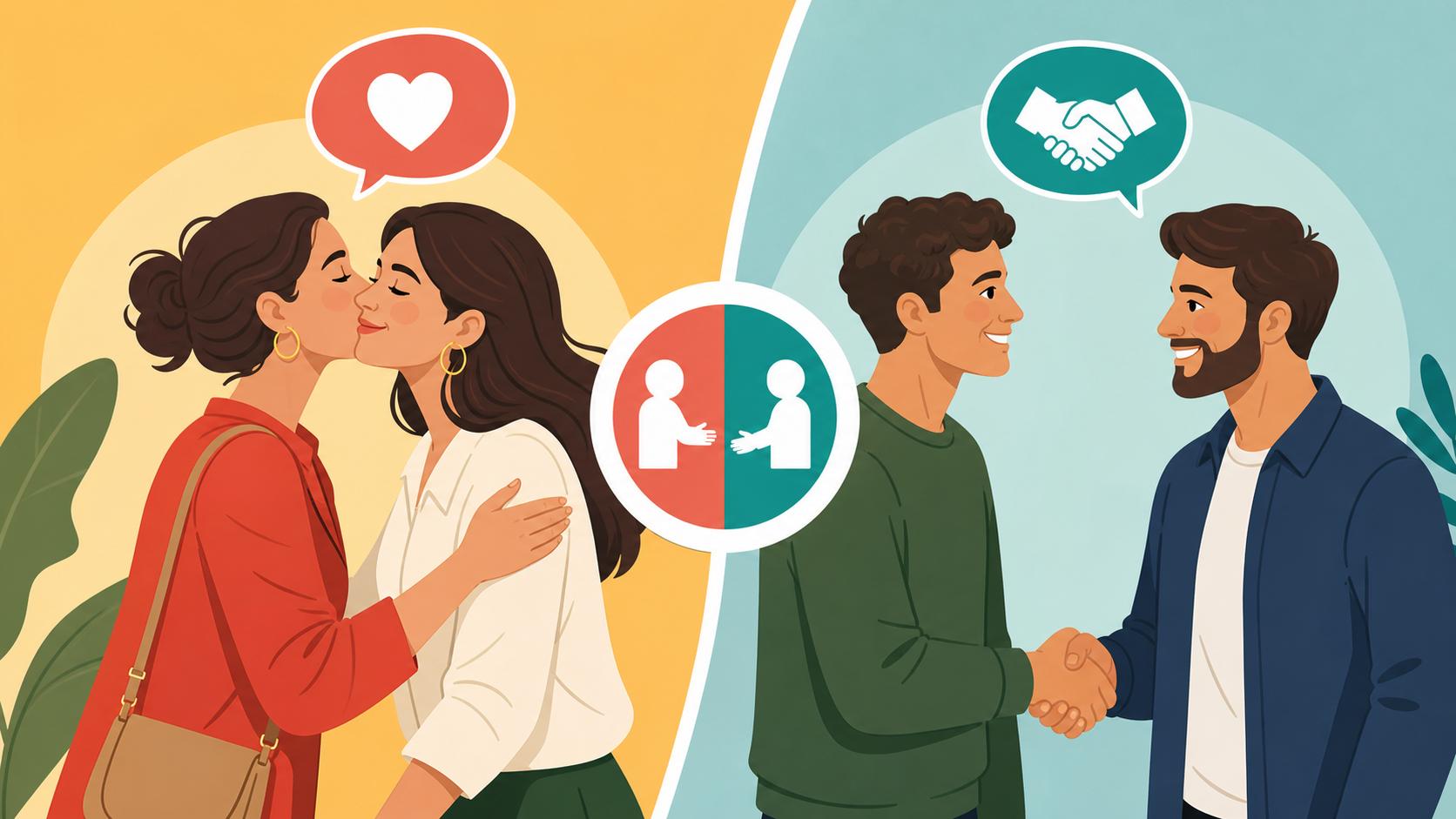
The beijinhos (little kisses) are the most iconic part of Portuguese greeting culture, and also the source of the most "expat panic." The standard rule across mainland Portugal is two kisses, starting with the right cheek. This means you lean to your left so your right cheeks touch first. I cannot emphasize this enough: it is an "air kiss." You are not actually planting your lips on a stranger’s skin. You touch cheeks and make a light kissing sound with your lips. If you actually kiss the skin, it can feel overly intimate and a bit strange for the other person.
The gender dynamics of the beijinho are specific. Women kiss women, and women kiss men. Men, however, generally do not kiss other men unless they are family members or extremely close, lifelong friends. For two men who are meeting for the first time or who are casual acquaintances, a handshake is the absolute gold standard. If you are a man and you lean in to kiss another man you just met at one of the Making Friends and Networking in Portugal: Expat Groups and Meetups, expect a moment of visible confusion. However, if you are a woman, be prepared to give two kisses to almost everyone you meet in a social setting, regardless of their gender.
Timing is everything when it comes to the beijinho. You do not kiss the person at the post office or the pharmacist. You save the kisses for social introductions or when visiting someone's home. If you have just moved into a new apartment found through Uniplaces and your landlord introduces you to their spouse, two kisses are appropriate. However, in a professional environment, the rules shift toward the handshake. If you are unsure, wait for the Portuguese person to lead. They are generally very aware of foreign "stiffness" and will often wait to see if you extend a hand first before they lean in for the cheeks.
Professional and Formal Greetings: Handshakes and Beyond
In the workplace or formal business meetings, the handshake reigns supreme. This is true for all genders. A Portuguese handshake should be firm but not aggressive. It is usually accompanied by a polite "Muito prazer" (Much pleasure/Nice to meet you). If you are navigating Corporate Culture in Portugal: Hierarchy, Dress Code, and Meetings, you will find that the physical greeting remains consistent throughout the relationship until a certain level of personal friendship is established. Even then, in the office, the handshake is the safest bet to maintain professional decorum.
Greeting a group of people requires a bit of logistical planning. If you walk into a room with six people, it is traditionally expected that you greet each person individually. This can feel like it takes forever, especially if everyone is doing the two-kiss routine. However, simply waving to the room and saying "Olá" to the collective is often seen as a bit cold or rushed. If the room is very crowded, you can get away with a general greeting, but if you are sitting down for a meal or a meeting, take the time to go around the table. It shows that you value each individual presence.
Digital greetings have their own set of rules as well. When emailing or messaging, the formality usually starts high and drops as the relationship develops. You might start an email with "Caro/a" (Dear) and end with "Atentamente" (Sincerely). As you become more familiar, this might shift to "Bom dia" and "Cumprimentos" (Regards). If you are ordering things like household essentials from Amazon Spain, your interactions with customer service will stay very formal, but once you know your local delivery driver, a friendly "Bom trabalho" (Good work/Have a good shift) is a great way to build rapport.
Practical Scenarios: A Greeting Cheat Sheet
To help you visualize how this works in daily life, I have put together a table of common scenarios you will encounter while living in Portugal. This should serve as a quick reference when you are heading out the door.
| Scenario | Greeting Type | Verbal Accompaniment |
|---|---|---|
| Meeting a new neighbor in the elevator | Nod or Handshake | "Bom dia / Boa tarde" |
| Introduced to a friend's friend (Social) | Two Kisses (unless two men) | "Olá, tudo bem?" |
| Arriving at a business meeting | Firm Handshake | "Muito prazer" |
| Ordering a coffee at a local café | Verbal only (No touch) | "Bom dia, um café, por favor" |
| Meeting your landlord for the first time | Handshake | "Muito prazer, Senhor/a Name" |
| Visiting a doctor or specialist | Handshake | "Bom dia, Doutor/a" |
| Saying goodbye to a close friend | Two Kisses and a light hug | "Beijinhos, tchau!" |
When you are out and about, especially when Learning European Portuguese: Top Apps, Tutors, and Free Government Classes, you will notice that the verbal part of the greeting is just as important as the physical one. In a café, for example, you would never just walk up and say "Coffee." You must start with "Bom dia" or "Boa tarde." This is a non-negotiable part of the etiquette. For more on the specifics of these interactions, check out our guide on How to order coffee in Portugal: Bica, Meia de Leite, Pingado, and Galão.
Finally, remember that the "embrace" or hug is usually reserved for people you actually have an emotional connection with. Portuguese men will often do a "handshake-hug-pat on the back" combo once they are good friends. For women, a light squeeze of the arm during the two kisses is common among friends. If you are ever in doubt, just remember the "Right cheek first, air kiss only" rule. If you follow that, you will avoid most of the awkwardness. And if you do accidentally head-butt someone? Just laugh it off and say "Desculpe" (I'm sorry). The Portuguese are incredibly forgiving of expats who are genuinely trying to learn their ways.
Disclaimer
The information provided in this article is for general informational purposes only and represents the personal experiences and observations of the author living in Portugal. While we strive to provide accurate and up-to-date cultural advice, social norms and etiquette can vary significantly by region, age group, and specific social context. This guide should not be taken as professional sociological or legal advice. Cultural practices are evolving, and what is standard in 2026 may shift over time. Always observe your immediate surroundings and follow the lead of locals when navigating social interactions.