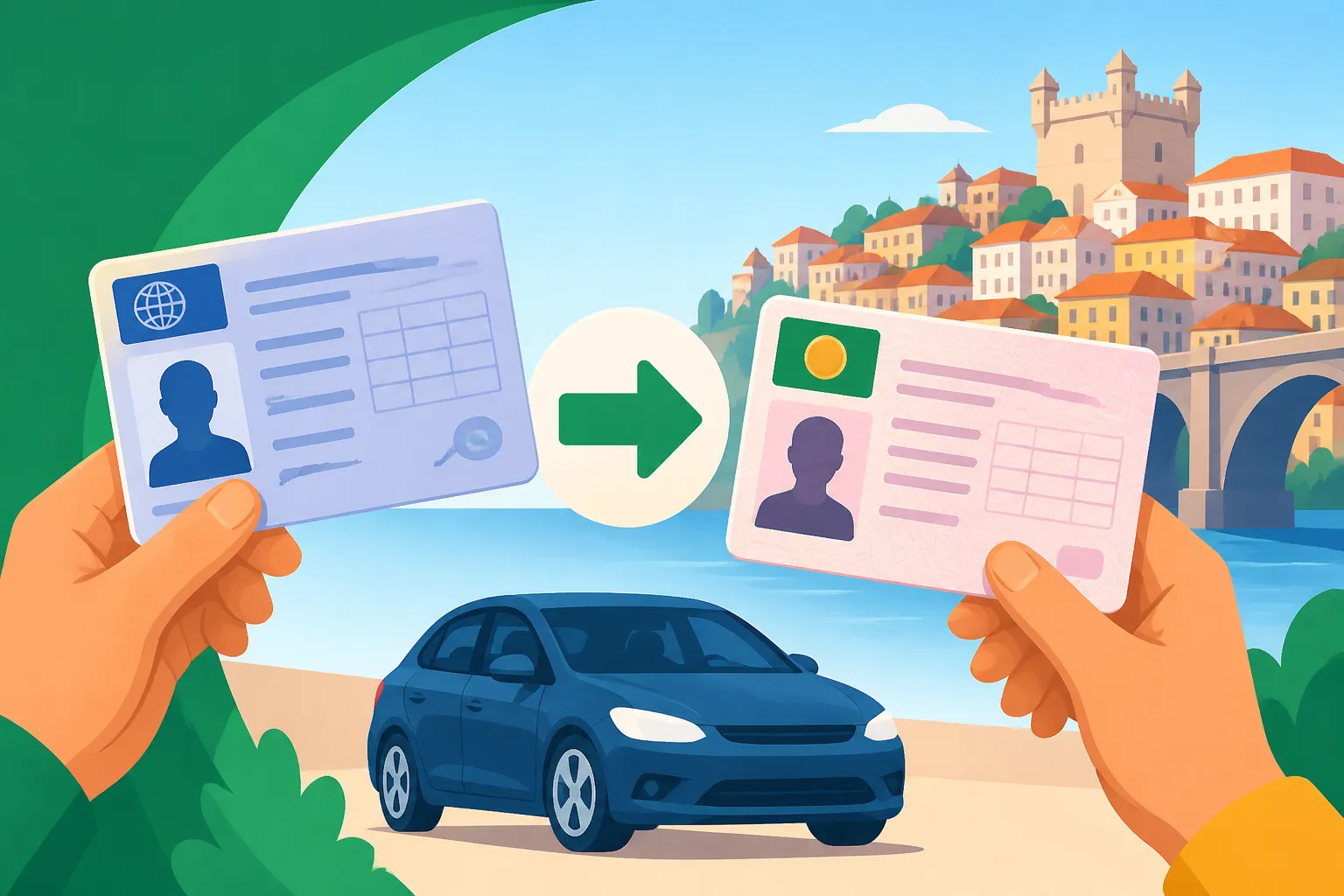
How to Exchange a Foreign Driving Licence in Portugal
Disclosure: This article contains affiliate links. If you buy through them, we may earn a commission at no extra cost to you. Read our full disclosure.
One of the first things that truly sinks in when you move to Portugal is how many administrative hurdles there are, and getting your driver's license sorted is often a top contender for the most confusing. You're trying to settle into a new country, perhaps start a new job, and the last thing you want is to be caught off guard by driving regulations. This comprehensive guide is here to demystify the process of exchanging your foreign driving license for a Portuguese one, making sure you know exactly what to expect and how to prepare.
Navigating the Portuguese Driving License Exchange: Who Needs to Do What?
Understanding whether you need to exchange your foreign driving license, or if simply registering it will suffice, is the crucial first step. The rules vary significantly based on your nationality and the country where your original license was issued. Ignoring these rules can lead to hefty fines or, worse, having your vehicle seized, so pay close attention.
EU/EEA Citizens: Registration, Not Always an Exchange
If you're a citizen of an EU or EEA country (that's Iceland, Liechtenstein, and Norway, in addition to the EU member states), the good news is that your existing driving license is generally recognized throughout Portugal. You won't usually need to exchange it for a Portuguese one immediately. However, there's a vital step you absolutely cannot skip: you must register your foreign driving license with the Instituto da Mobilidade e dos Transportes (IMT) within 60 days of establishing residency in Portugal. This isn't just a suggestion; it's a legal obligation. The registration process is relatively straightforward, usually involving submitting a form, a copy of your license, proof of address, and your NIF (Portuguese tax number).
While you don't have to exchange it, there are specific scenarios where an exchange becomes necessary. For instance, if your EU/EEA license expires while you are a resident in Portugal, you'll need to exchange it for a Portuguese one. This typically involves submitting the expired license and undergoing a medical examination to prove you're still fit to drive. It's often easier to simply exchange it preemptively if your license is nearing its expiry date, just to avoid any last-minute stress.
Non-EU/EEA Citizens: The Mandatory Exchange Deadline
For those of us hailing from outside the EU/EEA, the rules are much stricter, and the process is mandatory. Once you obtain your residence permit in Portugal, you have a non-negotiable window of 90 days to initiate the process of exchanging your foreign driving license for a Portuguese one. Yes, you read that right – 90 days from the date your residence permit is issued, not from when you first arrived in the country. This can be a tight deadline, especially with Portugal's administrative pace, so it's paramount to get started as soon as possible.
Many expats mistakenly believe they can simply drive on their foreign license for a year or until it expires. While you can drive on your foreign license for up to 185 days from the date you entered Portugal, after that, and especially once you become a legal resident, you are expected to have started the exchange process. If you're pulled over after this period without having initiated the exchange, or if your 90-day window for exchange has passed since getting your residency, you could face significant fines, the temporary seizure of your vehicle, and even complications with your insurance. This is one area where the Portuguese authorities don't tend to be very lenient, so don't risk it!
Special Agreements and UK Citizens Post-Brexit
Portugal has specific agreements with certain countries that allow for a more streamlined exchange process, sometimes even waiving the need for a practical driving test. Countries like Brazil, Angola, Mozambique, and Cape Verde, among others, often have reciprocal agreements in place. It's always worth checking the IMT website directly or consulting with an immigration specialist to see if your country benefits from such an agreement.
For our friends from the UK, post-Brexit, the situation became a bit more complicated. UK citizens residing in Portugal before December 31, 2020, had until the end of 2022 to exchange their licenses. For those who became residents after January 1, 2021, the standard non-EU rules apply, meaning you must exchange your license within 90 days of your residency being granted. This also means obtaining a medical certificate and potentially a psychological assessment, depending on the license category and your age. Always check the very latest guidance, as rules can sometimes shift.
Your Step-by-Step Guide to the IMT Application
Now that you know if and when you need to exchange your license, let's dive into the nitty-gritty of the application itself. This is where many expats hit their first real wall of Portuguese bureaucracy, so a methodical approach is your best friend.
The Essential Document Checklist
This is perhaps the most critical part of the entire process. The IMT is notorious for rejecting applications due to missing or incorrect documents, so double-check everything! You'll need both originals and photocopies of most items.
Here’s a general list, but always confirm on the official IMT website or with your local IMT office, as requirements can sometimes have subtle regional differences:
- Your Original Foreign Driving License: This will be surrendered to the IMT during the process.
- Copy of Your Foreign Driving License: Both front and back.
- Portuguese Residence Permit (Título de Residência): Original and copy. This is your proof of legal residency.
- Portuguese Tax Identification Number (NIF): Original and copy. If you haven't sorted this out yet, you'll need to. Learn more about NIF and NISS: How to Get Your Portuguese Tax and Social Security Numbers.
- Proof of Address (Atestado de Residência): This is usually a Junta de Freguesia (local parish council) certificate or a recent utility bill in your name. A rental contract can sometimes suffice, but the Atestado is preferred. For new arrivals, getting stable accommodation is key, and services like Spotahome can help secure longer-term rentals that can then be used for such documentation. For insights into securing your living situation, check out our guide on Renting an Apartment in Portugal: Contracts, Fees, and Tenant Rights.
- Passport or EU/EEA ID Card: Original and copy.
- Medical Certificate (Atestado Médico): Issued by a Portuguese doctor, stating you are physically and mentally fit to drive. We'll dive into this more in the next section.
- Psychological Assessment (Relatório de Avaliação Psicológica): For certain license categories (e.g., heavy vehicles, professional drivers) or if you are over a certain age (often 60 or 70, depending on the license type). Check if this applies to you.
- Two Passport-Sized Color Photos: Recent, with a plain background.
- Sworn Translation of Your License: If your original license is not in Portuguese, French, English, or Spanish, you will need a sworn translation (Tradução Certificada). This must be done by a certified translator in Portugal or by a Portuguese consulate abroad. Don't skip this, as a simple notarized translation from your home country might not be accepted.
- Criminal Record Certificate (Certificado de Registo Criminal): In some cases, especially if your license is from certain non-EU countries, this might be requested. It’s less common for standard passenger car exchanges but be prepared if asked.
Table: Key Documents for Non-EU/EEA Driving License Exchange
| Document Required | Description | Notes |
|---|---|---|
| Original Foreign License | Must be valid. Will be surrendered. | Not required for EU/EEA citizens merely registering their license. |
| Portuguese Residence Permit | Proof of legal residency (Título de Residência). | Mandatory for non-EU/EEA citizens. |
| NIF (Tax Number) | Portuguese Tax Identification Number. | Essential for all administrative processes in Portugal. |
| Proof of Address | Atestado de Residência from Junta de Freguesia, or utility bill/rental contract. | Ensure it's recent and in your name. |
| Passport/ID | Valid identification. | Original and copy required. |
| Medical Certificate | Atestado Médico from a Portuguese doctor. | Required for non-EU/EEA exchanges and for EU/EEA license renewals/exchanges. |
| Psychological Assessment | Relatório de Avaliação Psicológica. | Only for specific license categories or age groups; confirm if applicable. |
| Passport-Sized Photos | Two recent color photos. | Standard requirements. |
| Sworn Translation | If original license is not in PT, EN, FR, ES. | Must be by a certified translator in Portugal or Portuguese consulate. |
Obtaining Your Medical and Psychological Assessments
This is a specific step that often catches expats off guard. Unlike some countries where a simple vision test might suffice, Portugal requires a proper medical examination.
- The Medical Certificate (Atestado Médico): You’ll need to visit a general practitioner (médico) in Portugal. This can be at a private clinic or, if you're already registered with the public health system, your local Centro de Saúde. The doctor will perform a general check-up, including vision, hearing, and a review of your medical history, to confirm you are fit to drive. Be prepared to discuss any pre-existing conditions. The cost for this certificate typically ranges from €20 to €50 at a private clinic.
- The Psychological Assessment (Relatório de Avaliação Psicológica): This assessment is not required for all standard passenger car (Category B) license exchanges. It's usually for higher categories (e.g., C, D, E for trucks, buses, or combinations) or if you are above a certain age (often 60 or 70, but this can vary and should be checked with IMT or your doctor). If required, you'll need to see a psychologist specializing in driving assessments. These can be found through private clinics, and the cost can be anywhere from €50 to €150. Always confirm with the IMT if this is necessary for your specific case before undertaking it.
Booking and Attending Your IMT Appointment
With your documents in hand, the next step is to actually get an appointment with the IMT. This often feels like a test of patience itself.
- Booking the Appointment: IMT appointments are typically booked online via the Portal do Cidadão or directly through the IMT website. Be aware that appointment slots, especially in major cities like Lisbon and Porto, can be booked out for weeks or even months in advance. This is why starting early is absolutely non-negotiable for non-EU citizens. You’ll select your nearest IMT service desk (balcão).
- The Appointment Day: Arrive on time, if not a little early, with all your original documents and photocopies. Even if you've been told you don't need a specific document, bring it if you have it. The administrative staff are thorough, and any missing piece can lead to a rescheduled appointment, pushing your timeline back considerably. During the appointment, your documents will be reviewed, your photograph taken (they have cameras there, but it's good to have spares just in case), fingerprints might be collected, and you'll pay the application fee.
- Language Barrier: While some IMT staff might speak English, it's not guaranteed. If your Portuguese isn't up to snuff, consider bringing a Portuguese-speaking friend or even a professional translator to ensure there are no misunderstandings. This is where having a reliable mobile connection, perhaps with an Airalo eSIM for international data, can be incredibly helpful for quick translations or calling for assistance if needed. If you're looking to improve your language skills, explore resources like Learning European Portuguese: Top Apps, Tutors, and Free Government Classes.
After the Application: What to Expect While You Wait
You've done the hard part: navigated the bureaucracy, gathered documents, and attended your IMT appointment. Now comes the waiting game, which can sometimes be just as frustrating.
Driving Legally During the Processing Period
Once you've submitted your application and paid the fee, the IMT should provide you with a temporary driving permit or a receipt confirming your application is being processed. This document is crucial. It acts as proof that you are legally allowed to drive while your new Portuguese license is being issued. Always carry this receipt with you when driving, along with a copy of your residence permit.
It's important to understand that this temporary document is not a permanent solution and has an expiry date. If your new license doesn't arrive before the temporary permit expires, you may need to contact the IMT to inquire about an extension or the status of your application. Don't assume anything; always confirm your legal standing. The processing times can vary wildly depending on the IMT office and current backlogs, ranging from a few weeks to several months.
Receiving Your New Portuguese Driving License
When it's finally ready, your new Portuguese driving license will typically be sent to your registered address via CTT (the Portuguese postal service). Ensure your address with the IMT is correct and up-to-date. If you move during the waiting period, notify the IMT immediately to avoid your license being sent to an old address.
The new Portuguese driving license will reflect the categories you were qualified for on your foreign license. It will also have a validity period, after which you will need to renew it through a similar process (though usually simpler, as your data will already be in the system). This is generally a standard 10-year validity for most categories, but it decreases with age.
The Fate of Your Original License
What happens to your old, cherished foreign driving license? In most cases, especially for non-EU/EEA licenses, the IMT will retain your original license. They are often obligated to send it back to the issuing authority in your home country. This means you won't get to keep it, so if you want a souvenir, take a picture before you hand it over!
For EU/EEA citizens who choose to exchange their license (rather than just registering it), the IMT will usually keep the original and issue a Portuguese one. If you later leave Portugal and wish to revert to your original country's license, you'll need to check the specific regulations in that country and potentially apply for a new one, as Portugal will have informed your home country that your license was exchanged.
Practical Tips and Common Challenges for Expats
Exchanging a driving license in Portugal isn't just a transaction; it's a mini-adventure in Portuguese bureaucracy. Here are some seasoned expat tips to help you navigate it more smoothly.
Tackling the Costs and Fees Involved
It's tempting to think of this as a free administrative swap, but alas, Portugal's administrative services almost always come with fees. Budget for the following:
- Medical Certificate (Atestado Médico): As mentioned, usually €20-€50.
- Psychological Assessment (if required): €50-€150.
- Sworn Translation (if required): This can vary significantly, from €30 to €100 or more, depending on the translator and the complexity.
- IMT Application Fee: The fee for the exchange itself. This varies but typically falls in the range of €30-€60.
- Photocopies: While seemingly small, these add up, especially if you need to provide multiple sets. Have your documents scanned and saved on your phone or cloud storage, and perhaps print them at home using paper and ink you might have ordered from a service like Amazon Spain.
- Transportation: Don't forget the cost of getting to and from the IMT office and any medical appointments.
For a broader understanding of daily expenses, you might want to read our article on Cost of Living in Portugal 2026: Detailed Budgets for Singles and Families.
Overcoming Language Barriers at the IMT
As much as we all try to learn Portuguese, the specific vocabulary and rapid-fire speech of administrative staff can be intimidating. Don't be shy about needing help.
- Bring a Friend: If you have a Portuguese-speaking friend, ask them to accompany you. Their assistance can be invaluable in understanding instructions, clarifying doubts, and ensuring your application progresses smoothly.
- Use Translation Apps: Have a reliable translation app on your phone. While not perfect, it can help with quick phrases or understanding written forms. Again, reliable internet is key, so consider an Airalo eSIM for seamless connectivity.
- Learn Key Phrases: Even a few basic Portuguese phrases related to your visit can go a long way in showing respect and effort. Phrases like "Eu gostaria de trocar a minha carta de condução" (I would like to exchange my driving license) or "Onde devo assinar?" (Where should I sign?) can be very helpful.
- Be Patient: Remember that the IMT staff deal with countless foreigners. A smile, a polite demeanor, and patience will serve you better than frustration.
What If Your License Expires Mid-Process?
This is a common expat nightmare: you started the process, but your foreign license expires before your Portuguese one arrives. If your country is outside the EU/EEA and your license expires before you receive your Portuguese one, you generally cannot drive. The temporary receipt from IMT proves you applied for the exchange, but your underlying right to drive, derived from your original license, has technically lapsed.
To avoid this stressful scenario:
- Start Early: For non-EU citizens, begin the exchange process as soon as your residence permit is issued, ideally within the first few weeks.
- Check Validity: Ensure your foreign license has ample validity remaining before you move to Portugal. If it's close to expiring, try to renew it in your home country before you apply for residency in Portugal. Renewing a foreign license from abroad can be a bureaucratic headache of its own.
- Communicate with IMT: If you foresee your license expiring, contact the IMT office directly. They might be able to offer guidance, extend your temporary permit, or fast-track your application in exceptional circumstances, though this is not guaranteed.
Driving is an essential part of life for many, whether it's for daily commutes, exploring the beautiful Portuguese countryside, or just getting groceries. Understanding the nuances of the Portuguese driving license exchange process, from dealing with the IMT to the medical requirements, can save you a ton of stress and keep you legally on the road. For general information about navigating life here, take a look at our larger guide on Living in Portugal Guide 2027: The Complete Relocation Manual for Expats. And once you have that shiny new Portuguese license, you'll be ready to explore, perhaps even grappling with the Navigating the Portuguese Toll System: Via Verde and Electronic Tolls or considering Buying a Car in Portugal: IUC Tax, Inspections (IPO), and High Vehicle Costs. It’s all part of the adventure!
Disclaimer
Please remember that immigration and administrative regulations in Portugal are subject to change. While we strive to provide the most current and accurate information, it is always recommended to verify details with official sources such as the IMT (Instituto da Mobilidade e dos Transportes) and AIMA (Agência para a Integração Migrações e Asilo), or to consult with a qualified legal professional specializing in Portuguese immigration law. This guide is for informational purposes only and does not constitute legal advice.