Where to recycle glass, plastic, and paper: The Ecoponto color system
Disclosure: This article contains affiliate links. If you buy through them, we may earn a commission at no extra cost to you. Read our full disclosure.
Standing in front of three giant, brightly colored bins with a greasy pizza box in one hand and a stack of mail in the other is a true rite of passage for every new arrival in Portugal. I remember my first week in a creaky Lisbon apartment, paralyzed by the fear of being "that foreigner" who accidentally ruins the neighborhood's recycling effort by putting a light bulb in the wrong bin. This guide demystifies the Portuguese Ecoponto system, ensuring you can sort your waste with the confidence of a local while navigating the cultural quirks of sustainable living.
Understanding the Primary Ecoponto Color System
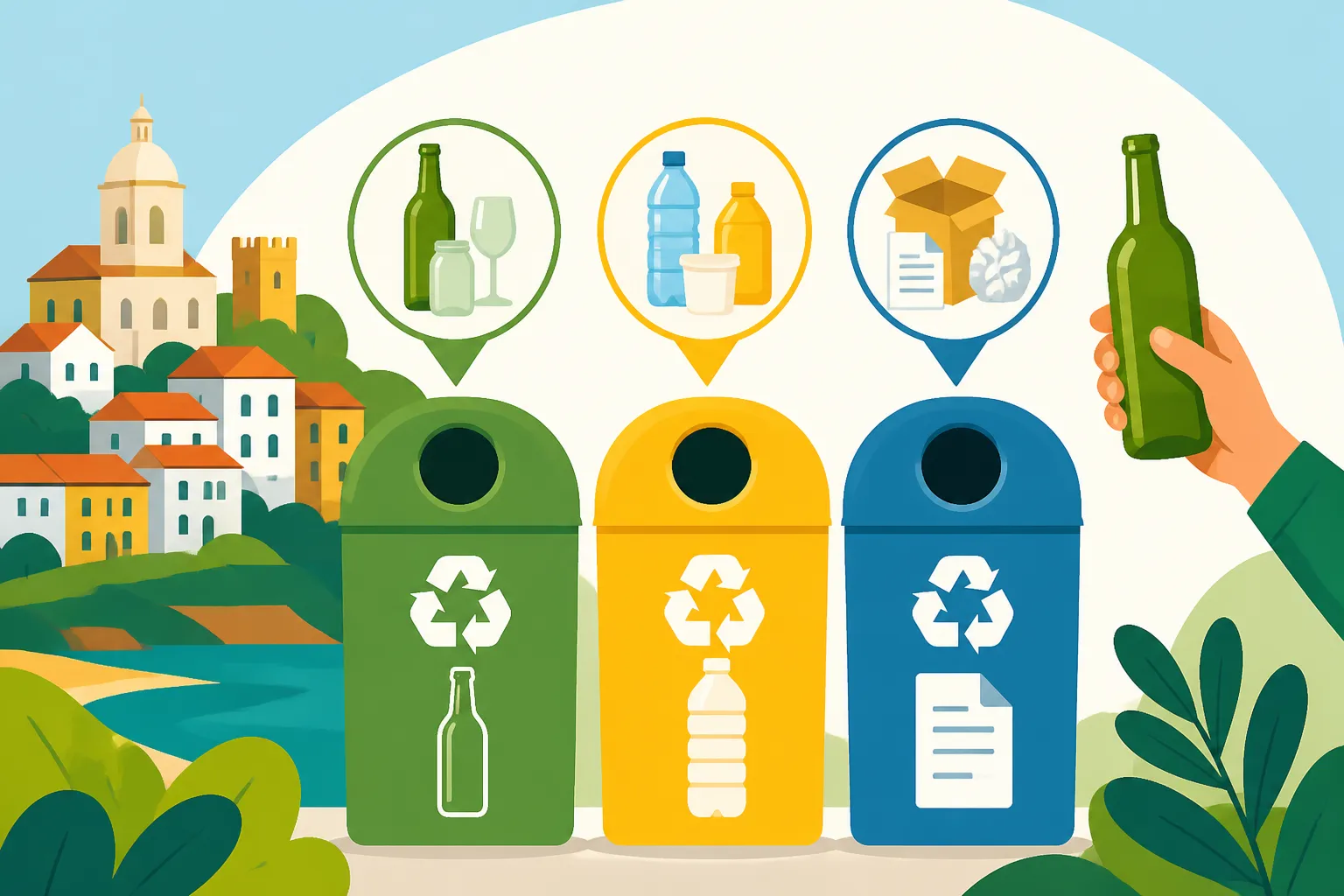
The first thing you’ll notice in almost any Portuguese neighborhood is a cluster of three large containers: blue, yellow, and green. These are your "Ecopontos." While they might seem straightforward, there are a few "gotchas" that often trip up expats. In Portugal, the responsibility for sorting starts at the source—your kitchen—and the local municipalities (Câmaras) take the purity of these streams quite seriously. If you are just moving in and used Uniplaces to find your first mid-term rental, you might find a small set of starter bins in your kitchen, but the real work happens at the street-side containers.
The Blue Bin: Papel e Cartão
The blue bin is dedicated to paper and cardboard. This sounds simple enough, but the most common mistake made by newcomers involves contamination. In Portugal, if paper is contaminated with food waste, it is no longer recyclable in the blue stream. This means your pizza boxes, if they have even a single drop of grease on them, actually belong in the "Lixo Comum" (general waste).
What does go in? Clean cereal boxes, newspapers, magazines, envelopes (even those with the little plastic windows), and flattened cardboard shipping boxes. Speaking of boxes, if you frequently use Amazon Spain to furnish your new home, you will quickly realize that the blue bin fills up faster than any other. A veteran tip: always flatten your boxes. Not only is it polite to your neighbors, but some municipalities have sensors on the bins, and "air-filled" boxes can trigger a premature (and expensive) collection route.
The Yellow Bin: Plástico e Metal
The yellow bin is arguably the most confusing because it handles both plastics and metals, along with "ECAL" (Embalagens de Cartão para Alimentos), which are your milk and juice cartons. Many expats assume these cartons belong in the blue paper bin because they feel like cardboard, but in Portugal, they go in the yellow bin because of their internal plastic or aluminum lining.
For plastics, you should include water bottles, detergent containers, and yogurt pots. For metals, soda cans, tuna tins, and even clean aluminum foil are welcome. A common debate among the expat community is whether you need to wash these items. You don't need to make them dishwasher-clean, but a quick rinse with leftover dishwater prevents smells and keeps the recycling facility workers from dealing with moldy residues. This is particularly important during the hot summer months in the Algarve or Alentejo.
The Green Bin: Vidro
The green bin is for glass only, but specifically "packaging" glass. This means wine bottles, jam jars, and olive oil bottles. It is a strictly "bottles and jars" zone. One of the biggest mistakes people make is throwing broken drinking glasses, mirrors, or window panes into the green Ecoponto. These items have a different melting point and chemical composition than bottle glass and can ruin an entire batch of recycled glass.
Before you drop your bottles in, remember to remove the caps. Metal caps go in the yellow bin, and corks should be saved separately. If you are a wine enthusiast, you will find that many supermarkets have a dedicated "Cortiça" (cork) recycling point, often shaped like a giant cork itself. Saving your corks is a small but impactful way to support Portugal's massive cork industry.
Specialized Recycling and Hard-to-Place Items
Once you’ve mastered the "Big Three," you’ll quickly realize that a modern household produces a lot of waste that doesn’t fit into a colored plastic hole. Living in Portugal means learning to hunt for specialized collection points. When I first moved here, I spent way too long wondering where to put my dead AA batteries until I discovered the "Pilhão."
The Pilhão and Battery Disposal
Batteries should never, ever go into the general waste or the Ecopontos. Instead, look for a small red box often attached to the side of the main Ecoponto cluster or located inside supermarkets like Pingo Doce or Continente. These are called Pilhões. They are designed for small household batteries. For larger car batteries, you’ll need to visit a dedicated "Ecocentro" (a larger waste facility) or hand them over when you buy a new one, as retailers are legally required to accept the old ones.
Dealing with Used Cooking Oil (Olee)
Portugal has a high consumption of olive oil and vegetable oils, and pouring this down the sink is a surefire way to destroy your plumbing and the local water system. Most neighborhoods now feature an "Oleão," which is usually a bright orange container. You don’t pour the oil directly into the bin; instead, you fill an old plastic bottle (like a water or soda bottle), screw the cap on tight, and drop the entire bottle into the orange Oleão. This oil is often converted into biodiesel, making it a very efficient recycling loop.
Large Items and Electronic Waste
If you are renovating or just Moving to Portugal with Kids: Schools, Childcare, and Family Life, you will inevitably end up with "Monstros" (monsters). This is the Portuguese term for bulky waste like old mattresses, broken sofas, or refrigerators. Every municipality has a free collection service for these. You simply call your local Câmara Municipal or Junta de Freguesia and schedule a "recolha de monstros." They will give you a specific day and time to place the item on the sidewalk. Do not just leave it by the bins; without a scheduled pickup, it’s considered illegal dumping and can result in a hefty fine.
| Item Category | Bin Color / Location | Pro Tip |
|---|---|---|
| Paper & Cardboard | Blue (Azul) | Flatten everything; no greasy pizza boxes. |
| Plastic & Metal | Yellow (Amarelo) | Includes milk/juice cartons (Tetra Pak). |
| Glass Bottles/Jars | Green (Verde) | No mirrors, light bulbs, or drinking glasses. |
| Household Batteries | Red Box (Pilhão) | Often found inside supermarkets. |
| Used Cooking Oil | Orange (Oleão) | Must be in a sealed plastic bottle. |
| General Trash | Grey/Black/Brown | Anything that isn't recyclable or organic. |
| Bulky Furniture | Scheduled Pickup | Call the "Linha Verde" of your local council. |
Managing Waste in Small Apartments and Cities
Many expats live in historic city centers like Alfama in Lisbon or Ribeira in Porto, where space is at a premium. Managing four or five different waste streams in a tiny kitchen requires a bit of strategy. When you first arrive and are using an Airalo eSIM to navigate your new neighborhood, take a walk specifically to map out your nearest Ecoponto. They aren't always right outside your door, especially in old, narrow streets where the collection trucks can't easily pass.
The Organic Waste Revolution
In recent years, Portugal has been rolling out the "Brown Bin" for organic waste (Bio-resíduos). Depending on where you live, you might have a dedicated brown bin on the street or a small countertop bucket provided by the council. This is for fruit peels, vegetable scraps, coffee grounds, and leftover food. Using these bins significantly reduces the amount of waste sent to landfills and helps produce compost for Portuguese farms.
Cultural Etiquette and "The Rules"
There is an unwritten social contract regarding recycling in Portugal. For instance, try to avoid dumping glass bottles into the green bin late at night or very early in the morning. The sound of smashing glass echoes loudly in narrow cobblestone streets and is a quick way to annoy your neighbors. Also, if you find an Ecoponto is full, do not leave your bags on the ground next to it. This attracts seagulls and stray cats, who will tear the bags open and scatter the contents. If the bin is full, walk to the next cluster or take your recycling back home and try again tomorrow.
If you ever feel that the waste management in your area is subpar, you have the right to use the Understanding the 'Livro Amarelo' (Yellow Book) for Medical Complaints concept in a broader sense—every public service, including waste management, is subject to the "Livro de Reclamações." However, usually, a polite word at the Junta de Freguesia is enough to get a full bin emptied.
Troubleshooting and Local Variations
Recycling isn't perfectly uniform across the whole country. While the color system is national, the frequency of collection and the specific bins available can change. In some rural areas, you might only have a general waste bin and have to drive your recyclables to a central point in the village.
Apartment Building Protocols
If you live in a newer apartment block, you might have "ilha ecológica" (ecological islands) which are underground bins. These are fantastic because they keep the streets smelling fresh and look much tidier. You just lift the lid and drop your items down the chute. However, be warned: the chutes are often smaller than the old-fashioned bins, so you really have to break down those boxes into very small pieces to make them fit.
When in Doubt: The General Bin
If you truly cannot figure out where something goes, and you've exhausted your research, put it in the "Lixo Comum." It is better to "waste" a single recyclable item than to contaminate an entire recycling bin with the wrong material. For example, some specialized plastics (like certain toy plastics or heavy-duty crates) are not processed in the yellow bin stream. As you settle in, you'll learn these nuances. You might also want to look into Booking large trash pickup (Monstros) for old furniture via your local Camara if you find yourself with an accumulation of odd items after a big move.
Disclaimer
This guide is intended for informational purposes and reflects the general recycling practices in Portugal as of 2026. Local municipal rules can vary significantly between regions (e.g., Lisbon vs. the Azores). Always check with your local Câmara Municipal or "Junta de Freguesia" for the most specific and up-to-date regulations in your direct neighborhood to avoid fines or service disruptions.