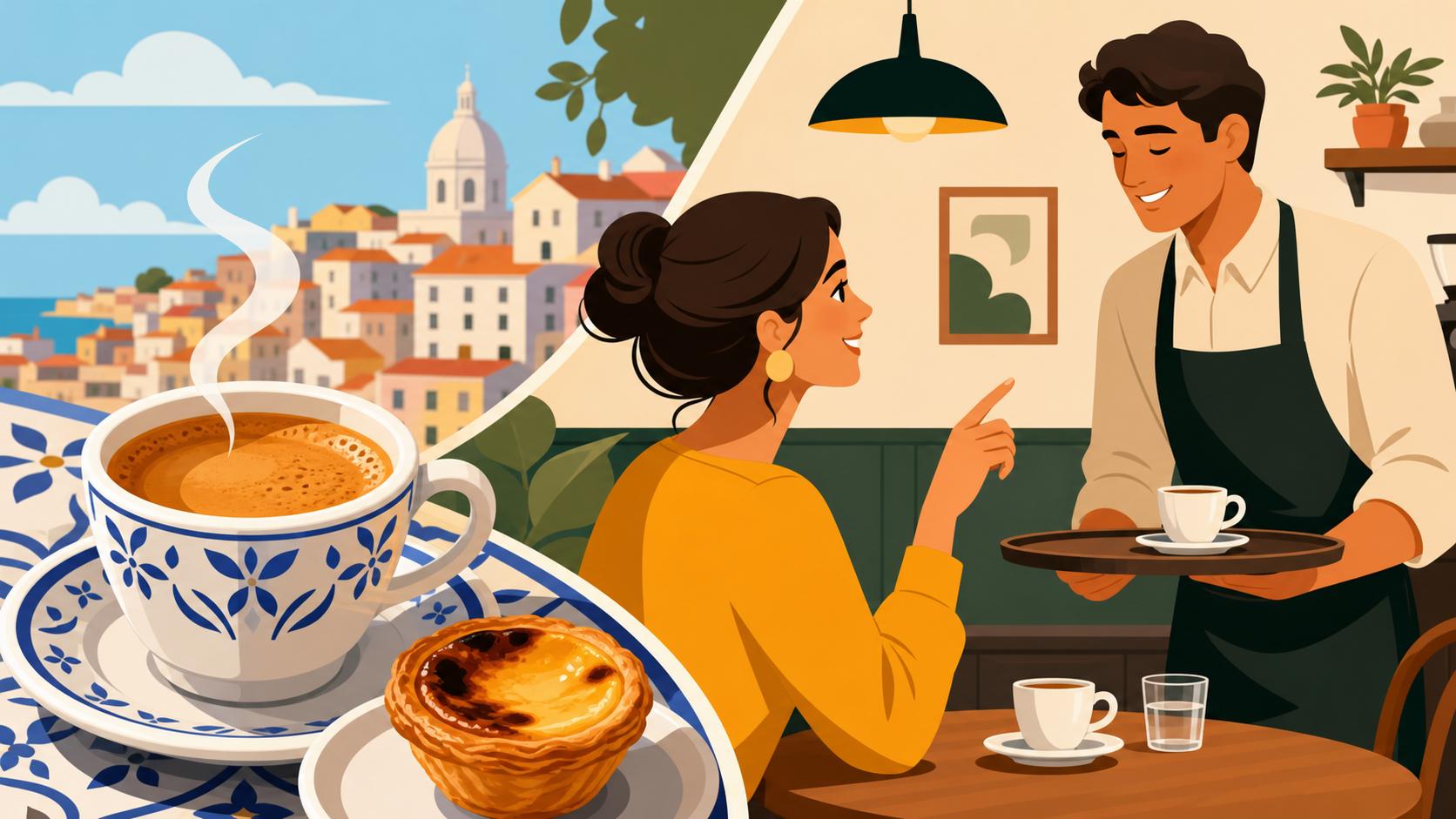
Portuguese Coffee Culture and Restaurant Etiquette: Ordering Like a Local
Disclosure: This article contains affiliate links. If you buy through them, we may earn a commission at no extra cost to you. Read our full disclosure.
Standing at a crowded counter in a Lisbon pastelaria while a line of impatient locals waits behind you is a rite of passage every expat fears. I remember my first week in Chiado, sweating through my shirt because I couldn't remember the word for a coffee with just a "drop" of milk. This guide ensures you never face that social paralysis again by mastering local dining norms.
The Soul of the Street: Understanding Portuguese Coffee Culture
Coffee is not just a caffeine delivery system in Portugal; it is the social lubricant that keeps the country running. Whether you are settling into a new apartment found through Uniplaces or just visiting for a month, the cafe (or pastelaria) will become your second living room. Understanding the nuances of how and when to order is the first step to feeling like a true resident rather than a passing tourist.
The Bica and Beyond: A Guide to Coffee Types
The most fundamental thing to learn is that a "coffee" (um café) is, by default, a small, potent shot of espresso. In Lisbon, you might hear it called a "bica," while in Porto, it’s often a "cimbalino." If you want something longer, you ask for a "café cheio," which is an espresso shot topped up with a bit more hot water. For those who find the standard espresso too bitter, a "pingado" is an espresso with a tiny drop of cold milk, while a "garoto" is an espresso with a bit of foamed milk, usually served in the same small cup.
When you move into larger servings, the terminology changes significantly. A "meia de leite" is half milk and half coffee served in a medium cup, similar to a flat white. If you want a tall glass of hot milk with a shot of coffee, you ask for a "galão." For a deeper dive into these specific variations, check out our guide on How to order coffee in Portugal: Bica, Meia de Leite, Pingado, and Galão. It is a common mistake for expats to order a galão in the afternoon; typically, the Portuguese stick to black espresso after lunch, saving the milkier versions for breakfast or a mid-morning snack.
If you are trying to replicate these flavors at home, you can find high-end espresso machines and Portuguese coffee brands like Delta or Nicola on Amazon Spain, which offers fast shipping to most Portuguese addresses. Having a solid setup at home is great, but it will never replace the social atmosphere of the local corner shop where everyone knows your name—or at least your "usual" order.
The Ritual: Where, When, and How to Drink Your Coffee
The Portuguese coffee ritual usually happens standing up at the counter (ao balcão) or sitting down at a table (à mesa). If you are in a rush, standing at the counter is the fastest way to get your fix and is often a few cents cheaper than sitting. You will see businessmen, construction workers, and grandmothers all huddled at the counter, stirring their sugar into their bicas and downing them in two gulps. It is a democratic space where social hierarchies seem to vanish for five minutes.
Timing is everything. There is the "pequeno-almoço" (breakfast) coffee, usually accompanied by a toast (torrada) or a pastry. Then there is the mid-morning break around 11:00 AM, the post-lunch espresso which is non-negotiable, and the "lanche" (afternoon snack) around 4:30 PM or 5:00 PM. If you are working remotely, having a reliable data connection via Airalo is essential so you can check your emails while enjoying a slow mid-morning galão at a riverside cafe.
Be aware that "coffee to go" is a relatively new and still somewhat foreign concept in traditional areas. While major chains and modern brunch spots offer paper cups, the traditional pastelaria expects you to drink from ceramic. If you try to walk out with a ceramic cup, you will get some very confused looks. Embrace the five-minute pause; it is one of the best parts of living here.
Coffee House Etiquette for Newcomers
When you enter a pastelaria, you don’t wait to be seated. You either head to the counter or find an empty table. If you sit at a table, a waiter will eventually come to you, though in busy spots, you might need to make eye contact and give a polite nod. "Bom dia" (Good morning) or "Boa tarde" (Good afternoon) is the mandatory greeting. If you skip this and go straight to your order, you will be marked as a "turista" immediately.
Payment usually happens at the end. Even if you only had one espresso, you don't necessarily pay the moment it is served. You can sit for an hour with that single cup, and no one will rush you. When you are ready to leave, you can go to the register and tell them what you had, or catch the waiter’s eye and make a writing motion in the air to ask for the "conta." To improve your interactions, it is worth Learning European Portuguese: Top Apps, Tutors, and Free Government Classes to master the polite forms of address.
One specific cultural quirk is the "sugar packet" habit. Most Portuguese people use the entire packet of sugar, stir vigorously, and then use the spoon to eat the remaining coffee-soaked sugar at the bottom of the cup. While you don't have to go that far, don't be surprised to see it. Also, it is perfectly acceptable to ask for a glass of tap water (um copo de água da torneira) with your coffee; it is usually free and expected.
Navigating the Portuguese Restaurant Landscape
Once you move past the morning coffee and into the world of lunch and dinner, the rules change again. Portugal has a tiered system of eateries, each with its own level of formality and price point. Understanding where you are eating will help you manage your expectations regarding service speed and Cost of living in Lisbon 2026: Rent, groceries, and eating out breakdown.
Tascas vs. Restaurantes vs. Marisqueiras
The "tasca" is the backbone of Portuguese dining. These are small, often family-run establishments with paper tablecloths, bright fluorescent lighting, and a TV tuned to the football or the news. The food is traditional, portions are massive, and the prices are low. If you see a place with "Prato do Dia" (Plate of the Day) handwritten on a paper strip taped to the window, you are in a tasca. This is where you will find the most authentic experience and the best "Bacalhau" or "Cozido."
A "Restaurante" is a step up in formality. You will likely find cloth napkins, a more extensive wine list, and a broader menu that might include international dishes. Then there is the "Marisqueira," which specializes in seafood. These are often lively, noisy places where the floor is covered in discarded shrimp shells (in the more traditional ones) and the "Arroz de Marisco" is the star of the show. In these spots, the price is often "ao quilo" (by the kilo), so be sure to check the weight before you agree to that giant tiger prawn.
Finally, you have the "Cervejaria," which translates to "beer house" but is essentially a casual restaurant focused on snacks (petiscos), steaks, and seafood, paired with cold draught beer (imperial or fino). Regardless of the type of establishment, if you are unsure about how to behave, observing Portuguese greeting etiquette: When to use Beijinhos vs Handshakes can help you navigate the initial meeting with the host or waiter.
The Couvert Confusion: It’s Not Free
The biggest source of frustration for new expats is the "couvert." Almost as soon as you sit down, the waiter will bring out bread, butter, olives, cheese, and sometimes ham or tuna pate. It looks like a welcoming gift, but it is not free. If you eat it, you pay for it. In 2026, the law is very clear: you should only be charged for what you consume, but the items are placed there by default.
If you don't want the couvert, simply say "Não, obrigado" and the waiter will take it away. Don't feel rude doing this; locals do it all the time if they aren't hungry or want to save space for the main course. However, the cheese and ham are often local specialties and well worth the extra few euros. If you do keep the bread, try to avoid asking for "more butter" multiple times, as each little packet will likely show up on the final bill.
This system is a legacy of a different era of dining, and while it can feel "scammy" to newcomers, it is just how things work here. If you are budgeting carefully, keep an eye on the couvert prices listed at the start of the menu. Sometimes a fancy cheese can cost as much as a small starter. For more on managing your restaurant spend, read about Tipping culture in Portugal: Do you leave 10% or just round up the bill?.
Timing Your Meals: The Portuguese Clock
The Portuguese eat later than North Europeans or Americans, but earlier than the Spanish. Lunch (almoço) typically happens between 12:30 PM and 2:30 PM. If you show up at 11:30 AM, the kitchen might not even be on. If you show up at 3:00 PM, they will likely tell you "a cozinha fechou" (the kitchen is closed), and you will be relegated to a toastie at a cafe.
Dinner (jantar) starts around 7:30 PM or 8:00 PM. While touristy areas serve food all day, local spots won't see a crowd until at least 8:30 PM. On weekends, dinner can easily stretch until 11:00 PM. It is also important to note that many traditional restaurants close on Sundays or Mondays, and during the summer, The "August Shutdown": Why getting things done in summer is impossible means your favorite local spot might be closed for the entire month while the owners go to the Algarve.
Always check the hours on Google Maps, but verify them with a quick look at the door. If you are planning a big group dinner, it is highly recommended to call ahead and book a table (reservar uma mesa). In smaller towns, you might find that the restaurant doesn't have an online booking system, so you'll need to use your burgeoning Portuguese skills or drop by in person earlier in the day.
Ordering and Dining Like a Local
Mastering the menu is where you truly transition from a visitor to a local. Portuguese menus can be repetitive, but they rely on seasonal availability and the "catch of the day." Knowing how to navigate the "Prato do Dia" will save you money and ensure you get the freshest food possible.
Essential Phrases for Seamless Service
You don't need to be fluent to have a great dining experience, but a few key phrases go a long way. Always start with a greeting. When the waiter asks what you want, you can say "Eu queria…" (I would like…) followed by your choice. If you are looking for a recommendation, ask "Qual é a especialidade da casa?" (What is the house specialty?).
| English Phrase | Portuguese Phrase | Context |
|---|---|---|
| The bill, please | A conta, por favor | When you are finished |
| Is there a table for two? | Tem mesa para dois? | Upon arrival |
| Do you accept cards? | Aceitam cartão? | Before ordering |
| A glass of red wine | Um copo de vinho tinto | Ordering drinks |
| Where is the bathroom? | Onde é o casa de banho? | Essential |
When you are finished, don't wait for the waiter to bring the bill automatically. In Portugal, it is considered rude to rush a guest out, so they will wait for you to ask. If the restaurant is closing and you are the last ones there, they might politely clear the neighboring tables as a hint, but generally, the table is yours for the night. If you find yourself in a situation where the menu is only in Portuguese, having a travel eSIM from Airalo allows you to use translation apps in real-time.
Deciphering the Menu: Prato do Dia and Specials
The "Prato do Dia" is the holy grail of Portuguese lunch. It usually includes a soup, a main dish (meat or fish), a drink, and a coffee for a fixed price—often between €10 and €15 in 2026. These dishes are prepared in large quantities and are usually the best thing the kitchen is making that day. If you see "Dourada Grelhada" (grilled sea bream) as the daily special, it’s a safe bet it was in the ocean 24 hours ago.
Be aware of portions. A "dose" is a full portion, often enough for two people if you aren't starving. A "meia dose" (half portion) is usually plenty for one person. Many expats make the mistake of ordering a full "dose" each and ending up with enough food to feed a small village. If you see a price for a "travessa," that usually implies a large platter meant for sharing.
If you have dietary restrictions, be very specific. While awareness is growing in Lisbon and Porto, traditional tascas might not understand "vegan" or "gluten-free" fully. "Sou vegetariano/a" is understood, but they might still offer you "Peixe" (fish) because some old-school spots don't count fish as meat. If you need specific ingredients for cooking at home, you can often find international items on Amazon Spain or by Finding Asian, Mexican, or specialty food ingredients in Lisbon and Porto.
Tipping and Paying the Bill (The MB Way)
Tipping in Portugal is appreciated but not mandatory or expected in the same way as in the US. In a casual tasca, rounding up to the nearest Euro or leaving a couple of €1 coins is perfectly fine. In a more upscale restaurant, a 5-10% tip is generous. If the service was poor, leaving nothing is not considered a social sin.
When it comes to paying, "Multibanco" is king. Portugal has one of the most advanced banking systems in the world. Most places accept debit cards, but some smaller tascas might have a "mínimo para cartão" (minimum for card) or be "só dinheiro" (cash only). Always check for the Multibanco sign on the door. A very popular way to pay among locals is Using the MB Way app: Why it’s better than carrying cash in Portugal. It allows you to send money via your phone number and is incredibly convenient for Splitting the bill at a restaurant: Do Portuguese places accept multiple cards?.
If you are splitting the bill, tell the waiter "queremos dividir a conta" (we want to divide the bill). Most modern terminals allow the waiter to enter the specific amount each person wants to pay. However, in traditional spots, it’s much easier if one person pays the whole thing and the others "MB Way" them their share.
Social Norms and Cultural Nuances at the Table
Dining in Portugal is a loud, communal, and often long-winded affair. If you are coming from a culture that values quiet, efficient meals, the Portuguese table might feel overwhelming at first. However, once you embrace the chaos, it becomes one of the most rewarding parts of the lifestyle.
Greeting Etiquette and Table Manners
If you are meeting friends or being introduced to the restaurant owner, the greeting is important. Men usually handshake, while women (or men and women) give two kisses—starting with the right cheek. It is common to see people greeting half the restaurant if it’s a local neighborhood spot. When you sit down, don't start eating until everyone is served. The phrase "Bom proveito" (Enjoy your meal) is the signal to begin.
Table manners are generally formal but relaxed. Keep your elbows off the table, and use your bread to push food onto your fork (a very common local move). One thing that often surprises expats is the "noise level." Portuguese people love to debate, and a dinner table is the primary arena for discussions about politics, football, and family drama. Don't mistake the volume for anger; it’s usually just passion.
If you are invited to a Portuguese home for dinner, never show up empty-handed. A bottle of wine or a box of "pastéis" from a good local bakery is the standard. And a pro-tip: never show up exactly on time. If the invitation is for 8:00 PM, arriving at 8:15 PM is considered "on time," while 8:30 PM is still perfectly acceptable. Showing up at 7:59 PM might find your host still in the shower.
The "August Shutdown" and Holiday Dining
If you are living in Portugal, you need to plan your life around the calendar. Many family-run restaurants close for two to four weeks in August. This is when the cities empty out and everyone heads to the coast. You might find a sign on the door saying "Fechado para férias" (Closed for holidays). Don't take it personally; it's the national law of rest.
The same applies to Portuguese public holidays 2026: When supermarkets and banks are closed. On days like April 25th (Freedom Day) or June 10th (Portugal Day), many restaurants will be packed with families, and reservations are essential. Christmas Eve and New Year’s Eve are also tricky; most places close on the 24th so staff can be with their families, while the 31st often features "Menus de Réveillon" that are significantly more expensive than usual.
During the month of June, especially in Lisbon and Porto, the "Santos Populares" festivals take over the streets. Restaurants move their grills onto the sidewalk, and the only thing on the menu is "Sardinhas Assadas" (grilled sardines) and "Febras" (pork steaks) on bread. It is a month-long outdoor dinner party that every expat should experience at least once.
Dining with Children and Large Groups
Portugal is incredibly child-friendly. You will see toddlers at restaurant tables at 11:00 PM, and no one bats an eyelid. Most restaurants have high chairs (cadeiras de bebé), though they might only have one or two, so it's worth checking. There isn't always a "kids' menu," but every kitchen can whip up a "bitoque" (steak with an egg and chips) or a simple pasta for a child.
For large groups, the "jantar de grupo" is a cultural institution. These are often fixed-price affairs that include unlimited wine and beer (within reason). They can get very rowdy, especially on Friday nights. If you are organizing one, be sure to confirm the final number of people a day before, as "no-shows" are increasingly being charged for in 2026 to help restaurants manage food waste.
Whether you are dining as a couple or a crowd, the key to a successful evening is to relax. The service might be slower than you are used to, the waiter might forget your extra napkins, and the bill might take ten minutes to arrive. But in the grand scheme of things, you are sitting in a beautiful country, eating some of the best produce in Europe. Take a breath, have another sip of wine, and enjoy the "slow life."
Comparison of Coffee and Dining Costs in 2026
To help you budget for your new life in Portugal, here is a breakdown of what you can expect to pay in a typical urban area like Lisbon or Porto. Prices in rural areas will generally be 20-30% lower.
| Item | Estimated Price (Urban) | Estimated Price (Rural) |
|---|---|---|
| Espresso (Café/Bica) | €0.80 – €1.20 | €0.60 – €0.90 |
| Galão or Meia de Leite | €1.50 – €2.50 | €1.20 – €1.80 |
| Pastel de Nata | €1.10 – €1.50 | €0.90 – €1.20 |
| Prato do Dia (Lunch) | €10.00 – €15.00 | €8.00 – €11.00 |
| Dinner (Mid-range, per person) | €25.00 – €40.00 | €18.00 – €28.00 |
| Imperial (Small Draught Beer) | €1.50 – €2.50 | €1.00 – €1.80 |
| Bottle of House Wine | €8.00 – €15.00 | €5.00 – €10.00 |
Practical Resources for Your Move
Getting Connected and Settled
If you are just arriving and need to find a place to stay while you scout out the best cafes, Uniplaces offers long-term rentals that are expat-friendly. Once you have your keys, getting your internet and mobile set up is the next hurdle. While you wait for a local contract, an eSIM from Airalo is a lifesaver for navigating the city and looking up restaurant reviews on the fly.
For setting up your new Portuguese kitchen, Amazon Spain is often the most reliable way to get international kitchen gadgets or specialty pantry items delivered to your door. Remember to always use your NIF (tax number) on larger purchases to benefit from potential tax deductions. Navigating the administrative side of living here can be tough, but the food makes it all worthwhile.
Disclaimer
The information provided in this guide is for informational purposes only and reflects the cultural and economic landscape of Portugal in 2026. While we strive for accuracy, prices, laws, and social norms can change. Always verify specific restaurant hours and policies locally. This guide does not constitute legal or financial advice regarding residency or taxation in Portugal.