Getting Around Porto: Metro, Buses, and Funiculars
Disclosure: This article contains affiliate links. If you buy through them, we may earn a commission at no extra cost to you. Read our full disclosure.
Porto is one of the most beautiful cities in the world, but if you arrive unprepared, its verticality will break your spirit and your calves. Navigating the labyrinthine streets, hidden staircases, and steep riverbanks requires more than just a pair of sturdy boots; it requires a deep understanding of the local transit network. This guide solves the confusion of the Andante system, explains how to conquer the hills without collapsing, and ensures you travel like a seasoned local.
The Andante Card System: Your Golden Ticket
The first thing you will notice when you step off the plane or train is the yellow ticket machine. This is where most newcomers experience their first minor breakdown. The Andante card is the lifeblood of Porto's public transport, but it is not a "one size fits all" deal. You have two primary choices: the Blue card (Andante Azul) for occasional users and the Silver card (Andante Próprio) for residents or long-term visitors. Most tourists will stick with the Blue card, which is made of paper but contains a small chip. It costs 0.60 EUR for the card itself, and then you load it with "titles" or trips.
A common frustration for expats is the "one card, one person" rule. You cannot buy one card and tap it twice for you and your partner. Each traveler must have their own physical card. Furthermore, a single Blue card can only hold one type of fare at a time. If you have a Z2 trip (for the city center) loaded on your card, you cannot add a Z4 trip (for the airport) until you have used all the Z2 trips. This often leads to people carrying two or three different paper cards, which can become a chaotic mess in your wallet.
Understanding Zones Z2, Z3, and Z4
Porto’s transit is divided into rings or zones. For the vast majority of sightseeing, you only need a Z2 ticket. This covers the historic center, the Ribeira, and the main shopping districts. If you are heading slightly further out, perhaps to the beaches of Matosinhos to enjoy some fresh grilled fish, you will likely need a Z3. The most important one for arrivals is the Z4, which covers the journey from Francisco Sá Carneiro Airport into the city center.
When you look at the map at a station, you will see a list of destinations and a corresponding "Z" number next to them. Do not overthink the geography; just find your destination on the list and buy the "Z" number indicated. If you are staying for several months, you might want to look into the monthly passes, similar to the Navegante Pass Lisbon: How to get the €40 monthly unlimited transit card, though Porto’s monthly system is slightly more localized.
The Validation Rule You Can't Forget
In many cities, you only validate your ticket when you enter a station. In Porto, you must validate every single time you board a vehicle or enter a station, even if you are just transferring between two metro lines. You simply tap your card against the yellow sensor until it glows green and gives a soft beep. If it glows red, it means your card is empty or you have the wrong zone loaded.
The ticket inspectors (fiscais) are notoriously strict. They don't care if you are a tourist who didn't understand the rules; they will issue a fine on the spot. Many people try to argue their way out of a fine, but it rarely works. To avoid any issues, keep your card accessible and always tap in. For more on staying on the right side of local regulations, see our guide on Safety and Emergency Preparedness in Portugal for Foreign Residents.
Where to Buy and Top Up
You can buy Andante cards at the airport, at any Metro station, at "PayShop" locations, and at many kiosks labeled with the Andante logo. The machines at the Metro stations have an English language option, which is a lifesaver. If you find the machines confusing, you can always visit an Andante shop (Loja Andante) at major hubs like Trindade, Campanhã, or Casa da Música, where a human being can help you.
If you are planning your trip ahead of time and looking for accommodation near these hubs, checking Booking.com for hotels near Trindade is a smart move, as it is the central intersection for all Metro lines. Being within walking distance of a major station saves you significant time when navigating the city's steep inclines.
The Porto Metro: Fast, Clean, and Mostly Overground
The Metro do Porto is actually a light rail system, and it is remarkably efficient. It consists of six lines (A through F), and they are all color-coded. What makes Porto's metro unique is that once it leaves the downtown core, it runs mostly above ground, offering some of the best views of the city for the price of a standard ticket. If you are coming from a city with a dark, dingy subway, you will find Porto’s stations, designed by Pritzker Prize-winning architect Souto de Moura, to be a breath of fresh air.
Line E (Violet) is the one you will use to get from the airport to the center. It runs every 20 to 30 minutes, and the journey to Trindade takes about 25 minutes. It is clean, safe, and significantly cheaper than a taxi. For a broader look at how this fits into the national infrastructure, you can read about Public Transport and Driving in Portugal: Trains, Tolls, and Licenses.
Navigating the Six Lines
The Metro lines overlap in the center, particularly between the stations of Senhora da Hora and Trindade. This means that in the heart of the city, you rarely have to wait more than a few minutes for a train. However, if you are heading to specific outskirts, you must pay attention to the destination displayed on the front of the train. For example, Line D (Yellow) is the only one that runs north to south, crossing the top level of the Dom Luís I Bridge. This is arguably the most scenic public transport ride in Europe.
Riding the Yellow line across the bridge at sunset is a rite of passage. You get a panoramic view of the Douro River, the Port wine cellars of Gaia, and the tiled rooftops of the Ribeira. Just remember that if you get off at Jardim do Morro to take photos, you must re-validate your card when you get back on the Metro to head back across the river.
Key Stations for Sightseeing
Trindade is the ultimate hub where all lines meet. If you are lost, get to Trindade and you can find your way anywhere else. São Bento is another crucial station, not just for the Metro, but for the stunning train station above it, adorned with 20,000 hand-painted blue and white tiles (azulejos). Even if you aren't catching a train, you must walk through the atrium.
Bolhão is the stop for the famous market and the shopping street of Rua de Santa Catarina. If you are looking for a break between sights, you can find plenty of spots nearby to experience the local cafe scene; check out our tips on Portuguese Coffee Culture and Restaurant Etiquette: Ordering Like a Local to make sure you order your "café" or "cimbalino" correctly.
Late-Night Travel and Safety
The Metro generally runs from 6:00 AM to 1:00 AM. If you are out late enjoying the nightlife in the Galerias de Paris, you will need to rely on the night bus or a ride-sharing app. Generally, the Metro is very safe, even late at night. However, like any major city, keep an eye on your belongings in crowded stations like Trindade or Bolhão.
If you ever find yourself in a medical bind while traveling, it's good to know how the local system works. For instance, if you have a non-emergency issue after hours, you can refer to Finding English-Speaking Doctors and Specialists in Portugal: English-Speaking Medical Care.
STCP Buses: Reaching Every Corner of the City
While the Metro is great for the main arteries, the STCP buses (Sociedade de Transportes Colectivos do Porto) are what you use to reach the "real" Porto. The bus network is dense and covers areas the Metro cannot reach, especially the hilly neighborhoods of the west and the coastal stretches.
Buses in Porto are modern and usually equipped with free Wi-Fi, though it can be hit or miss. You can use your Andante card on the buses, or you can buy a single-ride ticket directly from the driver for a higher "on-board" fare. It is wise to have a loaded Andante card to save money and avoid the awkward scramble for change while the bus is idling.
Reading the Bus Timetables and Stops
Each bus stop (paragem) has a sign showing the numbers of the buses that stop there and a simplified route map. Many major stops have digital displays showing how many minutes remain until the next bus arrives. These are surprisingly accurate.
If you are using an app like Google Maps or Citymapper, they work well in Porto, but I find the official STCP website or app to be more reliable for real-time changes or strikes. Strikes (greves) do happen occasionally in Portugal, and they can catch you off guard if you aren't checking the local news.
The Night Bus (Madrugada) Network
When the Metro closes at 1:00 AM, the "Madrugada" (dawn) bus lines take over. These lines are prefixed with the letter "M." They are a lifesaver for those who want to stay out late without paying for an Uber. They mostly radiate out from the city center (Aliados) to the various suburbs.
The night buses are generally safe, but they can be a bit rowdy on Friday and Saturday nights with students and revelers. If you are a solo traveler, sitting near the driver is always a sensible choice. Using these buses is quite straightforward, and the drivers are used to tourists, though they may not speak much English.
Etiquette and Paying Onboard
In Porto, you enter the bus through the front door and exit through the middle or back doors. You must validate your Andante card at the machine right next to the driver. If the bus is crowded, you might see people passing their cards forward to be validated by those standing near the machine—it’s a common local courtesy.
If you are paying the driver in cash, try to have small coins. They often do not have change for 10 or 20 Euro notes. Also, remember that tipping is not expected on city buses. If you're curious about where tipping is appropriate, see Tipping culture in Portugal: Do you leave 10% or just round up the bill?
Iconic Inclines: The Funicular dos Guindais and Trams
Because Porto is built on a granite cliff, moving between the riverside (Ribeira) and the upper city (Batalha) is a physical challenge. This is where the Funicular dos Guindais comes in. It’s not just a tourist attraction; it’s a vital piece of urban infrastructure that saves you from climbing hundreds of stone steps.
The funicular is a steep cable railway that connects the base of the Dom Luís I Bridge to the Batalha district. The ride is short—only about three minutes—but it offers a spectacular, moving perspective of the bridge and the river.
Riding the Funicular dos Guindais
The entrance at the bottom is tucked away near the bridge's pillars. You can use a special Andante trip or buy a ticket at the kiosk. It is slightly more expensive than a standard Metro ride, but when it’s 30 degrees Celsius and you’re carrying shopping bags, it’s the best money you’ll ever spend.
The funicular runs roughly every 10 to 15 minutes. It’s worth noting that it occasionally closes for maintenance, so if you see it's not running, you’ll have to brace yourself for the "Escadas dos Guindais"—the steep stairs that run alongside the tracks. If you want to book specific tours that include these historic modes of transport, GetYourGuide often has packages that combine a funicular ride with a walking tour of the old city.
The Historic Trams (Eléctricos)
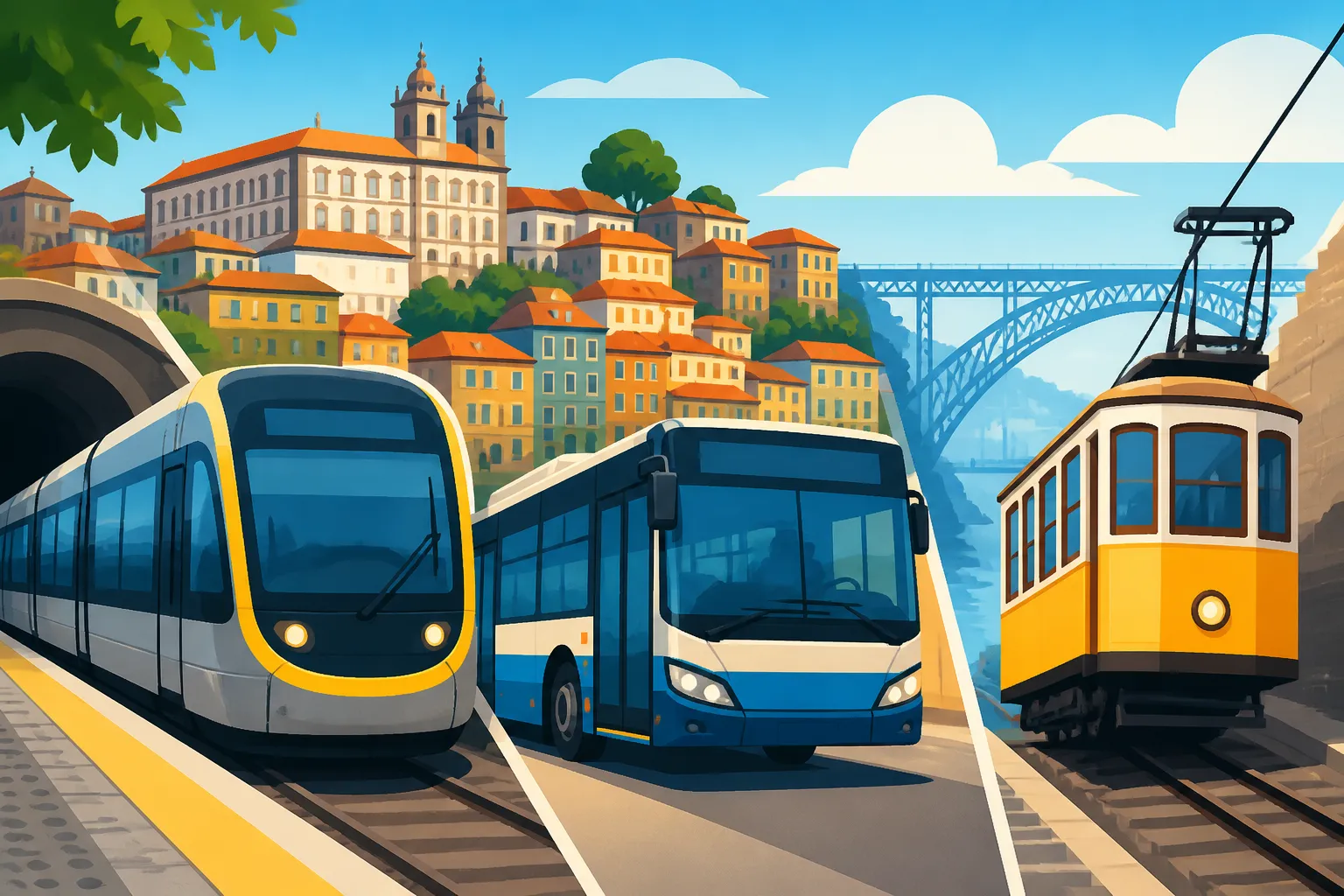
Porto's trams (eléctricos) are iconic. Unlike the modern Metro, these are vintage wooden cars that clatter along the tracks. There are three remaining lines: Line 1 (Infante–Passeio Alegre), Line 18 (Carmo–Massarelos), and Line 22 (Guindais–Batalha loop).
Line 1 is the most popular as it follows the river all the way to Foz, where the Douro meets the Atlantic. It’s a beautiful, slow-paced journey. However, be warned: the vintage trams are not part of the standard Andante network. You have to buy a separate ticket on board, which is around 5 EUR for a single trip. They are often very crowded with tourists, so if you want a seat, board at the beginning of the line.
Teleférico de Gaia: The Cable Car Experience
Technically across the river in Vila Nova de Gaia, the Teleférico de Gaia is another "transit" option that is essentially a scenic ride. it connects the upper level of the bridge (near the Jardim do Morro Metro station) to the riverside where the Port wine cellars are located.
It’s an excellent way to get down to the river for a tasting without having to navigate the steep, winding streets of Gaia. It is quite pricey for a short ride, but the view is unparalleled. For many, it's a highlight of their visit. If you are planning to visit the cellars, you can often find combined tickets that include a boat trip and the cable car.
Alternative Transit: Walking, Taxis, and Trains
Even with all the public transport, you will find yourself walking a lot in Porto. The city is best seen on foot, but you have to be strategic. My best advice: always try to travel "downhill." Start your day at the top of the city (near the Torre dos Clérigos or Batalha) and work your way down to the Ribeira. Then, use the funicular or the Metro to get back up.
The pavement in Porto is the traditional "calçada portuguesa"—small, white and black limestone cobbles. They are beautiful but can be incredibly slippery when wet and are a nightmare for high heels or thin-soled shoes. Wear shoes with good grip.
| Transit Mode | Best For | Payment Method | Approx. Cost |
|---|---|---|---|
| Metro | Speed, Airport, Gaia | Andante Card | €1.30 – €2.15 |
| STCP Bus | Reaching Foz or Suburbs | Andante / Cash | €1.30 – €2.50 |
| Tram | Riverside Views (Scenic) | Cash / Special Ticket | €5.00 |
| Funicular | Avoiding Steep Hills | Andante / Cash | €3.00 – €4.00 |
| Uber/Bolt | Door-to-Door, Late Night | App (Card) | €4.00 – €12.00 |
Crossing the Dom Luís I Bridge
There are two levels to the bridge. The upper level is for the Metro and pedestrians, offering dizzying heights and great views. The lower level is for cars and pedestrians, bringing you right into the heart of the Ribeira and the Gaia riverfront.
Walking across the top level is a must-do, but if you have vertigo, be aware that the pedestrian paths are right next to the Metro tracks with only a railing between you and the drop. On windy days, it can feel quite adventurous.
Using Uber, Bolt, and Free Now
Ride-sharing is incredibly cheap in Portugal compared to the US or UK. Bolt is often the cheapest option and is very popular in Porto. If you are a group of three or four, taking a Bolt from the city center to Matosinhos can actually be cheaper and faster than four Metro tickets.
Taxis are also available and are generally honest, but make sure they turn the meter on. For a detailed breakdown of the apps you should download, see Using Bolt vs Uber in Portugal: Which ride-hailing app is cheaper?
Day Trips via São Bento and Campanhã
If you want to head out of the city to see the Douro Valley, Braga, or Guimarães, you will use the CP (Comboios de Portugal) trains. São Bento is the "urban" station for short-distance trips, while Campanhã is the "main" station for the high-speed Alfa Pendular or Intercidades trains heading to Lisbon.
You can buy tickets at the station or through the CP app. For long-distance travel across Portugal, I often use Omio to compare train and bus prices (like Rede Expressos or FlixBus), as sometimes the bus is actually faster and more comfortable for certain routes. If you are heading towards Lisbon, you can check Buying train tickets online with Comboios de Portugal (CP) app for a seamless experience.
Practical Strategies for Stress-Free Travel
One of the biggest mistakes people make is trying to do too much in one day. Porto is a city to be savored, not rushed. If you are staying for a few days, I highly recommend the Andante Tour card. It comes in 24-hour (Tour 1) and 72-hour (Tour 3) versions. Unlike the regular Blue card, the Tour card gives you unlimited travel on the Metro, STCP buses, and even some urban trains without worrying about zones.
It’s slightly more expensive upfront, but the peace of mind of not having to stand at a ticket machine every time you change zones is worth every cent. You can buy these at the airport or at Andante shops.
The Best Apps for Real-Time Updates
Don't rely solely on paper maps. Download the Move-me app, which is the official app for Porto transit. It gives you real-time arrivals for buses and Metro. Google Maps is generally reliable for the Metro, but it often misses the "real-time" delays for the buses.
If you are a digital nomad or an expat, having a stable internet connection is vital for these apps. If you haven't set up a local SIM yet, you can look into various options for mobile data to ensure you're never stranded without a map.
Accessibility for Families and Seniors
Porto is a difficult city for strollers and wheelchairs. While the Metro stations are mostly equipped with elevators, they are sometimes out of service. The buses have "low floor" entry, but navigating the narrow, cobbled sidewalks to get to the bus stop can be a challenge.
If you are traveling with someone who has limited mobility, rely more on the Metro and taxis rather than the buses or trams. The vintage trams, in particular, have high steps and are not accessible for wheelchairs.
Avoiding Common Tourist Traps
Be wary of "Tuk-Tuks" that offer city tours. While they look fun, they are very expensive and often don't provide any transit value you can't get from a standard bus or a short walk. Similarly, the "Hop-On Hop-Off" buses are popular, but in Porto, the traffic in the narrow streets can be so bad that you spend most of your "tour" sitting behind a delivery truck.
The public transport system is so good and so cheap that you really don't need these private tourist services unless you have a very specific interest in the guided commentary. Use that money instead for an extra glass of Port at a riverside bar or a nice meal in a local "tasca."
Disclaimer
The information provided in this guide is for informational purposes only. Transit routes, fares, and regulations in Porto are subject to change by the authorities (AIMA, STCP, and Metro do Porto). While we strive to provide the most up-to-date advice for 2026, always verify schedules and prices at official kiosks or websites before traveling. The author is not responsible for any fines incurred due to improper ticket validation or changes in local law.