Portuguese Language and Everyday Communication for Visitors
Disclosure: This article contains affiliate links. If you buy through them, we may earn a commission at no extra cost to you. Read our full disclosure.
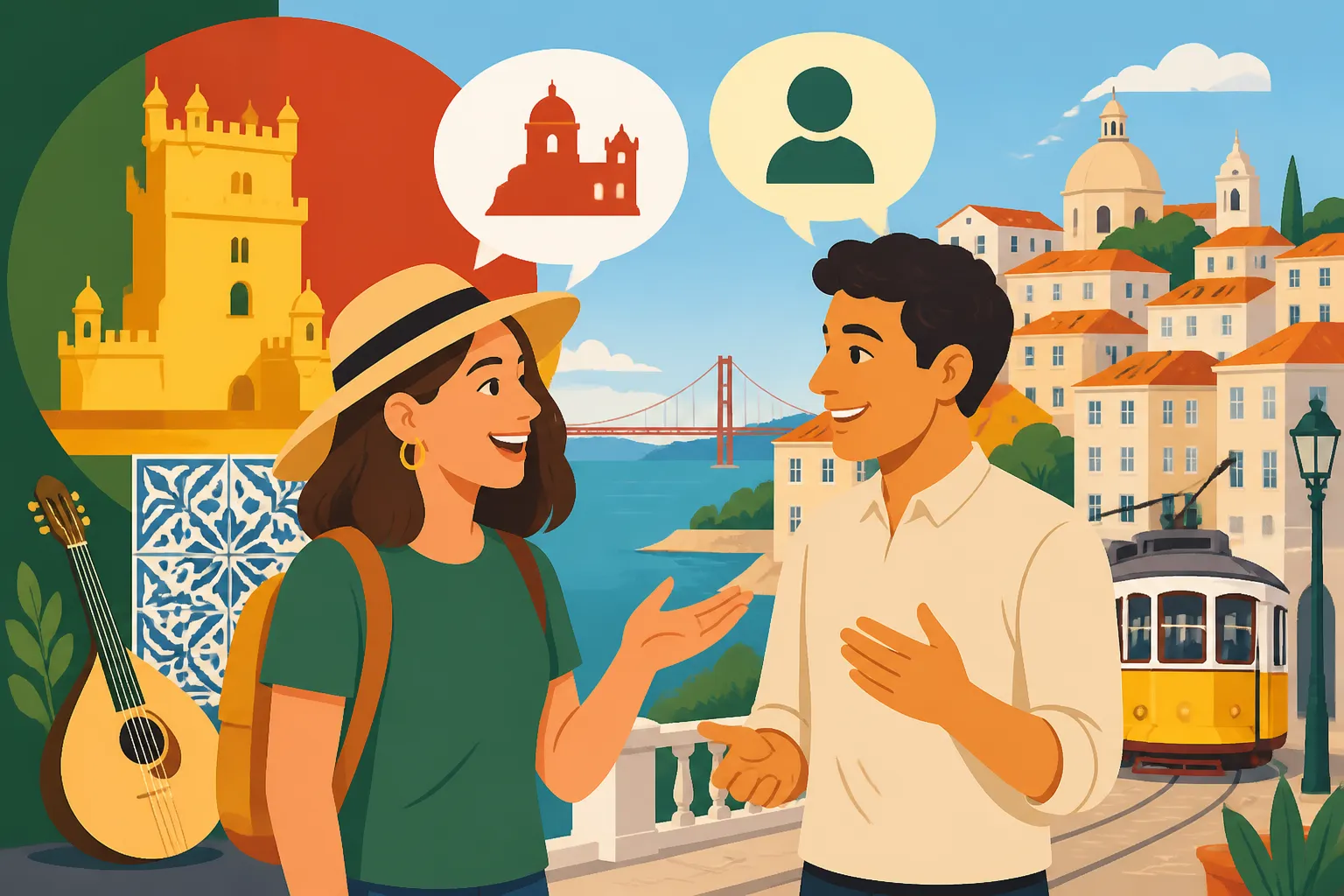
You smile, say “Hola” to the waiter in Lisbon, and get a polite but slightly cooler reply in perfect English. Five minutes later you cannot read the menu, and the word on the bus sign looks nothing like how locals say it. This guide covers the Portuguese words, pronunciation tricks, etiquette and body language that make everyday conversations in Portugal easier.
Why European Portuguese Catches Visitors Off Guard
I still remember my first week in Lisbon. I had done months of app lessons and felt ready. Then a woman at the Pingo Doce checkout asked me something, and I understood nothing. It was not my vocabulary. It was the sound. European Portuguese can feel like a different language from the one you studied, and that is normal.
The Sound of European Portuguese
Written Portuguese looks friendly to anyone who knows a little Spanish, French or Italian. Spoken European Portuguese does not. People in Portugal drop many unstressed vowels, so a word with four syllables on paper can come out with two. “Telefone” sounds closer to “tlfon,” and “obrigado” often becomes “brigad” in quick speech.
Then there is the “sh” sound. In Portugal, an “s” at the end of a word or before most consonants is said like “sh.” “Dois” (two) sounds like “doysh,” and “Cais do Sodré” sounds like “kysh doo soo-DREH.” On top of that come nasal vowels, like the “ão” in “pão” (bread). It sounds a bit like “ow” pushed through your nose.
Here is a typical first-day moment. You ask a bus driver, “Este autocarro vai para Belém?” He answers with something that sounds like one long word. You did nothing wrong. Your ear just needs a few days to tune in. Most visitors find that by day four or five, the language starts to break into separate words.
Where English Works and Where It Fades
Let me be honest with you. In central Lisbon, Porto’s Ribeira, the Algarve resorts and most hotels, you can get by in English. Younger Portuguese people often speak it very well, partly because foreign TV and films here are subtitled, not dubbed. Staff in museums, tour companies and restaurants near the main sights are used to English speakers.
Things change fast once you leave the tourist zones. At a family-run tasca in Alfama, a small grocery in Évora, a train ticket window in a small town, or a pharmacy in a village in the Minho, older staff may speak only Portuguese, sometimes some French. That is when a handful of phrases goes from “nice to have” to “essential.” For a closer look at this, see Do People Speak English in Portugal’s Tourist Areas?
Picture this. You take a regional train to Tomar, and the station café owner is in his seventies. You point at the pastry case, say “um destes, por favor” (one of these, please), and add “obrigado.” He smiles, wraps it, and tells you which way the convent is, with gestures. That small exchange happens all over the country. Simple words and goodwill get you far.
Why Trying Matters More Than Being Perfect
Portuguese people are often modest about their own language. You will hear “Ah, o português é muito difícil” (Portuguese is very hard) with a laugh. So when a visitor tries, even badly, it shows respect. In my experience, people warm up as soon as you open with “Bom dia” instead of jumping straight into English.
Effort does not mean holding up a busy café queue while you work out a sentence. A good habit is to open in Portuguese, then switch to English when the other person does. That first greeting sets a friendly tone, and nobody expects you to keep going in Portuguese.
There is also a practical reward. Shopkeepers are often more patient, a waiter may point out the dish of the day, and a stranger might walk you to the right tram stop. To build your phrase list before you fly, start with Survival Portuguese for Travelers: Key Phrases to Learn First
Essential Words and Phrases for Your First Days
You do not need hundreds of words. A small core set used confidently covers most travel situations. Below are the phrases I hear myself using every single day, years after moving here.
Greetings by Time of Day
Portugal greets by time of day, and people expect it. “Bom dia” (good morning) is used until about lunchtime. “Boa tarde” (good afternoon) runs from lunch until dark. “Boa noite” (good evening or good night) is used after dark, both as hello and goodbye. When you walk into a small shop, a café or a lift with neighbours, saying one of these is basic manners.
“Olá” (hello) is fine and friendly, though a bit casual with older people. For goodbye, “Adeus” sounds quite final. “Até logo” (see you later) and “Tchau” (bye) are what you hear more. In a shop, “Obrigado, bom dia” on your way out covers both thanks and goodbye in one go.
Here is a situation you will meet often. You walk into a small bakery at 2 PM, say “Bom dia,” and the owner replies “Boa tarde.” She is not correcting you to be rude. She is just answering with the right greeting. Copy her next time. It is one of the easiest ways to sound more local.
Politeness Words That Do the Heavy Lifting
“Por favor” means please, but in Portugal you will also hear “se faz favor” a lot. It is used to get a waiter’s attention, to ask for something, or to say “excuse me, please.” “Com licença” means excuse me when you need to pass someone on a narrow Alfama staircase or a packed tram. “Desculpe” means sorry, and it also works to get someone’s attention before asking a question.
“Obrigado” means thank you, and it changes with the speaker, not the listener. If you are a man, you say “obrigado.” If you are a woman, you say “obrigada.” When someone thanks you, answer “de nada” (you’re welcome). Older people may also say “não tem de quê.”
Two lifesavers when you get lost in a conversation: “Não percebo” (I don’t understand) and “Pode falar mais devagar, por favor?” (Can you speak more slowly, please?). “Fala inglês?” (Do you speak English?) is perfectly polite after a Portuguese greeting.
Numbers, Questions and Quick Reference
Numbers matter more than you expect, from prices at markets to platform numbers at stations. Learn one to ten at least: um/uma, dois/duas, três, quatro, cinco, seis, sete, oito, nove, dez.
Key question words help you build sentences quickly. “Onde fica…?” means “Where is…?” “Quanto custa?” means “How much does it cost?” “A que horas…?” means “At what time…?” Put them together with a noun and you can handle most errands.
| Portuguese phrase | Rough pronunciation | Meaning | When to use it |
|---|---|---|---|
| Bom dia | bong DEE-uh | Good morning | Until lunchtime, entering shops |
| Boa tarde | BOH-uh TARD | Good afternoon | After lunch until dark |
| Boa noite | BOH-uh NOYT | Good evening or night | After dark, hello and goodbye |
| Obrigado / Obrigada | oh-bree-GAH-doo / oh-bree-GAH-duh | Thank you | Man says -o, woman says -a |
| Se faz favor | suh fash fuh-VOR | Please, excuse me | Calling a waiter, asking politely |
| Com licença | kong lee-SEN-suh | Excuse me | Passing someone |
| Desculpe | desh-KOOLP | Sorry | Small mistakes, getting attention |
| Não percebo | nowng per-SAY-boo | I don’t understand | When lost in a conversation |
| Quanto custa? | KWAN-too KOOSH-tuh | How much is it? | Shops and markets |
| Onde fica a casa de banho? | OND FEE-kuh uh KAH-zuh duh BAHN-yoo | Where is the toilet? | Restaurants, stations |
| A conta, se faz favor | uh KON-tuh, suh fash fuh-VOR | The bill, please | End of a meal |
Pronunciation Without Panic
You will never be mistaken for a local after a two-week holiday, and that is fine. A few rules help people understand you. They also help you hear words you already know.
Swallowed Vowels and Nasal Sounds
Here are the rules that helped me most in my first year:
- A final “o” usually sounds like “oo.” “Porto” is close to “POR-too,” and “obrigado” ends in “doo.”
- An unstressed final “e” nearly disappears. “Noite” sounds like “noyt,” and “leite” (milk) sounds like “layt.”
- An “s” at the end of a word or before most consonants sounds like “sh.” “Mais” sounds like “mysh.”
- “Lh” sounds like the “lli” in “million,” so “Coelho” is “koo-EL-yoo.”
- “Nh” sounds like the “ny” in “canyon,” so “vinho” (wine) is “VEEN-yoo.”
- “Ão” is nasal, like “ow” through the nose, so “não” is close to “nowng.”
Practise with phrases you will use, not random lists. Say “Um galão e um pastel de nata, se faz favor” (a milky coffee and a custard tart, please) out loud a few times before your first café visit. If it comes out slightly wrong, the person behind the counter will still understand. They hear accented Portuguese all day.
A fun trick is to listen to Portuguese radio or a fado playlist on your flight. You will not follow the words. Your ear will start to pick up the rhythm, though, and that alone makes the first day easier.
Place Names and the Spanish Question
Place names are where visitors stumble most, and getting them close makes asking for directions much easier. Lisboa is “leezh-BOH-uh.” Sintra is “SEEN-truh.” Óbidos is “OH-bee-doosh.” Évora is “EH-voo-ruh.” Guimarães is roughly “ghee-muh-RYNSH.” Cascais sounds like “kush-KYSH.” For a longer list with tips, see How to Pronounce Common Portuguese Place Names
Now, about Spanish. Portuguese and Spanish share many written words, and many Portuguese people understand Spanish well. Even so, opening a conversation in Spanish can land awkwardly. The two countries have a long and proud separate history, and some people feel their language is being treated as a dialect. If you only speak Spanish, ask first: “Fala espanhol?” That small question shows respect, and many people will happily switch.
You should also watch out for false friends. “Esquisito” means strange, not delicious. “Polvo” means octopus, not dust. “Embaraçada” means embarrassed in a mild sense, not pregnant. Brazilian and European Portuguese differ too, from vocabulary to accent. The breakdown in European vs Brazilian Portuguese: What Visitors Should Know helps if your app or course taught you Brazilian forms.
Talking Your Way Through Cafés, Restaurants and Markets
Food is where most of your daily Portuguese gets used. It is also where cultural habits trip people up, from the bread that arrives unasked to the way coffee is named.
Ordering Coffee and Food Like You Belong
Coffee culture here has its own words. “Um café” means an espresso. In Lisbon you will also hear “uma bica,” and in Porto some older people say “um cimbalino.” “Um galão” is a tall glass of milky coffee, “uma meia de leite” is half coffee and half milk in a cup, and “um pingado” is an espresso with a drop of milk. People often drink coffee standing at the counter, quickly. The details are in How to Order Coffee in Portugal Like a Local
At a restaurant, ask for “a ementa” (the menu). Look for “o prato do dia” (the dish of the day), which is often the best-value and freshest choice at a local place. “Para mim” (for me) is a simple way to start your order: “Para mim, o bacalhau, se faz favor.” For water, “água sem gás” is still and “com gás” is sparkling. You may then be asked “natural ou fresca?” meaning room temperature or chilled.
Beer has regional words too. A small draught beer is “uma imperial” in Lisbon and the south, and “um fino” in Porto and the north. Order a fino in Lisbon and they will understand. Use the local word, though, and the bartender may grin. For a full menu vocabulary, see Ordering Food and Drinks in Portuguese: A Practical Phrasebook
Calling the Waiter, the Bill and the Couvert
Portuguese waiters rarely hover, and they will not bring the bill until you ask. Rushing you would be rude here. Catch their eye, raise your hand slightly, and say “se faz favor.” Snapping fingers or calling across the room is seen as rude. When you are ready, “A conta, se faz favor” gets the bill. Some people also make a small writing gesture in the air, and that is understood everywhere.
Then there is the couvert. Soon after you sit down, bread, butter, olives, maybe cheese or a fish paste will appear. These are not free. You pay for what you eat. If you do not want them, simply say “Não, obrigado” and push the plate slightly away, or leave it untouched and ask the waiter to take it. Nobody is offended. To understand how it shows on the bill, read The Couvert Explained: Bread and Starters in Portuguese Restaurants
A typical scene: you sit at a terrace in Porto, a basket of bread and a small plate of cheese arrive, and you are not sure whether to touch them. Just ask: “Isto paga-se?” (Is this charged?). The waiter will answer honestly. This one question saves a lot of confusion.
Markets, Bakeries and Small Shops
At markets like Mercado do Bolhão in Porto or a weekly village market, a few words go a long way. “Queria…” (I would like…) is softer and more polite than “Quero” (I want). “Queria meio quilo de cerejas” means “I would like half a kilo of cherries.” “Só isto, obrigado” means “Just this, thank you.”
Many shops, pharmacies, post offices and deli counters use a ticket system called “senha.” You take a numbered ticket from a machine and wait for your number on a screen. If you walk up to the counter without one, staff will point you to the machine. It is not personal. It is simply how the queue works.
Pointing is fine with food. “Este” (this one) and “aquele” (that one) plus a finger toward the item will get you almost anything in a bakery. Add “um” or “dois” and you are set. I have bought weeks of pastries in my first months with only those words.
Getting Around and Booking Things in Portuguese
Transport and bookings create the most stressful language moments for visitors, mostly because they involve timetables, platforms and deadlines. A bit of planning removes most of that stress.
Train Stations, Buses and Asking for Directions
Key words first: “comboio” is train, “autocarro” is bus, “paragem” is bus stop, “estação” is station, “linha” is platform or line, “bilhete” is ticket, “ida” is one-way and “ida e volta” is return. At a ticket window, “Um bilhete para Coimbra, ida e volta, se faz favor” covers most needs. Ask “De que linha parte?” to find out which platform the train leaves from.
To cut down on window conversations, many visitors compare and book routes in English beforehand. A platform like Omio lets you compare train and long-distance bus options between cities and keep the ticket on your phone. That is helpful when the station clerk speaks little English and the queue behind you is growing. Still, learn “atrasado” (delayed) and “suprimido” (cancelled), because station announcements and screens are often only in Portuguese.
For directions, start with “Desculpe, onde fica…?” and the place name. Expect answers like “sempre em frente” (straight ahead), “à direita” (to the right), “à esquerda” (to the left), and “ali” (over there). Portuguese people tend to give directions with a lot of arm movement, which helps. If someone says “é já ali” (it’s just there), be warned that “just there” can mean anything from a short walk to a steep uphill hike.
Tours, Check-Ins and Messaging Hosts
Guided activities are a gentle way to hear Portuguese in context while still having English support. When you book a food walk in Lisbon or a Douro wine day through GetYourGuide, check the listing for the language of the tour. On food tours, guides often teach you how to order a ginjinha or name the pastries, which is a fun way to pick up phrases you will actually use.
Accommodation is another moment where clear communication matters. Many small guesthouses and local apartment hosts message guests through Booking.com before arrival, and the app’s chat keeps a written record of check-in times, key collection and parking details. Writing is often easier than a phone call in a second language for both sides. A short line in Portuguese, like “Obrigado pela informação” (thanks for the information), is a warm touch even if the rest is in English.
For self-check-in apartments, read instructions carefully. You may see words like “porta” (door), “chave” (key), “cofre” (lockbox), “rés-do-chão” (ground floor), “esquerdo” and “direito” (left and right flat on a floor). Portuguese addresses often look like “3º Esq.,” meaning third floor, left-side door. Knowing that one detail has saved me from ringing the wrong neighbour many times.
Formality, Forms of Address and Social Etiquette
Portuguese is a language where how you address someone carries social weight. You do not need to master it, but knowing the basics stops small awkward moments.
Tu, Você and the Polite Third Person
“Tu” is the informal “you,” used among friends, family, children and young people of similar age. “Você” exists in Portugal, but some people, especially older ones, find it a little cold or even rude when used directly. That surprises learners who studied Brazilian Portuguese, where “você” is standard.
The safest polite approach is to use “o senhor” (sir) or “a senhora” (madam) with the verb, or to drop the pronoun completely. “O senhor sabe onde fica a estação?” means “Do you, sir, know where the station is?” Even simpler: “Sabe onde fica a estação?” uses the third-person verb with no pronoun at all. It sounds natural and respectful.
Here is an everyday example. You need help with a ticket machine at Rossio. Turning to an older lady, you say “Desculpe, a senhora pode ajudar?” (Excuse me, could you help?). That phrasing tends to win instant goodwill. With a student your age, “Podes ajudar?” with the tu form is perfectly normal.
Greetings, Titles and Warmth
Titles are still used in Portugal more than in many places. People with a degree may be called “Doutor” or “Doutora,” and engineers “Engenheiro.” As a visitor you do not need to use these, but do not be surprised when a receptionist calls someone “Senhor Doutor.” Using “Dona” with a first name, like “Dona Maria,” is common for older women.
Physical greetings depend on the setting. In social situations, women and mixed pairs often exchange two light cheek kisses, called “beijinhos,” usually starting with the right cheek. Men usually shake hands, while close male friends or family may hug. As a visitor meeting someone for business or for the first time, a handshake is always safe. If someone leans in for beijinhos, go along with it. The kiss is mostly a cheek touch with a kissing sound.
Portuguese warmth often starts reserved and builds over time. A waiter may seem formal the first night and joke with you on the third. The guide to Portuguese Social Etiquette for Visitors: Greetings and Warmth explains these social codes in more detail, including how to behave when you are invited into someone’s home.
Body Language and Nonverbal Communication
When words fail, gestures fill the gap, and Portugal has a rich set of them. Knowing the common ones helps you read situations faster and avoid sending the wrong signal.
Common Gestures You Will Notice
The one that surprises visitors most is the earlobe tug. A Portuguese person gently pulling or rubbing their earlobe between thumb and finger usually means something is delicious or excellent. If your host’s grandmother does this after tasting her own arroz de pato, she is very pleased with it.
Other common gestures:
- Rubbing the thumb against the first two fingers means money or “expensive.”
- Waggling a flat hand side to side means “more or less,” matching the phrase “mais ou menos.”
- Flicking the hand loosely from the wrist often means “a lot,” “far away” or “wow, that’s intense.”
- Beckoning someone toward you is usually done with the palm facing down and fingers moving inward.
- A small upward nod of the chin can mean “what?” or “what’s up?”
- Tapping the wrist where a watch would be means “hurry” or “it’s late.”
The thumbs-up is widely understood and friendly. Pointing directly at people is seen as impolite, though pointing at objects, like pastries in a case, is normal. If you need to indicate a person, a small nod or open hand in their direction is better.
Personal Space, Eye Contact and Queues
Personal space in Portugal is a bit closer than in Northern Europe or North America, especially among friends and family. People may touch your arm during a conversation, and that is a sign of friendliness, not pressure. On crowded trams and metro trains, physical closeness is unavoidable, and people accept it without fuss.
Eye contact is normal and shows that you are paying attention. Holding eye contact while speaking to a shopkeeper or official comes across as honest and polite. In cafés and restaurants, eye contact is also how you call the waiter, so look up from your phone from time to time if you want service.
Queues matter. Wait your turn, use the senha ticket machines, and notice priority signs for elderly people, pregnant women, people with disabilities and adults with small children. These people are often served first by law, and nobody questions it. Pushing ahead or hovering near the counter causes more irritation than any language mistake ever will.
Volume, Pace and Conversation Style
Conversations among friends can be animated, with hand movement and overlapping voices, especially over long Sunday lunches. In public spaces, though, Portuguese people tend to be more restrained than visitors expect. Loud groups on a quiet residential street at night stand out, and neighbours do notice. Keep your voice down in churches, on trains and in residential areas late in the evening.
The pace of daily life also shapes communication. Meals take time, coffee is a pause rather than a rush, and small talk before business is part of the exchange. A shop assistant chatting with the customer before you is not ignoring you. It is how service works here. Showing impatience, sighing or tapping your foot is quickly noticed and not appreciated.
Silence is comfortable too. If a conversation pauses, there is no need to fill it. A simple smile and nod say “all good.” Combine that with “pois,” a very common Portuguese word that roughly means “yeah, right, indeed,” and you will sound surprisingly natural. You will hear “pois” constantly, along with other everyday filler words covered in Portuguese Slang and Everyday Expressions for Visitors
Apps, Emergencies and Fixing Misunderstandings
Even with a good phrase list, there will be moments when you need backup. Preparing for those moments is part of travelling smart.
Making Translation Apps Work for You
Translation apps are useful, but they work best when you prepare them before you need them. Download the Portuguese language pack for offline use, because signal can be patchy on rural trains or in old stone buildings. Check whether your app defaults to Brazilian Portuguese, since some words will differ from what people in Portugal use.
Camera translation is my favourite feature for menus, pharmacy labels and parking signs. Speech mode works well in quiet places, less so in noisy cafés. A practical tip is to type short, simple sentences. “Where is the pharmacy?” translates cleanly. A long paragraph about your plans will not. Hand the phone over politely, and give the other person time to read.
Do not let the app replace basic greetings. Start with “Bom dia,” then show the screen with a smile. That mix of effort and technology gets the best response. For app recommendations and offline setup tips, see Using Translation Apps in Portugal: What Works Best
Medical Words and Emergency Communication
In an emergency, call 112, the European emergency number. Operators can often connect you with someone who speaks English, but it helps to know key words: “socorro” (help), “ambulância” (ambulance), “polícia” (police), “acidente” (accident), and “hospital” (pronounced oh-shpee-TAL). Saying your location clearly matters most, so keep your accommodation address saved on your phone.
For less urgent issues, pharmacies are your first stop. Look for the green cross sign. Pharmacists in Portugal are well trained and can advise on minor issues. Useful phrases include “Tenho dores de cabeça” (I have a headache), “Tenho febre” (I have a fever), “Sou alérgico/alérgica a…” (I am allergic to…), and “Dói aqui” (it hurts here), said while pointing. A man says “alérgico,” a woman says “alérgica.”
If you have a known condition or allergy, write it in Portuguese on a card or in your phone notes before you travel. Showing that to a pharmacist or doctor removes guesswork. For what to expect at a hospital and how emergency care works, see Emergency Medical Care in Portugal: Calling 112 and Going to the Hospital
Recovering From Misunderstandings Gracefully
You will make mistakes. Laughing with people is the best way through these moments.
When you are lost in a conversation, follow these steps:
- Say “Desculpe, não percebo” calmly and with a smile.
- Ask “Pode repetir mais devagar, se faz favor?” to slow things down.
- Use key words and gestures, like a place name plus pointing on a map.
- Offer your phone with a short typed question in the translation app.
- Ask “Fala inglês?” if the exchange is still stuck.
- End with “Obrigado” or “Obrigada,” whatever the outcome.
Most Portuguese people respond kindly to visitors who stay calm and polite. Frustration shows quickly in body language, so a deep breath helps more than a raised voice. In my years here, every language mix-up I have had has ended with someone trying hard to help me. Bring a few words, a lot of patience and a smile, and Portugal will meet you more than halfway.
Disclaimer
This article is for general informational purposes only and does not constitute professional advice. Laws, prices and regulations vary by location and change over time. Consult a qualified professional for guidance on your specific situation.