Using Bolt vs Uber in Portugal: Which ride-hailing app is cheaper?
Disclosure: This article contains affiliate links. If you buy through them, we may earn a commission at no extra cost to you. Read our full disclosure.
Navigating the cobbled hills of Lisbon or the winding streets of Porto without your own wheels can feel like a logistical nightmare, especially when you are lugging groceries or trying to make a flight on time. I remember my first month in Chiado, sweating through my shirt as I tried to figure out why three different taxis refused to take me a short distance. This guide breaks down the real-world costs and service differences between Bolt and Uber in Portugal to ensure you never overpay for a ride again.
The Reality of Ride Hailing in Portugal
When you first arrive in Portugal, you will notice that almost every rideshare car has a small "TVDE" sticker on the corner of the windshield. This stands for Transporte Individual e Remunerado de Passageiros em Veículos Descaracterizados, the legal framework that governs apps like Uber and Bolt. Unlike some countries where any person with a car can pick up passengers, Portugal requires drivers to undergo specific training and cars to meet strict age and safety standards. This is a massive win for us as expats because it means the "random" car you summon is generally safer and more regulated than in other European hubs.
However, the administrative hurdle for drivers is high. Many drivers actually work for "fleets"—companies that own 20 or 30 cars and hire drivers as employees. This is why you will often see the same driver switching between the Uber and Bolt apps throughout the day to find the best fare. For you, the user, this means the car quality is often identical across both platforms, but the pricing logic varies wildly depending on which algorithm is "hungry" for passengers at that specific moment.
If you are just landing and haven't set up your local life yet, you will likely need a reliable data connection to even open these apps. Using Best unlimited data eSIMs for digital nomads arriving in Portugal or an Airalo eSIM is usually the first thing I recommend to people stepping off the plane at Portela. Without a stable connection, the GPS pin drop will fail, and you’ll find yourself wandering around the "Kiss and Fly" zone at Lisbon Airport trying to find a driver who has already cancelled on you.
Price Comparison: Is Bolt Really Always Cheaper
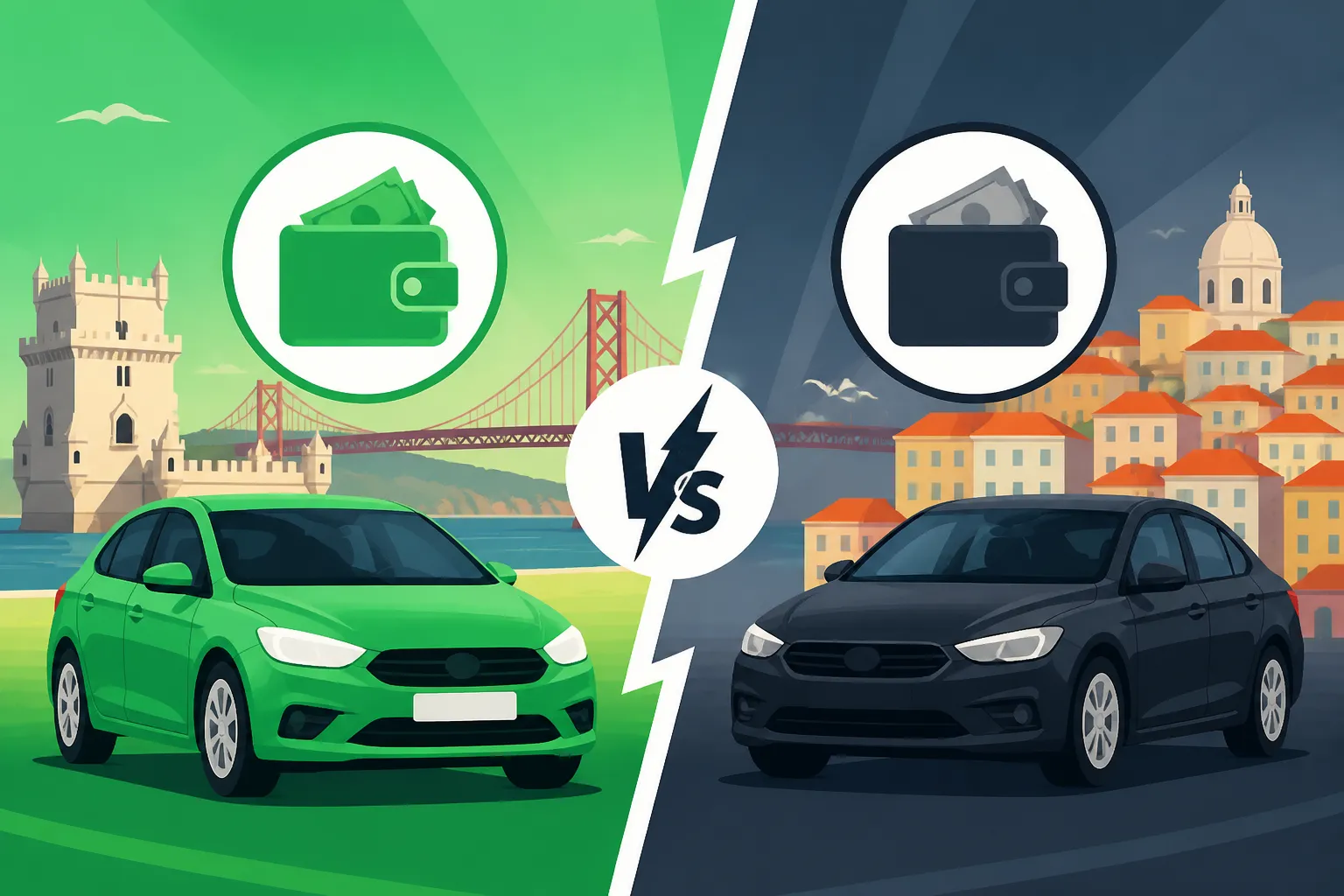
The short answer is: yes, Bolt is frequently cheaper, but there is a catch. Bolt entered the Portuguese market with a strategy of aggressive undercutting. They typically take a lower commission from the drivers (often around 15% to 20%) compared to Uber’s higher take. This allows Bolt to offer lower base fares to the passenger while theoretically keeping the driver’s take-home pay similar.
In my experience living in various Lisbon Neighborhood Guide: Best Areas for Expats and Digital Nomads, a standard ride from Cais do Sodré to Belém might cost €6.50 on Uber but only €5.20 on Bolt. While a Euro here or there doesn't seem like much, it adds up quickly if you are using these services daily. Bolt also runs frequent "campaigns" where they offer 20% to 50% discounts for a week at a time. I always check both apps, but nine times out of ten, Bolt wins on the raw number.
The "catch" with Bolt’s lower pricing is the surge logic. Because Bolt is the "budget" option, when it rains in Lisbon or Porto, everyone jumps on the Bolt app. This causes their surge pricing to spike much faster and higher than Uber’s. There have been moments where a Bolt ride was quoted at €15 due to high demand, while Uber—having more "Premium" or "Comfort" cars available—stayed steady at €11. If the price looks insane on one app, it is a veteran expat move to immediately check the other.
Quality of Service and Driver Behavior
Uber generally maintains a slightly higher standard for its "Comfort" and "Black" categories. If you are moving into a new place and have just signed a Portuguese Lease Contracts (Contrato de Arrendamento): What to Look For, you might have several suitcases or a small piece of furniture you bought at a local shop. In these cases, booking an "Uber XL" or "Bolt XL" is essential. Uber's XL drivers tend to be a bit more professional in my experience, often helping with bags without being asked, whereas Bolt drivers might stay in the car unless prompted.
One frustration I've faced repeatedly is the "phantom driver" on Bolt. Because the fares are lower, Bolt drivers are more likely to cancel your ride if they see a more lucrative "priority" fare pop up on their screen or if they simply don't want to drive into a high-traffic area like the Avenida da Liberdade during rush hour. Uber seems to penalize drivers more strictly for cancellations, so if you are in a rush to get to a medical appointment you booked through the Hospital da Luz app: How to Book a Specialist Appointment on your phone, Uber is often the more reliable bet.
Safety features are robust on both. Both apps allow you to share your live location with a friend. This is particularly useful if you are heading home late from a night out in Bairro Alto or Ribeira. I personally feel comfortable in both, but if you prefer a driver who speaks fluent English, Uber’s "Comfort" tier is worth the extra €2. These drivers are usually higher-rated and more accustomed to interacting with the international community.
Regional Availability and the Algarve Factor
In Lisbon and Porto, the competition is fierce, and you will rarely wait more than three or four minutes for a car on either app. However, if you are living the Cascais expat life: Is the premium rent worth the seaside lifestyle or staying in the Silver Coast, the availability changes. Bolt has a surprisingly strong presence in smaller towns because their lower entry barriers for fleet owners make it easier to operate where demand is lower.
The Algarve is a completely different beast. During the summer months, the Cost of living in the Algarve: Winter vs Summer price differences for expats becomes very apparent in the rideshare market. Prices can triple during July and August. In Faro, Albufeira, and Lagos, Uber is often dominant, but Bolt is catching up by recruiting seasonal drivers. A word of warning: during the peak of summer, neither app may be able to find you a car at 2:00 AM after a festival. It is always good to have the number of a local "Radio Taxi" as a backup, though they will almost certainly be more expensive.
If you are staying in more remote areas, don't forget that you can also use these apps for more than just people. If you've ordered something from Amazon Spain and it’s delivered to a pickup point that's a bit too far to walk, a quick Bolt ride is a lifesaver. Just be sure to check the map within the app; sometimes Bolt’s GPS in rural Portugal can be a little "creative" with one-way streets, leading to a frustrated driver calling you in Portuguese.
Comparing Costs and Features
To help you visualize the differences, I’ve put together this table based on typical mid-range trips in Portuguese cities.
| Feature | Uber | Bolt | Traditional Taxi |
|---|---|---|---|
| Base Fare | Slightly Higher | Lowest | Regulated / Higher |
| Availability | Excellent (Major Cities) | Excellent (All regions) | High (Taxi Ranks) |
| Vehicle Types | Green, Comfort, XL, Black | Economy, Bolt, XL, Electric | Standard Sedan |
| Cancellation Rates | Low | Moderate | N/A |
| App Features | Highly Polished | Simple / Functional | Phone Call / Local Apps |
| Best For | Reliability & Business | Daily Budget Commutes | Short hops / No Data |
As you can see, the choice depends on your priority. If you are a student or on a tight budget, Bolt is your best friend. If you are an expat professional who needs to ensure you aren't late for a meeting about Taxation on Portuguese Salaries: IRS Withholding and Social Security, you might find the extra cost of Uber worth the peace of mind.
Tips for Saving Money and Navigating Like a Local
One of the best ways to save money is to use the "Green" or "Electric" categories. Both apps are heavily incentivizing electric vehicle (EV) use in Portugal to meet EU climate goals. Often, an "Uber Green" or "Bolt Electric" ride is actually cheaper than the standard "X" or "Economy" category because the apps lower the service fee for these drivers. Plus, you get to ride in a silent Tesla or Nissan Leaf, which is much nicer when navigating the steep inclines of Graça.
Another tip: watch your pickup location. In places like Lisbon's Rossio station or Porto’s São Bento, there are specific "TVDE" pickup zones. If you try to call a car to a restricted bus lane, the driver will be forced to cancel or drive around the block, and you might get charged a "no-show" fee. Always look for the blue "TVDE" signs on the street—it's where the drivers are legally allowed to stop.
If you are just arriving and need to move your entire life into a Uniplaces rental, don't try to squeeze four people and six suitcases into a standard Bolt. The driver will arrive, see the luggage, and likely refuse the ride because it's a safety hazard. Pay the extra €4 for an XL. It saves the headache of standing on the sidewalk arguing in broken Portuguese while the driver tries to explain why their trunk won't close.
Lastly, always check for "MB Way" integration. Using the MB Way app: Why it’s better than carrying cash in Portugal is the gold standard for payments here. While you usually link a credit card to Uber or Bolt, having your Portuguese bank account connected via MB Way or a digital card can sometimes help you avoid foreign transaction fees if your primary card is still from the US or UK.
Choosing Between Apps for Long-Term Living
For those of us living here long-term, the best strategy is a hybrid one. I keep both apps in a dedicated "Travel" folder on my phone. On Monday morning, I check my email for Bolt promo codes. If I have a 30% discount, Bolt is my go-to for the week. If I'm heading to an important appointment at the Centro de Saúde: Getting Your SNS Número de Utente, I'll open Uber to see which driver is closer.
It is also worth noting that Bolt has expanded into "Bolt Food" and electric scooter rentals. If you use their scooters, you can sometimes earn credits that apply to your next car ride. Uber offers "Uber Eats" integration, but the cross-platform rewards are generally less frequent than Bolt’s. If you are trying to minimize the number of apps on your phone while maintaining a low Cost of Living in Portugal 2026: Detailed Budgets for Singles and Families, Bolt’s all-in-one ecosystem is quite compelling.
Ultimately, the "cheaper" app is the one that has a car nearest to you when the surge pricing hasn't kicked in. In a country where things can sometimes move at a "manhã" (tomorrow) pace, having the ability to summon a car in minutes is one of the greatest modern comforts for any expat. Whether you choose the sleek reliability of Uber or the budget-friendly hustle of Bolt, you’ll find that getting around Portugal has never been easier.
Disclaimer
The information provided in this guide is for general informational purposes only and represents the personal experiences of the author. Prices, app features, and regional availability for ride-hailing services in Portugal are subject to change by the respective companies (Uber and Bolt) and local government regulations. Always check the individual apps for the most current pricing and terms of service before booking a ride.