Markets in Portugal: Food, Flea, and Farmers’ Markets
Disclosure: This article contains affiliate links. If you buy through them, we may earn a commission at no extra cost to you. Read our full disclosure.
A Saturday morning at a Portuguese market can go two ways. You can wander in at noon, find half the stalls packed up, and get waved off by a fishmonger because you pointed instead of asked. Or you can arrive early, greet the right people, and leave with a bag of cheese, cherries and a vintage tile. This guide covers how to get the second outcome.
Why Portuguese Markets Feel Confusing at First
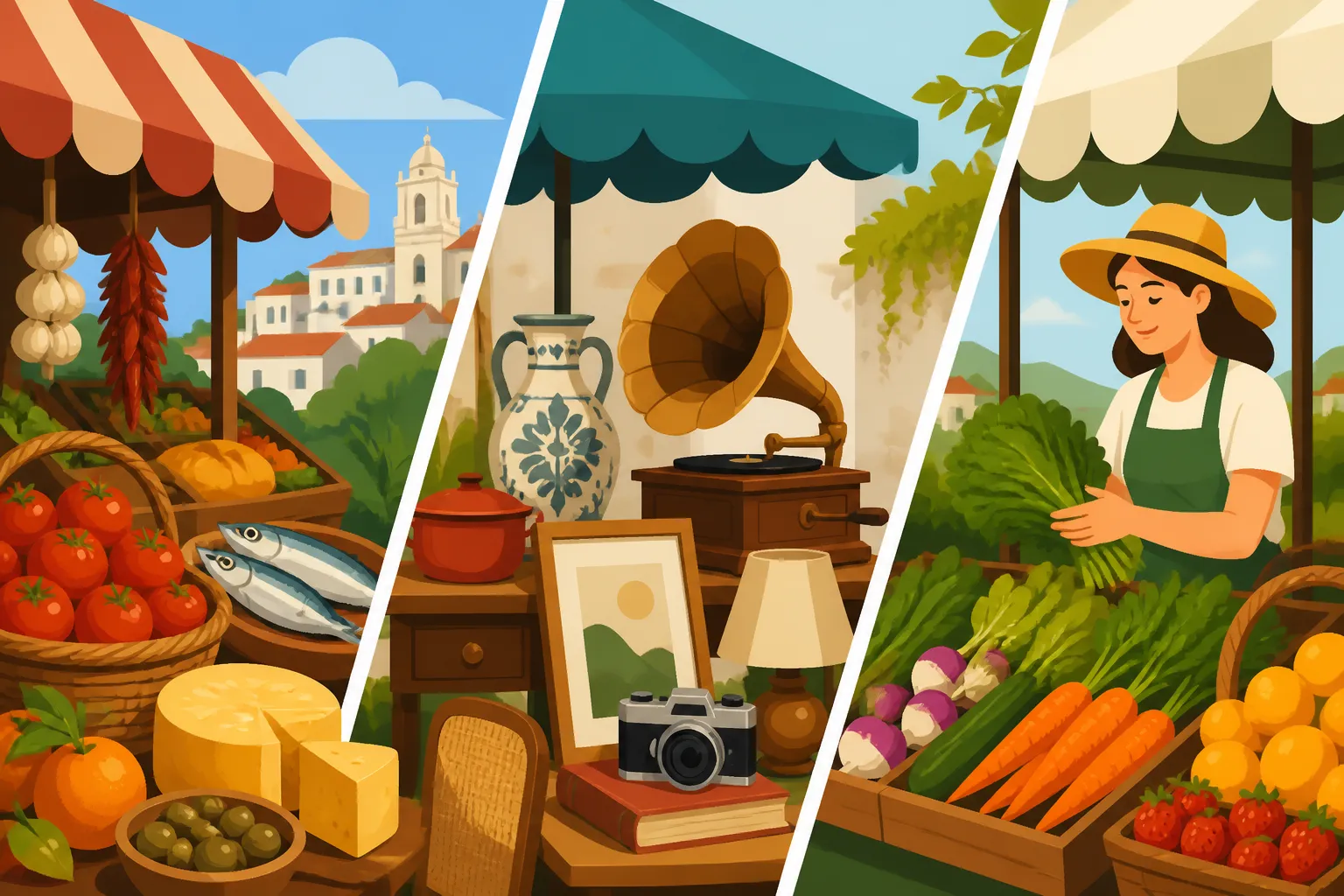
When I first moved here, I assumed a market was a market. I would read “Mercado” on a map, show up with a tote bag, and find either a gleaming food hall with craft beer or a half-empty concrete building with three elderly women selling cabbages. Both were real markets. Neither matched what I expected. Portugal has several distinct traditions sharing similar names, and each one has its own schedule, etiquette and kind of treasure.
Mercado Municipal, Feira, and Food Hall Explained
A mercado municipal is the permanent municipal market. It usually runs from Monday to Saturday and is busiest in the morning. Think fish counters on crushed ice, butchers, fruit and vegetable stalls, and a few cheese and charcuterie sellers. These are where locals do their weekly shopping, and they are the beating heart of most towns, from Setúbal to Braga.
A feira is different. It is a periodic fair, often weekly or monthly, held in an open square or on a patch of land at the edge of town. A feira can sell almost anything: live chickens, plastic buckets, underwear, olive trees, pottery, cheap sneakers and handmade baskets, sometimes all within a few metres of each other. Flea markets also fall under this word, which is why “Feira da Ladra” in Lisbon and the weekly fair in Barcelos share a label but feel completely different.
Then there is the modern food hall, the Time Out Market model, where a traditional market building is partly converted into a dining space with restaurant counters and long communal tables. These are great for a lunch that samples several regional dishes, but they are not where you buy groceries. Knowing which of the three you are heading to saves a lot of disappointment.
The Unwritten Rules of Market Timing
Here is the hardest lesson I learned: Portuguese markets reward early birds and punish late risers. The fish is landed, sold and gone by late morning. Many municipal markets wind down around lunchtime, and some stalls close earlier still. If you arrive in the afternoon, you may find the building open but the best counters hosed down and empty.
Sundays and Mondays are the tricky days. Many municipal markets close on Sunday, and fish counters are often thin on Monday because the fishing boats did not go out the day before. Saturday is the liveliest day almost everywhere, with extra stalls spilling into the streets. If you only have one morning in a town, make it Saturday and get there before mid-morning.
The weekly feiras follow their own fixed calendar, usually tied to a specific weekday, or to a specific Sunday of the month. Check the local câmara municipal website or ask at your guesthouse the day before, because a town with a famous fair can feel completely deserted on the other six days of the week.
Food Markets Worth Planning a Morning Around
Food markets are where you see how Portuguese people actually eat. The produce follows the seasons, the fish depends on the tide and the weather, and the vendors will happily tell you how to cook anything you buy, if you ask in the right way. If you want to know what to look for at the fish counter, see Seafood in Portugal: Bacalhau, Sardines, and More.
Lisbon: Ribeira, Campo de Ourique, and Arroios
The Mercado da Ribeira in Cais do Sodré is the most famous market in the country, largely because half of it is now the Time Out Market food hall. The other half, the traditional fresh market, still trades in the mornings, and it is worth seeing before the tourists arrive for lunch. Walk the fish aisle early, then buy fruit for the day, and you will have seen both sides of the building.
Mercado de Campo de Ourique is my personal favourite in Lisbon. It is a neighbourhood market with a covered food court that is used mainly by local residents rather than tour groups. You can shop for vegetables in the morning, then sit down for grilled fish or a glass of wine at one of the inner counters. The atmosphere feels like the neighbourhood’s living room.
For something rawer and more everyday, try Mercado de Arroios. This is where you see grandmothers haggling over chard and stallholders who have run the same counter for decades. It is less polished, and that is exactly the point. For more on combining these with Lisbon’s design and creative markets, see How to Visit the LX Factory and Lisbon’s Markets.
Porto’s Bolhão and the Northern Food Halls
The Mercado do Bolhão is Porto’s grand old market, a two-level iron and stone building in the city centre. After a long restoration, it is again a working market with fishmongers, flower sellers, bakers and stalls selling canned fish, cured sausages and northern cheeses. The vendors here have a reputation for being loud and direct, and you will hear them calling out prices before you see them.
Do not treat Bolhão as a museum. Buy something, even if it is just a bag of cherries or a slice of broa, the dense corn bread of the north. The vendors notice whether you are shopping or simply photographing them, and the conversations you get as a customer are far better. For a full walkthrough of the stalls and the best times to visit, see How to Shop at the Bolhão Market in Porto.
If you want a more modern take, the Mercado do Bom Sucesso in Boavista is a renovated market turned food court. It is useful on a rainy day, but it is a dining venue rather than a fresh produce market, so treat it as a lunch stop.
Southern and Island Gems: Olhão, Setúbal, and Funchal
In the Algarve, the Mercado de Olhão sits in two red-brick buildings on the waterfront, one for fish and one for fruit and vegetables. On Saturday mornings, farmers set up extra stalls outside selling honey, almonds, figs, carob and homemade sausage. It is one of the most authentic market mornings in the south, and it feels nothing like the resort strips further west.
The Mercado do Livramento in Setúbal is a short trip south of Lisbon and is often counted among the best fish markets in Portugal. The interior walls are lined with azulejo panels depicting rural and fishing life, and the fish counters are some of the most varied I have ever seen. Expect cuttlefish, the local speciality, in many forms.
In Madeira, the Mercado dos Lavradores in Funchal is spectacular, with flower sellers in traditional dress and towers of tropical fruit. But be careful at the fruit stalls in the main hall. Some vendors offer you a sample, cut more fruit while you are still chewing, and then present a startlingly high bill for an exotic fruit mix. Always ask the price per kilo before you accept a taste. For the rest of the island, see Madeira for Travelers: Levadas, Funchal, and Peaks.
Flea Markets and Antique Hunting
Portuguese flea markets are glorious chaos. You will dig through old keys, faded postcards, chipped plates, military buttons, vinyl records and the occasional genuinely valuable antique. The thrill is in the hunt, and the frustration is real too: the good stuff goes fast, and quality varies wildly.
Feira da Ladra in Lisbon
The Feira da Ladra, literally “the thieves’ market”, takes over Campo de Santa Clara, near the National Pantheon in Alfama, on Tuesdays and Saturdays. It is the oldest and most famous flea market in Lisbon. Sellers lay blankets on the ground or set up folding tables, and the range runs from priceless to truly bizarre.
Go early, especially on Saturday. Dealers and serious collectors arrive at the opening to scoop up the best pieces. By late morning, the crowd is mostly tourists browsing. The hill can be steep, so wear comfortable shoes and bring a bag you can carry over your shoulder.
One practical warning: Alfama is crowded, and flea markets attract pickpockets just as much as tram stops do. Keep your phone in a front pocket and your wallet zipped away. For more on staying alert in busy spots, see Avoiding Pickpockets and Scams in Portugal.
Vandoma, São Pedro de Sintra, and LX Market
In Porto, the Feira da Vandoma runs on Saturday mornings and is the northern answer to Feira da Ladra. It is grittier and less tourist-focused. You will find tools, electronics, old furniture and household odds and ends, with a few gems hidden among them. If you are setting up a flat, this is a good hunting ground, though for bigger furniture pieces many residents use online platforms instead. See Second-hand furniture in Portugal: Using OLX, Vinted, and Facebook Marketplace.
The Feira de São Pedro in São Pedro de Sintra is held on the second and fourth Sundays of the month. It mixes antiques, plants, food, livestock and household goods, and it has a wonderfully rural feel despite being so close to Lisbon. Combine it with a visit to Sintra’s palaces and you have a full day.
The LX Market at LX Factory, the converted industrial complex in Alcântara, runs on Sundays. It is more of a curated creative market than a true flea market, with vintage clothing, handmade jewellery, independent designers and second-hand books. It is a good option if you prefer browsing over digging.
Spotting Genuine Finds Versus Reproductions
Old azulejo tiles are the classic flea market temptation, and this is where you need to be careful. Portugal takes the theft of historic tiles from buildings seriously, and genuine antique tiles of uncertain origin are a legal and ethical grey area. Reputable antique shops can tell you where their tiles came from. A blanket seller usually cannot.
For reproductions, look at the glaze and the back of the tile. Mass-produced copies often have a perfectly uniform glaze and a clean, flat back. Older handmade tiles tend to have slight irregularities, mortar traces and a rougher body. Neither is wrong to buy, but you should pay accordingly and know what you are getting.
The same logic applies to ceramics and cork goods. If you want to understand what makes a real Caldas da Rainha piece or genuine filigree jewellery, see Portuguese Crafts: Ceramics, Cork, and Filigree before you spend serious money.
Farmers’ Markets and Weekly Town Fairs
This is where Portugal feels most like Portugal. Weekly fairs in market towns pull in farmers from the surrounding villages, and the scene has barely changed in generations. These markets are less about souvenirs and more about watching rural life unfold.
The Barcelos Thursday Fair
The weekly fair in Barcelos, in the Minho region north of Porto, is held on Thursdays on the huge Campo da República and is one of the largest and oldest in the country. Farmers sell live poultry, seedlings, wicker baskets, linen, smoked sausages and local bread, alongside the famous Barcelos pottery and the brightly painted rooster that has become a national symbol.
Barcelos is an easy trip by train from Porto. Arrive mid-morning and the fair is in full swing. Wander the pottery stalls in particular, because you will find the same rooster figures that are sold in Lisbon souvenir shops, often in more traditional styles and straight from the workshops that make them. For more ideas for northern excursions, see Best Day Trips From Porto.
A personal tip: the live animal section is genuinely interesting, but it can be confronting if you are not used to seeing chickens and rabbits sold in crates. If that is not your thing, stick to the ceramics and food end of the square.
Loulé and the Algarve’s Saturday Markets
The Mercado Municipal de Loulé sits in a striking building with Moorish-style domes and is open through the week. On Saturday mornings, the town also hosts a large weekly fair on its outskirts, and the streets around the municipal market fill with farmers selling oranges, almonds, fig cakes, honey and cheese.
Loulé is a good contrast to the coastal resorts. You will see far more locals than tourists, and the produce reflects the hills of the inland Algarve rather than the beach. Pair the market with lunch in a tasca in the old town and you will have a far more authentic Algarve day than anything at the marina.
Many other Algarve towns hold monthly fairs on a set weekend. Ask your host, or check with the local tourist office, because these change from town to town and the schedule matters.
Organic and Biológico Markets in the Cities
The urban organic market is a growing scene. In Lisbon, the Mercado Biológico do Príncipe Real sets up in the Jardim do Príncipe Real on Saturday mornings, with small producers selling organic vegetables, sourdough, natural wine and eggs. The garden setting, with its enormous cedar tree, makes it one of the most pleasant places in the city to spend a Saturday morning.
Porto and other larger towns have similar biológico markets on rotating days. These tend to attract a mix of expats, younger Portuguese families and health-conscious shoppers. The prices are higher than at a municipal market, but you are often buying directly from the person who grew the food.
If you are trying to find these smaller producer markets in other cities or villages, see How to Find Local Farmers’ Markets in Portugal for the local channels that are worth checking.
How to Shop Like a Local Without Feeling Awkward
This section is the one I wish someone had given me when I arrived. The goods are easy to find. The social choreography is the hard part.
Greeting Vendors and Ordering by Weight
Always say “Bom dia” before anything else. Walking up and pointing at tomatoes without a greeting is the fastest way to get curt service. Portuguese market culture is personal, and a greeting signals that you are a customer, not a passer-by.
Most produce is sold by the kilo. A few phrases go a long way:
- “Quanto custa o quilo?” means how much is it per kilo.
- “Meio quilo de (product), por favor” means half a kilo of (product), please.
- “Posso provar?” means may I taste it.
- “Só estou a ver, obrigado” or “obrigada” means I am just looking, thank you.
- “Quem é o último?” means who is last in line, which is how you join an informal queue at a busy counter.
That last phrase is gold. Many market counters do not have a visible line. People simply remember who arrived before them. Asking who is last, and then watching for that person, is how you avoid being skipped. For more basic vocabulary, see Survival Portuguese for Travelers: Key Phrases to Learn First.
Cash, Cards, and Bringing Your Own Bag
Many larger market stalls now accept cards or MB Way, the Portuguese mobile payment app. But plenty of smaller farmers, flea market sellers and weekly fair vendors still deal only in cash, and they will struggle to break a large note early in the morning. Carry coins and small notes. For how payments work more broadly, see Cash vs Card in Portugal and Using Multibanco.
Bring a reusable bag, or better yet a folding trolley if you plan to shop properly. Plastic bags may be offered, but locals tend to bring their own. If you are buying fish, ask the fishmonger to clean it for you with “pode limpar, por favor?”, which is a normal request and saves you a messy job at home.
Bargaining Etiquette
At municipal food markets, prices are generally fixed and posted. Do not haggle over the price of tomatoes. It is considered rude, and the margins are thin. What you can do is let a vendor round down a total, or accept a small extra like a bunch of parsley thrown in for a regular customer.
Flea markets are different. Polite bargaining is expected, especially if you buy several items. Ask the price, show interest, and offer a little less with a smile. If you are buying three things from the same seller, ask for a combined price. Be friendly, never aggressive, and walk away graciously if the seller does not budge.
At weekly fairs, it depends on what you are buying. Clothing and household goods often have some flexibility. Handmade pottery and food rarely do. When in doubt, ask “faz um descontinho?”, a soft, almost playful way of asking for a small discount.
Planning Your Market Trips
Here is a quick reference comparing the markets in this guide. Schedules can shift, so confirm locally before you travel.
| Market | Location | Type | Best Time to Visit | What to Look For |
|---|---|---|---|---|
| Mercado da Ribeira | Lisbon, Cais do Sodré | Food market and food hall | Early morning for produce, lunch for the food hall | Fish, fruit, regional dishes |
| Mercado de Campo de Ourique | Lisbon | Food market with dining counters | Weekday or Saturday morning | Fresh produce, lunch counters |
| Feira da Ladra | Lisbon, Campo de Santa Clara | Flea market | Tuesday and Saturday, early | Antiques, vintage items, curiosities |
| LX Market | Lisbon, LX Factory | Creative and vintage market | Sunday | Designer goods, vintage clothing |
| Mercado Biológico do Príncipe Real | Lisbon | Organic farmers’ market | Saturday morning | Organic vegetables, bread, natural wine |
| Mercado do Bolhão | Porto | Food market | Weekday or Saturday morning | Fish, cheese, canned fish, flowers |
| Feira da Vandoma | Porto | Flea market | Saturday morning | Tools, furniture, household items |
| Feira de São Pedro | São Pedro de Sintra | Mixed fair | Second and fourth Sundays | Antiques, plants, food |
| Feira de Barcelos | Barcelos, Minho | Weekly town fair | Thursday | Pottery, roosters, baskets, live produce |
| Mercado de Olhão | Olhão, Algarve | Fish and produce market | Saturday morning | Fish, honey, almonds, figs |
| Mercado de Loulé | Loulé, Algarve | Municipal market and weekly fair | Saturday morning | Citrus, fig cakes, cheese |
| Mercado do Livramento | Setúbal | Fish and produce market | Weekday or Saturday morning | Cuttlefish, fresh fish, azulejo panels |
| Mercado dos Lavradores | Funchal, Madeira | Food and flower market | Morning | Tropical fruit, flowers |
Getting to Market Towns
Most of the markets in this guide are reachable without a car. Barcelos and Setúbal are easy train trips from Porto and Lisbon respectively, and Loulé and Olhão connect by train or bus within the Algarve. Platforms like Omio let you compare train and bus options side by side, which is useful when you are trying to arrive in a market town before the morning rush rather than at lunch.
My one piece of advice: check the first departure of the day and work backwards. A weekly fair that starts early is not much fun if your bus arrives when sellers are already packing up their tables. Omio can help you see whether an early regional train or a coach gets you there first.
Guided Food Tours Versus Going Solo
If your Portuguese is shaky and you feel self-conscious at the counters, a guided market and food tour can be a gentle introduction. Operators listed on GetYourGuide run tastings around Lisbon and Porto markets that walk you through cheeses, cured meats and petiscos, and that context makes solo visits far easier afterwards.
Going alone has its own rewards, though. You move at your own pace, you can linger over the flea market stall that catches your eye, and the vendors often treat a lone shopper who tries a few words of Portuguese with real warmth. Many travellers do one guided tour early in their trip, then explore independently. To build your tasting list before you go, see Portuguese Regional Dishes Every Visitor Should Try.
Where to Stay and What to Do With Your Haul
If you are planning around a specific fair, stay close by the night before. Booking.com is handy for finding guesthouses within walking distance of places like Campo de Santa Clara in Lisbon or the centre of Barcelos, so you can be at the stalls when they open rather than fighting early traffic.
As for what you buy, think about transport home. Cheese, cured sausage, honey and canned fish travel well. Fresh produce is for eating that day. Fragile pottery needs wrapping, so bring a scarf or ask the seller for newspaper. Non-EU visitors buying larger items in shops, rather than at market stalls, may be able to reclaim sales tax; see Tax-Free Shopping in Portugal for Non-EU Visitors. And for honest advice on which keepsakes are worth the suitcase space, see Portuguese Souvenirs Worth Buying (and What to Skip).
The best markets in Portugal are not the polished ones in guidebooks. They are the busy Saturday mornings where you finally remember to ask who is last in line, get handed a free bunch of coriander, and realise you have started shopping like a local.
Disclaimer
This article is for general informational purposes only and does not constitute professional advice. Laws, prices and regulations vary by location and change over time. Consult a qualified professional for guidance on your specific situation.