Portuguese Crafts: Ceramics, Cork, and Filigree
Disclosure: This article contains affiliate links. If you buy through them, we may earn a commission at no extra cost to you. Read our full disclosure.
Moving to Portugal often feels like a beautiful sensory overload, but when it comes to decorating your new home or finding gifts, the sea of "tourist traps" can be frustratingly shallow. This guide helps you distinguish authentic Portuguese craftsmanship from cheap imports, exploring the deep cultural roots of ceramics, cork, and filigree to ensure you support local artisans and own pieces with genuine history.
The Art of the Azulejo and Traditional Ceramics
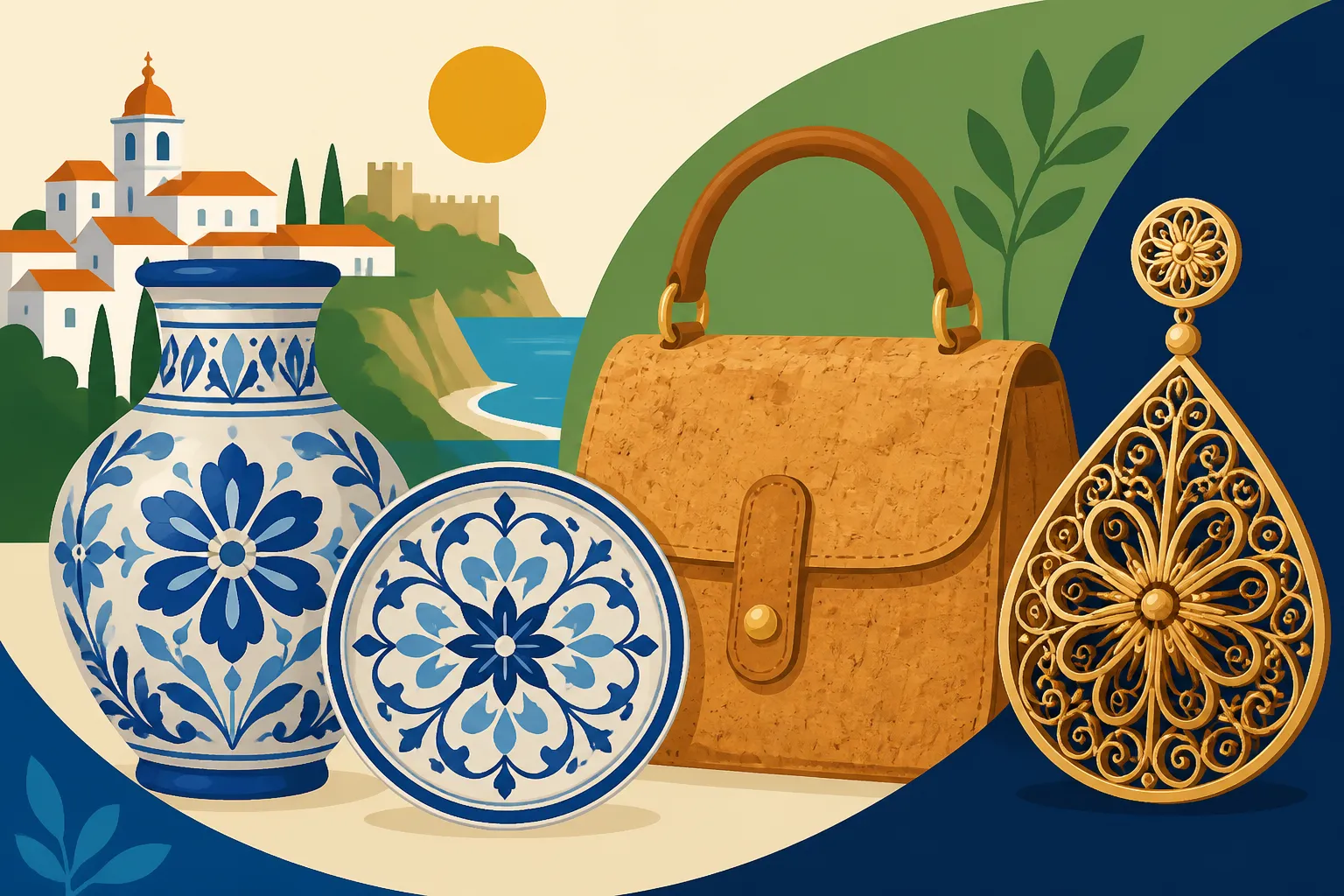
If you’ve spent more than five minutes walking through any Portuguese city, you’ve realized that the walls are literally speaking to you. The azulejo (ceramic tile) is the heartbeat of Portuguese aesthetics. However, as an expat, you’ll quickly notice a massive difference between the mass-produced coasters sold in Baixa and the hand-painted masterpieces found in small workshops. Understanding the history is the first step toward appreciation. The word itself comes from the Arabic al-zulaich, meaning "polished stone." While tiles are found across the Mediterranean, Portugal took the art form and scaled it to cover entire churches, palaces, and train stations.
The Evolution of Tile Art and Design
Traditional Portuguese tiles are famous for their blue and white patterns, a style that became dominant in the 17th and 18th centuries. This wasn't just a random choice; it was heavily influenced by the "China mania" of the era and the importation of Ming Dynasty porcelain. When you visit a local workshop, you’ll see artisans still using the majolica technique, where metallic oxides are painted onto a raw, unfired tin glaze. It’s a high-stakes game—one wrong brushstroke and the tile is ruined.
For those living in the capital, checking out the Lisbon Neighborhood Guide: Best Areas for Expats and Digital Nomads will show you how different districts utilize tiles to tell their own stories. In Alfama, tiles often depict religious scenes or "registos" designed to protect the house from fires or earthquakes. If you're interested in trying this yourself, you can use GetYourGuide to find authentic tile-painting workshops where master craftsmen teach you the "stencil" and "freehand" methods. It's a wonderful way to ground yourself in the local culture rather than just being a spectator.
Regional Pottery: From Caldas to Alentejo
Beyond the flat tile, Portugal’s 3D ceramic game is incredibly strong. If you head north of Lisbon to Caldas da Rainha, you’ll encounter the legacy of Rafael Bordallo Pinheiro. His work is the antithesis of "minimalism." We’re talking about plates that look like giant cabbage leaves, soup tureens shaped like ducks, and the famous (and often controversial) phallic pottery that populates the local markets. It’s whimsical, vibrant, and deeply satirical.
Further south, the Alentejo region offers a completely different vibe. Here, the pottery is often rustic, earth-toned, and functional. Places like São Pedro do Corval, near Reguengos de Monsaraz, are home to dozens of family-run potteries. You can literally walk into a "olaria" and watch a master potter turn a lump of clay into a "talha" (large clay jar) used for fermenting wine. If you're planning a trip to see these artisans, using Omio to book a bus or train down to Évora is the most efficient way to navigate the rural landscape. Once you’re there, you’ll find that the Portuguese Coffee Culture and Restaurant Etiquette: Ordering Like a Local often involves being served in these very same rustic ceramic vessels.
Buying and Shipping Ceramics as an Expat
The biggest heartbreak for many expats is finding a stunning, oversized ceramic vase in a rural village and realizing it won’t fit in their suitcase—or worse, trying to ship it through CTT and having it arrive in a hundred pieces. When buying high-end ceramics like Vista Alegre (the gold standard of Portuguese porcelain), always ask about professional international crating.
If you are currently Buying furniture for your new flat: IKEA, Conforama, and local shops, consider integrating these artisanal pieces as statement items. A hand-painted ceramic lamp or a set of Alentejo "pratos" can transform a generic apartment into a home that feels connected to Portuguese soil. Many expats also find gems by browsing Second-hand furniture in Portugal: Using OLX, Vinted, and Facebook Marketplace, where legacy ceramic collections are often sold by families at a fraction of their gallery price.
Cork: Portugal’s Sustainable Gold
Many foreigners arrive in Portugal thinking cork is just for wine bottles. They couldn't be more wrong. Portugal is the world’s largest producer of cork, accounting for over 50% of the global supply. This isn't just an industry; it's an ecosystem. The montado (cork oak forest) is a protected landscape, mostly located in the Alentejo and parts of the Algarve. For an expat, understanding cork is about understanding the Portuguese value of patience. A cork oak tree must be 25 years old before its first harvest, and even then, the first batch is too "virgin" and rough for high-quality use. It takes another nine years for the bark to regrow for the next stripping.
The Stripping Process and the Montado Landscape
If you have the chance to visit the interior during the summer months (typically June to August), you can witness the "descortiçamento" (the stripping). Men use specialized axes to slice the bark with surgical precision. If they cut too deep and hit the "mother" trunk, the tree dies. It is a high-skill, high-pay manual labor job that has remained unchanged for centuries. The trees are then marked with a white number indicating the year they were stripped, so the owner knows exactly when they can return—nine years later.
Living in the south, perhaps while exploring The Algarve for Expats: Lagos, Faro, and Tavira Compared, you’ll see the influence of the cork industry everywhere. The trees themselves provide a habitat for the endangered Iberian Lynx and the Spanish Imperial Eagle. As a resident, purchasing cork products isn't just about the "souvenir" factor; it's about supporting a carbon-sequestering industry that prevents the desertification of the Portuguese interior.
Modern Innovation: Cork as a Textile
In the last two decades, Portuguese designers have pushed cork far beyond the bulletin board. You’ll find "cork leather" used for high-fashion handbags, wallets, umbrellas, and even yoga mats. Cork is naturally antimicrobial, water-resistant, and surprisingly soft to the touch. It’s also a fantastic insulator. If you are struggling with the typical Portuguese winter chill—often discussed in guides about the Cost of Living in Portugal 2026: Detailed Budgets for Singles and Families—you’ll find that cork flooring or even wall panels are elite solutions for keeping a home warm and damp-free.
When shopping for cork, beware of the "pressed" versions often found in tourist kiosks. These are usually scraps of cork glued together with synthetic binders. Real, high-quality cork textiles are made from thin "veers" of natural cork harvested in whole sheets. These pieces will last a lifetime, whereas the cheap versions will crack and peel within a year. Look for brands like Pelcor or Artelusa if you want items that actually stand up to daily use.
Sustainable Living and Cork Crafts
As we move toward a more eco-conscious lifestyle, cork is the hero of the Portuguese economy. You can find everything from cork-based furniture to soundproofing materials. Many expats choose to stay in eco-hotels in the Alentejo, often booked through Booking.com, which are built entirely using cork insulation. It gives the rooms a specific, earthy scent and an acoustic silence that is hard to find in modern concrete builds.
| Craft Type | Primary Region | Typical Price Range | Key Feature |
|---|---|---|---|
| Azulejos (Hand-painted) | Lisbon / Aveiro | €15 – €100+ per tile | Traditional tin-glaze technique |
| Cork Fashion | Alentejo / Algarve | €20 – €250 | Vegan, water-resistant, sustainable |
| Filigree Jewelry | Gondomar / Viana | €50 – €2,000+ | Intricate gold/silver wire work |
| Arraiolos Rugs | Alentejo | €200 – €5,000 | Hand-stitched wool on linen |
| Black Pottery | Bisalhães | €10 – €150 | Fired in earth pits for smoke color |
Portuguese Filigree: Gold and Silver Embroidery
If ceramics are the skin of Portugal and cork is its muscle, filigree is undoubtedly its soul. Filigrana is the art of twisting incredibly thin wires of gold or silver into complex patterns, which are then soldered together to create jewelry that looks like metallic lace. While other countries have filigree, the Portuguese style is distinguished by its "puxado" technique, where the frame is created first and then filled with "filling" wires so thin they are almost invisible to the naked eye.
The Heart of Viana and Symbolic Jewelry
The most iconic piece of Portuguese filigree is the Coração de Viana (the Heart of Viana). While it’s now a symbol of love and Portuguese identity, its origins are actually religious. Queen Maria I commissioned the first "heart" in the late 18th century to thank God for the birth of her son. The "flame" at the top of the heart represents the Sacred Heart of Jesus.
For an expat, wearing a Viana heart is often seen as a sign of integration and respect for local traditions. You’ll see them in abundance during the "Romaria de Nossa Senhora d'Agonia" in Viana do Castelo, where hundreds of women parade through the streets "loaded" with gold. If you’re heading north for this festival, check out Finding Doctors and Specialists in Portugal: English-Speaking Medical Care just in case the summer heat or the crowds get the better of you—it’s a busy time in the Minho region!
Gondomar: The Workshop of the North
While Viana do Castelo is where the jewelry is celebrated, Gondomar, near Porto, is where it is made. Over 60% of Portuguese jewelry is produced in this municipality. Many of the workshops are tucked away in unassuming residential buildings, where three generations of a family might be working at the same bench.
When buying filigree, the hallmark is your best friend. Authentic Portuguese gold is 19.2 karats (80% pure), which is higher than the 14k or 18k standard in much of the US or UK. This gives it a distinctively rich, yellow hue. If you’re looking to invest in a piece, it’s worth staying a few nights in Porto. You can use Booking.com to find a boutique hotel in the Ribeira district and take a short taxi or train to Gondomar to visit the Rota da Filigrana (The Filigree Route).
How to Spot Authentic vs. Cast Filigree
It is worth warning you: 90% of the "filigree" you see in tourist shops isn't filigree at all. It is "cast" jewelry. Casting involves pouring molten metal into a mold. It’s fast, cheap, and produces a heavy, chunky piece. Real filigree is never cast. It is light, airy, and flexible. If you hold a piece up to the light, you should see the tiny gaps between the wires. If it looks like a solid piece of metal with a pattern stamped on it, walk away. Genuine filigree is an investment, often passed down through families, and its price reflects the dozens of hours of labor required to "fill" a single pendant.
Textiles and Woven Wonders
The diversity of Portuguese textiles is a map of the country’s geography and climate. In the rugged, cold mountains of the Serra da Estrela, you find Burel—a wool fabric that is felted and hammered until it becomes waterproof and virtually indestructible. Originally used by shepherds for capes to withstand the snow and rain, it is now used by high-end designers for everything from acoustic wall panels to minimalist winter coats.
The Rugs of Arraiolos and Moorish Roots
In the Alentejo town of Arraiolos, women have been sitting on their doorsteps for centuries, hand-stitching intricate rugs. The "Ponto de Arraiolos" is a specific cross-stitch on a linen canvas. The designs are a fascinating mix of Persian influence (brought by the Moors) and local flora and fauna. These rugs are not just floor coverings; they are heirlooms. A genuine, large Arraiolos rug can take months to complete and costs thousands of euros.
If you are Opening a Bank Account in Portugal: Best Banks for Foreigners and Expats and settling in for the long haul, purchasing an Arraiolos rug for your living room is a major "milestone" in a Portuguese home. They are famously durable, and rugs that are 50 years old can still look vibrant. Just remember to have them professionally cleaned by someone who understands natural dyes and wool.
Madeira Embroidery: A Dying Luxury
On the island of Madeira, embroidery is a regulated craft. To be sold as "Madeira Embroidery," a piece must be hand-stitched on the island and pass through a government verification house, where a lead seal is attached to the fabric. The level of detail is staggering—think "Richelieu" work where the fabric is cut away to create lace-like holes.
The tragic reality is that this is a "dying" art. Younger generations are less inclined to spend hundreds of hours on a single tablecloth. This makes any authentic piece you find today a potential museum item for the future. If you’re visiting the islands, use Omio to find the best flights from Lisbon or Porto, and then head to the Instituto do Vinho, do Bordado e do Artesanato da Madeira to see the real deal.
Navigating the Craft Scene as an Expat
One of the best parts of living in Portugal is the "Feira." These are the massive, often chaotic open-air markets that take place monthly or weekly. In Lisbon, the Feira da Ladra (Thieves' Market) on Tuesdays and Saturdays is a treasure trove for ceramics and old textiles. In the north, the Feira de Barcelos is the king of all markets, where you can buy everything from a live chicken to a hand-carved wooden yoke for an ox.
Distinguishing Artisan from "Made in China"
As the "expat bubble" grows, so does the influx of cheap imports designed to look like Portuguese crafts. Always check the bottom of ceramics for a "Handmade in Portugal" or "Pintado à Mão" stamp. For textiles, feel the weight and the fiber. Portugal is a powerhouse in the textile industry (even luxury brands like Hermès and Armani produce their linens here), so there is no excuse for buying synthetic blends.
Supporting local artisans is a form of cultural preservation. When you buy a hand-painted tile from a small "atelier" in Caldas or a silver filigree ring from a bench jeweler in Gondomar, you are ensuring these skills don't disappear in the face of globalization. Plus, the stories you’ll collect—the coffee the potter shared with you, or the way the weaver explained the meaning of a specific stitch—make the object infinitely more valuable than anything bought in a shopping mall.
Shipping and Logistics for Your Collection
If you're collecting these items to eventually move back home or to send gifts to family, be aware of the "IVA" (VAT) rules. If you are shipping outside the EU, you can sometimes claim a tax refund, though this is usually easier for tourists than for residents. For large items like rugs or furniture, always use a specialized moving company rather than the standard post. Many expats find that after their first year, they have "outgrown" the IKEA furniture they bought in a rush and begin replacing pieces with these authentic crafts.
Whether you are decorating a villa in the Algarve or a studio in Porto, these crafts provide a tangible link to the history of the people around you. They turn your house from a "place where you live" into a home that honors the traditions of your host country.
Disclaimer
The information provided in this guide is for informational purposes only and represents the personal experiences and research of the author as of 2026. While we strive for accuracy, local regulations regarding craft certifications, hallmarks, and shipping laws in Portugal can change. We recommend verifying specific details with local municipal offices (Câmaras Municipais) or the National Association of Jewelers and Watchmakers (Associação de Ourivesaria e Relojoaria de Portugal) before making significant financial investments in high-value artisanal goods.