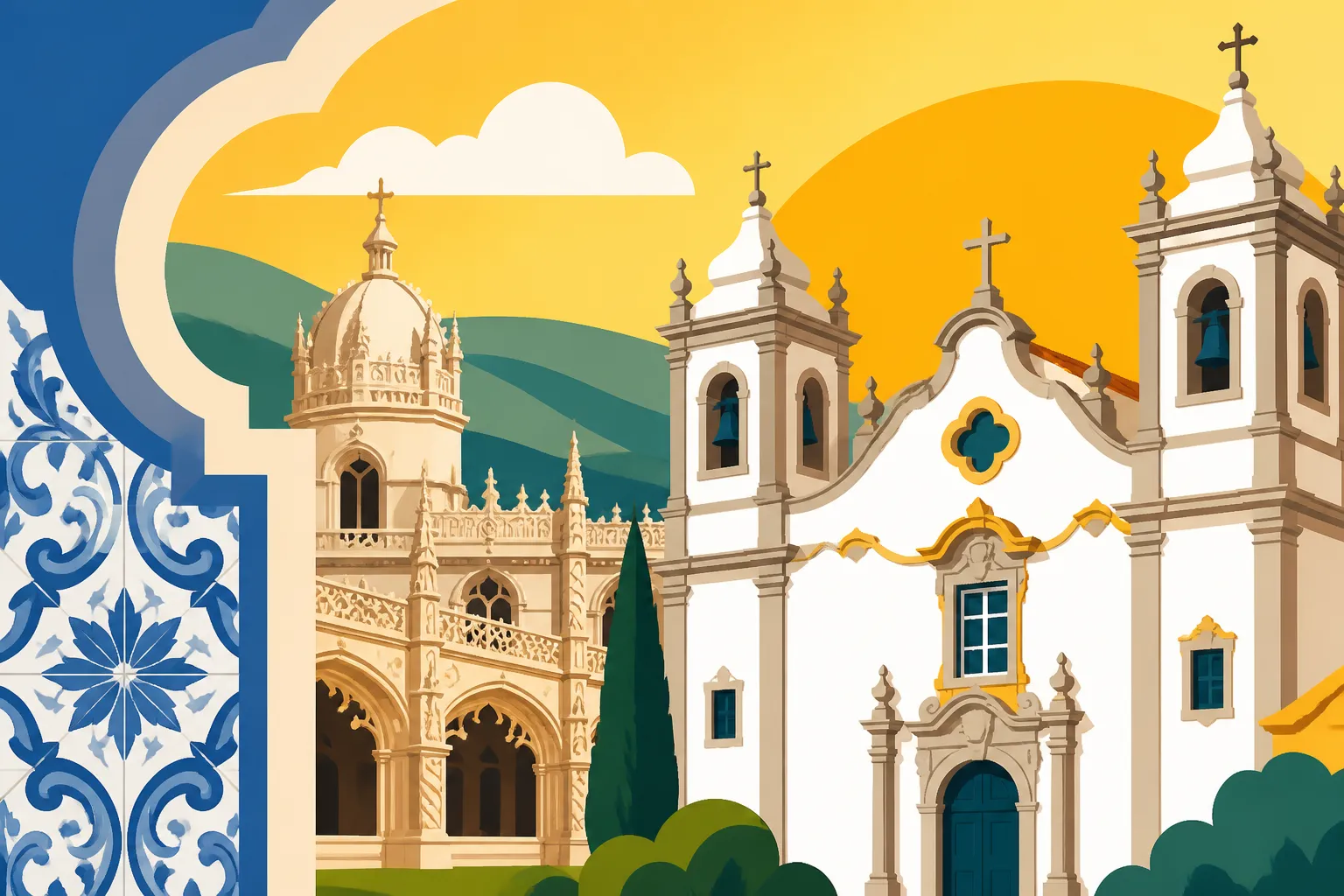
Monasteries and Churches of Portugal
Disclosure: This article contains affiliate links. If you buy through them, we may earn a commission at no extra cost to you. Read our full disclosure.
You land in Lisbon with a list of “must-see” monasteries. Then the problems start. A church that was open in the morning is locked after lunch, a sacristan quietly points at your bare shoulders, and the monastery two towns over has no direct train. This guide covers Portugal’s essential monasteries and churches, how to reach them, and how to visit without wasting a day.
Why Portugal’s Religious Buildings Deserve Their Own Trip
When I first moved here, I treated churches the way a lot of visitors do. They were background scenery between pastry stops. That changed on a wet November afternoon in Alcobaça. I ducked into the monastery to escape the rain and ended up staying three hours. Portugal’s religious architecture is not a sideshow. It is the clearest record the country has of its kings, its sea voyages, its disasters and its faith.
A Country Built Around Its Monasteries
Many Portuguese towns grew up around monastic orders. The Cistercians drained marshes and planted orchards around Alcobaça. The military orders, first the Templars and then the Order of Christ, turned Tomar into a frontier fortress. Royal vows after battles produced Batalha, whose name literally means “battle.” So when you visit these sites, you are really reading the country’s founding chapters in stone.
That also explains why the great monasteries tend to sit in small towns rather than big cities. The Silver Coast and the Ribatejo interior hold an extraordinary concentration of them. For a visitor, this is both good and bad news. The good news is that the crowds thin out quickly once you leave Lisbon. The bad news is that public transport between these towns needs some planning.
The Styles You Will Keep Seeing
Four architectural styles will follow you around Portugal, and spotting them makes every visit richer:
- Romanesque: thick walls, rounded arches and a fortress-like feel. Lisbon’s Sé and the cathedrals of Porto and Braga keep strong Romanesque bones.
- Gothic: soaring vaults and pointed arches. Alcobaça and Batalha are the textbook examples.
- Manueline: a style unique to Portugal, full of carved ropes, armillary spheres, coral and sea creatures. It celebrates the Age of Discoveries. For a deeper dive, see Manueline Architecture: Jerónimos, Belém, and Beyond.
- Baroque: gilded woodwork, called talha dourada, plus dramatic staircases and walls covered in blue-and-white tiles.
Those tiles deserve a special mention. Many visitors assume azulejos are mainly for facades and metro stations. Then they walk into a church and find entire biblical stories painted across the walls. If tiles become your obsession, as they did mine, see Azulejos: Portugal’s Tile Art and Where to See It.
Lisbon’s Essential Monasteries and Churches
Lisbon is where most people start, and the capital alone could fill several days of church-hopping. The city’s religious landscape was also shaped by the Great Earthquake of the eighteenth century. You can see that disaster’s fingerprints everywhere.
Jerónimos Monastery in Belém
The Mosteiro dos Jerónimos is the showpiece. Its cloister is a two-storey lace of Manueline stonework, and it is one of the most photographed spaces in the country. The church, Santa Maria de Belém, is free to enter and holds the tombs of Vasco da Gama and the poet Luís de Camões. The cloister requires a ticket.
Here is the frustration I hear constantly. People see the enormous queue, assume it is for everything, and give up. In reality, the church and the cloister often have separate lines. Arrive at opening time, or come late in the afternoon. Many state-managed monuments close one day a week, frequently Monday, so check before you take the tram out to Belém. For the step-by-step logistics, see How to Visit the Jerónimos Monastery in Lisbon.
The Sé, São Vicente de Fora and São Roque
Lisbon Cathedral, the Sé, sits on the route of the famous tram 28. Its fortress-like Romanesque front hides a cloister where excavations have exposed Roman and Moorish layers. Uphill, the Monastery of São Vicente de Fora has one of the largest collections of azulejos you can walk through. Its roof terrace also offers a view over the Alfama rooftops that few tourists find.
The Igreja de São Roque in Bairro Alto looks plain from outside. Inside, it holds the Chapel of St John the Baptist, which was built in Rome, blessed by the Pope and shipped to Lisbon in pieces. The interior is covered in lapis lazuli, marble and gilt. I bring every visiting friend here, and every single one has gasped.
Earthquake Survivors: Carmo and São Domingos
For something haunting, visit the Convento do Carmo in Chiado. Its roof collapsed in the earthquake and was never rebuilt, so the Gothic arches now frame open sky. Inside, the archaeological museum is small, odd and wonderful.
A short walk away, the Igreja de São Domingos survived both the earthquake and a later fire. Its columns are still scorched and cracked. Locals still attend Mass here, which reminds you that these are living churches, not museums. Lower your voice, and step aside when a service begins.
The Silver Coast Monastery Circuit
Three UNESCO-listed monasteries sit close enough together to visit on one ambitious day or two relaxed ones: Alcobaça, Batalha and the Convent of Christ in Tomar. If you are collecting World Heritage sites, see Portugal’s UNESCO World Heritage Sites: A Visitor’s Guide.
Alcobaça and the Story of Pedro and Inês
The Mosteiro de Alcobaça is the largest church in Portugal and a masterpiece of Cistercian Gothic. Its nave is so tall, white and bare that it almost feels modern. The emotional heart of the building is a pair of carved tombs facing each other across the transept.
These are the tombs of King Pedro I and Inês de Castro. Inês was murdered on the orders of Pedro’s father. According to legend, once Pedro became king, he had her body exhumed, crowned her and made the court kiss her hand. The tombs were placed foot to foot so that, at the resurrection, the first thing each would see is the other.
Do not skip the monastery kitchen. A diverted river once ran straight through it, bringing fresh fish to the monks. Its huge chimney gives you a sense of how many people this community fed.
Batalha’s Unfinished Chapels
The Mosteiro de Santa Maria da Vitória at Batalha was built to give thanks for a victory over Castile. Its exterior has an intricate, almost wedding-cake quality, with pinnacles everywhere. Inside, the Founder’s Chapel holds the tombs of King João I and Philippa of Lancaster, an English princess whose marriage sealed the old alliance between England and Portugal.
The real surprise is the Capelas Imperfeitas, the “Unfinished Chapels.” They are an octagonal space open to the sky, with Manueline portals carved in astonishing detail, and they were simply never completed. The chapter house holds the Tomb of the Unknown Soldier, guarded by a ceremonial watch. If you time it right, you can see the changing of the guard.
Tomar and the Convent of Christ
The Convento de Cristo in Tomar is my personal favourite. It started as a Templar castle, and at its core is the Charola, a round church modelled on the Holy Sepulchre in Jerusalem. Legend says the knights could attend Mass on horseback here. The paintings and gilding inside are breathtaking after the climb up the hill.
Outside, look for the famous Manueline window on the chapter house. It is carved with ropes, cork, coral and seaweed and is one of the most photographed details in Portugal. Allow at least two to three hours. The convent has several cloisters, and you will want to wander. For timings and transport, see How to Visit Tomar and the Convent of Christ. For the other two monasteries, see How to Visit the Monastery of Batalha and Alcobaça.
Planning the Circuit Without a Breakdown
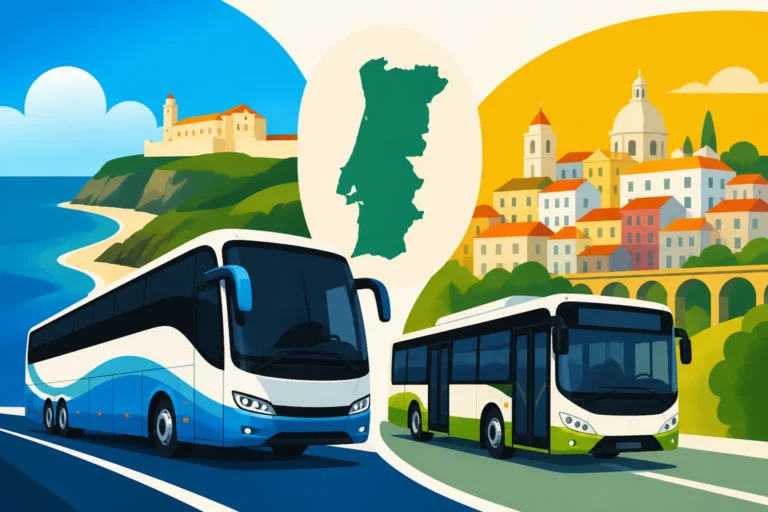
This is where visitors get stuck, and I sympathise. Tomar has a direct train line from Lisbon, but Alcobaça and Batalha are mainly served by buses. Connections between them can be sparse, especially on weekends. When I plan these trips for visiting family, comparing train and bus combinations on Omio helps me see which routes actually link up on a given day.
A realistic plan for travellers without a car looks like this:
- Take a morning train from Lisbon to Tomar and spend the first day at the Convent of Christ.
- Stay overnight in Tomar, whose quiet old town is lovely in the evening.
- Travel the next morning by bus towards Batalha, checking connections the night before.
- Visit Batalha, then continue by bus to Alcobaça for the afternoon.
- Return to Lisbon by bus from Alcobaça in the evening.
Small towns like Tomar and Alcobaça have guesthouses and simple hotels rather than big chains. I usually filter by “old town” location on Booking.com so I can walk to the monuments. If you would rather not deal with timetables at all, GetYourGuide lists guided day tours from Lisbon that bundle Batalha and Alcobaça with Fátima, Nazaré or Óbidos. The trade-off is less time inside each monument. If you drive yourself, see How to Rent a Car in Portugal Without Toll Surprises before you hit the motorways.
Northern Portugal: Porto, Braga and Sacred Staircases
The north is more devout and more traditional, and its churches feel noticeably lived-in. Elderly women light candles on weekday mornings, and festivals still spill out of church doors into the streets.
Porto’s Gilded Interiors and Tiled Facades
The Igreja de São Francisco near the Ribeira looks like a modest Gothic church from the street. Inside, nearly every surface is covered in gilded carved wood. People often say it is the most extravagant baroque interior in the country. Underneath, the catacombs hold the graves of friars and wealthy merchants.
Porto Sé, the cathedral, sits on a hilltop with sweeping views over the city. Its cloister is lined with azulejos. Then there is the Torre dos Clérigos, a baroque tower you can climb for a panorama. For tile lovers, the Capela das Almas and the side wall of the Igreja do Carmo are covered entirely in blue-and-white tiles. They are free to admire from the street.
Braga: Portugal’s Religious Capital
Braga has a saying that compares it to Rome for its number of churches. Its cathedral is among the oldest in the country. The real pilgrimage, though, is to Bom Jesus do Monte on the hill above the city. Its zigzagging baroque staircase climbs past fountains themed on the five senses and the virtues.
You can climb the steps, as pilgrims traditionally do, or take the funicular. It is powered by a water counterweight system and is a historic attraction in itself. Nearby, the Sanctuary of Sameiro offers even wider views. For day-trip logistics, see How to Visit Braga From Porto. For the wider region, see Braga and Guimarães: The Cradle of Portugal.
Lamego and the Douro Detour
If you are heading into the Douro Valley, stop in Lamego. The Sanctuary of Nossa Senhora dos Remédios sits at the top of a monumental tiled staircase that rivals Bom Jesus. In late summer, the town’s pilgrimage festival draws huge crowds. If you enjoy that kind of atmosphere, see Local Romarias and Religious Festivals in Portugal.
Central and Southern Highlights
Some of the most memorable religious sites sit away from the main tourist circuits. They are well worth the detour.
Coimbra, Fátima and Mafra
In Coimbra, the Mosteiro de Santa Cruz holds the tombs of Portugal’s first two kings, including Afonso Henriques, the country’s founder. The Old Cathedral, the Sé Velha, is a squat Romanesque fortress-church that students still gather around. For the rest of the city, see Coimbra City Guide: University Town and History.
Fátima is a different experience altogether. It is one of the world’s major Marian shrines. The vast esplanade, the small Chapel of the Apparitions and the candlelit evening processions move many visitors, religious or not. On major pilgrimage dates the town becomes extremely crowded, so check the calendar before you go.
The Palace-Convent of Mafra, north of Lisbon, is enormous. It combines a basilica, a royal palace and a monastery in one baroque complex. Its library is the highlight, and a colony of bats famously lives there and helps protect the books from insects.
Évora’s Chapel of Bones and Sintra’s Cork Convent
Évora’s Capela dos Ossos, inside the Church of São Francisco, is lined with human bones and skulls. Above the entrance, an inscription tells visitors that “we bones that are here are waiting for yours.” It sounds macabre. In practice it is a quiet, thoughtful meditation on mortality. Évora’s cathedral roof walk is also a delight. For transport, see How to Visit Évora From Lisbon.
In the Sintra hills, the Convento dos Capuchos is the opposite of grand. It is a tiny Franciscan retreat with low doorways and cells lined with cork, built into the rocks of the forest. After the crowds at the Pena Palace, it feels like stepping into silence. Combine it with the rest of the town using Sintra in a Day: Palaces and Practical Tips.
Comparing the Major Sites at a Glance
| Site | Location | Main Style | Do Not Miss | Time Needed |
|---|---|---|---|---|
| Jerónimos Monastery | Lisbon, Belém | Manueline | Two-storey cloister, Vasco da Gama’s tomb | 1.5 to 2 hours |
| Alcobaça Monastery | Alcobaça | Cistercian Gothic | Tombs of Pedro and Inês, the kitchen | 1.5 hours |
| Batalha Monastery | Batalha | Gothic and Manueline | Unfinished Chapels, Founder’s Chapel | 1.5 hours |
| Convent of Christ | Tomar | Romanesque to Manueline | The Charola, the Manueline window | 2 to 3 hours |
| Igreja de São Francisco | Porto | Gothic shell, baroque interior | Gilded woodwork, catacombs | 45 minutes |
| Bom Jesus do Monte | Braga | Baroque | Staircase, water-powered funicular | 2 hours |
| Capela dos Ossos | Évora | Baroque chapel | Bone-lined walls | 30 to 45 minutes |
| Palace-Convent of Mafra | Mafra | Baroque | The library | 2 hours |
Practical Etiquette and Planning Tips
The architecture is the easy part. The everyday logistics are what trip people up.
Dress Codes, Mass Times and Behaviour
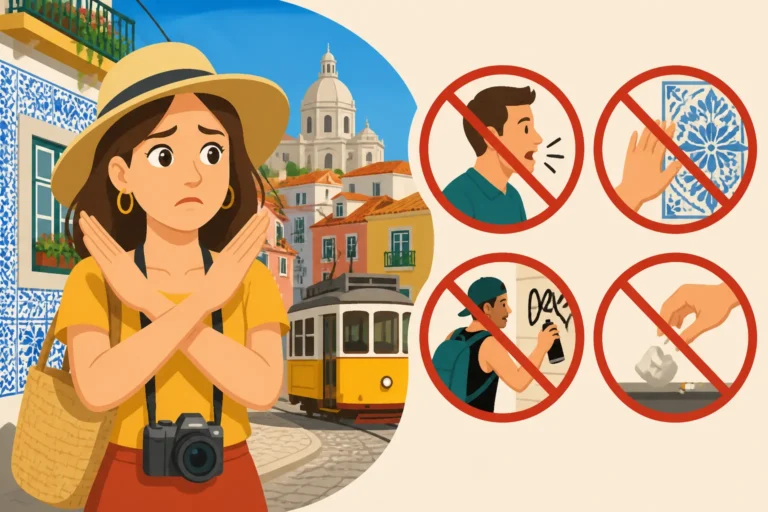
Many Portuguese churches are active places of worship. Covering your shoulders and knees is expected in most of them, and shrines like Fátima are especially strict. I keep a light scarf in my bag all summer for exactly this reason. For specifics, see How to Dress for Churches and Religious Sites in Portugal.
During Mass, wandering around taking photos is considered rude, even if the doors are open. Either sit quietly and join in, or come back later. Flash photography is often banned to protect paintings and gilding. Some sacristans also ask visitors not to photograph certain altars at all.
Opening Hours, Tickets and Donations
Small parish churches often close for a long lunch in the early afternoon and may open only around Mass times. Big monuments keep longer hours but usually have a weekly closing day. Hours also shift between summer and winter, so check the official page for each site the day before you go.
Ticketing works in a few different ways:
- Free entry: many churches charge nothing to enter.
- Separate tickets: some charge only for cloisters, towers, treasuries or museums.
- Donation boxes: even where entry is free, a small donation helps maintain the building.
- Combined passes: around the Silver Coast circuit, ask at the ticket desk whether a combined pass covers several monasteries.
- Free days: some state-run monuments have free-entry days for residents. See How to Find Free Museum Days in Portugal.
Timing Your Visit Around Religious Festivals
Holy Week brings processions, especially in Braga, where hooded penitents and candlelit streets create an unforgettable atmosphere. Churches may also restrict tourist access during services. If you will be here then, see Easter and Holy Week (Páscoa) in Portugal.
My final advice is to slow down. My best church memories have nothing to do with the famous monuments. One was an elderly sacristan in a village chapel who turned on the lights just for me. Another was organ practice drifting through an empty cathedral on a winter afternoon. Give yourself unscheduled time, and Portugal’s sacred spaces will surprise you.
Disclaimer
This article is for general informational purposes only and does not constitute professional advice. Laws, prices and regulations vary by location and change over time. Consult a qualified professional for guidance on your specific situation.