Coimbra City Guide: University Town and History
Disclosure: This article contains affiliate links. If you buy through them, we may earn a commission at no extra cost to you. Read our full disclosure.
Many travelers and expats treat Coimbra as a quick pitstop between Lisbon and Porto, often missing the profound historical weight and vibrant student culture that defines this city. This guide solves that oversight by providing a deep, local perspective on how to navigate the steep medieval alleys, understand the unique academic traditions, and manage the practicalities of living or staying in Portugal's former capital.
Navigating the Medieval Streets: Getting to and Around Coimbra
Coimbra is a city of layers, both historically and topographically. For many of us who have lived here, the first lesson you learn is that your calf muscles will undergo a significant transformation within the first week. The city is divided into the "Alta" (Upper City), where the University sits perched like a crown, and the "Baixa" (Lower City), which stretches along the banks of the Mondego River. Navigating this verticality requires a bit of strategy, especially if you are arriving with luggage or planning a long-term stay.
Arriving by Train and Bus
Most expats and tourists arrive via the northern train line or the main motorway. A common mistake I see newcomers make is getting confused between the two main train stations: Coimbra-B and Coimbra-A. Coimbra-B is the main hub where the high-speed Alfa Pendular and Intercidades trains stop. It is located slightly outside the city center. Coimbra-A is the station right in the heart of the Baixa, but it primarily serves regional lines. Usually, your ticket to Coimbra-B includes the short five-minute shuttle train to Coimbra-A, so don't pay for an extra taxi unless you are staying far from the center.
For those looking to compare prices and schedules between the national rail (CP) and various bus companies like Rede Expressos or FlixBus, using Omio is a practical choice. It simplifies the process of seeing whether a bus might actually be faster or cheaper than the train, which is sometimes the case if you are coming from the Silver Coast or the interior. If you prefer the rails, Buying train tickets online with Comboios de Portugal (CP) app is the most efficient way to manage your journeys and secure those sought-after "Promo" discounts that can save you up to 50% if booked eight days in advance.
The Geography of the Upper and Lower City
The distinction between Alta and Baixa isn't just about altitude; it is about atmosphere. The Baixa is the commercial heart, filled with traditional shops, historic cafes, and the bustling Praça do Comércio. It is flatter and easier to walk, but it can feel quite humid due to its proximity to the river. The Alta is the academic soul of the city, characterized by narrow, winding streets that have remained largely unchanged since the Middle Ages. Living in the Alta means being surrounded by student "Repúblicas" (traditional communal student houses), but it also means bracing yourself for the "Quebra-Costas" (the Back-Breaker stairs).
When you are exploring these areas, you will notice the pavement is the classic Calçada Portuguesa. While beautiful, it is notoriously slippery when wet. If you are moving here, invest in shoes with excellent grip. Many confident expats take a tumble on the limestone cobbles after a light Atlantic drizzle. Understanding this geography is crucial when deciding Where to Live in Portugal: Lisbon, Porto, Algarve, and Silver Coast Compared, as Coimbra offers a much more vertical and dense urban experience than the sprawling Algarve or the coastal Silver Coast.
Public Transport and the SMTUC
Coimbra’s municipal transport system, SMTUC, consists mostly of a dense network of buses and a few electric trolleybuses. While it isn't as expansive as the metro systems in larger cities, it is essential for reaching the outlying residential neighborhoods like Solum or Santa Clara. Unlike the Navegante Pass Lisbon: How to get the €40 monthly unlimited transit card, Coimbra uses its own ticketing system, though the prices are generally lower. You can buy "viagens" (trips) at kiosks or via the app, and it is always cheaper than buying a ticket from the driver.
For those who have lived in the north, you might be used to the Using the Andante card in Porto: Zones, top-ups, and ticket validation fines, but Coimbra’s system is a bit more old-school. There is a long-awaited "Metrobus" project currently under construction that aims to link the city center with the hospitals and the suburbs using high-capacity electric buses on dedicated lanes. Until then, expect the bus schedules to be a "suggestion" during peak student hours or when there is a football match at the Académica stadium.
The University of Coimbra: More Than Just a School
The University of Coimbra is one of the oldest in continuous operation in the world and is a UNESCO World Heritage site. But for us locals, it isn't just a museum; it is the pulse of the city. The students here wear black capes (traje académico) that might remind you of a certain famous wizarding world, but the tradition predates the movies by centuries. The presence of 25,000 students in a city of 140,000 creates a unique seasonal energy where the city breathes in during the semester and exhales in the quiet summer months.
The Joanina Library and Academic Traditions
The Biblioteca Joanina is the undisputed jewel of the university. Built in the 18th century, it is a masterpiece of Baroque architecture. One of the most fascinating details I love sharing with visitors is that the library is home to a colony of bats. These bats aren't pests; they are protectors. At night, they emerge to eat insects that would otherwise damage the ancient books. Because of the library's fragility, tickets are timed and strictly enforced. I recommend checking GetYourGuide to book a guided tour that includes the library, the Chapel of São Miguel, and the Royal Palace, as walking through these halls without context means missing the layers of royal and ecclesiastical history.
Beyond the buildings, the traditions are what truly define the university. You will often see students performing "praxe" (initiation rituals) in the squares. While it can look intense to an outsider, it is a deeply rooted part of the Coimbra identity. If you are interested in the academic side of things, perhaps because you are moving here with family, it is worth researching How the Portuguese university grading system works (0-20 scale explained) to understand the high standards held by this institution.
Student Life and the Queima das Fitas
The "Queima das Fitas" (Burning of the Ribbons) is the biggest event in the Coimbra calendar, usually taking place in May. It marks the end of the academic year for graduating students. The city turns into a week-long festival with parades, concerts, and traditional ceremonies. The "Serenata Monumental" on the steps of the Old Cathedral is a particularly moving event where thousands of students gather in their black capes to listen to Coimbra Fado.
If you are planning a visit or moving to Coimbra, you need to be aware of this week. The city becomes incredibly crowded, and noise levels in the Alta remain high until the early hours of the morning. However, witnessing the "Cortejo" (the float parade) is a bucket-list experience. Each faculty has its own color, and students distribute beer and food from decorated trucks. It is the purest expression of the "Coimbra Spirit."
Museums and Science in the University
While the library gets all the glory, the Science Museum of the University of Coimbra (located in the Laboratório Chimico) is equally impressive. It houses a vast collection of scientific instruments and natural history specimens that date back to the Enlightenment. It is an excellent place for families, providing a more interactive look at how Coimbra became a center for global knowledge.
Expats living in Coimbra often find themselves frequenting the university’s botanical garden (Jardim Botânico). Founded in 1772, it is a peaceful retreat from the urban bustle. It is free to enter and features exotic plants brought back from Portuguese expeditions in Africa, Brazil, and Asia. It is one of those spots where you can truly feel the historical reach of the Portuguese Empire while sitting on a quiet stone bench under a giant Australian fig tree.
Coimbra’s Unique Soul: Fado and Folklore
When people think of Fado, they usually think of the soul-stirring, mournful songs of Lisbon’s Alfama district. But Coimbra has its own version of Fado, and the two are vastly different. In Lisbon, Fado is often sung by women and deals with "saudade" (longing) and the hardships of life. In Coimbra, Fado is exclusively sung by men, usually current or former students, and it is often a serenade of love or a song of social and political protest.
Fado de Coimbra vs. Fado de Lisboa
The technical differences are significant. Coimbra Fado is tuned a step lower, giving it a deeper, more resonant sound. The singers do not use microphones in traditional settings, relying on the natural acoustics of the stone squares or small "casas de fado." The lyrics are also more literary and intellectual, reflecting the university environment. It is often said that if Lisbon Fado is the sound of the tavern, Coimbra Fado is the sound of the moonlit courtyard.
Another cultural rule to remember: in Lisbon, you applaud Fado. In Coimbra, you do not applaud. Instead, you clear your throat (a "hmmm" sound) as a sign of respect. This can be confusing for tourists, but following this etiquette will earn you a lot of respect from the locals. This is a prime example of why Learning European Portuguese: Top Apps, Tutors, and Free Government Classes can help you pick up on these subtle cultural nuances that make living here so much richer.
Best Venues to Experience Coimbra Fado
To experience this properly, stay away from the overly "touristy" dinner shows. Instead, look for dedicated cultural centers. "Fado ao Centro" is a fantastic venue where the musicians are all former students who explain the history of the songs in English and Portuguese. It is an intimate setting that feels more like a private recital than a commercial performance.
Another great spot is "Café Santa Cruz," located in a former wing of the Santa Cruz Monastery. The soaring vaulted ceilings provide incredible acoustics. Sitting there with a "café cheio" and a traditional pastry while the melancholic chords of the Portuguese guitar ring out is one of those quintessential Coimbra moments. Just make sure you understand Portuguese Coffee Culture and Restaurant Etiquette: Ordering Like a Local before you head in, so you can order your "bica" like a pro.
Cultural Festivals Beyond Academia
While the university dominates the scene, Coimbra has a rich municipal cultural life. The "Festas da Cidade" in July celebrate the city's patron saint, Queen Saint Isabel. These festivals involve religious processions, fireworks over the river, and outdoor concerts in the Parque Verde. It is a time when the "non-student" population of the city takes center stage.
There is also a growing contemporary arts scene. The "Círculo de Artes Plásticas de Coimbra" (CAPC) and the "Centro de Artes Visuais" (CAV) offer exhibitions that contrast sharply with the city’s medieval backdrop. For an expat, these venues are great for meeting a more diverse, international crowd that isn't solely focused on the university cycle.
Practical Living in Coimbra: Housing and Costs
Coimbra is often cited as one of the most affordable cities in Portugal for its size. However, the housing market here is notoriously tricky because of the high demand from students. If you are looking to rent or buy, you have to compete with the academic calendar.
Finding Accommodation in a Student Town
If you are looking for short-term stays to scout the area, Booking.com is your best bet for finding guesthouses in the Baixa or apartments in the Santa Clara district across the river. For long-term rentals, most locals use Idealista or Imovirtual. Be prepared: many apartments in the historic center are old and lack modern insulation. I cannot stress this enough—Portuguese winters are damp, and Coimbra, being in a river valley, can feel bone-chillingly cold indoors if you don't have a good heating system.
Expats often find that the Coimbra cost of living: Why expats and students are moving to this city is significantly lower than in Lisbon or Porto. You can still get a "prato do dia" (lunch special) for under 10 euros, and utility costs are manageable. However, the quality of housing varies wildly. Check for signs of "humidade" (dampness/mold) when viewing properties, as it is a common issue in the stone-built houses of the Alta.
Neighborhood Guide for Expats and Students
Where you choose to live depends on your lifestyle.
- Solum: This is the "modern" part of the city. It has high-rise apartments, the best shopping malls (Alma Shopping), and is very popular with families and faculty members.
- Santa Clara: Located across the river, it offers the best views of the city skyline. It’s quieter and has more green spaces, making it a favorite for retirees and expats who want to avoid the student noise.
- Celas: This area is close to the main hospitals (CHUC). It is a busy, professional neighborhood with many cafes and services. It’s perfect if you want to be centrally located but away from the medieval tourist core.
The Realities of Coimbra's Winter and Housing Quality
Living in an ancient city is romantic until February hits. Many of the beautiful buildings in the Baixa were built long before central heating was a concept. When you are looking for a place, ask specifically about "aquecimento" (heating). Many people rely on "aquecedores a óleo" (oil heaters) or "ar condicionado" (AC) units that also heat.
If you are renovating an old place or just need help with maintenance, Finding English-speaking plumbers and electricians using the Fixando app can be a lifesaver. The local tradespeople are skilled, but in a university town, they are often booked up weeks in advance. Planning ahead is the key to surviving your first winter without a major leak or a blown fuse.
| Feature | Upper City (Alta) | Lower City (Baixa) | Modern Suburbs (Solum/Celas) |
|---|---|---|---|
| Vibe | Academic, Historic, Noisy | Commercial, Touristy, Busy | Residential, Family-friendly |
| Housing | Old, stone buildings | Renovated flats, damp issues | Modern apartments, better insulation |
| Accessibility | Very steep, narrow streets | Flat, walkable | Wide boulevards, bus-dependent |
| Cost | Mid-range (student demand) | High (tourist/AirBnb demand) | Moderate to High (professional demand) |
Sightseeing and Experiences: Curating Your Itinerary
Coimbra isn't just about the university. The city is packed with monasteries, gardens, and hidden ruins that tell the story of Portugal's foundation. If you are here for a few days, you need to balance the "must-sees" with some local favorites.
Historic Monasteries and Churches
The Monastery of Santa Cruz is where the first two kings of Portugal are buried. Its Manueline facade is stunning, and the interior "pantry" cafe is a great place to soak in the history. Across the river, the Monastery of Santa Clara-a-Velha tells a more tragic story. It was abandoned because of constant flooding from the Mondego. Today, you can visit the partially submerged ruins and the modern museum that explains the life of the Poor Clare nuns.
For those who want a guided experience that covers both the famous and the forgotten corners of the city, I recommend checking GetYourGuide for walking tours led by local historians. They can take you to the "Sé Velha" (Old Cathedral), which looks more like a fortress than a church, reflecting the era when Coimbra was a frontier city between the Christian north and the Moorish south.
Exploring the River Mondego and Green Spaces
The Mondego River is the lifeblood of Coimbra. The "Parque Verde do Mondego" is a long stretch of green space along the banks with walking paths, bars, and restaurants. It’s the best place for a sunset stroll or a morning run. You can also rent kayaks or take a small boat cruise to see the city from a different angle.
Just a short walk from the university is "Portugal dos Pequenitos." It is a miniature park featuring scaled-down versions of Portuguese monuments and traditional houses. While it is ostensibly for children, it is actually a fascinating look at the architectural history of the former Portuguese colonies. It was built during the Estado Novo period and remains one of the most visited attractions in the country.
Day Trips from Coimbra: Lousã and Conimbriga
If you have a car or are willing to brave the local buses, the surrounding region is spectacular.
- Conimbriga: Located about 20 minutes away, these are some of the best-preserved Roman ruins in Western Europe. The floor mosaics are incredibly detailed and worth the trip alone.
- Serra da Lousã: For nature lovers, the Schist Villages (Aldeias do Xisto) in the Lousã mountains are magical. These tiny villages made of dark stone are hidden in deep valleys and offer some of the best hiking in central Portugal.
- Bairrada Wine Region: Just north of Coimbra, this region is famous for its sparkling wines and "Leitão" (suckling pig). It’s a mandatory food pilgrimage for anyone living in the area.
Eating and Drinking Like a Local (Cozinha de Coimbra)
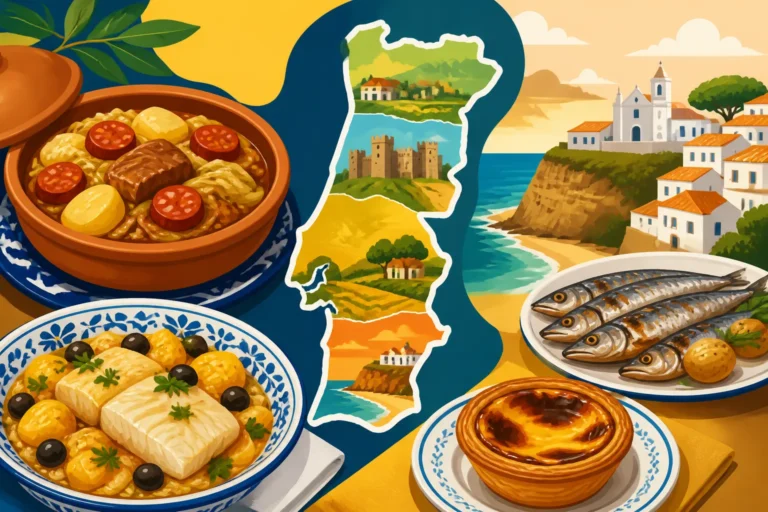
Coimbra’s gastronomy is a reflection of its location—halfway between the sea and the mountains. The food here is hearty, unpretentious, and deeply rooted in monastic and rural traditions. If you are following a Cost of Living in Portugal 2026: Detailed Budgets for Singles and Families, you will find that eating out in Coimbra is remarkably affordable compared to the Algarve or Lisbon.
Traditional Dishes: Chanfana and Leitão
The most famous dish in the Coimbra region is "Chanfana." It is goat meat slow-cooked in a clay pot with red wine, garlic, and laurel. The meat becomes incredibly tender and flavorful. Traditionally, this dish was associated with the Napoleonic invasions, as locals would hide their livestock and then cook the older animals in wine to preserve and soften the meat.
Then there is the "Leitão da Bairrada." While the town of Mealhada is the "capital" of suckling pig, you will find excellent versions in Coimbra. The skin must be extra crispy, and the meat succulent, served with a spicy pepper sauce and "batatas fritas" (homemade chips). I recommend trying "Tia Nazaré" or one of the traditional spots in the Baixa for an authentic experience.
The Pastry Scene: Arroz Doce and Pastéis de Santa Clara
Coimbra has a legendary "Doçaria Conventual" (convent sweets) tradition. Because the city had so many monasteries, the nuns developed recipes using the egg yolks left over from starching their habits with egg whites.
- Pastéis de Santa Clara: Thin, crescent-shaped pastries filled with an almond and egg yolk cream.
- Arroz Doce (Coimbra Style): This rice pudding is different here; it is often served cold with elaborate cinnamon patterns on top and is a staple at every family gathering.
- Crúzio: A specialty of Café Santa Cruz, these are almond-based cakes that have become a modern symbol of the city.
Where to Shop: Local Markets vs. Big Box Retailers
For the freshest ingredients, skip the supermarkets like Continente or Pingo Doce and head to the "Mercado Municipal D. Pedro V." This is where the local farmers bring their produce, cheeses, and honey. It is a fantastic place to practice your Portuguese and get better prices on seasonal fruit and vegetables.
If you are an expat living here long-term, you will eventually need the convenience of the larger malls. "Alma Shopping" and "Coimbra Shopping" have everything from IKEA pickup points to large electronics stores. But for the soul of the city, nothing beats the small specialty shops in the Baixa, where you can still buy loose-leaf tea, traditional ceramics, and hand-woven linens.
Disclaimer
The information provided in this guide is for general informational purposes only. While I strive to provide accurate and up-to-date details regarding travel, culture, and living in Coimbra, regulations and prices in Portugal are subject to change. Always verify official requirements for visas, housing, and administrative procedures with the relevant Portuguese authorities.