Tipping in Portugal: When, Where, and How Much
Disclosure: This article contains affiliate links. If you buy through them, we may earn a commission at no extra cost to you. Read our full disclosure.
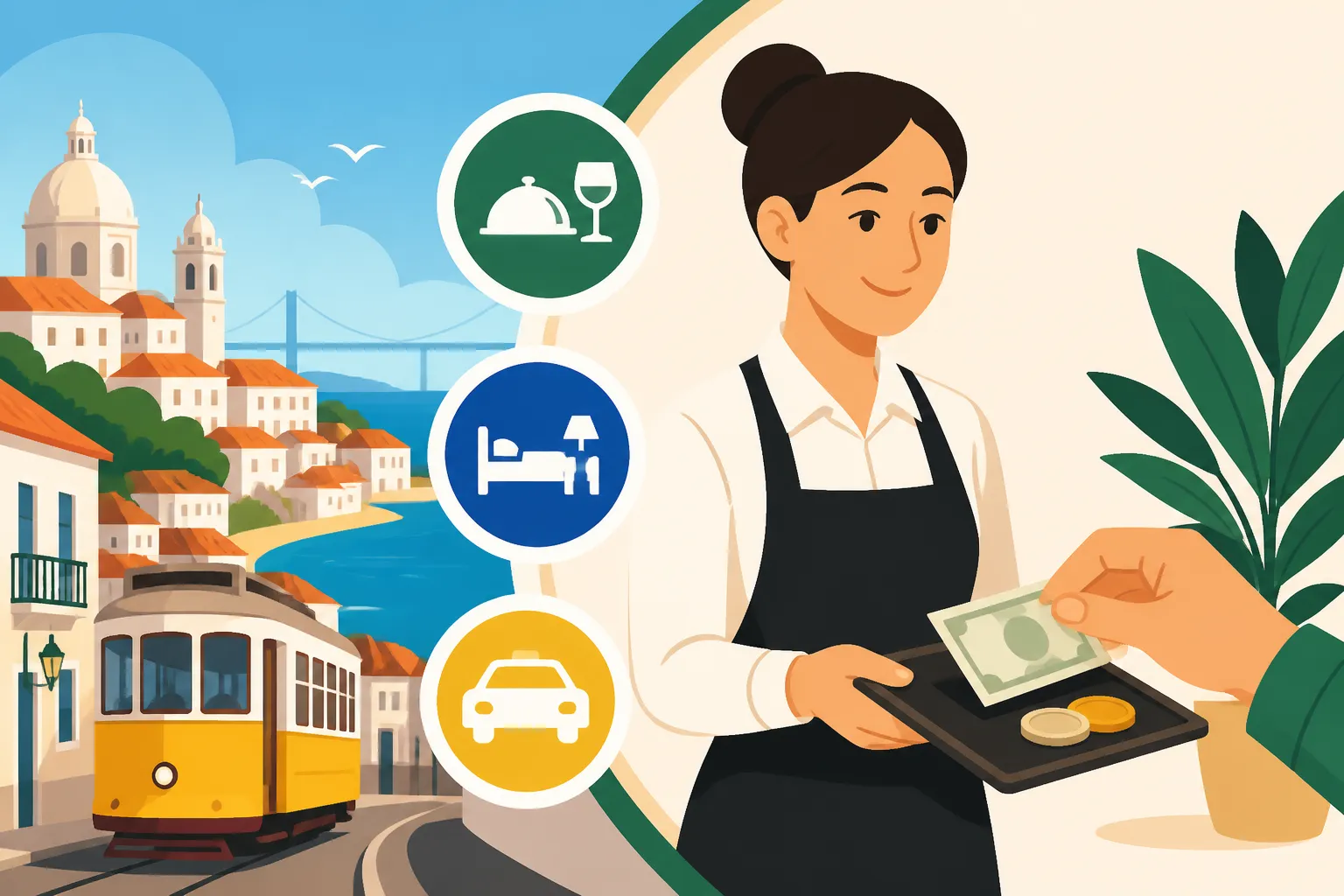
A waiter in a Lisbon tasca sets down the bill. You hold your card and wonder whether to add something, how much, and how. If you don’t, will they think you’re rude? If you do, are you just the tourist who overpays? This guide covers when, where, and how much to tip in Portugal, from a café counter in Porto to a taxi in the Algarve.
How Tipping Really Works in Portugal
I’ve lived here long enough to watch dozens of visiting friends go through the same small panic at the end of a meal. They come from a country where tipping is either compulsory or completely absent, and Portugal sits somewhere in between. The good news is that the Portuguese approach is relaxed, and nobody will chase you down the street over a missing coin. The custom does exist, though, and knowing it makes those end-of-meal moments far less awkward.
Service Is Included, the Tip Is a Thank-You
Start with the most important fact. As of October 2026, Turismo de Portugal’s official guidance for visitors says service is included in the bill at restaurants. It also says it is customary to leave an additional tip of about 5-10% of the total. No law sets a tip. That one sentence explains most of how tipping works here.
“Service included” means the staff are paid wages rather than living on tips, as servers do in some countries. Your bill is not a deposit on their rent, and there’s no hidden expectation that you’ll add a large percentage to make up their pay. When you leave something extra, it really is a gesture. It says you enjoyed the food, the waiter looked after you, and you’d come back.
Picture a typical evening. You and a friend share grilled sea bream, a salad, and a bottle of vinho verde at a family-run restaurant in Alfama. The waiter recommends the fish of the day, brings extra lemon without being asked, and jokes with you about your Portuguese. That’s the moment to leave something in the 5-10% range. Now picture a different night: the food arrives cold, the waiter vanishes for twenty minutes, and you have to flag someone down for the bill. Leaving nothing is perfectly acceptable, and nobody will hold it against you.
Where the Custom Comes From
Portuguese tipping has never been a fixed system like the North American one. Locals tend to leave small amounts, often just the coins from their change, at cafés and casual places. They are more deliberate at a proper dinner or a special occasion. In tourist-heavy neighborhoods of Lisbon, Porto, and the Algarve, staff are used to visitors leaving a bit more, but that is a habit, not a rule.
Tipping here also follows how personal the service feels. A waiter who has spent an evening guiding you through the menu gets more consideration than a counter worker who hands you an espresso in four seconds. The more someone has gone out of their way for you, the more natural a tip becomes. If you want a feel for the wider dining rhythm, see Portuguese Meal Times and Restaurant Etiquette for Visitors, which covers why dinners here can stretch on so pleasantly.
One more cultural point: Portuguese people tend to be discreet about money. Tipping is done quietly. You leave coins on the saucer, round up when paying, or say a quick phrase to the waiter. Nobody makes a show of it, and you shouldn’t feel you need to either.
Cash, Cards, and the Missing Tip Button
This is where many visitors get stuck. Card payment is widespread in Portugal, but terminals often don’t prompt you to add a tip the way they do in some other countries. The waiter brings the handheld machine to your table, you tap your card, and that’s it. Many people then realize they wanted to leave something but have no cash.
The easiest fix is to keep a small stash of coins for this purpose. Cash tips are the norm because they go straight to the person who served you. Some restaurants can add a tip to a card payment if you ask before they key in the amount, but that varies from place to place, so don’t count on it. If you want to understand how payments work here, including the national Multibanco ATM network, see Cash vs Card in Portugal and Using Multibanco.
In practice it goes like this. Before going out for the evening, withdraw a little cash from a bank-affiliated Multibanco machine rather than one of the standalone tourist-area machines. Break larger notes when you buy a coffee or a pastry. That way you have small change when the bill arrives. For a fuller sense of how much cash is worth carrying, see How Much Cash Should You Carry When Traveling in Portugal?
Tipping in Restaurants, Cafés, and Bars
Food and drink is where you’ll make most of your tipping decisions in Portugal, so it’s worth taking it venue by venue. A pastelaria counter, a neighborhood tasca, and a white-tablecloth restaurant each have their own unwritten rules.
Cafés and Pastelarias
Portuguese café culture moves fast. Locals walk up to the counter, order a bica or a galão, drink it standing, pay, and leave. Tipping at this level is not expected. If you want to leave something, leaving your small change in the little dish by the till, or telling the server to keep the change, is about as far as anyone goes.
Imagine you’ve ordered a coffee and a pastel de nata at a busy pastelaria in Baixa. You pay with a note and get a handful of coins back. You can pocket them all and no one will blink. Or you can leave the smallest coins in the saucer as a friendly gesture. Both are completely normal. What would look odd is calculating a percentage on a coffee, which isn’t done here.
Sitting down changes things slightly. Some cafés charge a little more for table service, and if a waiter brings your order to a terrace table, leaving a coin or two is a nice touch. It’s still not obligatory. For the vocabulary to order without fumbling, see How to Order Coffee in Portugal Like a Local.
Sit-Down Restaurants From Tascas to Fine Dining
This is where the 5-10% guideline applies. Whether you’re at a simple tasca with paper tablecloths or a restaurant with a tasting menu, leaving roughly 5-10% of the total is customary when you’re happy with the service. At a casual place, you’ll often end up near the lower end of that range just by rounding up and leaving some coins. At a more formal restaurant, where service is more attentive, people tend toward the upper end.
Here’s how I handle it step by step:
- Check the bill for anything you didn’t order or eat, especially the couvert, which is covered below.
- Decide whether the service deserves a tip at all. Friendly, attentive, and helpful means yes. Slow, careless, or rude means you can leave nothing.
- If you’re tipping, work out roughly 5-10% of the total and round to a convenient figure.
- Pay the bill itself by card or cash, then leave the tip in coins or notes on the table or the bill tray.
- Thank the waiter on the way out. A warm “obrigado” or “obrigada” counts for a lot.
The couvert is a uniquely Portuguese wrinkle. When you sit down, the waiter may bring bread, butter, olives, cheese, or small starters you never ordered. These are not free. If you eat them, they appear on your bill. If you don’t want them, you can politely send them back or simply not touch them. This has nothing to do with the tip, but it often confuses people at the end of the meal, so check the bill before working out your tip. See The Couvert Explained: Bread and Starters in Portuguese Restaurants for the full breakdown.
Getting the bill can also take a while. Portuguese waiters will rarely bring it until you ask, because rushing a customer is considered rude. Ask with “a conta, por favor,” and see How to Ask for the Bill in a Portuguese Restaurant for the other polite ways to signal you’re ready.
Bars, Rooftops, and Fado Houses
Bars follow the café pattern. If you order a beer or a glass of wine at the counter, tipping isn’t expected, although rounding up or leaving small change is friendly, especially if you’re staying a while and the bartender is chatty. At a cocktail bar or rooftop with table service, treat it more like a restaurant and leave a little extra if the service was good.
Fado houses are a special case. Many casas de fado work like restaurants: you have dinner while the fadistas perform between courses. The 5-10% restaurant guideline applies to the meal and service. Some smaller, more traditional venues have a more informal feel, and the musicians may be supported by the house rather than by tips. Applause, silence during the songs, and respect for the performers matter more than money here. See How to See a Live Fado Show in Lisbon (Not a Tourist Trap) to find venues where the music comes first.
A quick scenario: you’re in a small fado house in Mouraria, the singer has just finished a song that silenced the whole room, and the owner comes around for the bill. You pay for dinner and add something in that customary range because the evening was memorable. That’s a natural, appreciated gesture. Nobody expects you to tip each performer individually.
Tipping Taxi Drivers, Ride-Hailing, and Transport
Transport is the second most common tipping situation for visitors, and here the official guidance gives a clear benchmark as well.
Traditional Taxis
As of October 2026, Turismo de Portugal says it’s normal to tip taxi drivers 5-10% or round up to the nearest euro. In practice, most people simply round up. If the meter shows an amount with some cents, you hand over the next whole euro and say keep the change. For longer trips, or when the driver helps with heavy luggage, stretching to 5-10% is a kind gesture.
Imagine arriving late at night after a delayed flight. The taxi driver loads two large suitcases, finds your guesthouse in a maze of narrow streets, and carries the bags to the door. That’s exactly when you’d go beyond simple rounding. On the other hand, if the trip is short, the driver doesn’t help, and the ride is perfectly ordinary, rounding up to the nearest euro is all you need.
Taxi tipping is easier in cash. Many Portuguese taxis now accept cards, but don’t assume every one does, and having coins ready makes rounding up simple. If you’re coming from the airport, see How to Get From Lisbon Airport to the City Center to compare taxi, metro, and other options before choosing.
Bolt and Uber
Ride-hailing apps are very common in Lisbon, Porto, and the Algarve, and many expats use them more than street taxis. Tipping drivers is optional. If the app offers a tipping option after the ride, you can use it. Otherwise a small cash tip is fine. Treat it the same way you would a taxi: a small amount for good service, extra for help with luggage, and nothing if the ride was ordinary and the driver was disinterested.
The rating counts too. A five-star rating and a short positive comment often matter as much to the driver as a coin, since ratings affect their standing on the platform. If you can’t or don’t want to tip, rating fairly is a meaningful thank-you.
For a broader comparison of the two main apps, including how their fares tend to differ, see Using Bolt vs Uber in Portugal: Which ride-hailing app is cheaper?
Trains, Buses, and Transfers
On public transport there’s no tipping at all. You don’t tip the driver of a Carris bus, the conductor on a CP train, or the staff on a Lisbon ferry. Fares are fares, and staff would be confused if you tried. The same applies to intercity buses and regional services.
Many travelers plan intercity journeys on comparison platforms like Omio, which show train and bus options side by side in one search. Whatever you book through a platform like that, tipping isn’t part of the trip once you’re on board. Your only job is to validate your ticket where required and enjoy the view of the Douro or the Alentejo plains.
Private transfers are different. If you’ve booked a private driver to take you from Porto to a Douro quinta, or from Faro airport to a resort, the driver is providing a personal service. A tip here works like a taxi tip: optional, appreciated, and sized to the help the driver gave. If the driver spent the day pointing out viewpoints and waiting patiently while you lingered at wineries, it’s worth leaving more.
Tipping at Hotels, on Tours, and for Personal Services
Outside restaurants and transport, tipping becomes more about personal judgment. These are the situations my visiting friends ask about most.
Hotels, Guesthouses, and Pousadas
Portuguese hotels don’t have a strong tipping culture, but some small gestures are normal. A porter who carries your bags to your room can be given small change, perhaps a coin or two per bag. Housekeeping staff appreciate a few coins left in the room at the end of a stay, especially if you’ve been there several nights. A concierge who books a hard-to-get table or sorts out a problem for you deserves a thank-you, and some small cash is welcome.
At a small family-run guesthouse, the dynamic changes. The person checking you in may be the owner, who has cooked your breakfast and drawn you a map of the neighborhood. A tip can feel slightly awkward here. A warm thank-you, a glowing review, or a small gift is often more fitting. Many travelers find these guesthouses through Booking.com, and a detailed, positive review there helps a small business more than a few coins.
Pousadas, the historic hotels in converted castles, monasteries, and manor houses, sit at the upper end. Service is polished and staff are professional, so hotel-style tipping for porters and housekeeping fits well. For more on choosing between these types of accommodation, see Accommodation in Portugal: Hotels, Guesthouses, and Pousadas.
Tour Guides and Wine Tastings
Guided tours are where I’m most likely to tip myself, because a good guide changes a trip. For a walking tour of Lisbon, a day trip to Sintra, or a full day in the Douro Valley, tipping the guide is customary and appreciated when they’ve done a good job. There’s no fixed percentage, so think about the length of the tour, the group size, and how much the guide added to the experience.
Free walking tours work differently. They’re usually advertised as pay-what-you-want, so the tip is effectively the price. Leaving nothing at the end of a free tour you enjoyed is not good form. Paid tours, including those booked through GetYourGuide, already include the guide’s fee, so a tip on top is truly optional.
Here’s a typical case. You’ve booked a Douro day trip through GetYourGuide. The guide picks you up in Porto, explains how Port is made, takes you to two quintas for tastings, and arranges lunch overlooking the river terraces. At the end of the day, giving the guide a tip in cash, along with a sincere thank-you, is a natural way to show appreciation. Tasting room staff at the quintas generally aren’t tipped individually. Buying a bottle you liked is the usual gesture there. For planning, see How to Plan a Douro Valley Wine Tour.
Hairdressers, Spas, and Delivery Drivers
Personal services follow the same relaxed logic. At a hairdresser or barber, rounding up the bill or leaving a little extra is common when you’re happy with the result. At a spa, tipping your therapist for a massage is optional and appreciated, but not expected the way it might be elsewhere. If you’re unsure, rounding up is always a safe middle ground.
Food delivery is increasingly common in the cities. Tipping riders is optional. Some apps let you add a tip during or after ordering, and that’s a nice gesture on a rainy night when someone has cycled up one of Lisbon’s punishing hills to bring your dinner. If you pay cash on delivery, you can let the rider keep the change.
For tradespeople at a rental, such as a plumber fixing a leaking tap, tipping isn’t really part of the culture. Offering a coffee or a glass of water is a far more typical Portuguese gesture than handing over cash.
Your Portugal Tipping Cheat Sheet and Etiquette Tips
Here’s everything in one place, plus the phrases and judgment calls that make tipping feel natural.
Quick Reference Table
| Situation | Is a tip expected? | What is customary |
|---|---|---|
| Café or pastelaria counter | No | Leave small change or nothing |
| Café with table service | Optional | A coin or two if service was friendly |
| Casual sit-down restaurant or tasca | Customary when happy | About 5-10% of the total |
| Upscale or fine dining restaurant | Customary when happy | About 5-10% of the total |
| Bar counter | No | Round up or leave small change |
| Bar or rooftop with table service | Optional | A little extra if service was good |
| Fado house with dinner | Customary when happy | About 5-10% of the total for the meal |
| Traditional taxi | Customary | 5-10% or round up to the nearest euro |
| Bolt or Uber | Optional | Small amount in app or cash, plus a fair rating |
| Trains, buses, metro, ferries | No | No tip |
| Private transfer driver | Optional | More if the driver helped with luggage or added value |
| Hotel porter | Optional | Small change per bag |
| Hotel housekeeping | Optional | A few coins at the end of a longer stay |
| Small guesthouse owner | Rarely | A warm thank-you or a positive review |
| Paid guided tour | Customary when happy | Cash tip based on length and quality |
| Free walking tour | Yes | Pay what you think the tour was worth |
| Hairdresser or barber | Optional | Round up or leave a little extra |
| Food delivery rider | Optional | Small tip in app or keep the change |
Useful Portuguese Phrases for Tipping
You don’t need fluent Portuguese to tip gracefully. A few phrases cover almost every situation and earn you goodwill:
- “Pode ficar com o troco” means “You can keep the change.” This is the most useful phrase for taxis, cafés, and restaurants.
- “Está bom assim” means “That’s fine like this.” Say it while handing over money to signal you don’t need change back.
- “Obrigado” if you’re male, or “Obrigada” if you’re female, means “Thank you.” Say it warmly and often.
- “Estava tudo ótimo” means “Everything was great.” It’s a lovely thing to tell a waiter as you leave a tip.
- “A conta, por favor” means “The bill, please.” You’ll need it before any tipping happens.
Let me paint a scene. You’re at a seafood restaurant in Cascais, the bill is on the table, and you’ve decided on a tip in the customary range. You put the money on the tray, look up at the waiter, and say “Está bom assim, obrigada, estava tudo ótimo.” The waiter smiles, nods, and maybe tells you to come back soon. That’s Portuguese tipping at its best: brief, warm, and without fuss.
When You Can Skip the Tip Without Guilt
Because service is included and no law sets a tip, you’re never obliged to leave one in Portugal. If the service was poor, it’s fine to pay the bill and leave nothing. Portuguese diners do this all the time, and it isn’t seen as an insult. The same goes for situations where tipping simply isn’t part of the interaction, such as public transport, shops, supermarkets, and government offices. Tipping a cashier at Pingo Doce or the clerk at a Loja do Cidadão would cause mild confusion, not gratitude.
There are also times when a tip and a kind word should come together. If a waiter has been patient with your halting Portuguese, or a taxi driver went out of their way on a confusing route, a small tip with a genuine thank-you makes their day. If you’re still worried about seeming rude, see Is It Rude Not to Tip in Portugal? for more on how locals see it.
My closing advice after many years here: tip in proportion to the warmth and effort you received, keep coins in your pocket, and don’t stress about getting it exactly right. Portugal is a forgiving place, and kindness and courtesy count for far more than the exact amount you leave on a saucer.
Disclaimer
This article is for general informational purposes only and does not constitute professional advice. Laws, prices and regulations vary by location and change over time. Consult a qualified professional for guidance on your specific situation.