Portuguese Meal Times and Restaurant Etiquette for Visitors
Disclosure: This article contains affiliate links. If you buy through them, we may earn a commission at no extra cost to you. Read our full disclosure.
It is 17:30 in Lisbon. You have walked the hills of Alfama since lunch, and every restaurant you pass has its chairs stacked or a waiter wiping tables who shakes his head. This guide explains when the Portuguese actually eat, how a restaurant meal unfolds from bread basket to bill, and the small courtesies that make you feel like a regular.
The Portuguese Daily Meal Rhythm Explained
When I first moved here, my stomach was still set to another country’s schedule. I spent my first fortnight snacking on crisps from a minimercado at odd hours, because I kept arriving at restaurants when they were between services. The Portuguese day has a clear shape. Once you understand it, eating well here becomes easy instead of a daily gamble.
The structure is simple. Breakfast is light and quick. Lunch is the serious, sit-down meal for many working people. A mid-afternoon snack bridges the long gap. Dinner starts later than many visitors are used to and runs at an unhurried pace. Restaurants follow this rhythm closely, and that is why a kitchen can be roaring at 13:00 and completely dark at 16:30.
Official Lunch and Dinner Hours
As of October 2026, Visit Lisboa, Lisbon’s official tourism board, says restaurants typically serve lunch from 12:00 to 15:00 and dinner from 19:00 to 22:00. Hours vary from restaurant to restaurant, so check the door or the restaurant’s own page before you set out, especially for a place you have been looking forward to.
In practice, a kitchen that serves from 19:00 will have a quiet first hour. The early tables tend to go to tourists, families with small children and people heading to a fado show or a concert afterwards. Portuguese diners often arrive later in the evening, so a dining room that feels half-empty at 19:15 can be full and loud by the time you order dessert. Neither time is wrong. Eating at opening time is simply a calmer, more relaxed experience.
The end of the window matters as much as the start. If a kitchen stops taking orders around 22:00, walking in at 21:55 with a group of six is a gamble. You may be seated, but the staff will be tired and some dishes may already be gone. If you plan to eat late, aim to be seated with plenty of time before the kitchen closes. For a closer look at how locals pace their day, see What Time Do Portuguese People Eat Lunch and Dinner?
Breakfast and the Afternoon Lanche
Breakfast, or pequeno-almoço, is rarely a big plated affair outside hotels. Most Portuguese people stop at a café on the way to work, stand at the counter, and have a coffee with a pastry or a slice of buttered toast called a torrada. It takes about five minutes. If you want eggs, bacon and pancakes, you will need a hotel buffet or one of the brunch spots that have opened in Lisbon and Porto’s central neighbourhoods.
The real secret weapon for visitors is the lanche, the mid-to-late afternoon snack. It fills the long stretch between lunch closing and dinner opening. Pastelarias fill up with retirees, office workers and students eating a pastel de nata, a bola de Berlim, a toasted ham and cheese sandwich called a tosta mista, or a sweet roll with a galão, a tall milky coffee served in a glass. If you are starving at 17:00, this is not a failure of planning. It is exactly what the locals are doing.
Café culture shapes the whole day here, and ordering confidently at the counter makes a real difference. See How to Order Coffee in Portugal Like a Local for the vocabulary, and Portuguese Daily Rhythm and Café Culture for Visitors for how the café fits into ordinary life.
Daily Meal Schedule at a Glance
| Meal | Portuguese Name | Typical Timing | What to Expect |
|---|---|---|---|
| Breakfast | Pequeno-almoço | Early morning, before work | Coffee and a pastry or toast, often standing at the café counter |
| Lunch | Almoço | 12:00 to 15:00 | Full sit-down meal, often a dish of the day, busiest in the middle of the window |
| Afternoon snack | Lanche | Mid to late afternoon | Pastries, toasted sandwiches, coffee or tea at a pastelaria |
| Dinner | Jantar | 19:00 to 22:00 | Relaxed, multi-course meal; restaurants open at 19:00 and fill up later in the evening |
Lunch in Portugal: The Meal Locals Take Seriously
If you take one piece of advice from this guide, make it this: eat your main meal of the day at lunchtime. Lunch is where Portuguese food culture shows off its everyday generosity. Construction workers, bank clerks and grandparents all sit down to proper plates of food, and the restaurants that feed them are often the most honest and enjoyable places to eat in the country.
The Prato do Dia and Menu do Dia
Walk past any neighbourhood restaurant in the late morning and you will see a handwritten board or a sheet of paper taped to the window. That is the prato do dia, the dish of the day. It might be grilled fish, a stewed pork dish, bacalhau prepared one of the many traditional ways, or a hearty soup-and-main combination. Some places offer a menu do dia, a set lunch that bundles soup, a main course, a drink and sometimes coffee or dessert.
These daily dishes change, often by weekday, and they tend to be the freshest, best-value choice on the menu. The kitchen cooked them in bulk that morning, the regulars expect them, and they move fast. The catch is that popular dishes sell out. Arrive at 14:40 and the server may tell you, apologetically, that the grilled dourada is finished. Arriving earlier in the lunch window gives you the full choice.
Prices for these menus vary widely by neighbourhood and city, and they change. Look at the board outside before you sit down. Prices are almost always posted, and that is part of how these restaurants compete for the local lunch crowd.
Navigating the Lunch Rush
Between roughly 13:00 and 14:00, popular tascas in Lisbon’s Baixa, Porto’s Bonfim or the side streets of Coimbra can be packed with people on their lunch break. Do not be put off if there is a short queue of locals at the door. It is a good sign. Stand near the entrance, catch a server’s eye, and hold up fingers to show how many are in your group. They will usually tell you how long the wait is or wave you to a table being cleared.
Shared tables are not unusual in very busy, very local spots, particularly at a counter. If someone gestures at an empty stool beside them, it is fine to take it with a quick “com licença” (excuse me). You are not expected to chat, though a polite “bom apetite” when your neighbour’s food arrives is warmly received.
For a slower lunch, aim for the start or the end of the window. Around 12:00 the kitchen is fresh and the staff have time to explain the dishes. Around 14:30 the dining room quietens down, though the choice of daily dishes may be smaller. Telling these local eateries apart from tourist-facing places is a skill of its own, and How to Find Authentic Restaurants in Portugal (Not Tourist Traps) explains it in detail.
Planning Day Trips Around Lunch
The lunch window becomes important when you travel between cities. Picture this. You take a morning train from Lisbon to Évora, wander the Roman temple, and decide to find lunch at 15:15. Most traditional restaurants in a small Alentejo town will have finished service. You end up with a sandwich from a café, which is perfectly nice but not the slow-cooked Alentejano meal you dreamed about.
When I plan a day trip, I work backwards from lunch. I book an early train or bus so I arrive mid-morning, sightsee for an hour or two, and walk into a restaurant soon after it opens for lunch. Comparison platforms such as Omio make it easy to see train and bus departure times side by side when you are lining up an arrival with a lunch window. For coach routes, double-check the operator’s own timetable.
The same logic applies to wine country. Many quintas in the Douro and family restaurants in the Minho are built around a long, leisurely lunch rather than a big dinner. If your itinerary has you driving back to Porto in the evening, lunch may well be the best meal of your trip.
Dinner Etiquette: Arriving, Ordering and Pacing
Dinner is the meal where visitors feel most out of step, mostly because of the timing and the pace. Once you know what to expect, though, it becomes one of the most pleasant parts of a trip to Portugal. A dinner here is meant to take a while, and nobody will rush you out of your seat.
When to Arrive for Dinner
Dinner service typically opens at 19:00, which suits families with children, people catching an evening performance, and anyone who simply prefers to eat earlier. At that hour you get attentive service, a quiet room and the full menu. If you want to see a neighbourhood restaurant at its liveliest, arrive later in the evening, when local groups, couples and extended families fill the tables and the noise rises.
Reservations are wise for well-known restaurants, particularly on Friday and Saturday nights, during the Santos Populares festivals in June, and throughout the summer in the Algarve. Many smaller places still take bookings mainly by phone, and some do not take them at all. If you are staying in an apartment or guesthouse booked through Booking.com, use the platform’s messaging to ask your host which nearby places locals actually go to and whether they need a reservation. Hosts are often happy to call ahead for you in Portuguese.
Weekly closing days catch many travellers out. Plenty of family-run restaurants close one day a week, often Sunday evening or Monday, and some close for part of the summer for staff holidays. Always check opening days before you make a special trip across town.
Being Seated and Ordering
In most sit-down restaurants you wait at the entrance to be shown to a table instead of seating yourself. In casual tascas and snack bars, a nod from the staff towards a free table is your invitation. Outdoor terrace tables in tourist areas sometimes come with someone at the door encouraging you in. That is normal in busy squares, but nobody has to accept the first menu waved at them.
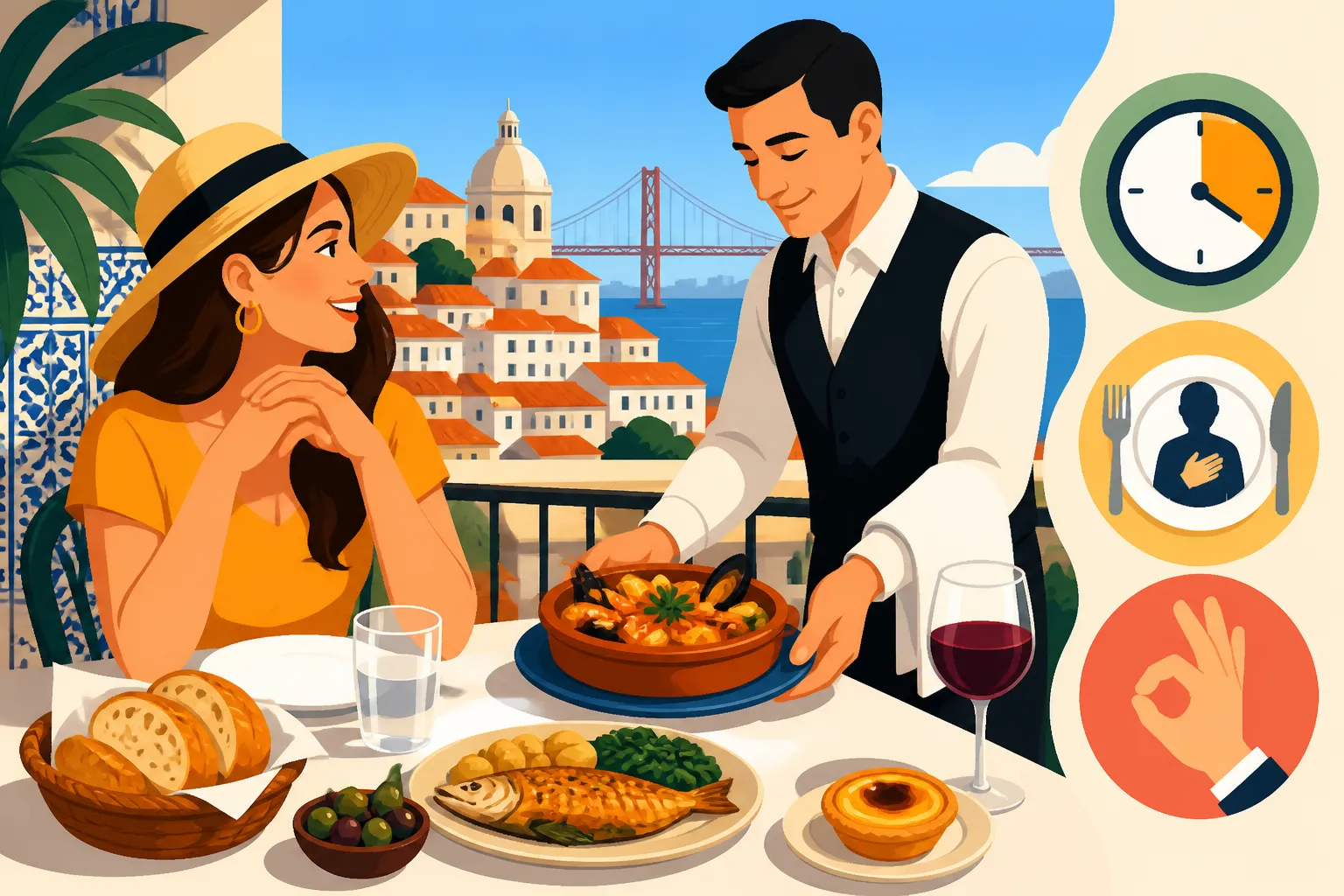
Do not be surprised if the server does not hover. Portuguese service tends to be efficient but unintrusive. When you are ready, a small raised hand or eye contact with a quiet “se faz favor” (please, or excuse me) is the standard way to call someone over. Clicking fingers or whistling is considered rude, and calling across the room is best avoided.
Ask for recommendations. A question such as “O que recomenda?” (What do you recommend?) often leads to the fish that came in that morning or a dish the owner’s mother still makes. Fish may be sold by weight, in which case the server may bring the whole fish to show you before cooking it. If the menu shows a price per kilogram, ask roughly what your portion will cost before agreeing. For more phrases, keep Ordering Food and Drinks in Portuguese: A Practical Phrasebook handy on your phone.
The Pace of a Portuguese Meal
A Portuguese dinner unfolds slowly. There may be a pause after the starters, another before the main course, and a long one before dessert and coffee. This is not neglect. It is how meals are meant to be enjoyed. The table is yours for the evening, and staff will rarely bring the bill or clear your glasses until you signal that you are finished.
Portions are often generous. A single dose of a main dish can be enough for two light eaters, and many restaurants offer a meia dose, a half portion, that suits a smaller appetite. Asking “Dá para dois?” (Is it enough for two?) is a perfectly normal question, and servers will answer honestly.
When it comes to drinks, wine is part of everyday dining, and house wine served by the jug or carafe is common and usually very drinkable. Water is mostly served bottled, and you will be asked whether you want it still (sem gás) or sparkling (com gás), and sometimes at room temperature (natural) or chilled (fresca). You can ask for tap water, “água da torneira”, although some restaurants will gently steer you towards a bottle.
The Couvert, the Bill and Tipping
Nothing confuses first-time visitors quite like the bread basket that arrives without being ordered, followed by the bill that never seems to come. Both have simple explanations, and once you know them you will never feel awkward at the end of a meal again.
Understanding the Couvert
Shortly after you sit down, a server may place bread, butter, olives, a small cheese, a tin of pâté or even little cod fritters on your table. This is the couvert. It is not a free gift. Each item is usually charged if you eat it. Equally, it is not a trap. You are free to decline the couvert, and if you leave it untouched you should not be charged for it.
To decline politely, simply say “Não, obrigado” (if you are a man) or “Não, obrigada” (if you are a woman) and gesture that the server can take it away. Nobody will be offended. If you want some of it, eat only what you want. You can also ask what the couvert costs before you begin, and many menus list the prices of these items. Check your bill afterwards to be sure that only the items you ate appear on it.
Locals treat the couvert as a normal part of the meal and eat it happily. Good bread with olive oil and olives is part of the pleasure of eating in Portugal. For the details and the relevant terms, see What Is the Couvert on a Portuguese Restaurant Bill?
Asking for the Bill
The bill will not arrive on its own. Bringing it unprompted would feel like asking you to leave, so staff wait until you ask. When you are ready, say “A conta, se faz favor” (The bill, please). Across a room, the universal gesture of pretending to write a signature in the air with one hand works perfectly.
Splitting the bill is possible but not always simple. Many restaurants, especially small family-run ones, prefer to issue one bill per table and may not be set up to divide it item by item. Larger groups usually split the total equally between cards, or one person pays and the others settle up afterwards through a payment app. Ask at the start of the meal if you know you will need separate bills. How to Ask for the Bill in a Portuguese Restaurant goes through the phrases and the process.
You may also be asked whether you want your contribuinte number on the receipt. This is a Portuguese tax number. As a visitor without one, just say no and the receipt is issued without it.
Tipping and Payment Methods
Tipping in Portugal is modest and genuinely optional. Many locals round up the bill or leave some coins for good service at a sit-down restaurant, and leave nothing extra for a quick coffee at the counter. Nobody will chase you down the street over a tip. Generous tipping for excellent service is appreciated, but it is not built into the culture as an obligation. Tipping in Portugal: When, Where, and How Much goes into the specifics.
Card payment is widespread in cities and tourist areas, and contactless cards are accepted in most mid-range and upmarket restaurants. Small traditional tascas, cafés and rural places sometimes prefer cash, have a minimum spend for cards, or have a card machine that happens to be out of order. Carrying a small amount of cash for these situations saves embarrassment. Cash vs Card in Portugal and Using Multibanco explains the local payment landscape.
If you want to leave a tip after paying by card, it is usually simplest to leave coins on the table, because not every card terminal offers a tip option.
Types of Restaurants and How They Differ
Part of eating well in Portugal is choosing the right kind of place for the moment. A rushed lunch, a long seafood feast and a late-night beer with snacks each have their own type of venue, their own pace and their own unwritten rules.
Comparing Common Eating Places
| Venue Type | What It Is | Best For | Etiquette Notes |
|---|---|---|---|
| Tasca | Small, traditional, family-run eatery | Daily dishes at lunch, home-style cooking | Casual, sometimes shared tables, may prefer cash, often closed one day a week |
| Restaurante | Standard sit-down restaurant | Full lunch or dinner service | Wait to be seated, reservations wise at weekends |
| Marisqueira | Seafood house | Shellfish, grilled fish, long dinners | Seafood is often priced by weight, so ask before ordering |
| Cervejaria | Beer hall, often with seafood and steaks | Lively group meals, late evenings | Noisy and social, sharing plates is normal |
| Pastelaria | Pastry shop and café | Breakfast, lanche, coffee | Order at the counter, standing is fine |
| Petisqueira | Small-plates venue | Sharing petiscos with drinks | Order a few plates at a time and add more as you go |
Tascas and Neighbourhood Eateries
The tasca is the beating heart of Portuguese everyday eating. Think paper tablecloths, a television showing football in the corner, a menu written on a chalkboard, and an owner who may be cooking, serving and taking payment all at once. These are the places where you will eat the most authentic food and often the best value.
Etiquette in a tasca is relaxed but quietly important. Greet the room with a “boa tarde” (good afternoon) or “boa noite” (good evening) when you walk in. Be patient when it is busy. Do not expect long explanations of the menu at the peak of the lunch rush. If you are unsure, pointing at what the next table is eating and saying “Isso, por favor” (That, please) is a time-honoured technique.
Many tascas are open mainly at lunch, and some do not serve dinner at all. If one has caught your eye, plan to go at midday rather than counting on it for the evening.
Petiscos, Seafood Houses and Food Tours
Petiscos are Portugal’s small plates: garlic prawns, octopus salad, grilled chouriço flamed at the table, peixinhos da horta, fried green beans in batter, and plenty more. They are meant to be shared and ordered in waves. Order three or four, see how hungry you are, then order more. How to Order Petiscos Like a Local in Portugal explains which dishes to try first.
Seafood houses deserve their own preparation. In a marisqueira, much of the shellfish and fish is priced by weight, and a glass case near the entrance often displays the day’s catch. Point to what you want, ask for an approximate weight for your group, and confirm the price before it goes to the kitchen. That one question prevents the most common source of surprise at the end of the night.
If you are short on time or feel daunted by an unfamiliar menu, a guided food tour can teach you the etiquette in an afternoon. Platforms such as GetYourGuide list walking food tours in Lisbon, Porto and other cities, where a local guide takes you through markets, tascas and pastelarias and explains how to order. It is a good way to build confidence early in your trip before you explore on your own.
Table Manners and Cultural Courtesies
Portuguese table manners are warm rather than stiff. People talk, laugh, linger and enjoy themselves. A few courtesies still go a long way and mark you out as a considerate guest instead of a hurried tourist.
Everyday Courtesies at the Table
Wishing others “bom apetite” before eating is common, and it is polite to say it when the food arrives. Wait until everyone at your table has been served before you start, unless someone urges you to go ahead while your food is hot. Keep your hands visible on the table rather than in your lap, and use a knife and fork for most dishes, including many fruits at more formal meals.
Dress codes are relaxed in most restaurants. Smart-casual clothing works almost everywhere. In upmarket restaurants, swimwear and bare chests are out of place, and even in beach towns most people put on a shirt and shoes for dinner. Children are welcome in nearly all restaurants, including at dinner, and it is completely normal to see families with young children eating together in the evening.
If you are invited into a Portuguese home, the courtesies change somewhat: bringing a small gift, accepting second helpings, and staying at the table long after the food is gone are all part of it. How to Behave at a Portuguese Family Meal covers that setting in depth.
Dietary Needs and Special Requests
Traditional Portuguese cooking leans heavily on meat, fish and seafood, and soups that look vegetarian often use meat stock. Communicate dietary needs clearly and early. Useful phrases include “Sou vegetariano” or “Sou vegetariana” (I am vegetarian), “Não como carne” (I do not eat meat), and “Tenho alergia a…” followed by the ingredient, for example “Tenho alergia a marisco” (I am allergic to shellfish).
Larger cities have plenty of dedicated vegetarian and vegan restaurants, and many modern kitchens are happy to adapt. In rural areas and small tascas, options can be limited, and a dish of rice, salad, chips and eggs may be what the kitchen can realistically offer. For strategies and restaurant types to look for, see How to Eat Vegetarian or Vegan in Portugal.
For serious allergies, a card written in Portuguese that states your allergy and its severity is worth carrying. Servers can show it directly to the kitchen, which avoids any confusion caused by language gaps during a busy service.
After Dinner: Coffee, Digestifs and the Night Ahead
A Portuguese meal usually ends with a short, strong coffee, a bica in Lisbon or a cimbalino in Porto, taken after dessert rather than alongside it. Ordering a large milky coffee straight after dinner will not offend anyone, but it will mark you as a visitor. Some restaurants offer a small glass of aguardente, ginjinha or port to finish, sometimes on the house for regulars or for tables that clearly enjoyed themselves.
Leaving the table is unhurried too. After paying, people often keep chatting for a while, and that is perfectly acceptable. Nobody will hover over you with a stack of plates.
Because dinner runs at a relaxed pace and can finish fairly late, the rest of the evening also starts later than you might expect. Bars in Bairro Alto in Lisbon or along the Ribeira in Porto often get busy well after dinner. What Time Does Nightlife Start in Portugal? explains when the evening really gets going, so you can plan your dinner and night out as one smooth evening.
Disclaimer
This article is for general informational purposes only and does not constitute professional advice. Laws, prices and regulations vary by location and change over time. Consult a qualified professional for guidance on your specific situation.