Do You Have to Pay for the Couvert in Portugal?
Disclosure: This article contains affiliate links. If you buy through them, we may earn a commission at no extra cost to you. Read our full disclosure.
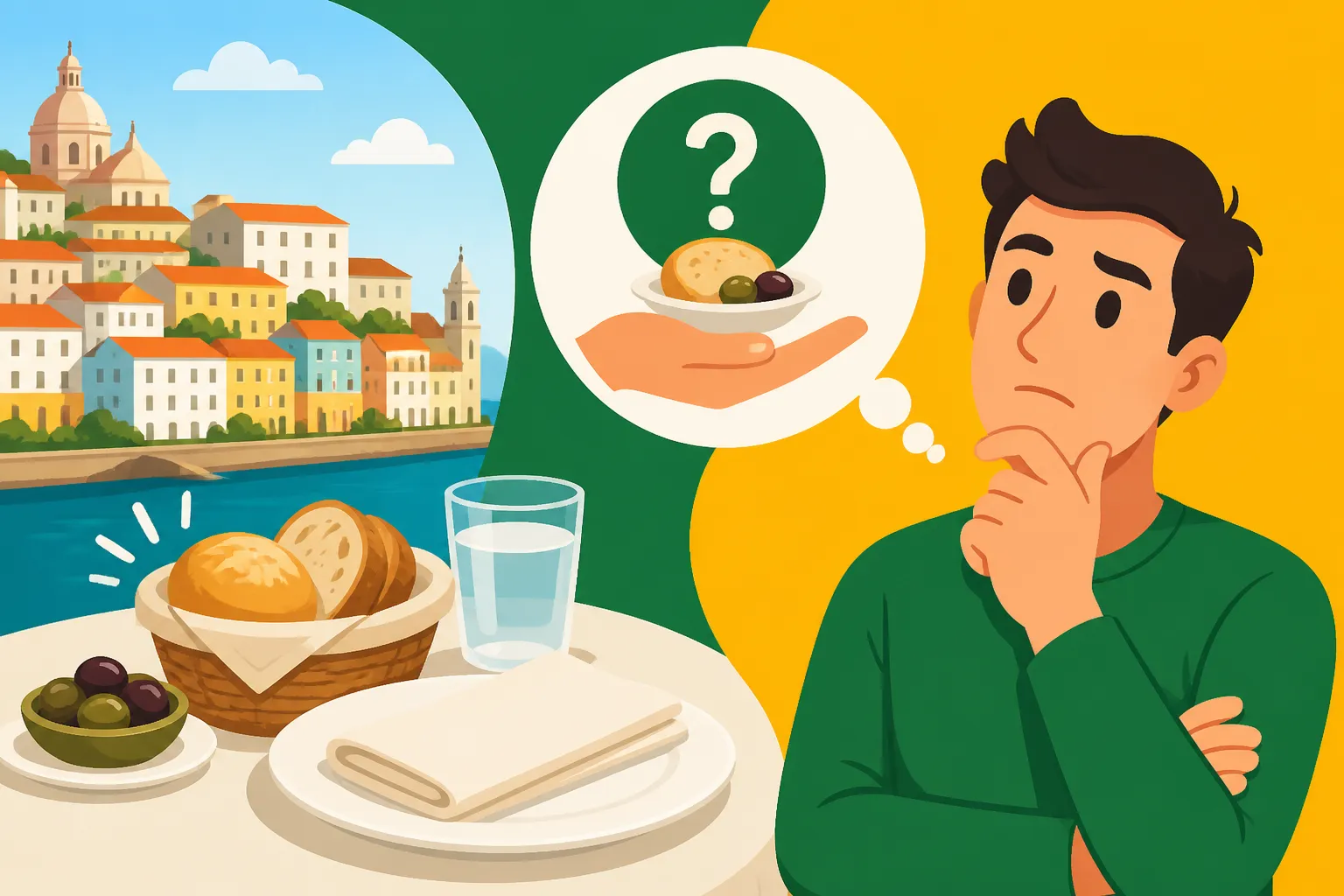
You sit down at a sunny terrace in Lisbon and, before you’ve opened the menu, a waiter sets down bread, butter, olives and a little tin of sardine pâté. Nobody asked you. Is it a welcome gift or a line on your bill? This guide explains what the couvert is, when you pay for it, and how to decline it politely.
What the Couvert Actually Is in a Portuguese Restaurant
My first week in Portugal, I ate an entire basket of warm bread at a little place near Campo de Ourique. I thought it was the Portuguese version of free chips and salsa. When the bill came, there it was: a separate line for “couvert.” I wasn’t angry, just confused. I had no idea whether I’d been scammed or had simply missed a custom.
It took me a few months and a lot of conversations with Portuguese friends to understand it properly. In short, the couvert is neither a scam nor a gift. It is an optional starter that the restaurant offers before you order, and you pay for it if you eat it. Once you understand that, the whole thing stops feeling awkward.
The Bread Basket and Its Usual Companions
The word comes from French, but the custom is entirely Portuguese. A couvert usually arrives within a minute or two of sitting down, often before you’ve even taken your jacket off. The classic line-up looks something like this:
- A basket of bread, often a mix of crusty white rolls and, in the north, a slice of dense broa de milho, the cornbread
- Small foil-wrapped butter portions or a little dish of butter
- Olives, usually marinated with garlic, oregano or a bit of chili
- Tinned or house-made pâtés, often tuna, sardine or a mild chicken spread
- In slightly fancier places, a small fresh cheese called queijo fresco, a cured cheese wedge, slices of chouriço or presunto, or a small salad of carrots with coriander
Some restaurants bring two or three items. Others go further and put down a small spread of six or seven plates. A seafood restaurant in Setúbal might add a little bowl of shrimp or a plate of clams. A tasca in the Alentejo might bring a chunk of local sheep’s cheese that is honestly worth the trip on its own.
For a deeper dive into the individual items and what they’re called, see The Couvert Explained: Bread and Starters in Portuguese Restaurants, which goes through them one by one.
Why Portuguese Restaurants Serve It Unasked
This is where a lot of the frustration comes from, and I get it. In many countries, food that appears without being ordered is free, or a cover charge is fixed and unavoidable. Portugal does neither. The couvert grew out of a long tradition of hospitality. You arrive hungry, the kitchen takes time, and something to nibble keeps you happy while the grilled fish is on the coals.
Restaurants also use the couvert to show off a little. A family-run place in Trás-os-Montes will put down its best cured ham, and a Lisbon marisqueira will bring something from the sea. It is part of the dining rhythm here, which ties into the slower meal pace explained in Portuguese Meal Times and Restaurant Etiquette for Visitors.
There is a commercial side too, and it would be silly to pretend otherwise. The couvert brings in revenue, and in heavily touristed areas some restaurants lean on it harder than others. That doesn’t make it a trick. It just means you should know how it works so the decision is yours.
Couvert Compared With Other Charges You Might See
Visitors from Italy, France or the United States often mix up the couvert with charges they know from home. This table separates them out.
| Charge | What It Covers | Is It Optional in Portugal | How It Appears on the Bill |
|---|---|---|---|
| Couvert | Bread, butter, olives, pâtés and similar starters brought to the table before ordering | Yes, you only pay for what you eat | Listed as “couvert” or item by item, such as “pão,” “manteiga,” “azeitonas” |
| Coperto-style flat cover charge | A fixed per-person fee just for sitting down, common in Italy | Not a standard Portuguese practice | Not normally seen on Portuguese bills |
| Service charge | A percentage added for service | Not standard in Portugal, so tipping is left to you | Rarely appears, and you should ask about it if it does |
| Tip or gorjeta | A voluntary extra for good service | Entirely voluntary | Left in cash or added when paying by card if the terminal allows |
Tipping is its own topic, and I cover the norms in Tipping in Portugal: When, Where, and How Much. The key point here is that the couvert and the tip are completely separate. Paying for the bread does not count as tipping, and declining the bread does not make you a bad customer.
Do You Legally Have to Pay for the Couvert?
This is the question that sends people into expat Facebook groups in a panic, so here is the clear answer. Under Portuguese consumer rules for restaurants, you cannot be charged for food or drink you didn’t order and didn’t consume. If the couvert sits on your table untouched and you send it back or leave it alone, it should not appear on your bill.
I have relied on this rule dozens of times, from cheap lunch spots in Arroios to a fairly upmarket place in Foz do Douro, and I have never had a restaurant argue once I pointed out politely that we hadn’t touched anything.
The Untouched Rule Explained in Plain Terms
Think of the couvert as being put on the table on trust. The restaurant is offering it. If you accept, by eating or even opening it, you pay. If you decline, you don’t. Leaving it sitting on the table does not mean you have accepted it.
Two other rules are worth knowing. First, the couvert must be listed on the menu with its price. That can be a single price for the whole set or a price for each item. Second, the restaurant cannot charge you for something it did not disclose. If there is no couvert price anywhere on the menu or the outdoor menu board, you have a strong argument not to pay for it.
In practice, the cleanest approach is to deal with it straight away rather than leaving it on the table for the whole meal. More on how to do that in a moment.
The One-Bite Reality
This is the bit that catches people out. Once you eat a single olive or butter a single piece of bread, you have consumed it. You can’t eat half the pâté and then argue that you never wanted it. The restaurant is entitled to charge for what you opened or ate.
Some restaurants charge item by item, so eating the bread doesn’t mean you pay for the olives you didn’t touch. Others price the couvert as one set, and eating anything from it counts as accepting the whole thing. The menu should tell you which system the restaurant uses. If it’s unclear, ask before you eat anything, not after.
A common scenario: a family of four sits down in Albufeira, the kids pounce on the bread before the parents have looked at anything, and suddenly there are four portions of couvert on the bill. Nothing illegal happened, the kids ate it. If you’re traveling with hungry children, decide on the couvert before anyone gets seated, or at least before the basket lands within reach.
Where the Price Must Be Shown
The price of the couvert should be on the menu, normally at the top under a heading like “couvert” or “entradas,” or at the bottom in small print. In places with outdoor menu boards, it is often posted there too. It may be listed per person, per basket, or per item.
If you can’t find it, ask: “Quanto custa o couvert?” (How much is the couvert?). Waiters are used to the question, and asking is completely normal. A good restaurant will tell you immediately and without fuss. If the waiter is vague or dismissive, that tells you something about how the rest of the bill might go.
For a closer look at reading the bill itself and which lines to expect, see What Is the Couvert on a Portuguese Restaurant Bill?, which walks through a typical receipt.
How to Handle the Couvert Without Any Awkwardness
I used to feel rude sending food back. It felt like rejecting someone’s hospitality. My Portuguese neighbor, who has run a café in Graça for longer than I’ve been alive, laughed at me when I told her this. She said waiters send back untouched couverts all day and no one gives it a second thought. The only time it’s awkward is when a customer eats it and then complains.
So here is how I handle it now, without any tension.
A Step-by-Step Approach at the Table
- As you sit down, glance at the menu or the menu board for a couvert line and its price before the basket arrives, or as it does.
- When the couvert is placed on the table, decide right away. Don’t let it sit there for ten minutes while you talk.
- If you want it, enjoy it. It is often delicious, and the bread in a good tasca is a highlight in its own right.
- If you want only part of it, say which items you’d like to keep and which you’d like taken away, especially where items are priced individually.
- If you don’t want any of it, say so with a smile and let the waiter take it away. Don’t push it to the edge of the table and leave it there.
- When you ask for the bill, read through each line and check that the couvert charge matches what you actually ate.
- If something you didn’t touch has been charged, point it out calmly and ask for it to be removed before you pay.
That is all there is to it. Step five matters most. Having the waiter physically remove the plate leaves no doubt about whether you ate from it, which protects both you and the restaurant.
Phrases That Make It Easy
You don’t need fluent Portuguese for this. A few short phrases will do, and waiters in Lisbon, Porto and the Algarve generally understand English anyway. Trying the Portuguese version still gets you a warmer reaction.
| Situation | Portuguese Phrase | English Meaning |
|---|---|---|
| Declining the whole couvert | Não, obrigado, pode levar | No thanks, you can take it away |
| Declining as a woman speaking | Não, obrigada, pode levar | No thanks, you can take it away |
| Keeping only the bread | Só o pão, por favor | Just the bread, please |
| Asking the price | Quanto custa o couvert? | How much is the couvert? |
| Asking if it is per person | É por pessoa? | Is it per person? |
| Pointing out an untouched item on the bill | Não comemos isto | We didn’t eat this |
| Pointing out something you did not order | Não pedi isto | I didn’t order this |
| Asking for the bill | A conta, por favor | The bill, please |
Remember that “obrigado” and “obrigada” depend on the speaker, not the listener. A man says obrigado and a woman says obrigada. Waiters won’t mind if you get it wrong, but they notice when you get it right.
For more useful restaurant vocabulary, see Ordering Food and Drinks in Portuguese: A Practical Phrasebook. It’s worth bookmarking before your first big meal out. When you’re ready to pay, How to Ask for the Bill in a Portuguese Restaurant explains why the bill almost never arrives until you ask, which surprises many first-timers.
Checking the Bill and Fixing Mistakes Politely
Even in honest restaurants, mistakes happen. A busy waiter on a Friday night in Bairro Alto might punch in the couvert for a table of six when only four of you nibbled. Most of the time, a quick polite word is all it takes.
Here’s how I handle it. I point to the line, say “Desculpe, não comemos isto” (sorry, we didn’t eat this), and wait. Nine times out of ten, the waiter apologizes, takes the bill back and returns with a corrected one. Keep your tone light. Portuguese service culture generally responds much better to courtesy than to confrontation, and you’ll be surprised how quickly things get sorted.
If you’re splitting the bill with friends, check the couvert before anyone starts paying separately. Untangling a charge after three cards have gone through is a headache. For card-splitting logistics, see Splitting the bill at a restaurant: Do Portuguese places accept multiple cards?.
When a Restaurant Refuses to Remove the Charge
It’s rare, but now and then you’ll meet a restaurant that insists you pay for a couvert you never touched or that wasn’t priced on the menu. If a polite conversation doesn’t fix it, you have a formal option. Every restaurant in Portugal must have a complaints book, the Livro de Reclamações, and you’re entitled to ask for it. There’s also an electronic version you can file online.
Just asking for the book often changes the conversation, because a complaint is formally recorded and gets forwarded to the relevant authority. I’ve only needed it once, at a place on a heavily touristed street in central Lisbon. The manager removed the charge before I’d written a single word. For the full process, see What is the ‘Livro de Reclamações’ and how does it solve consumer disputes?.
A word of perspective: asking for the complaints book is a serious step, and for most people a small couvert charge isn’t worth the time. Use it for real problems, such as items you clearly didn’t eat, charges that were never disclosed, or a restaurant that is obviously padding bills. For a simple mistake, a quiet word with the waiter is almost always enough.
When the Couvert Is Worth It and When to Wave It Away
Now for the part I enjoy most. Once you know you can decline, the couvert stops being something to worry about and becomes a choice. Some of my best food memories in Portugal started with a couvert: a slab of warm cornbread with melting butter in a Minho village, a dish of fat olives on a rainy afternoon in Évora. And sometimes I send it straight back because I’d rather save room for dessert.
Local Tascas Versus Tourist Strips
In a neighborhood tasca, the kind with paper tablecloths and a TV showing the football, the couvert is usually simple and modest: bread, maybe olives, maybe butter. Locals often accept it without thinking, because it’s part of the meal and good value for what you get.
On the busiest tourist streets, the couvert can be more elaborate and more expensive relative to the rest of the meal. Some places bring a spread that looks generous but adds up quickly. That doesn’t mean you should avoid these restaurants. It just means you should look at the price before you start eating. If you’d like to find places where locals actually eat, see How to Find Authentic Restaurants in Portugal (Not Tourist Traps).
One trick I use: if you’re curious about the local food scene but unsure where to start, a guided food walk can be a great way in. Food tours booked through GetYourGuide in Lisbon’s Alfama or Porto’s Ribeira often include tasca stops, and the guides usually explain the couvert at the table, so you see how locals handle it before you’re on your own.
How the Couvert Varies Across Portugal
The couvert isn’t identical everywhere, and noticing the differences is half the fun of traveling around the country. If you’re moving between cities by train or bus, an app like Omio makes it easy to compare routes from Lisbon to Porto or Coimbra, and every stop brings a slightly different version of the bread basket.
| Region | What the Couvert Often Includes | Practical Tip |
|---|---|---|
| Lisbon | Bread, butter, olives, tuna or sardine pâté, sometimes queijo fresco | Check prices carefully in Baixa, Chiado and around Rua Augusta |
| Porto and the North | Broa de milho cornbread, olives, cured ham or chouriço | The cornbread is a regional specialty and often worth keeping |
| Alentejo | Rustic bread, sheep’s cheese, olives with herbs | Cheese portions can be generous, so ask whether they’re priced separately |
| Algarve | Bread, olives, carrots with coriander, fish pâtés | Beachfront restaurants may offer larger spreads, so confirm the price first |
| Madeira | Bolo do caco flatbread with garlic butter | Often served warm and very tempting, so decide quickly |
| Azores | Local bread, regional cheese, sometimes pickled peppers | Island cheeses are a highlight and many visitors happily accept them |
When I’m planning a trip somewhere new in Portugal, I often book a small guesthouse through Booking.com and ask the host for their favorite local restaurant. Hosts in smaller towns almost always know a family-run place where the couvert is simple and the grilled fish is excellent. That kind of tip has never let me down.
In Porto in particular, the broa de milho deserves a moment of your attention. It’s dense, slightly sweet and nothing like the white bread you’ll find elsewhere. I nearly always keep it. And if you’re heading to the coast in summer, a grilled sardine lunch with a basket of bread on the side is close to perfect, which How to Eat Fresh Grilled Sardines in Portugal covers in proper detail.
Dietary Needs, Allergies and Traveling With Kids
The couvert can be a minefield if you have dietary restrictions. Pâtés are usually made with fish or meat, butter is dairy, and bread contains gluten. Ingredients are rarely labeled on the table, so it’s worth asking or simply declining the whole lot.
If you’re celiac or avoiding gluten, the simplest thing is to send the couvert back as soon as it arrives and ask if the kitchen can bring something suitable instead. Some restaurants will happily bring olives or cheese on their own. For more on eating safely, see How to Find Gluten-Free Food in Portugal, which lists useful phrases and the dishes that tend to be safe.
For families, my advice is to sort out the couvert before anyone sits down. Children see bread and grab it, and then the decision has been made for you. A quick word as you arrive, such as “só o pão, por favor” or “não, obrigado,” saves any confusion. If your kids love bread and you’re happy to pay, let them enjoy it. A good Portuguese roll is a treat.
Petiscos, Snack Bars and Cafés Without a Couvert
Not every place serves a couvert. Pastelarias, snack bars, cafés and many petisco bars skip it altogether, because you’re ordering small plates or a quick bite anyway. At a petisco bar, you choose your own little dishes from the start, so there’s nothing to accept or decline.
Petiscos are one of my favorite ways to eat in Portugal, especially for a relaxed evening with friends. For how they work and what to order, see How to Order Petiscos Like a Local in Portugal. It’s a nice change from the full sit-down meal and the couvert ritual that comes with it.
The couvert is one of several things that catch new arrivals off guard. Meal timing, the slow pace of service and the way the bill only comes when you ask are all part of the same adjustment. Common Cultural Surprises for First-Time Visitors to Portugal covers these, and reading it before you arrive takes a lot of the guesswork out of your first few meals.
A Few Final Realities From Years of Eating Out Here
After many years of eating out across this country, here’s what I wish someone had told me on day one. The couvert isn’t a trap. Portuguese waiters don’t expect you to accept it. Declining is completely normal, and nobody will treat you worse for it. Accepting it is often a real pleasure. The only mistake is not deciding at all, letting it sit there, nibbling absent-mindedly, and then being surprised by the bill.
Treat it like any other menu item. Look at the price, decide whether you want it, and enjoy it or send it back with a smile. Once you’ve done that a few times, it becomes second nature, and you’ll find yourself reaching for the broa in Porto or the bolo do caco in Funchal because you actually want it, not because it happened to be in front of you.
Disclaimer
This article is for general informational purposes only and does not constitute professional advice. Laws, prices and regulations vary by location and change over time. Consult a qualified professional for guidance on your specific situation.