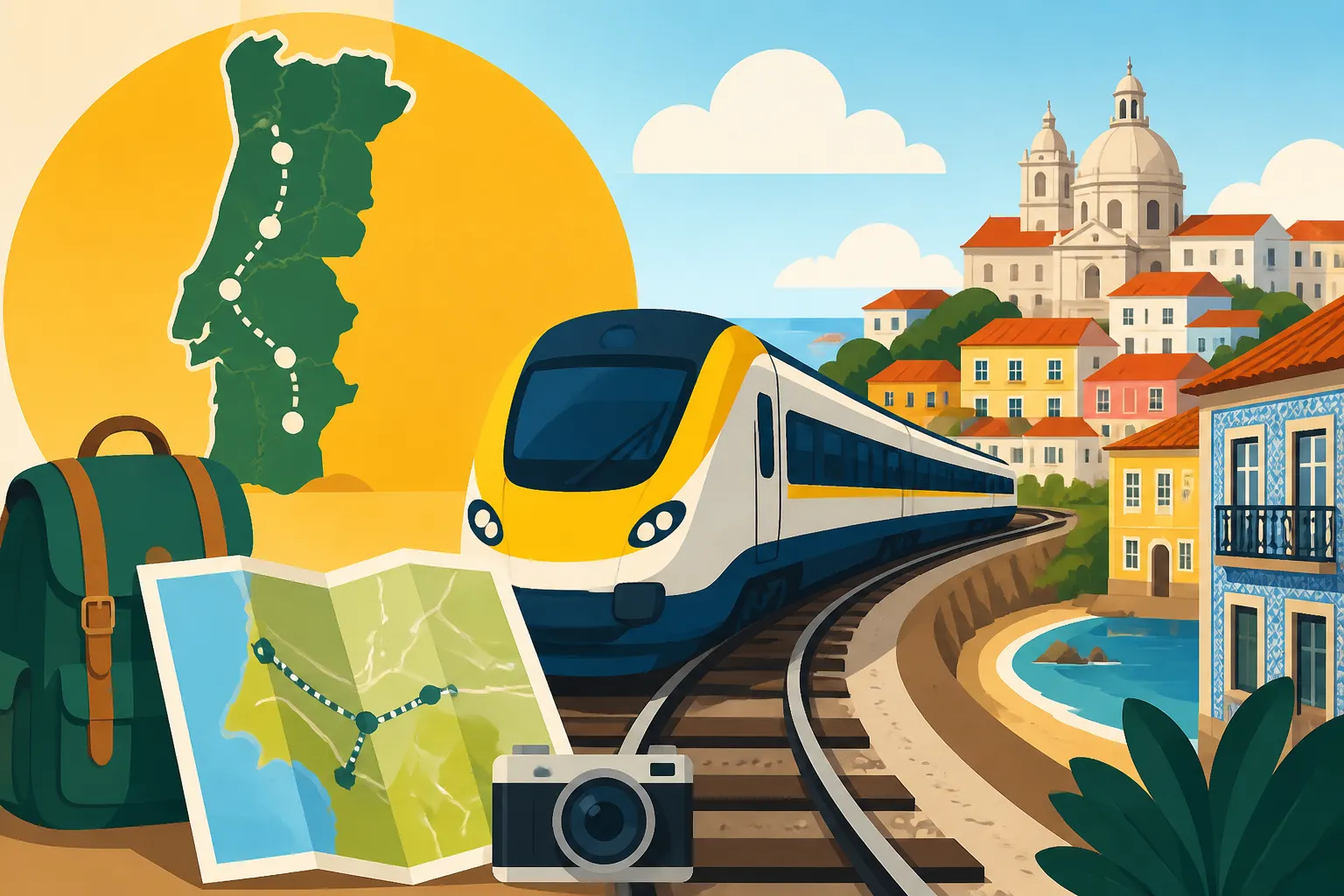
How to Plan a Portugal Itinerary by Train
Disclosure: This article contains affiliate links. If you buy through them, we may earn a commission at no extra cost to you. Read our full disclosure.
You’ve booked flights into Lisbon. You want Porto, the Douro Valley, maybe the Algarve, and you’d rather not drive. Then you open the Comboios de Portugal site and hit a wall of Alfa Pendular, Intercidades, Regional and two stations both called “Lisbon.” This guide shows you how to turn Portugal’s rail network into a realistic, low-stress itinerary.
I’ve lived here long enough to have made most of the mistakes. It is easy to watch a train to Porto leave from Oriente while standing on the wrong platform at Santa Apolónia. I’ve learned the hard way that Óbidos and Nazaré are not train towns. I’ve also sat for hours on the Douro line with my forehead pressed to the window. That trip is why I still tell every visiting friend to plan around the rails. Here is everything I wish someone had told me first.
Understanding Portugal’s Rail Network Before You Plan
Before you pick a single town, you need a mental picture of how Portuguese trains work. The network is not dense like Switzerland’s or Germany’s. It is a strong north-south spine with some beautiful but slow branches, and a few big gaps where the bus simply wins. Once you understand that shape, the itinerary almost plans itself.
Train Types and What They Mean for Your Route
Comboios de Portugal, which everyone calls CP, runs several service categories. The name on your ticket tells you how fast you will go, how comfortable the seats are, and whether you need a reservation. That last point matters most for planning.
| Service | Typical Use | Seat Reservation | Booking Advice | Best For |
|---|---|---|---|---|
| Alfa Pendular | Fastest long-distance trains on the Braga, Porto, Lisbon and Faro axis | Required, assigned seat | Book ahead in summer and on Friday and Sunday | Big city-to-city hops |
| Intercidades | Long-distance trains with more stops, including routes toward Évora, Guarda, Covilhã and the Algarve | Required, assigned seat | Book ahead on popular days | Reaching mid-sized cities |
| InterRegional and Regional | Slower trains that stop at smaller stations | Not usually needed | Buy at the station or on the app | Scenic lines like the Douro and the Algarve coast |
| Urbanos | Suburban commuter trains around Lisbon, Porto and Coimbra | Not needed | Pay with a rechargeable transit card or a ticket | Day trips to Sintra, Cascais, Guimarães, Braga, Aveiro |
| Historic and tourist trains | Seasonal heritage services, such as the Douro steam train | Usually sold as an experience | Book well ahead in season | A special one-off day |
The practical lesson is simple. Alfa Pendular and Intercidades trains are where you need to think about booking in advance. Regional and suburban trains are the turn-up-and-go part of your trip. If you remember nothing else, remember that split.
For a deeper look at each service class and the booking quirks, see Trains in Portugal: CP Routes, Alfa Pendular, and Booking.
Where the Tracks Go and Where They Do Not
Picture a long line running down the western side of the country. At the top sits Braga, then Porto, then Aveiro and Coimbra, then Lisbon. After Lisbon the line crosses the Tagus and heads south through the Alentejo to the Algarve, finishing at Faro. That spine is fast, frequent and comfortable, and it is the backbone of any rail itinerary.
Off the spine, you have some wonderful branches. The Douro line runs east from Porto along the river through Peso da Régua and Pinhão to Pocinho, and it is one of the most beautiful rail journeys in Europe. The Algarve line runs along the southern coast from Lagos in the west to Vila Real de Santo António on the Spanish border, stopping at towns like Portimão, Tunes, Albufeira, Faro, Olhão and Tavira. Lisbon has suburban lines to Sintra and to Cascais. Porto has suburban lines to Guimarães, Braga and Aveiro. Évora is reachable by Intercidades from Lisbon, and Tomar sits at the end of a regional line from the capital.
Now the gaps, because these are where itineraries fall apart. Óbidos technically has a station on the slow Oeste line, but the bus from Lisbon is far more practical. Nazaré has no useful station in town. The nearest stop is miles away, so take the bus. Much of the interior, including the Serra da Estrela villages and the hilltop towns of the Alentejo like Monsaraz and Marvão, needs a bus or a car. The Costa Vicentina’s wild beaches are not on any rail line. And the islands are islands. Madeira and the Azores have no passenger trains at all.
They assumed every dot with a railway icon meant a usable train. They spent a full afternoon trying to reach a village whose station had closed years earlier. Always check the actual CP timetable for any small-town stop before you build a day around it.
The Stations That Trip Up First-Timers
Lisbon and Porto both have more than one main station. Getting this wrong is the single most common way visitors miss trains.
In Lisbon, long-distance trains to Porto, Braga and the north generally start at Santa Apolónia, the riverside terminus near Alfama. They then stop at Oriente, the big modern hub in Parque das Nações. Trains heading south to the Algarve and Évora typically leave from Oriente or Entrecampos rather than Santa Apolónia. Sintra trains leave from Rossio, the gorgeous neo-Manueline building in Baixa, and also from Oriente and Entrecampos. Cascais trains leave from Cais do Sodré. If you are staying near Baixa and heading north, Santa Apolónia is easier. If you are near the airport or Parque das Nações, Oriente is your friend.
In Porto, all long-distance trains use Campanhã, which sits a little east of the centre. São Bento is the famous tiled station in the heart of the city. It is mostly served by suburban and regional trains, including services to Guimarães, Braga, Aveiro and the Douro line. Many Douro trains start at São Bento and stop at Campanhã, so you can board at either. A frequent shuttle runs between the two, and your long-distance ticket often lets you ride it at no extra cost. Ask at the ticket office to confirm.
Coimbra is the other classic trap. Main-line trains stop at Coimbra-B, which is outside the historic centre. You then need a short connection into town. Factor that into your timing, especially if you have booked a tour of the university.
Building Your Rail Itinerary Step by Step
This is where planning shifts from “where can I go” to “how should I structure this.” The biggest improvement you can make is to think in bases, not stops.
Start With Your Bases, Not Your Stops
The instinct is to sleep somewhere new every night: Lisbon, then Sintra, then Óbidos, then Coimbra, then Aveiro, then Porto. On paper it looks efficient. In practice, you spend every morning packing, checking out, dragging a suitcase over cobblestones and hunting for a station. By day four you are exhausted and resentful.
The better approach is to pick a small number of bases on the rail spine and do day trips from each. Lisbon is a base for Sintra, Cascais, Évora and Tomar. Porto is a base for the Douro Valley, Guimarães, Braga and Aveiro. Coimbra is a pleasant one- or two-night stop between the two. The Algarve can be a base in Faro, Lagos or Tavira, with the coastal line linking the towns.
Here is a scenario I see constantly. A friend visits for ten days and wants to see “everything.” We sketch out a plan: four nights in Lisbon, one in Coimbra, four in Porto, and a final night back in Lisbon near the airport. She unpacks three times instead of eight. Every day trip is a relaxed train ride with a small daypack. She sees more, not less, because she isn’t spending half her waking hours in transit with luggage.
A Step-by-Step Planning Method
This is the process I use whenever someone asks me to help with a rail trip. It works whether you have five days or three weeks.
- List every place you want to see, then sort them into three groups: on the main spine, on a branch line or suburban line, and not served by rail at all.
- Choose two to four bases on the spine where you will sleep, ideally within walking distance or a short metro ride of the station you will use most.
- Assign each branch-line or suburban destination to the base it is easiest to reach from. Sintra goes with Lisbon. The Douro goes with Porto.
- For each place not served by rail, decide whether a bus, an organised tour or simply dropping it makes the most sense.
- Check the CP timetable for every journey, paying attention to the first and last trains of the day and any weekend differences.
- Mark which legs are Alfa Pendular or Intercidades, because these need reserved seats and are worth booking once your dates are fixed.
- Leave at least one unplanned day in the middle of the trip for weather, strikes or simple tiredness.
- Book your accommodation near the right station, then buy your long-distance tickets, and leave regional and suburban tickets until the day.
Step five deserves extra attention. Branch lines can have long gaps between trains, especially on Sundays and outside summer. On the Douro line, missing the last train back from Pinhão is a very real way to end up negotiating for a taxi. Always write down the last return train before you set off on a day trip.
If you are flying into Lisbon and starting immediately, read How to Get From Lisbon Airport to the City Center so your first leg is painless.
Sample Rail Itineraries That Actually Work
These are routes I have done myself or helped friends plan. Adjust the nights to suit your pace. The structure is what matters.
| Trip Length | Bases and Nights | Key Day Trips by Train | Gaps to Fill by Bus or Tour |
|---|---|---|---|
| Five days | Lisbon three nights, Porto two nights | Sintra from Lisbon | None needed |
| One week | Lisbon three, Coimbra one, Porto three | Sintra, Cascais, Douro Valley | Optional Óbidos by bus |
| Ten days | Lisbon four, Coimbra one, Porto four, Lisbon one | Sintra, Cascais, Évora, Douro, Guimarães, Aveiro | Óbidos and Nazaré by bus |
| Two weeks | Lisbon four, Coimbra one, Porto four, Faro or Lagos four, Lisbon one | Everything above plus the Algarve coastal line | Benagil and the Costa Vicentina by tour or bus |
| Slow northern week | Porto four, Braga or Guimarães three | Douro, Aveiro, Braga, Guimarães, Viana do Castelo | Peneda-Gerês by tour or car |
The Lisbon to Porto leg is the hinge of almost every itinerary. For tips on which train to pick and where to sit for the best views, see How to Take the Train From Lisbon to Porto. If you are working on a longer trip that mixes trains with other transport, How to Plan a Two-Week Portugal Itinerary goes into the broader trade-offs.
A note on the Algarve: the coastal line is slow and the stations are not always close to the beaches or old towns. Lagos station is near the marina and an easy walk to the centre. Albufeira’s station sits well outside town, so you will need a bus or taxi. Tavira’s station is a short walk from the old town. Plan your Algarve base around station location, not just around beach photos.
Booking Tickets and Riding Like a Regular
Once your route is set, the next question is how and when to buy tickets. Portugal is refreshingly simple here compared with some European countries, but there are a few habits worth picking up.
When to Book and When to Just Show Up
For Alfa Pendular and Intercidades trains, book once your dates are firm. CP releases tickets in advance and sometimes offers discounted fares for early purchase. Those cheaper fares can disappear on busy routes. Friday afternoons and Sunday evenings between Lisbon and Porto fill up with students and commuters heading home. Summer weekends to the Algarve are just as busy. Trains are often fully booked in August.
For regional and suburban trains, there is no advantage to booking ahead. You buy a ticket at the station machine, the ticket office, or through the CP app. For the Lisbon suburban lines, you load credit or a ticket onto a rechargeable transit card. In Porto, the suburban trains work with the city’s Andante system, though you can also buy CP tickets.
CP offers discounts for certain groups, including younger travellers, seniors and families. The eligibility rules and the size of the discounts change, so check the conditions on the CP website before you buy. You may need to show ID on board to prove eligibility. Rail passes such as Interrail and Eurail also cover Portugal, but you still need a paid seat reservation on Alfa Pendular and Intercidades trains. Whether a pass saves money depends heavily on how many long-distance legs you take. For most short Portugal-only trips, point-to-point tickets work out simpler.
For a full breakdown of fare types and how to save, see How to Buy CP Train Tickets in Portugal and Save Money.
Seat Reservations, Validation, and Luggage
On Alfa Pendular and Intercidades trains, your ticket shows a carriage number and a seat number. Platform screens and signs show where each carriage stops, so check them rather than boarding the first door and walking the length of the train with your bag. Alfa Pendular has two classes. Second class, called Turística, is perfectly comfortable. First class, called Conforto, gives you more space and a quieter carriage.
On suburban trains, you must tap or validate before you board. In Lisbon, many stations have gates. Where there are no gates, validation machines sit on the platform. Inspectors do check, especially on the Sintra and Cascais lines in summer, and fines for travelling without a valid ticket are not small. Visitors have been fined on the Cascais line because they bought tickets and never tapped them. It can ruin a beach day and is entirely avoidable.
Luggage is relaxed by European standards. There are no strict size checks, and long-distance trains have racks at the ends of carriages and above the seats. The real challenge is not the train but the city. Lisbon’s hills and cobbles are brutal on cheap wheeled suitcases. If you are basing yourself in Alfama or Graça, pack lighter than you think you need, or budget for a taxi or ride-hail from the station.
Apps and Tools That Make Rail Travel Easier
The CP app and website are the primary source for timetables, live updates and tickets. The app lets you buy long-distance tickets and store them on your phone. It is worth downloading before you arrive, so you can set up your account on good Wi-Fi.
Some visitors prefer a single app that compares trains and buses side by side, especially when part of the trip relies on coaches. Omio can be handy for this. It shows CP train options next to bus operators for a route like Lisbon to Óbidos, which helps you quickly see when the bus is the smarter choice. Booking fees and how they compare with buying directly vary, so check the final price against CP’s own site before you pay.
Mobile data matters more than people expect. You will be checking platform numbers, live delays and walking routes from stations. Sort out a local SIM or an eSIM before your first train day. Options are covered in Mobile Data and eSIMs for Travel in Portugal.
Real-World Problems and How to Handle Them
No rail trip is perfect, and Portugal has its own particular frustrations. Knowing about them in advance turns a potential disaster into a minor shuffle.
Strikes, Delays, and the Unplanned Day
Rail strikes, called greves, happen in Portugal. They are usually announced in advance, and minimum services are often set for some trains. The challenge for visitors is that announcements tend to appear in Portuguese first. Before each long-distance travel day, check the CP website or app for any notices, and look for the word “greve.” If a strike is announced, CP typically explains which trains will run and what refund or exchange options apply.
This is exactly why I insist on that one unplanned day. If a strike hits your Lisbon to Porto day, you can shift by 24 hours without cancelling hotels or tours. Without that buffer, you may end up booking an expensive last-minute coach or flight. Long-distance buses run by operators like Rede Expressos and FlixBus are the most common fallback on the main routes. They fill up quickly on strike days, so act early.
Everyday delays do happen, particularly on single-track branch lines. If you have a fixed-time commitment, such as a timed Pena Palace entry in Sintra or a port lodge tasting in Gaia, take an earlier train than you think you need. Arriving early and having a coffee beats sprinting up a hill.
Filling the Gaps With Buses and Tours
Some of Portugal’s best places are simply not on the rail network. Rather than forcing a car rental for one or two days, fill those gaps with coaches or a guided tour. The bus network is extensive and often faster than you would expect. Óbidos and Nazaré are straightforward by bus from Lisbon, and buses link many interior towns that trains never reach. For details, see Buses in Portugal: Rede Expressos and Regional Networks.
Organised tours make sense where logistics get fiddly. The Benagil caves on the Algarve coast, the remote Douro quintas away from the railway, and Peneda-Gerês National Park are all easier with someone else handling transport. GetYourGuide lists a wide range of these day trips, from Douro wine tours starting in Porto to Sintra and Cascais combinations from Lisbon. It is useful if you would rather not juggle multiple connections on a single day. Compare inclusions carefully, though. Some Douro tours include the train itself, some use a minibus, and some combine a boat. Each gives a very different experience.
For the Douro specifically, it is worth doing it at least once by regular train. It is cheap, beautiful and gives you the freedom to hop off in Pinhão and wander. How to Visit the Douro Valley From Porto walks through both the independent and the tour options.
For Sintra, the train from Rossio is the obvious choice. The real puzzle is getting between the palaces once you arrive. How to Visit Sintra From Lisbon in a Day covers the local buses, the walking routes and the timing tricks that help you dodge the worst crowds. If you are stopping in Coimbra between Lisbon and Porto, How to Visit Coimbra’s University and Library explains how to time your visit so the short connection from Coimbra-B does not eat into your slot.
Pacing Your Trip and Choosing Accommodation Near Stations
The final piece is where you sleep. A hotel ten minutes’ walk from the right station is worth more than a slightly nicer one across town. In Lisbon, staying in Baixa, Chiado or near Avenida da Liberdade gives easy access to Rossio for Sintra and a short ride to Santa Apolónia. Parque das Nações puts you next to Oriente and close to the airport. In Porto, staying near São Bento or in the Bolhão area gives you suburban and Douro trains on your doorstep, plus a quick hop to Campanhã.
When I am searching for places to stay, I use Booking.com’s map view to see exactly how far each property is from the station I will use most. Filtering by distance and reading recent reviews about stairs and steep streets saves a lot of grief. A “central” listing that turns out to be up five flights in an old building with no lift is a common Lisbon surprise. Reviews will usually warn you.
Pacing is the last thing I always stress. Portugal looks small on a map, and it is easy to cram in too much. Trains are relaxing, but every move between bases still costs most of a morning once you count checking out, getting to the station and settling in at the other end. Two nights in a base is the minimum I would recommend, with single nights kept for stopovers like Coimbra or a last night near the airport. Three or more lets you actually feel a city rather than just photograph it.
If you are weighing whether to skip a car entirely, How to Get Around Portugal Without a Car goes into the full picture, including taxis, ride-hail and the occasional rental day for remote areas. For most first-time visitors focusing on Lisbon, Porto, the Douro and maybe the Algarve, trains plus the odd bus or tour are all you need. They are also far more relaxing than navigating Portuguese roundabouts and electronic tolls.
Disclaimer
This article is for general informational purposes only and does not constitute professional advice. Laws, prices and regulations vary by location and change over time. Consult a qualified professional for guidance on your specific situation.
Routes and services described here reflect the rail network as of 2026. Check Comboios de Portugal’s own site, cp.pt, for current timetables and fares.