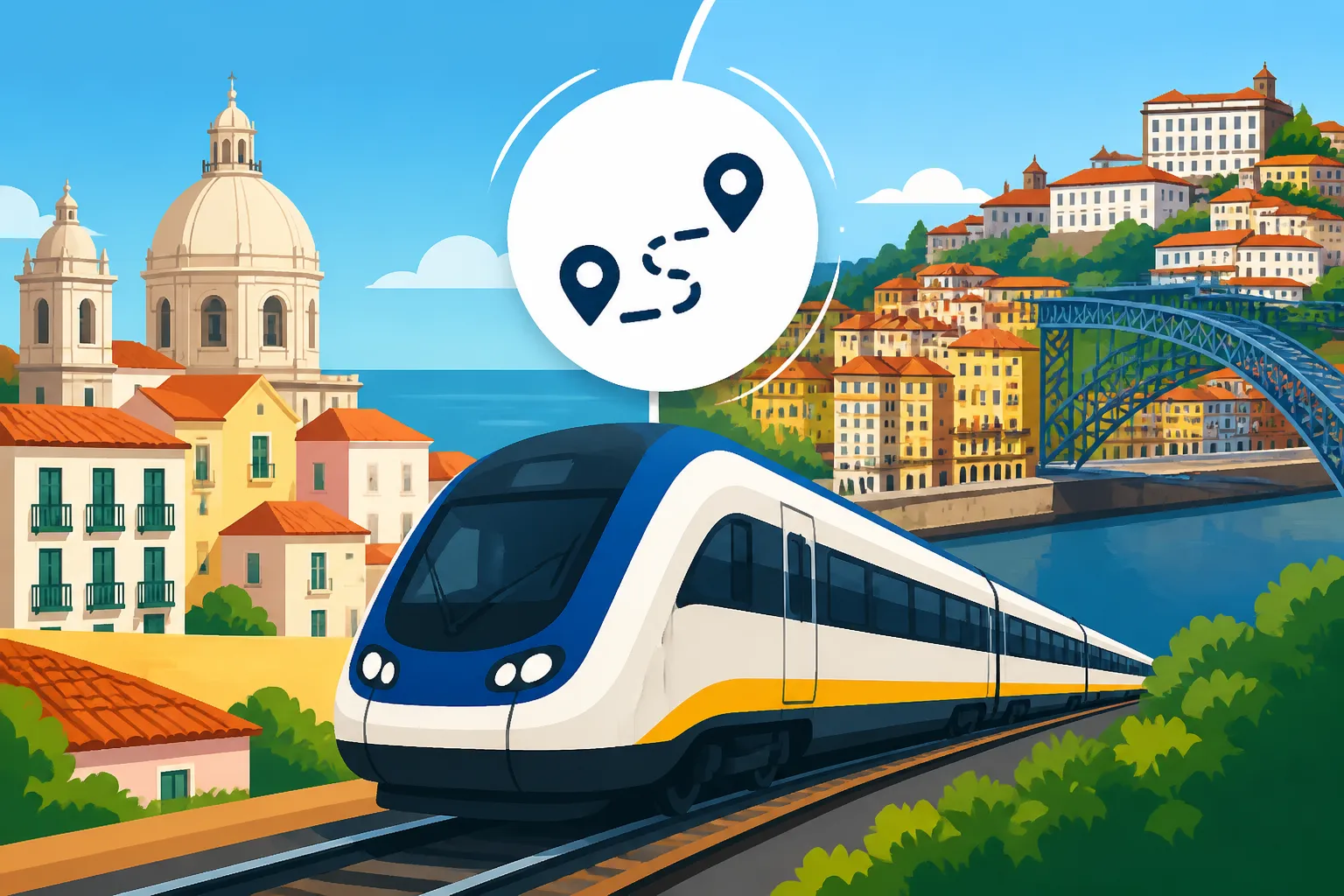
How to Take the Train From Lisbon to Porto
Disclosure: This article contains affiliate links. If you buy through them, we may earn a commission at no extra cost to you. Read our full disclosure.
Ah, Portugal! Moving between our two most vibrant cities, Lisbon and Porto, can feel a bit daunting at first, especially when you're navigating a new country and a public transport system that might be very different from what you're used to. Forget the stress of driving, dealing with tolls, or the hassle of airport security. This guide is going to walk you through everything you need to know about taking the train from Lisbon to Porto, making your journey as smooth and enjoyable as possible, just like a seasoned expat.
Why Choose the Train for Your Lisbon to Porto Journey?
When you’re planning to travel between Lisbon and Porto, you’ve got a few options: flying, driving, or taking the bus or train. Having personally done all of them, I can tell you there’s a clear winner in my book, especially if you want to soak in the experience rather than just get from A to B. The train offers a unique blend of comfort, convenience, and a chance to truly see the country change around you.
Comfort and Scenery
Let’s be honest, air travel within Portugal often feels like more trouble than it’s worth for such a short distance. By the time you get to the airport, check in, go through security, wait for your flight, fly, and then navigate from the airport into the city center, you've likely spent more time and stress than you would have on a train. Driving gives you flexibility, but then you're dealing with Portuguese traffic, sometimes confusing signage, and the often-expensive tolls. Plus, finding parking in both Lisbon and Porto is a whole other adventure – usually a frustrating one!
The train, on the other hand, is a civilized affair. You get to relax in a comfortable seat, stretch your legs whenever you like, and watch the stunning Portuguese landscape unfurl outside your window. From the urban sprawl of Lisbon, through the rolling hills and agricultural lands of the Ribatejo, past the central plains, and into the lush, green valleys heading north towards Porto, it’s a journey that really showcases the diversity of Portugal. There's something truly special about sipping a coffee from the onboard cafe car while the world rushes by, without a care in the world.
Convenience and City Center Access
One of the absolute biggest perks of train travel in Portugal is that you arrive right in the heart of the city. No fighting with taxis or expensive Ubers from a distant airport, no long bus rides from the periphery. In Lisbon, trains depart from major hubs like Santa Apolónia and Oriente, both directly connected to the metro system. And in Porto, your main intercity arrival point, Campanhã, is just a quick, often free, local train ride away from the iconic São Bento station, right in the beating heart of downtown.
This city-center-to-city-center connection is invaluable for tourists and expats alike. It means less transit time, less money spent on transfers, and more precious time actually enjoying your destination. Imagine stepping off the train and being just a short walk or metro ride from your hotel or apartment, ready to explore. This convenience alone often makes the train the most practical choice, especially if you're traveling with luggage.
Environmental Considerations
Beyond personal comfort and convenience, choosing the train also aligns with a more sustainable travel ethos. Trains are generally a more environmentally friendly mode of transport compared to flying or driving, emitting significantly less carbon per passenger. If you're someone who tries to minimize your ecological footprint while exploring the world, opting for rail travel is a conscious choice you can feel good about. It's a small but meaningful way to contribute to preserving the beautiful country you're visiting or calling home. Many expats find great joy in embracing Portugal's commitment to greener living, and rail travel fits right in.
Understanding Portuguese Train Services: Alfa Pendular vs. Intercidades
When you're looking at train tickets from Lisbon to Porto, you'll primarily see two types of services: Alfa Pendular (AP) and Intercidades (IC). Both are operated by Comboios de Portugal (CP), the national rail company, but they offer different experiences in terms of speed, comfort, and price. Understanding the nuances will help you pick the best option for your journey.
Alfa Pendular AP: The High-Speed Option
The Alfa Pendular is Portugal's flagship high-speed train service, connecting the major cities along the coast. Think of it as the express option for getting between Lisbon and Porto. These trains are modern, sleek, and designed for maximum comfort.
A typical Alfa Pendular journey from Lisbon to Porto takes approximately 2 hours and 49 minutes to 3 hours and 10 minutes, depending on the number of stops. They make fewer stops than the Intercidades, primarily serving major cities like Coimbra and Aveiro. Onboard, you'll find air-conditioned carriages, power outlets at every seat (a lifesaver for charging phones and laptops!), and usually decent Wi-Fi, though don't count on it being lightning-fast the entire journey. There's also a café-bar carriage where you can grab snacks, sandwiches, coffee, and even a glass of wine – a truly Portuguese touch!
The Alfa Pendular offers two classes of service:
- Conforto (First Class): This offers more spacious seating, typically a 2+1 configuration (two seats on one side of the aisle, one on the other), providing extra legroom and wider seats. You often get a complimentary newspaper or magazine, and sometimes a small snack or drink service, depending on the route and time. It's a noticeable upgrade for those who value space and a quieter environment.
- Turística (Second Class): Still very comfortable, with a 2+2 seating configuration. While the seats are a bit closer, they are perfectly adequate for a three-hour journey. Most expats and tourists find Turística class more than satisfactory, especially considering the modest price difference compared to Conforto.
If speed and modern amenities are your top priorities, and you don't mind paying a little extra, the Alfa Pendular is definitely the way to go. It’s a truly pleasant and efficient way to travel, giving you more time to explore once you arrive. You can often book these tickets through services like Omio, which can make the process simpler if you're not fluent in Portuguese or prefer a familiar interface.
Intercidades IC: The Scenic and Economical Choice
The Intercidades, or Intercity, service is a more traditional long-distance train. While not as fast as the Alfa Pendular, it's a solid, reliable, and often more economical option. These trains tend to be older, but they're still well-maintained and comfortable for the journey.
An Intercidades journey between Lisbon and Porto typically takes around 3 hours and 30 minutes to 3 hours and 50 minutes, making a few more stops at intermediate towns compared to the AP. This means you get a slightly longer ride, but it also gives you more opportunities to see the countryside and smaller Portuguese stations. Don't expect Wi-Fi or power outlets at every seat like the AP, though some newer IC trains might have limited availability. There's usually a small café-bar or a mobile trolley service for snacks and drinks, so you won't go hungry.
Like the Alfa Pendular, Intercidades also offers two classes, though the difference is less pronounced:
- Primeira (First Class): Provides slightly more spacious seating and is often a bit quieter.
- Segunda (Second Class): The standard class, perfectly fine for most travelers. The seats are comfortable, and you'll find plenty of legroom.
Choosing the Intercidades is a great option if you're on a tighter budget, if the slightly longer travel time doesn't bother you, or if you simply enjoy a more leisurely journey. It's a fantastic way to experience a bit more of authentic Portuguese life passing by your window. For those traveling on a tighter budget, checking the Cost of Living in Portugal 2026: Detailed Budgets for Singles and Families might help put the ticket price into perspective.
Here’s a quick comparison to help you decide:
| Feature | Alfa Pendular (AP) | Intercidades (IC) |
|---|---|---|
| Speed | Faster (High-speed) | Slower (Intercity) |
| Journey Time | ~2h 49m to 3h 10m | ~3h 30m to 3h 50m |
| Stops | Fewer, major cities | More, intermediate towns |
| Comfort | Modern, spacious, power outlets, Wi-Fi | Comfortable, older, limited amenities |
| Classes | Conforto (1st), Turística (2nd) | Primeira (1st), Segunda (2nd) |
| Price | Higher | Lower |
| Onboard Service | Café-bar, mobile service, sometimes complimentary snack in Conforto | Café-bar, mobile service |
| Booking | Recommended in advance | Recommended in advance |
Booking Your Train Tickets: A Step-by-Step Guide
Booking train tickets in Portugal can feel a bit like navigating a maze at first, especially if you’re not familiar with the language or the system. But once you get the hang of it, it's quite straightforward. Let's break down your options and some pro tips for getting the best deal.
Where to Buy Tickets: Online, Stations, and Third-Party Platforms
You have a few ways to secure your train ticket, each with its own set of pros and cons.
-
The Official CP Website (Comboios de Portugal):
This is often the first place people go, and for good reason: it’s the official source. The website (www.cp.pt) is available in Portuguese and English, which is a huge relief. However, sometimes the English translation can be a bit clunky, and the payment system can occasionally be finicky with foreign credit cards, especially if your bank has strong fraud prevention.- Pros: Direct, access to all available tickets and discounts.
- Cons: Interface can be less intuitive, potential payment issues with non-Portuguese cards, language nuances might still pop up.
- Tip: If you plan to use the CP website, ensure your bank knows you're making an international transaction. Creating an account beforehand can also sometimes smooth the process. Check out our guide on Buying train tickets online with Comboios de Portugal (CP) app for a more detailed walkthrough.
-
Third-Party Platforms (like Omio):
For many expats and tourists, using an aggregator like Omio can be a godsend. These platforms simplify the booking process significantly. They often have more user-friendly interfaces, accept a wider range of international payment methods, and can even compare train, bus, and sometimes even flight options for you.- Pros: Very easy to use, excellent for non-Portuguese speakers, accepts diverse payment methods, clear pricing, often provides e-tickets directly to your phone.
- Cons: Might include a small booking fee (though often negligible), occasionally doesn't show all the obscure local routes, but for Lisbon-Porto, it's usually comprehensive.
- Tip: If you value simplicity and a seamless experience, especially when dealing with multiple currencies, a platform like Omio is highly recommended. It takes the stress out of translation and payment worries.
-
Train Station Ticket Counters:
Of course, you can always buy your ticket directly at the station. This is a good option if you’re traveling spontaneously, prefer face-to-face interaction, or are having trouble with online booking.- Pros: Guaranteed to get the correct ticket for your chosen journey, you can ask questions directly.
- Cons: Potential for long queues, especially during peak travel times (like Friday afternoons or national holidays). English proficiency of the staff can vary, though at major stations like Lisbon's Oriente or Santa Apolónia, you'll generally find someone who speaks English.
- Tip: Arrive well in advance of your desired departure time if you plan to buy at the station. Have your desired train time and destination written down to minimize any language barriers. The Multibanco system also offers ticket purchase options, which can be useful if you're comfortable with the ATM interface.
Best Practices for Saving Money and Securing Seats
Portuguese train tickets, especially for the popular Lisbon-Porto route, operate on a dynamic pricing system. This means prices can fluctuate based on demand, how far in advance you book, and the class of service.
-
Book in Advance: This is probably the single most important tip for saving money. CP often releases tickets several weeks, sometimes even months, in advance, and the cheapest "Promo" fares go first. Waiting until the day of travel almost guarantees you’ll pay the highest price. For busy periods like summer, holidays, or long weekends, booking even further out is crucial. Remember, Portugal pretty much shuts down in August for holidays, so planning ahead is key if you're traveling during The "August Shutdown": Why getting things done in summer is impossible.
-
Travel Off-Peak: If your schedule allows, consider traveling during weekdays, outside of rush hour (early mornings or late afternoons), and avoiding public holidays. Mid-day trains on a Tuesday or Wednesday are usually less expensive and less crowded than a Friday evening or Sunday afternoon.
-
Utilize Discounts: Keep an eye out for potential discounts. CP offers various reductions for seniors (Cartão Dourado), youth (Cartão Jovem), and sometimes for groups. If you're eligible for any of these, make sure to apply them during the booking process. Proof of eligibility will be required, so carry your ID.
-
Consider Intercidades: As mentioned earlier, the Intercidades trains are generally cheaper than the Alfa Pendular. If saving money is a priority and a slightly longer journey is acceptable, this is a great alternative.
Understanding Your Ticket and Seat Reservation
Once you've purchased your ticket, whether it's digital or physical, understanding its components is key to a stress-free journey.
- Digital vs. Physical Tickets: Most online purchases will result in an e-ticket sent to your email or available via an app. You can usually show this on your phone to the conductor. Physical tickets from the station will have all the information printed.
- Seat Reservation: All Alfa Pendular and Intercidades tickets include a mandatory seat reservation. Your ticket will clearly state your carriage number (Carruagem) and seat number (Lugar). It’s always a good idea to double-check this before boarding to avoid any awkward musical chairs once the train is moving.
- Train Number and Platform: Your ticket will also display your train number (Comboio) and usually the departure platform (Plataforma). Keep an eye on the station screens for last-minute platform changes, as these can happen. If you're traveling through major hubs like Oriente or Campanhã, these stations are massive, so giving yourself ample time to find your platform is a smart move.
Your Journey from Lisbon to Porto: Stations and Onboard Experience
The journey itself is part of the adventure, and knowing what to expect at the departure and arrival stations, as well as on board, will definitely make your trip more relaxing.
Lisbon Departure Stations: Oriente and Santa Apolónia
When you book your train from Lisbon to Porto, you'll notice trains often depart from two main stations in Lisbon:
-
Gare do Oriente: This is a stunning, futuristic station designed by architect Santiago Calatrava, originally built for Expo '98. It's a major transportation hub, connecting to the red line of the Lisbon Metro, numerous bus routes, and a large shopping center (Vasco da Gama).
- Pros: Very modern, well-connected to public transport, plenty of shops and food options if you need to grab something before your train. Ideal if you're coming from the airport or staying in the eastern part of Lisbon.
- Cons: It's a large station, so allow extra time to find your platform.
- Accessibility: Directly linked to the Lisbon Metro (Oriente station, red line).
-
Santa Apolónia: This is Lisbon's oldest railway station, located closer to the historic city center, Alfama, and the cruise terminal. It has a more classic, grand feel.
- Pros: Great if you're staying in the Baixa, Alfama, or Chiado areas, as it's more centrally located. Usually a bit easier to navigate than Oriente.
- Cons: Fewer shops and amenities directly within the station compared to Oriente.
- Accessibility: Directly linked to the Lisbon Metro (Santa Apolónia station, blue line) and various bus lines.
- Which to choose? It really depends on where you're staying in Lisbon. If you're near the historic center, Santa Apolónia is likely more convenient. If you're further east, near Parque das Nações, or coming from the airport, Oriente is probably your best bet. Our Lisbon Neighborhood Guide: Best Areas for Expats and Digital Nomads can help you determine which station is closest to your accommodation.
Arrival in Porto: Campanhã and São Bento
Your intercity train will always arrive at Campanhã station in Porto. This is Porto's main railway hub for long-distance trains.
- Campanhã Station: This is where the Alfa Pendular and Intercidades trains from Lisbon terminate. While it's a bustling station with connections, it's not right in the tourist heart of Porto.
- Pros: Main hub, well-connected for onward travel.
- Cons: Not in the city center.
- Connecting to São Bento: The good news is that your intercity train ticket usually includes a free transfer on a local train to São Bento station, which is right in the historic center. These local trains run very frequently (every few minutes). Just follow the signs for "São Bento" or "Metro" and hop on the next available urban train (linhas urbanas). The journey only takes about 5-7 minutes.
- São Bento Station: This is arguably one of the most beautiful train stations in the world, famous for its stunning azulejo (blue and white tile) murals depicting scenes from Portuguese history.
- Pros: Right in the absolute center of Porto, walking distance to many attractions, hotels, and the metro. It's a destination in itself!
- Cons: Primarily serves local and regional trains, not the direct intercity ones from Lisbon.
- Recommendation: Always take the short connecting train from Campanhã to São Bento. It's easy, free, and puts you exactly where you want to be. After arriving, you can find our Porto Neighborhood Guide: Where to Live for Culture, Tech, and Family to help you find your bearings.
Onboard Comforts and What to Expect
Once you're on the train and settled into your seat, the journey itself is usually quite pleasant.
- Luggage Storage: Both Alfa Pendular and Intercidades trains have ample overhead racks for smaller bags and dedicated luggage areas at the end of each carriage for larger suitcases. It's generally safe to leave your luggage in the racks, but for peace of mind, try to keep valuables with you or choose a seat where you can see your bags.
- Café Car / Mobile Trolley: As mentioned, both services offer food and drink. The Alfa Pendular usually has a dedicated café car, while Intercidades might have a mobile trolley service that comes through the aisles. You can expect coffee, tea, soft drinks, water, beer, wine, sandwiches, pastries, and some snacks. It’s convenient for a light bite or a pick-me-up.
- Restrooms: Restrooms are available on all trains and are generally clean and functional.
- Enjoying the Landscape: This is truly the best part. From Lisbon, you’ll first pass through some industrial zones before quickly moving into the beautiful countryside. You'll see vineyards, olive groves, small villages, and a glimpse of traditional Portuguese life. Keep your camera handy! Having a good data plan on your phone (perhaps from a provider you picked up at Lisbon Airport like Getting a Portuguese SIM card at Lisbon Airport: Vodafone vs NOS vs MEO) can allow you to share these views with friends and family in real time.
Overall, taking the train from Lisbon to Porto is not just a mode of transport; it's an experience. It’s a chance to unwind, take in the sights, and arrive refreshed, ready to explore all that Porto has to offer. Enjoy the ride!
Disclaimer
Please note that while I strive to provide accurate and up-to-date information, regulations and services in Portugal can change. Always verify current schedules, prices, and requirements directly with Comboios de Portugal (CP) or reputable booking platforms before making your travel plans. This guide is for informational purposes only and does not constitute official travel advice.