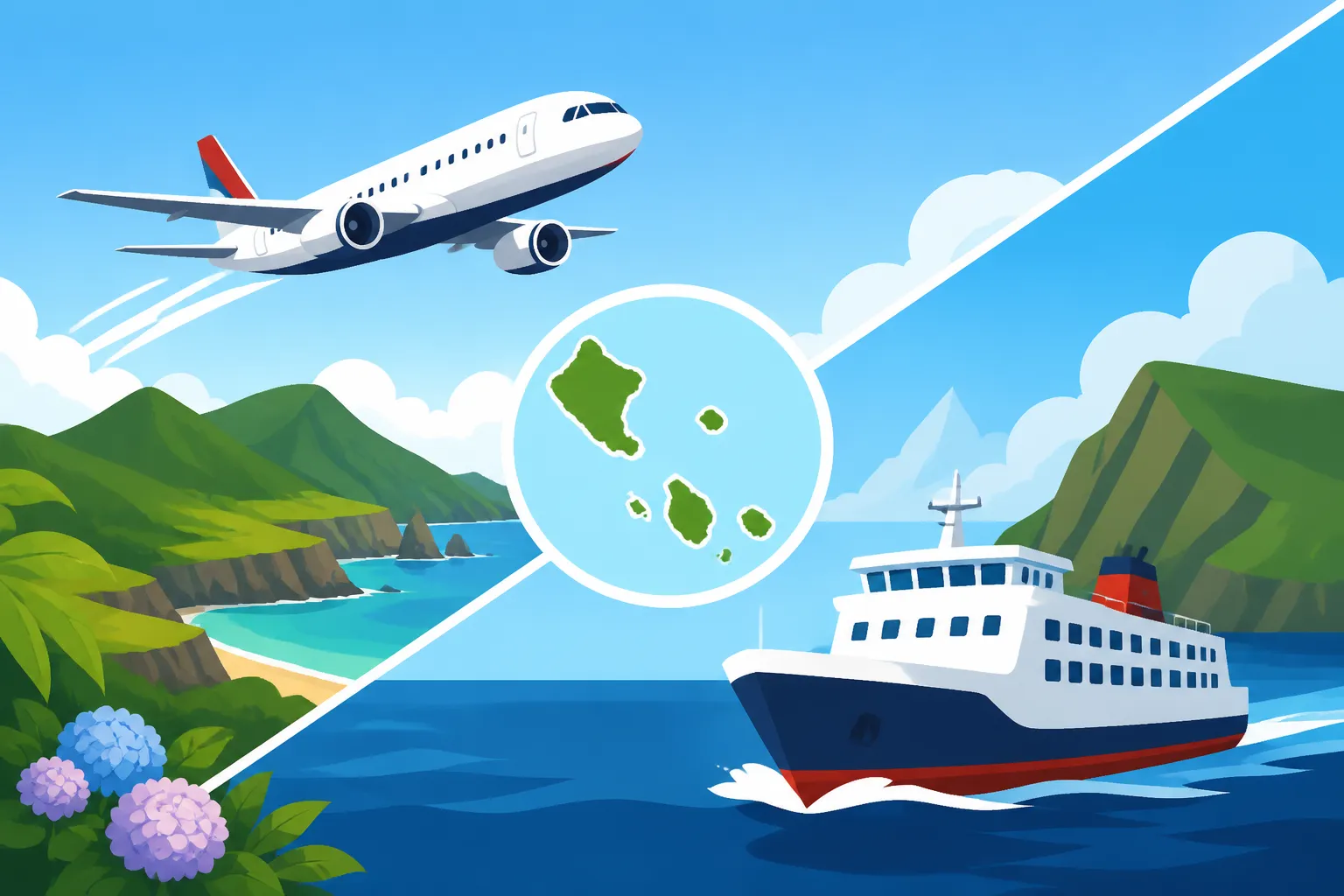
Domestic Flights and Ferries to Portugal’s Islands
Disclosure: This article contains affiliate links. If you buy through them, we may earn a commission at no extra cost to you. Read our full disclosure.
Planning a trip to the Azores or Madeira often feels like organizing a small expedition, especially when you realize that the mainland of Portugal is nearly 1,000 miles away from some of these volcanic outposts. Many travelers and new residents find themselves confused by the lack of a mainland-to-island ferry and the intricacies of inter-island flight vouchers. This guide solves those logistical puzzles, providing a veteran’s perspective on navigating domestic flights and ferries to Portugal's stunning islands.
Flying to the Atlantic Islands: Carriers and Logistics
If you are coming from Lisbon or Porto, the reality is that flying is your only consistent option. The days of a regular passenger ferry from the mainland to Funchal or Ponta Delgada are, unfortunately, a thing of the past. For most of us living here, the flight is just a standard part of life, like taking a long-distance bus, but for a newcomer, the varying service levels between carriers can be a bit of a shock. You’ll mostly be dealing with three players: TAP Air Portugal, SATA (Azores Airlines), and the low-cost giants like Ryanair and EasyJet.
The Major Carriers: TAP and SATA Azores Airlines
TAP Air Portugal is the flag carrier, and while they offer the most frequent connections from Lisbon (LIS) and Porto (OPO), they aren't always the most beloved by locals due to occasional delays. However, their network is robust. If you are heading to Madeira, you’ll find multiple flights daily into Funchal (FNC). For the Azores, TAP primarily services Ponta Delgada (PDL) on São Miguel and Terceira (TER). When I first moved here, I made the mistake of thinking all islands were equally accessible from the mainland. They aren't. Often, you’ll fly TAP to a main hub and then switch to a smaller SATA propeller plane to reach the "smaller" islands like Flores or Corvo.
SATA, or Azores Airlines, is the lifeline of the archipelago. They operate the inter-island flights that keep the nine islands connected. One thing to keep in mind is the "Free Inter-Island Connection" program. If you are flying from the mainland to an island without a direct flight, SATA is often mandated to provide the connecting flight at no extra cost, provided you meet specific booking criteria. It’s a bit of a bureaucratic dance, but it saves a fortune. This is where Madeira and Azores: Island Living, Costs, and Expat Communities becomes a relevant topic for those considering making these islands their permanent home.
Low-Cost Alternatives and the Wind Factor
Ryanair and EasyJet have revolutionized travel to the islands, making a weekend in Funchal often cheaper than a dinner in Cascais. However, there’s a catch that every veteran knows: the wind. Madeira’s airport is legendary for its short runway and crosswinds. While modern engineering has extended the track, "diverted flights" are a common part of the Madeira experience. Low-cost carriers are sometimes quicker to cancel or divert to Porto Santo or even back to the mainland if the weather turns.
When booking these flights, it is wise to use a platform like Omio to compare the budget carriers against the national airline. Sometimes the €20 you save on a budget seat is lost the moment you have to pay for a carry-on bag that TAP would have included for free. Furthermore, if you’re planning activities upon arrival, like a Jeep tour or a levada walk, I often check GetYourGuide to see which operators offer flexible cancellation policies in case your flight is one of the unlucky ones diverted by the Atlantic gusts.
The Inter-Island Flight Experience
Hopping between islands in the Azores is a unique experience. You’ll likely be on a Bombardier Dash 8, and the views are spectacular. Because these flights are short—sometimes only 20 minutes—the boarding process is remarkably casual compared to the mainland. However, weight limits are strictly enforced because the planes are small. If you’re a digital nomad carrying a mobile office, be prepared to have your "cabin bag" weighed and potentially moved to the hold.
For those of us who have spent time Finding Doctors and Specialists in Portugal: English-Speaking Medical Care, we know that sometimes island residents have to fly to the mainland for specific treatments. This means these domestic flights are often filled with locals going about their daily business, not just tourists. It’s a good reminder to be respectful and realize that for many people on the plane, this isn't a vacation; it’s their commute.
Ferries in Portugal: From River Crossings to Island Chains
While you can't catch a ferry from Lisbon to the islands, once you arrive in the archipelagos—or if you're navigating the mainland’s major rivers—ferries become an essential, and frankly much more scenic, way to travel. The ferry system in Portugal is split into three distinct "worlds": the Lisbon river crossings, the Azores inter-island routes, and the Madeira-Porto Santo connection.
The Azores Inter-Island Ferries
In the Azores, the ferry service is operated by Atlanticoline. During the summer months (roughly May to September), a large "yellow" line connects all the islands, but be warned: the Atlantic is not a lake. Even in July, the crossing from São Miguel to Santa Maria or the long haul to the Central Group can be stomach-churning. For many, the "Triangle" is the most practical ferry experience. This involves the islands of Faial, Pico, and São Jorge. They are so close to each other that the ferry is more like a bus service, running multiple times a day.
In the winter, the ferry service scales back significantly, often only operating within the Triangle. If you’re planning a winter visit, don't count on the boat to get you from Ponta Delgada to anywhere else. You’ll be flying. For those exploring the more remote areas, understanding Public Transport and Driving in Portugal: Trains, Tolls, and Licenses is vital, as once you step off that ferry, your options for getting to your accommodation might be limited to a single local taxi driver or a pre-booked rental car.
The Madeira to Porto Santo Link
Madeira has one primary ferry connection that is a staple for both locals and tourists: the Porto Santo Line. The ship, the Lobo Marinho, makes the trip from Funchal to the golden sands of Porto Santo in about two hours and fifteen minutes. It’s a massive vessel with cinemas, restaurants, and plenty of deck space. For expats living in Funchal, a "day trip" to Porto Santo is a rite of passage.
It is worth booking the "First Class" (Lobo Marinho Class) if the small upgrade is affordable. It gives you a quiet lounge and some snacks, which is a godsend during the busy summer months when the main decks are packed with excited families. If you’re looking for a place to stay on either end, Booking.com often has the best selection of local quintas or beach apartments that aren't always listed on the larger corporate sites.
River Ferries on the Mainland
While not "island" ferries in the traditional sense, the Transtejo and Soflusa ferries in Lisbon are a crucial part of the city's identity. They connect the north bank (Lisbon) to the south bank (Margem Sul). For a tourist, taking the ferry from Cais do Sodré to Cacilhas is the cheapest "cruise" you can buy, offering the best view of the Lisbon skyline for the price of a metro ticket.
This is a vital link for anyone Where to Live in Portugal: Lisbon, Porto, Algarve, and Silver Coast Compared, as many expats choose to live in Almada or Seixal for lower rents while commuting into the city center via boat. It’s a ten-minute crossing that beats sitting in traffic on the 25 de Abril Bridge any day of the week. You can read more about the specifics in our guide on Taking the ferry in Lisbon: Cacilhas, Trafaria, and Barreiro routes.
Comparison of Island Travel Methods
| Route Type | Primary Mode | Duration | Estimated Cost (One-Way) | Reliability |
|---|---|---|---|---|
| Mainland to Madeira | Flight | 1h 45m | €30 – €150 | Moderate (Wind issues) |
| Mainland to Azores | Flight | 2h 15m | €40 – €200 | High |
| Azores Inter-Island | Flight (SATA) | 20m – 50m | €60 – €100 | High |
| Azores Inter-Island | Ferry (Summer) | 30m – 6h | €10 – €60 | Weather Dependent |
| Funchal to Porto Santo | Ferry | 2h 15m | €30 – €45 | High |
| Lisbon River Crossing | Ferry | 10m – 20m | €1.30 – €3.00 | Very High |
Practical Planning for Your Island Journey
Living in Portugal teaches you one thing very quickly: patience. This is especially true when dealing with island logistics. You cannot approach a trip to Flores with the same rigid schedule you might use for a trip to Madrid. The Atlantic Ocean has its own plans, and "Island Time" is a very real phenomenon that dictates everything from when the grocery store restocks to when your flight might actually depart.
Managing Luggage and Delays
One of the most frequent frustrations I see involves luggage. If you are flying SATA between islands, the overhead bins are tiny. My advice is to pack as if you are going on a hiking trip, even if you’re staying in a luxury hotel. Use soft-sided bags that can be easily squashed into odd spaces. If your flight is delayed due to "nevoeiro" (fog), don't panic. This is so common that the airlines have standard procedures for it.
We suggest having a "buffer day" in Lisbon or Porto before your international flight home. Never book a flight from the islands that lands in Lisbon at 2:00 PM if your flight back to the US or UK leaves at 5:00 PM. If the wind picks up in Madeira, you might not leave the island for another 24 hours. During these waits, I find comfort in Portuguese Coffee Culture and Restaurant Etiquette: Ordering Like a Local, because there is no problem in Portugal that a café and a pastel de nata can’t make slightly more tolerable.
Using Travel Apps Effectively
To keep my sanity, I rely on a few specific tools. Omio is great for seeing if a flight is actually the best way, or if I should consider other options when I'm on the mainland. For the islands, I use GetYourGuide to book my transfers and boat tours in advance. In places like Pico, where whale watching is the main draw, these slots fill up weeks in advance during the summer.
When it comes to accommodation, I’m a loyal user of Booking.com because their "map view" is essential for the islands. In the Azores, you might find a beautiful house that looks close to town, but on the map, you realize it’s at the top of a volcanic crater with a 20-minute drive down a winding road. Knowing exactly where you are staying helps you decide if you need to rent a car—which, on most islands, you absolutely do.
The Resident Subsidy: A Note for Expats
If you have already gone through the process of Registering with the Centro de Saúde: Getting Your SNS Número de Utente and have your residency card, you need to know about the Subsídio Social de Mobilidade. This is a government program that subsidizes flights for residents of the islands. Essentially, you pay the full price upfront, and then after you fly, you take your boarding passes and invoice to a CTT (Post Office) to get a refund for anything above a set "resident price."
For Madeira, the resident price is capped at €86 for a round trip to the mainland. For the Azores, it’s around €134. This is a game-changer for those of us living here, as it makes travel between the islands and the mainland incredibly affordable. Just make sure your NIF (Tax Number) is on the invoice, or you won't get a cent back. It’s one of those "hidden" perks of residency that makes the initial paperwork headache of Portugal Visa and Immigration Guide for Expats: The Complete 2027 Overview feel worth it.
Cultural Nuances and Seasonal Realities
The islands aren't just "Portugal with more water." They have distinct cultures, accents, and rhythms. In the Azores, the influence of the sea is everywhere, and there is a deep, quiet resilience in the people. In Madeira, the terrain is so vertical that life feels like it’s built on a series of balconies overlooking the ocean. Understanding these nuances will make your travels much smoother.
The "Silly Season" and Winter Gaps
August is what the Portuguese call "Augusto," but in the travel industry, it’s the "silly season." Everything is triple-booked, the ferries are loud, and the airports are chaotic. If you can, visit the islands in the "shoulder" months of May, June, or September. The weather is still beautiful, the hydrangeas in the Azores are in full bloom, and you won't be fighting for a seat on the ferry to Porto Santo.
Conversely, winter in the islands is a time for "slow travel." It’s rainy, yes, but it’s also the time when you can have a massive crater lake all to yourself. Just be aware that many tourist-facing businesses close or reduce their hours. This is the time to hunker down in a local taberna and practice your Portuguese. If you're feeling the winter blues, remember that Safety and Emergency Preparedness in Portugal for Foreign Residents includes knowing how to handle the occasional Atlantic storm that might knock out power for an hour or two in rural island villages.
Navigating the "Triangle" with Ease
If you only have a week and want an "island" experience without too many flights, focus on the Triangle in the Azores (Faial, Pico, São Jorge). You can fly into Horta (Faial), take a 30-minute ferry to Madalena (Pico), and another ferry to Velas (São Jorge). It’s the most efficient way to see three very different islands with minimal logistical stress. Each island has its own personality: Faial is the sailor’s hub, Pico is the wine and mountain island, and São Jorge is the land of dramatic cliffs (fajãs) and incredible cheese.
During these crossings, keep your eyes on the water. The channel between Faial and Pico is one of the best places in the world to spot dolphins and whales right from the ferry deck. You don't always need a fancy tour to see the magic of the Atlantic, though I still recommend checking GetYourGuide for specialized marine biology tours if you want a deeper dive into the ecosystem.
Final Advice for Smooth Island Hopping
The most important piece of advice I can give any traveler or new expat is to embrace the unpredictability. The ferry might be late because the sea is rough; the flight might be delayed because the "nevoeiro" has rolled into the mountains. This is part of the charm. If you’re the kind of person who needs every minute of their itinerary to be perfect, the islands will challenge you.
Plan well, use the tools like Omio and Booking.com to give yourself a solid foundation, and keep your residency documents handy if you're an expat looking for those refunds. But once you’re on that boat or that small plane, let go of the mainland stress. You’re in the middle of the Atlantic now, and there’s no better place to be.
Disclaimer
This guide is for informational purposes only. Travel schedules, airline policies, and government subsidies (such as the Subsídio Social de Mobilidade) are subject to change. Always verify current routes and requirements with official carriers like SATA, TAP, and Atlanticoline, or consult with the Portuguese civil aviation authority (ANAC) for the latest regulations. This content does not constitute legal or financial advice.