How to pay the AIMA residence permit issuance fee (DUC) at a Multibanco ATM
You’ve just left your AIMA appointment with a printed sheet full of numbers. The officer said “pode pagar no Multibanco,” and now you’re at an ATM outside a Pingo Doce with a queue forming behind you. This guide shows you how to pay the AIMA residence permit issuance fee, known as the DUC, at a Multibanco ATM. It also covers what to do when the machine won’t take your payment.
What the DUC Is and Why AIMA Gives You One
DUC stands for Documento Único de Cobrança, roughly a “single collection document.” The Portuguese state uses it to collect payments for public services, from court costs to immigration fees. When AIMA approves the next stage of your residence permit, it usually generates a DUC for the card issuance fee. You get it as a printout at the appointment, by email, or through your area on the AIMA portal.
The first time I got one, I assumed it was a receipt for something I’d already paid. It isn’t. It’s an invoice with a payment reference attached, and until you pay it, nothing moves. Your card won’t go to print, and your file just sits there. Some newcomers have waited weeks for a residence card, only to realise the DUC was still unpaid in a folder at home.
The good news is that paying it is quick once you know the button sequence. The Multibanco network is built for exactly this kind of reference-based payment. For the wider picture of how the system works, see The Multibanco System and MB Way: Portugal’s Unique Payment Network.
Reading Your DUC Line by Line
Before you go anywhere near an ATM, sit down with the document and find the key fields. The layout varies a little depending on whether it was printed at a counter or downloaded. The same core information is always there.
| Field on the DUC | What It Means | Why You Need It at the ATM |
|---|---|---|
| Referência | The unique payment reference tied to your file | You type this into the machine exactly as printed |
| Montante or Valor | The amount owed | The ATM asks you to enter or confirm it |
| Entidade | A short entity code, shown on some payment formats | Needed only if you pay via the services menu |
| Data Limite de Pagamento | The payment deadline | After this date the reference may stop working |
| Identificação do Requerente | Your name and identifying details | Lets you check the DUC belongs to you and not a family member |
| Serviço | The description of what you are paying for | Confirms it is the issuance fee and not another charge |
If you’re handling the process for a whole family, check the name on every DUC. Each family member often gets a separate document with its own reference. Paying your spouse’s reference twice and your child’s not at all is an easy mistake when you’re juggling a stack of identical-looking papers.
The Deadline and Why It Matters
Every DUC carries a payment deadline, and AIMA takes it seriously. If you miss it, the reference can expire. Then you have to contact AIMA to get a new one, which is about as fun as it sounds given how hard it can be to reach anyone there.
My advice is to pay the same day or the next morning. Don’t put the paper on the fridge with good intentions. If you got the DUC by email, take a screenshot of the reference and amount so you can pay even when you’re away from your laptop. To see where this payment fits in the overall timeline, read AIMA Residence Permit Processing Times and How to Check Your Status.
Step-by-Step: Paying the DUC at a Multibanco ATM
Now for the actual process. A real Multibanco ATM is the blue-and-white machine run by Portuguese banks. You’ll find them in bank branches, supermarket entrances, and shopping centres. The flashy machines in tourist zones are a different thing; I’ll come back to those.
Before You Walk to the Machine
Get these sorted first:
- A debit card issued by a Portuguese bank, connected to the Multibanco network
- Enough money in that account to cover the full amount on the DUC
- The DUC itself, printed or on your phone, with the reference clearly readable
- A few calm minutes, ideally at a machine without a long queue
The first point is the one that trips people up. Many newcomers arrive with only a foreign card. Multibanco machines usually let foreign cards withdraw cash but often hide the payments menu from them. If you don’t have a Portuguese account yet, see Opening a Bank Account in Portugal: Best Banks for Foreigners and Expats. If you’re still abroad, or you’re stuck in the loop where the bank wants an NIF and the NIF office wants an address, services like Bordr can arrange the NIF and help with opening a Portuguese bank account remotely. That way you’ll have a working Multibanco card by the time the DUC arrives.
The Button Sequence for State Payments
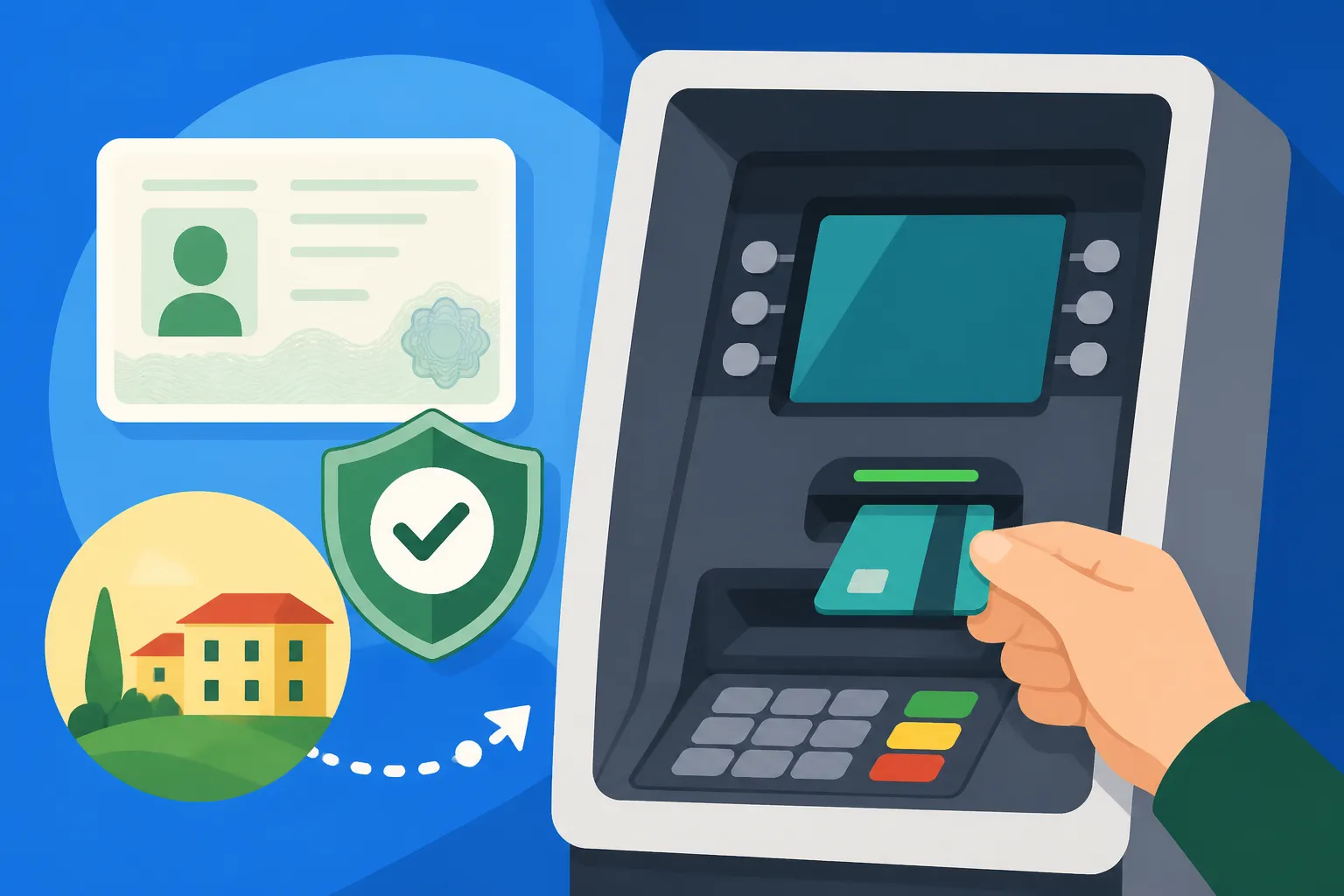
Most AIMA DUCs are paid through the state payments option. Machines run by different banks word the menus slightly differently, but the path is nearly always this:
- Insert your Portuguese debit card. If you’re asked to choose a language, English is available on many machines, but learning the Portuguese menu names is worth it because they stay the same everywhere.
- Enter your PIN.
- Select “Pagamentos e Outros Serviços” (Payments and Other Services). On some screens this is simply “Pagamentos.”
- Select “Pagamentos ao Estado” (Payments to the State). On some machines this option sits under a heading like “Estado e Setor Público.”
- If a second menu appears, choose “Pagamentos ao Estado” again or the closest option referring to state documents.
- Type in the reference from the DUC, slowly, checking each digit against the paper.
- Enter the amount exactly as shown on the DUC, including the cents.
- Review the confirmation screen. Many machines show a description of the payment, which should match the service on your DUC.
- Confirm the payment.
- Take the receipt (the talão). If the machine asks whether you want one, always say yes.
The whole thing takes about two minutes. The first time I did it, a lovely senhora behind me in the queue leaned over and pointed at “Pagamentos ao Estado” before I’d even found it. Don’t be embarrassed if this happens to you. It’s a very Portuguese form of kindness.
When the DUC Shows an Entidade and a Referência
Some payment documents use the classic three-field format: Entidade, Referência, and Montante. That’s the same format as your electricity bill or a toll payment. If your DUC is laid out like that, take a slightly different route:
- Insert your card and enter your PIN.
- Select “Pagamentos e Outros Serviços.”
- Select “Pagamento de Serviços” (Payment of Services).
- Enter the Entidade code.
- Enter the Referência.
- Enter the Montante.
- Confirm and take your talão.
If you’ve already paid utility bills this way, it will feel familiar. If not, How to use the Multibanco ATM network to pay taxes, tolls, and utility bills covers that general routine in more depth.
When the Multibanco Refuses to Cooperate
This is where people get frustrated, often after a long day of bureaucracy. These are the most common problems and how to get around them.
Foreign Cards and the Missing Payments Menu
If you use a foreign card, the screen may jump straight to withdrawal options and skip the payments menu altogether. That isn’t a fault you can fix by trying again. The payments functions are designed around Portuguese-issued cards, so you’ll need a different route.
Watch out for independent cash machines in tourist areas too. They look like ATMs but aren’t part of the Multibanco payments system, and they won’t process a DUC. They also tend to push expensive currency conversion on foreign cards. How to avoid ATM withdrawal fees from Euronet machines in tourist areas explains how to recognise them.
Common Errors at the Machine
When a payment fails, it’s usually one of a handful of causes:
- Reference typed incorrectly. One wrong digit makes the machine reject it as invalid. Start again and read the reference aloud as you type.
- Wrong menu. Entering a state payment reference under “Pagamento de Serviços,” or the reverse, produces an error. Go back and try the other path.
- Amount mismatch. Entering the amount without the cents, or rounding it, can cause a rejection. Type exactly what’s printed.
- Expired reference. If the deadline has passed, the machine won’t accept it. Contact AIMA to ask for a new DUC.
- Insufficient balance or daily limit. Some accounts have daily payment limits. Check your banking app before assuming the problem is with AIMA.
If the machine takes the money but doesn’t print a receipt, don’t pay again. Check your banking app for the transaction. Then go to your bank branch to get proof of payment printed or sent.
Alternative Ways to Pay the Same DUC
The ATM isn’t your only option. Here’s how the main routes compare:
| Payment Method | What You Need | Good For | Watch Out For |
|---|---|---|---|
| Multibanco ATM | Portuguese debit card and PIN | Fast payment with an instant paper receipt | Foreign cards often can’t see the payments menu |
| Portuguese bank app or home banking | Online banking access with a Portuguese bank | Paying from your sofa, plus a digital receipt | Menu names differ between banks, so look for state payments |
| CTT post office counter | The DUC and an accepted payment method | People without a Portuguese card | Opening hours and queues, and acceptance can vary by branch |
| Bank branch counter | Account at that bank | Situations where you want a human to check everything | Branch hours are limited and some branches charge for counter services |
Most traditional Portuguese banks have a state payments option in their apps, including Millennium bcp, Caixa Geral de Depósitos, and Novobanco. The wording is usually something like “Pagamentos ao Estado,” and you enter the same reference and amount. If you have no Portuguese card at all, see Using the CTT post office to pay your immigration fines or processing fees for the counter route.
After You Pay: Proof, Receipts, and What Happens Next
Paying the DUC is a small win, but you’ll want proof that it happened.
Keep the Talão Like It’s Gold
The little paper receipt from the ATM fades over time, especially if it sits in a warm wallet. Take a photo of it straight away and save it alongside a scan of the DUC. If AIMA ever asks for proof of payment, or the payment somehow isn’t linked to your file, that photo will save you a great deal of stress.
I keep a dedicated folder, both physical and digital, for everything AIMA-related. That means the appointment confirmation, the DUC, the talão, and any emails. It sounds obsessive, but Portuguese administration runs on paper trails, and the person with the folder is usually the one who gets sorted out first.
If AIMA asked for extra documents at the same appointment, such as a translated birth certificate or criminal record certificate, keep those with the payment records too. Certified translation services like RushTranslate can handle document translation if you were caught short. Before you order, check that the translation format meets AIMA’s requirements. To prepare for that stage, read Attending Your AIMA Appointment: Required Documents and Interview Process.
Waiting for Your Residence Card
Once the payment registers, your card moves into production and is usually posted to the address on your file. Payments don’t always show up in AIMA’s system instantly, so give it some time before you worry. When the card is on its way, How to track your AIMA residence card delivery via CTT registered mail explains how to follow it and what happens if you miss the postman.
Keep the basics of your file in good order while you wait. If your visa conditions require ongoing health insurance, keep the policy active. Many D7 and D8 holders use international plans like Cigna Global, and an unexpected lapse can complicate renewal later. Keep your address up to date with AIMA too, so the card doesn’t end up at your old Airbnb.
If you’re paying a DUC as part of a renewal rather than a first permit, the steps at the ATM are identical. The paperwork leading up to it differs, and How to Renew Your Portuguese Residence Permit Online via the AIMA Portal covers that side.
Spotting Fake Payment Requests
One last warning. Because DUCs are just references and amounts, scammers have learned to copy the format. Be suspicious of any payment request for an immigration fee that comes through a WhatsApp message, a Facebook group, or a “facilitator” who asks you to pay into a personal account. A real DUC comes from AIMA, through its official channels, in your own name.
If someone offers to “speed up” your card in exchange for a payment outside the official DUC, walk away. Immigration Scams in Portugal: Fake Contracts and Appointment Sellers covers the common tricks. Many people lose money to these schemes, and getting it back is close to impossible.
Paying the AIMA issuance fee at a Multibanco ATM really is one of the easier parts of becoming a resident in Portugal. You need a Portuguese card, the right menu, and a carefully typed reference. Do it promptly, keep the talão, and let the slow machinery of Portuguese bureaucracy take it from there.
Disclaimer
This article is for general informational purposes only and does not constitute professional advice. Laws, prices and regulations vary by location and change over time. Consult a qualified professional for guidance on your specific situation.