How to avoid ATM withdrawal fees from Euronet machines in tourist areas
Disclosure: This article contains affiliate links. If you buy through them, we may earn a commission at no extra cost to you. Read our full disclosure.
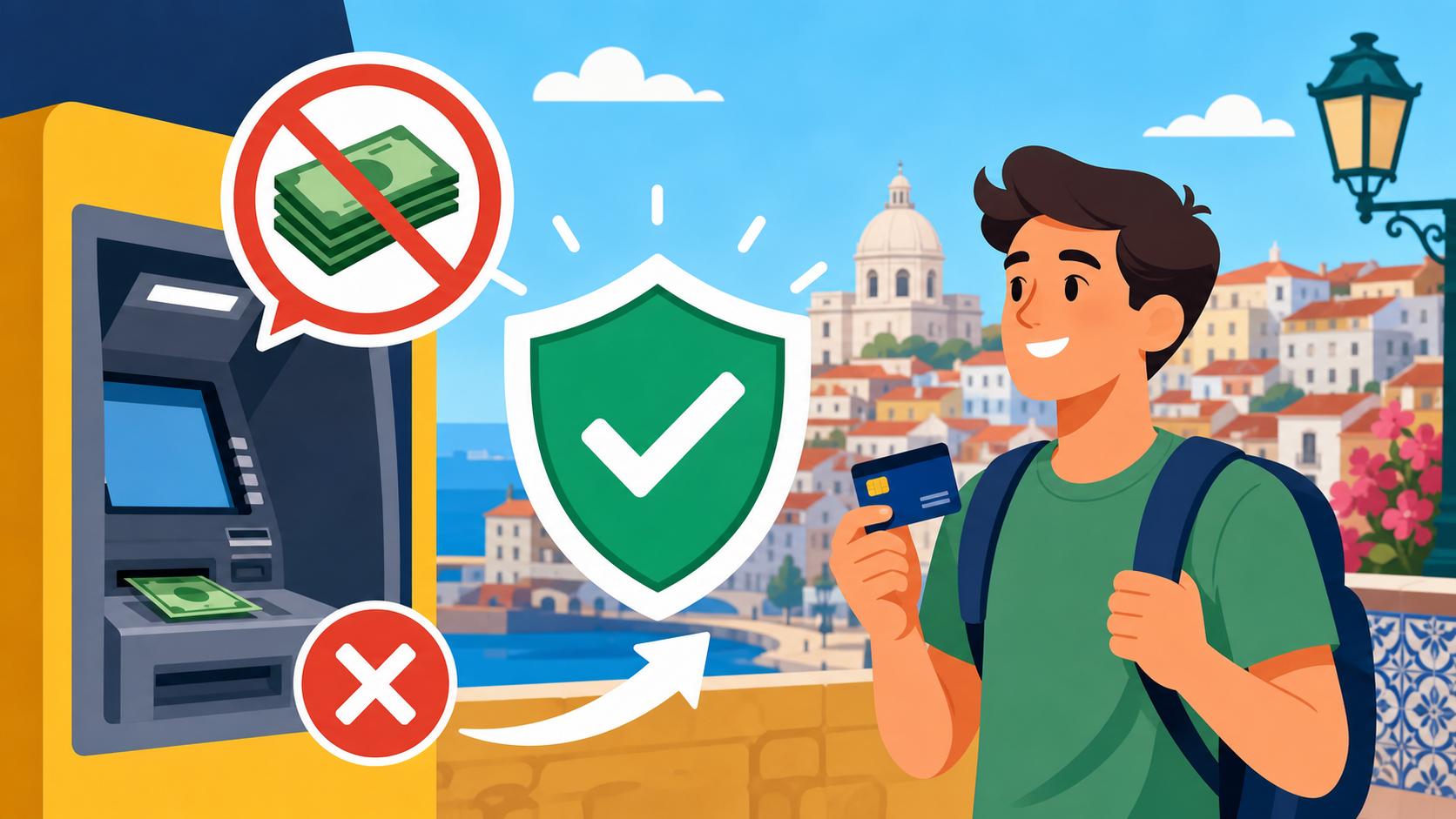
You are standing in the middle of Praça do Comércio, the sun is beating down, and you realize the traditional tasca where you just ate only takes "dinheiro vivo." I remember my first week in Lisbon, panicking and sprinting to the nearest blue-and-yellow Euronet box, only to lose nearly seven euros in fees on a twenty-euro withdrawal. This guide ensures you never fall for that predatory tourist trap again.
Identifying the Trap: Why Euronet ATMs Are Everywhere in Portugal
If you have spent more than ten minutes in the Baixa district of Lisbon or the Ribeira in Porto, you have seen them. They are bright, they are loud, and they are strategically placed right next to every major monument and ice cream shop. These are Euronet Worldwide machines, and they are not "banks" in the traditional sense. They are independent ATM providers that thrive on the lack of local knowledge among tourists and newly arrived expats.
The psychology behind their placement is brilliant and ruthless. They target areas where people are likely to be carrying out "lifestyle" spending—places where you might suddenly need five euros for a souvenir or ten euros for a street performer. Because they are often the only machines visible on a main thoroughfare, they bank on your exhaustion and your "I’ll just do it this once" mentality.
The Psychology of the Blue and Yellow Boxes
Euronet machines are designed to look official, often mimicking the color schemes of reputable European financial institutions. However, their primary revenue stream isn't just a small convenience fee; it is the spread they take on currency conversion. When you insert a non-Portuguese card, the machine immediately recognizes that you are an outsider. It offers a user-friendly interface that feels helpful, but every screen is designed to nudge you toward a high-cost transaction.
Many expats fall for the "Withdrawal with Conversion" button because it feels "safer" to see the amount in your home currency (like USD or GBP). In reality, that safety is an illusion that costs you between 10% and 15% of your total withdrawal value. They rely on the fact that you are likely overwhelmed by the Cost of Living in Portugal 2026: Detailed Budgets for Singles and Families and just want the transaction to be over with.
Dynamic Currency Conversion (DCC): The Hidden Fee
The most dangerous weapon in the Euronet arsenal is Dynamic Currency Conversion, or DCC. This is a "service" where the ATM provider offers to do the math for you. It shows you exactly how much will be deducted from your home bank account. It sounds transparent, right? It isn't. When you accept DCC, you are allowing Euronet to set its own exchange rate, which is invariably much worse than the mid-market rate.
When you use a card from a provider like Wise, you already have access to the real exchange rate. If you let the ATM "help" you with conversion, you are essentially paying for a service that your card already provides for free. Always look for the option that says "Decline Conversion" or "Charge in Local Currency (EUR)." Even if the machine warns you that it cannot "guarantee" the exchange rate if you decline, ignore it. Your home bank or your digital wallet will always give you a better deal than a plastic box on a street corner.
The Multibanco Network: Your Holy Grail for Fee-Free Withdrawals
To live like a local, you must look for the "MB" logo. The Multibanco network is one of the most sophisticated and integrated interbank networks in the world. It is a source of national pride for the Portuguese, and for good reason. Unlike the fragmented ATM systems in the US or the UK, almost every bank in Portugal is part of this network. This means that a client of a small northern credit union can use a machine at a major Lisbon branch without paying a cent in domestic fees.
For expats, the Multibanco machine is your best friend. As long as you are using a card from one of the Traditional Portuguese Banks: Millennium, CGD, Santander, and Novobanco, your withdrawals will be free. Even if you are using a foreign card, the fees at a standard Multibanco machine are either non-existent or significantly lower (usually just a couple of euros) compared to the daylight robbery of third-party machines.
How to Spot a Real Multibanco Machine
A real Multibanco machine is often built into the wall of an actual bank branch. Look for names like Caixa Geral de Depósitos, Santander, Millennium bcp, or Novo Banco. These machines are usually inside a small glass foyer that stays open 24/7, providing a layer of security that street-side Euronet machines lack.
If you are Opening a Bank Account in Portugal: Best Banks for Foreigners and Expats, you will quickly learn that the "MB" logo is a sign of reliability. These machines are maintained by SIBS, the company that manages the Portuguese payment infrastructure. They are rarely out of cash, they don't have "skimmers" as often as the isolated tourist boxes, and they offer a range of services from paying utility bills to topping up your phone credit.
Navigating the Multibanco Menu in English
The first thing you should do when you insert your card is look for the flag icon or the "English" button. The Multibanco interface is very consistent across the country. One quirk that often confuses newcomers is the withdrawal limit. Often, the machine will offer you "Other Amounts" if you need more than the standard €20 or €40 suggestions.
However, be aware that many Portuguese ATMs have a per-transaction limit of €200 and a daily limit of €400. If you are trying to pay a large deposit in cash (though I highly recommend Transferring Money to Portugal: Saving on Exchange Rates and Fees for larger sums), you might need to visit the machine over two separate days. Understanding The Multibanco System and MB Way: Portugal's Unique Payment Network is essential because it is about more than just cash; it is the heartbeat of how money moves in this country.
| ATM Feature | Multibanco (Bank-Linked) | Euronet / Third-Party |
|---|---|---|
| Typical Fee | €0 (Domestic) / Low (Foreign) | €3.95 to €5.95 |
| Exchange Rate | Network Standard (Visa/MC) | Proprietary (Marked up 10%+) |
| Withdrawal Limits | Usually €200 per transaction | Varies, often higher to lure fees |
| Security | High (Usually inside banks) | Low (Exposed on streets) |
| Additional Services | Bill pay, Tax pay, MB Way | None (Withdrawal only) |
Strategic Financial Tools for Savvy Expats and Travelers
If you are moving here or staying for an extended period, relying solely on your old high-street bank from home is a mistake. The fees for international transactions and ATM withdrawals can eat into your "vinho verde" budget faster than you realize. You need a modern toolkit that bridges the gap between your home currency and the Euro.
When I first arrived, I used my standard UK debit card and was shocked by the "non-sterling transaction fees" on every single coffee. Transitioning to digital-first solutions changed everything. For many, managing Money and Finance in Portugal: The Ultimate 2026 Guide for Expats means having a multi-layered approach to spending and cash access.
Using Wise and Digital Wallets to Bypass Fees
Wise is practically the "gold standard" for expats in Portugal. It allows you to hold a balance in Euros and provides you with a physical card that is treated like a local European card by most ATMs. When you use a Wise card at a Multibanco machine, you are effectively withdrawing from a local Euro balance, which eliminates the conversion fee entirely.
Furthermore, Wise allows for a certain amount of free international ATM withdrawals every month. If you stay within these limits and use only Multibanco machines, your cost for getting cash in Portugal can be exactly zero. This is a massive win when you are first navigating the Online and Neobanks in Portugal: ActivoBank, Moey!, Revolut, and N26 landscape.
Maximizing Benefits with Trade Republic and Binance
If you are more investment-focused, Trade Republic offers a debit card that provides "Saveback" on your spending. While it is primarily an investment platform, their card is a Visa, which is widely accepted at all Multibanco locations. By using Trade Republic, you can actually earn a small percentage back on the money you spend locally, which can help offset the general Currency Exchange Risk: Budgeting in EUR When You Earn in USD that many of us face.
For the crypto-native expat, the Binance card is another powerful tool. While the rules around crypto are changing, having a Binance card allows you to spend your stablecoin or crypto balances directly at Portuguese terminals. When you use this card at an ATM, it functions similarly to any other international Visa card. The key is to always decline the ATM's offer of conversion and let the card's backend handle the math at the real-time market rate.
Practical Tips for Managing Cash in Portugal
Even as the country moves toward digital payments, Portugal remains a "cash-heavy" society in certain contexts. Small cafes (pastelerias), local markets, and rural shops often have a "Minimum €5" or "Minimum €10" rule for card payments. If you are in a tiny village in the Alentejo, cash isn't just a suggestion; it’s a requirement.
However, carrying too much cash is also a risk. Carrying enough cash for one day of "emergency" expenses, usually around €50, is a sensible precaution. This is enough to cover a taxi if your phone dies or a meal at a local spot that doesn't take cards.
When Do You Actually Need Cash?
You will need cash for the legendary "Tram 28" in Lisbon if you aren't using a pre-paid Viva Viagem card. You will need it for the municipal markets where you buy the freshest fish and vegetables. You will also often need it for tipping in small, family-run restaurants. While tipping isn't mandatory, leaving a few Euro coins is a deeply appreciated gesture.
If you are still Comparing Traditional Portuguese Banks: Millennium, CGD, Santander, and Novobanco, ask them specifically about their "off-network" fees. Some of the newer digital accounts offered by these traditional banks have very generous ATM policies. Keeping a local account with a small balance is a great way to ensure you always have access to a Multibanco without any anxiety about fees.
Security and Safety at ATMs
Portugal is one of the safest countries in the world, but tourist areas are always magnets for petty theft. When using a Multibanco machine, especially one on the street, be mindful of your surroundings. "Distraction thefts" can happen where someone approaches you with a map or a question while you are mid-transaction.
Always cover your PIN—it sounds basic, but "shoulder surfing" is the primary way people get compromised. If a machine looks like it has been tampered with, or if the card slot feels loose, walk away. There is always another Multibanco just a few blocks away. Avoiding Currency Exchange Risk: Budgeting in EUR When You Earn in USD also means being smart about how and where you access your money.
By avoiding the blue-and-yellow Euronet traps and sticking to the "MB" network with a card from Wise, Trade Republic, or Binance, you are taking the first step toward financial integration in your new Portuguese life.
Disclaimer
The information provided in this guide is for informational purposes only and does not constitute financial, legal, or investment advice. Banking regulations, ATM fees, and exchange rates in Portugal are subject to change. Always check the specific terms and conditions of your bank or card provider before making international withdrawals. All mentions of third-party brands are based on current market availability as of 2026.