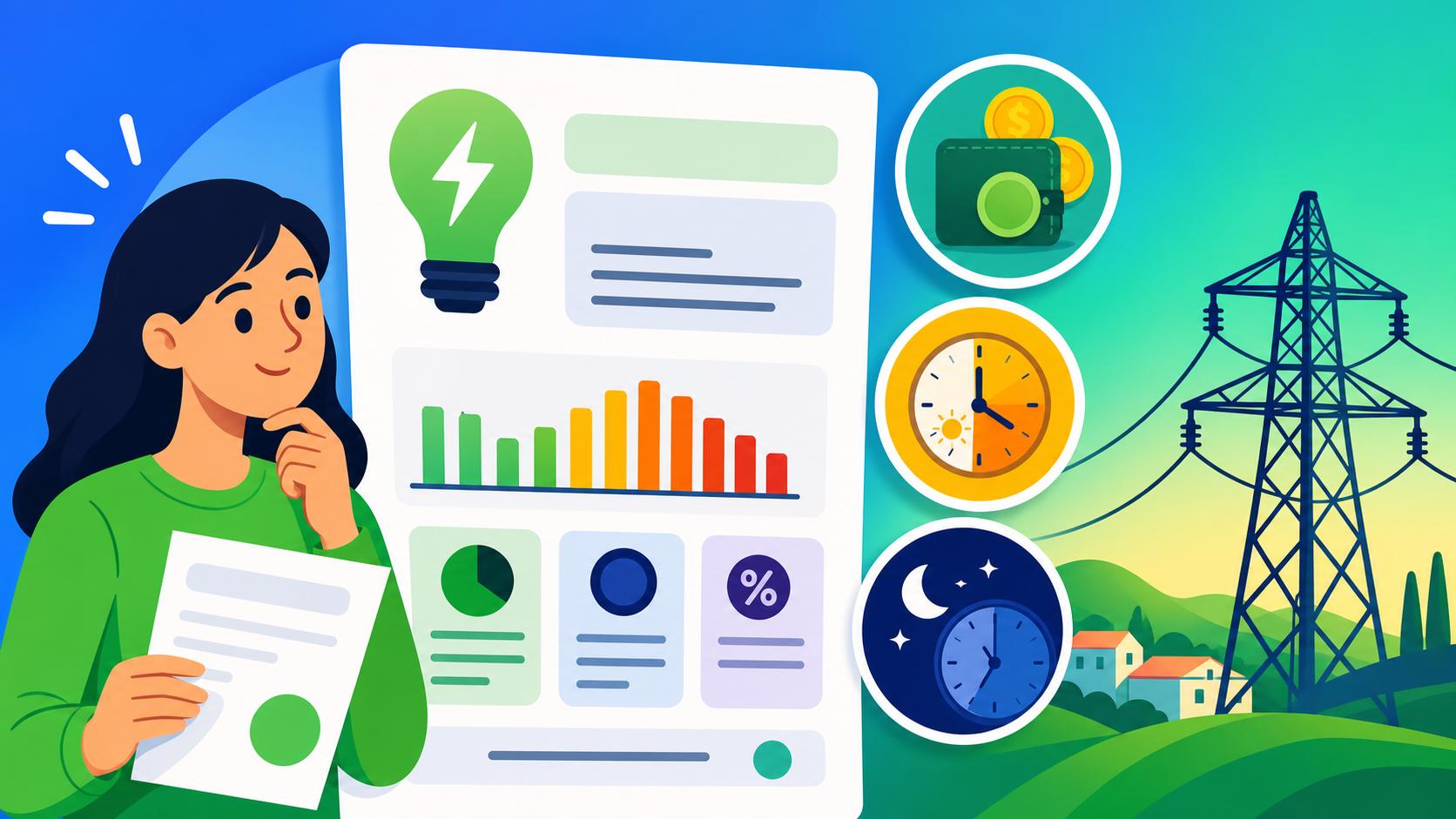
How to read an EDP electricity bill: Taxes, bi-hourly tariffs, and peak hours
Disclosure: This article contains affiliate links. If you buy through them, we may earn a commission at no extra cost to you. Read our full disclosure.
Staring at a four-page PDF from EDP and wondering why your "cheap" Portuguese lifestyle suddenly feels very expensive? I spent my first winter in Lisbon wrapped in three blankets because I couldn't decipher which hours were actually affordable to turn on the heater. This guide deconstructs the baffling terminology of your EDP bill, identifies the hidden taxes, and provides a roadmap to mastering peak hours for maximum savings.
The Anatomy of Your EDP Bill: Where to Look First
When you first open your bill, your eyes likely dart straight to the total amount due in bold at the top. While that’s the most painful part, it tells you almost nothing about your actual habits. To understand your costs, you need to look at the secondary data points that define your contract. If you are just starting your journey and following a Living in Portugal Guide 2027: The Complete Relocation Manual for Expats, getting these details right from day one is essential.
Identifying Your CPE and Why It Matters
The CPE (Código de Ponto de Entrega) is the most critical piece of information on your statement. It is a 20-digit identifier starting with "PT" that acts as the unique "social security number" for your electrical meter. Unlike your account number, the CPE stays with the property regardless of who lives there. If you have just used Uniplaces to secure a mid-term rental, you will need this number to ensure you aren't paying for the previous tenant's debt.
In my early days, I made the mistake of thinking my account number was enough to discuss issues with support. It wasn't. The CPE is what the technicians use to identify your physical connection in the grid. Keep this number saved in your phone; you’ll need it for everything from reporting a blackout to switching providers.
Potência Contratada: The "Invisible" Fixed Cost
In Portugal, you don't just pay for the energy you use; you pay for the capacity to use it. This is called "Potência Contratada," measured in kVA. Think of it like a pipe: a wider pipe (higher kVA) allows more "water" (electricity) to flow at once, but you pay a higher daily standing charge for that privilege.
Common levels for apartments are 3.45 kVA or 6.9 kVA. If you try to run your oven, washing machine, and a space heater simultaneously and your power trips (the "quadro" drops), your potencia is too low. However, if you are paying for 10.35 kVA and only live in a small studio, you are wasting money every single day on a standing fee. Adjusting this is one of the first things I recommend in any Setting Up Utilities in Portugal: Electricity, Gas, Water, and Internet checklist.
Understanding Bi-Hourly Tariffs and the Peak Hour Game
Portugal’s energy grid heavily incentivizes off-peak usage. Most expats start on a "Simples" (flat rate) plan because it’s easier to understand, but almost everyone is better off switching to a "Bi-Horário" (two-rate) plan. This is where the bill becomes a logic puzzle, as the hours change depending on whether it is "Inverno" (Winter) or "Verão" (Summer).
Vazio vs. Fora de Vazio
In a Bi-Horário plan, your usage is split into two categories. "Vazio" (Empty/Off-peak) is when electricity is significantly cheaper—often 40-50% less than the standard rate. "Fora de Vazio" (Peak) is everything else. To make this work, you have to be disciplined. I learned the hard way that running the dishwasher at 2 PM is a financial sin in Portugal.
I suggest buying smart timers on Amazon Spain to ensure your high-draw appliances only kick in during Vazio hours. If you are managing a tight Cost of Living in Portugal 2026: Detailed Budgets for Singles and Families, these savings can represent €30 to €50 a month, which covers a nice dinner out in most neighborhoods.
| Tariff Period | Winter Hours (Approx.) | Summer Hours (Approx.) | Strategy |
|---|---|---|---|
| Vazio (Off-Peak) | 10:00 PM – 8:00 AM | 11:00 PM – 9:00 AM | Best for laundry, heaters, and EVs |
| Fora de Vazio (Peak) | 8:00 AM – 10:00 PM | 9:00 AM – 11:00 PM | Limit usage; avoid heavy appliances |
| Weekend Vazio | All day / Late nights | All day / Late nights | Deep cleaning and meal prepping |
The Weekend Bonus
One of the best kept secrets for new residents is that the "Cycle Weekly" (Ciclo Semanal) option usually includes a much larger window of Vazio hours on Saturdays and Sundays. While the weekday Vazio remains the same (usually starting at 10 PM or midnight), the weekend often offers cheaper rates all day Sunday or during vast blocks of Saturday. Check your bill’s second page under "Ciclo" to see which one you are on. If it says "Diário," you are likely missing out on cheaper weekend laundry sessions.
Navigating the Maze of Taxes and Extra Charges
When you look at your total, you’ll notice that the actual electricity consumed is often only 50-60% of the bill. The rest is a collection of bureaucratic line items that can feel like a personal affront. Validating these frustrations is part of the expat experience; we all pay them, and we all complain about them.
The Infamous Contribuição Audiovisual
You will see a charge for roughly €3.00 plus VAT labeled "Contribuição Audiovisual." This is effectively a mandatory TV license fee that funds the public broadcaster, RTP. Even if you don't own a TV or only use an Airalo eSIM for data and never watch local channels, you must pay this. There is no opting out unless your consumption is incredibly low (essentially an empty house).
IEC and Environmental Fees
The "Imposto Especial de Consumo" (IEC) is a small tax on electricity as a commodity. Additionally, you will see "Encargos de Potência" and "Taxa de Exploração." These are network access fees that go toward maintaining the physical wires and transformers across the country. It’s frustrating to see four or five different taxes before you even get to the VAT, but it is a standard part of the Portuguese system.
The Three Tiers of IVA (VAT)
Portugal applies different VAT (IVA) rates to different parts of your bill, which makes manual calculation nearly impossible.
- 6% Rate: Applied to the first 100 kWh of consumption (for contracts up to 6.9 kVA) and the "fixed" part of the power charge.
- 13% Rate: Applied to certain intermediate consumption levels.
- 23% Rate: Applied to everything else, including the majority of your actual energy usage and the audiovisual tax.
Actionable Steps to Control Your Costs
The most common reason for a "bill shock"—a massive, unexpected €400 charge—is the "Estimativa" (Estimate). If EDP doesn't have your actual meter reading, they guess based on previous years. Then, six months later, they read the meter and charge you the "acerto" (adjustment) for everything they under-calculated.
Submitting Your Leituras Regularly
To avoid the Estimate Trap, you must submit your "Leituras" every month. There is a specific window of 3-5 days indicated on your bill (usually labeled "Período para comunicar leitura"). You can do this via the EDP app, their website, or a dedicated phone line. I set a recurring calendar alert for the 15th of every month. Since I started doing this, my bills have been consistent to the cent.
If you've just arrived and are working through your Health checklist for your first 30 days living in Portugal as an expat, add "Download EDP App" to that list. It is as important as finding a doctor.
Mastering the "Baixa" and Heating
Because of the way Heating and Insulation in Portuguese Homes: Fighting Winter Cold and Mold works in this country (or rather, doesn't work), electricity usage spikes in winter. Most Portuguese homes have zero insulation. If you use electric "oil radiators," your bill will quadruple.
One veteran tip: check if your rental contract allows for a "Tarifa Social." If you are on certain benefits or have a low income, you can get a significant discount. Even if you don't qualify, ensure your Renting an Apartment in Portugal: Contracts, Fees, and Tenant Rights includes a clause about who is responsible for maintaining the water heater (esquentador), as an old, inefficient heater is often the hidden culprit behind high bills.
Switching to Direct Debit
Finally, save yourself the "taxa de cobrança" by setting up a "Débito Direto." You can do this easily at any Multibanco ATM or via your banking app. If you're unsure how the machines work, read up on How to set up direct debit (Débito Direto) for your utility bills using Multibanco to avoid the queues at the CTT (Post Office). To manage your account online, you’ll eventually need your NIF password (Senha das Finanças): How to request and activate it by mail to verify your tax identity, so get that sorted early.
Disclaimer
The information provided in this guide is for informational purposes only and reflects the energy market conditions and tax regulations in Portugal as of 2026. Utility rates, tax percentages (IVA), and peak hour schedules are subject to change by the Portuguese government and regulatory bodies (ERSE). Always refer to your specific contract terms with EDP or your chosen provider for the most accurate and up-to-date pricing. This guide does not constitute financial or legal advice.