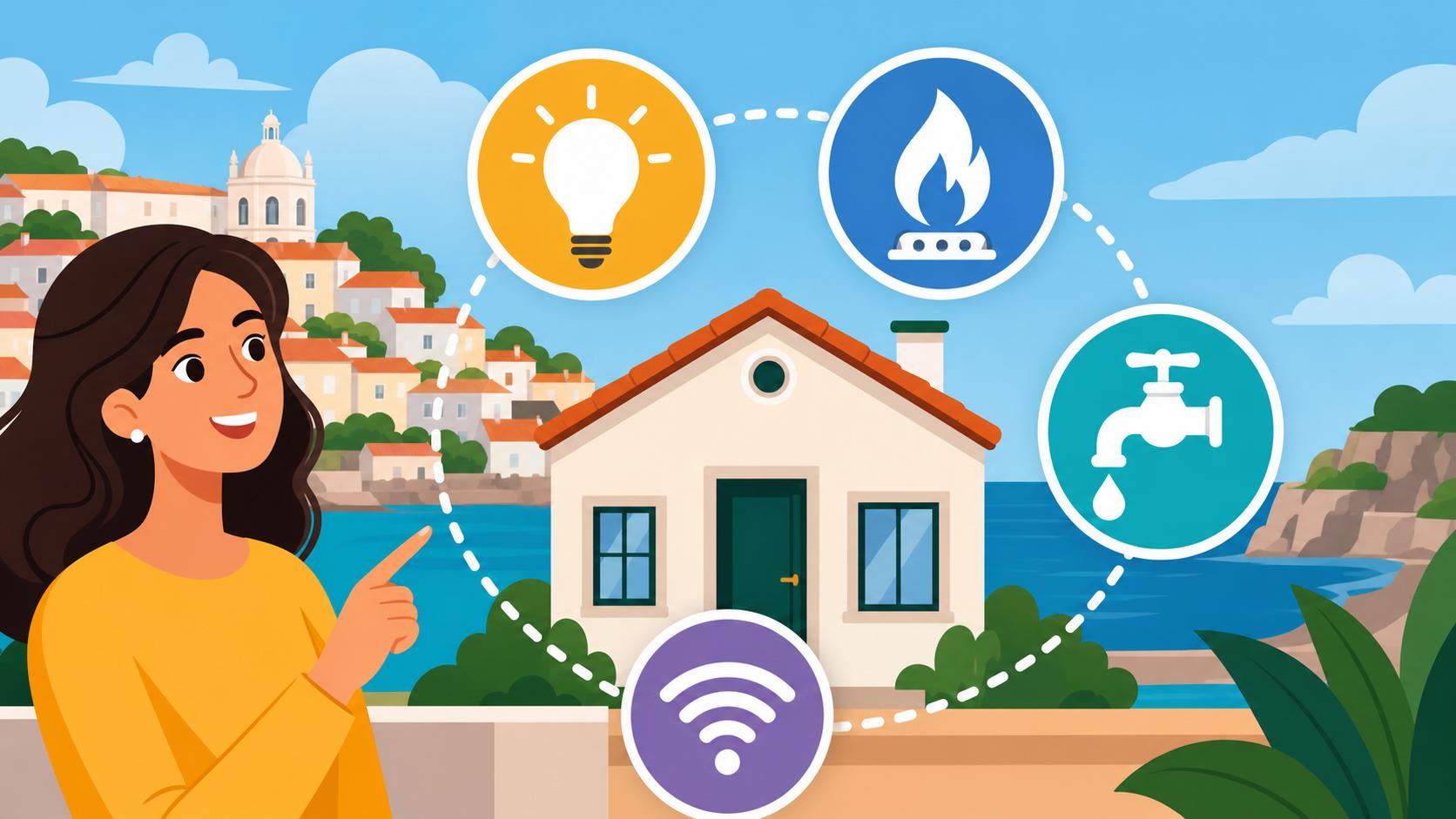
Setting Up Utilities in Portugal: Electricity, Gas, Water, and Internet
Disclosure: This article contains affiliate links. If you buy through them, we may earn a commission at no extra cost to you. Read our full disclosure.
Navigating the bureaucracy of a new country is exhausting, especially when you are just trying to perform the simple task of turning the lights on. I remember sitting in a dark Lisbon apartment for three days because I did not realize I needed a specific "spot code" for my meter that the landlord had forgotten to provide. This guide solves the complex administrative maze of setting up electricity, gas, water, and internet in Portugal, ensuring you never have to shower in the cold or work from a noisy café while waiting for a technician.
Understanding the Portuguese Utility Landscape
Setting up home services in Portugal is rarely as simple as a five-minute phone call. For many expats, the first hurdle is the sheer volume of documentation required before a company will even talk to you. You cannot simply provide a credit card and an address; the system is deeply integrated with your legal status and tax residency. This is why having your NIF and NISS: How to Get Your Portuguese Tax and Social Security Numbers finalized should be your absolute first priority before signing a lease or a purchase deed.
The Portuguese market is a mix of state-regulated monopolies, particularly with water, and a liberalized competitive market for electricity and gas. This means that while you are stuck with whoever manages the water in your specific municipality, you have a confusing array of choices for your power. In 2026, the focus has shifted heavily toward "green" energy and bundled packages, but these often come with hidden loyalty clauses that can haunt you if you decide to move house early.
The Essential Documentation Kit
Before you contact any provider, you need a digital or physical "utility folder." Every single company, from the water department to the internet provider, will ask for the same four or five documents. If you are missing one, the process stops immediately. Many newcomers lose a week of progress because they did not have their IBAN (International Bank Account Number) from a local bank ready. While some services might accept a foreign IBAN, most automated systems are still hard-wired for Portuguese accounts.
You will need your NIF (Número de Identificação Fiscal), a valid ID (passport or residence card), and your rental contract or property deed. Crucially, you need the specific identification codes for the meters already installed in the property. For electricity, this is the CPE (Código Ponto de Entrega). For gas, it is the CUI (Código Universal de Instalação). These are unique to the physical location, not the person. If you are using Uniplaces to find mid-term accommodation, many of these utilities might already be bundled into your monthly rent, which can save you this administrative headache during your first few months.
The Role of the Loja do Cidadão
The "Citizen’s Shop" or Loja do Cidadão is a place you will likely grow to both love and hate. It is a one-stop-shop where multiple government and private utility providers have kiosks. If you prefer to handle things in person rather than over a potentially confusing Portuguese-language phone menu, this is the place to go. However, the queues can be legendary.
Expats are advised to arrive 15 minutes before the doors open or use the "Siga" app to take a virtual ticket. In major hubs like Lisbon (Laranjeiras) or Porto, waiting times can exceed four hours if you arrive at midday. Handling your Registering with the Centro de Saúde: Getting Your SNS Número de Utente often happens in these same buildings, so it is wise to dedicate a full day to "the bureaucracy" and get everything done in one fell swoop.
Electricity Luz in the Liberalized Market
The electricity market in Portugal can be overwhelming because there are dozens of providers, each with multiple "tarifa" options. The biggest player remains EDP Comercial, but others like Endesa, Iberdrola, and Galp offer competitive rates. The most important thing to understand is that you are not just paying for the energy you consume; you are paying for the capacity you have access to. This is known as "Potência Contratada."
If your power constantly trips when you turn on the oven and the washing machine at the same time, your potency is too low. Most standard T1 or T2 apartments need at least 6.9 kVA. If you have a large family or use electric heating in the winter, you might need 10.35 kVA or more. Keep in mind that the higher the kVA, the higher your fixed daily standing charge will be, regardless of how much electricity you actually use.
Choosing the Right Tariff Structure
Portuguese electricity providers offer three main billing structures: Simples, Bi-horária, and Tri-horária. The "Simples" tariff means you pay the same rate 24/7. This is the safest bet for most people who do not want to micromanage their appliance usage. However, if you are a "night owl" or can program your dishwasher and laundry to run after midnight, the Bi-horária option can save you a significant amount of money.
In the Bi-horária system, the "Vazio" (Off-peak) hours usually run from 10:00 PM to 8:00 AM. During these times, the cost per kWh is significantly lower. I have saved roughly 20% on my monthly bill by simply shifting my heavy appliance usage to these windows. Just be careful; the "Fora de Vazio" (Peak) rates are higher than the standard "Simples" rate, so if you use most of your power during the day, you will end up paying more.
The Importance of Self-Readings
One of the biggest complaints expats have is receiving a "factura de estimativa" (estimated bill) that is double or triple their actual usage. To avoid this, you must submit your meter readings (leituras) every month. Most providers have an app or a dedicated phone line for this.
If you do not submit a reading, the company guesses based on previous months or the usage of the previous tenant. This is especially problematic when moving into a house that was previously occupied by five people if you are living alone. I always set a calendar reminder for the "reading window" indicated on my bill. This ensures that I only pay for what I actually use, which is vital for maintaining a Cost of Living in Portugal 2026: Detailed Budgets for Singles and Families that stays within your expectations.
Water Água and Municipal Monopolies
Unlike electricity, you do not get to choose your water provider. Water is managed at the municipal level, which means your experience will vary wildly depending on whether you live in Lisbon, Porto, or a small village in the Alentejo. In Lisbon, the provider is EPAL. In Sintra or Cascais, you will likely deal with SMAS.
Because these are often government-run or heavily regulated monopolies, the customer service can feel a bit more "old school." You will need to visit their local office or use their specific portal to set up your contract. A common frustration is that they often require a physical visit or a digital signature that is compatible with the Portuguese "Chave Móvel Digital."
Understanding Your Water Bill
Your water bill in Portugal is not just for the water that comes out of your tap. It is a composite bill that includes several other municipal services. You will see charges for "Saneamento" (sewage and wastewater treatment) and "Resíduos Sólidos" (garbage collection). The garbage fee is often calculated based on your water consumption, which feels strange at first but is the standard way the country funds waste management.
There is also a fixed component and a variable component based on tiers (escalões). The more water you use, the higher the rate becomes for those extra cubic meters. This is designed to encourage conservation. If you have a garden or a pool, be prepared for your bill to jump significantly as you enter the higher, more expensive tiers.
Dealing with Leaks and Maintenance
Portuguese plumbing in older buildings can be notoriously temperamental. If you notice a sudden spike in your water bill, do not assume it is just a price hike. Check your toilets and taps immediately. A silent leak in a toilet tank can cost you €50 extra a month.
When you move into a new place, take a photo of the water meter on day one. If the previous tenant left an unpaid balance, the water company might try to hold you responsible before they turn the service back on. Having your rental contract and a photo of the meter is your "get out of jail free" card in these disputes. If you need to buy any repair tools or water-saving fixtures, Amazon Spain is usually the fastest way to get them delivered to your door without hunting through local hardware stores (Ferragens) that might have limited stock.
Gas Gás Piped vs Bottled Solutions
Depending on where you live, you will either have "Gás Canalizado" (piped gas) or you will be part of the "Garrafão" (bottled gas) subculture. Most modern apartments in cities have piped natural gas. If you have a CUI number on your meter, you can set up a contract with a provider like Galp or EDP. This is generally the most convenient and cost-effective way to heat your water and cook.
However, if you are moving into an older building or a more rural area, you will likely need to buy gas bottles. These large orange or blue canisters are a staple of Portuguese life. You can buy them at petrol stations or have them delivered by a local truck. Managing bottled gas is an art form; there is nothing worse than the gas running out while you are mid-shower on a cold January morning.
Safety Inspections and Compliance
If you have piped gas, Portugal has very strict safety regulations. When you start a new contract, the company will send an inspector (inspector de gás) to check your "Esquentador" (water heater) and your stove. They will check for proper ventilation and ensure there are no leaks.
If your apartment does not meet the current safety standards—for example, if you have a windowless kitchen without a proper vent—the inspector will "chumbar" (fail) the installation and the gas will not be turned on. This can be a nightmare if you have just moved in. Always ask your landlord for the most recent "Certificado de Inspeção" before you sign a lease.
Choosing Between Gas and Electric
Many expats are moving away from gas entirely, opting for induction hobs and electric water heaters (Termoacumuladores). This simplifies your life because it is one less utility company to deal with and eliminates the safety inspection requirement. However, electricity is generally more expensive than gas for heating water.
If you choose the all-electric route, make sure your "Potência Contratada" is high enough. A large electric water heater can draw a lot of power. If you are renovating, you might want to look into solar thermal panels for water heating, which are highly incentivized in Portugal and can drastically reduce your Money and Finance in Portugal: The Ultimate 2026 Guide for Expats outgoings over time.
Internet TV and Mobile Packages
The telecommunications market in Portugal is dominated by three main players: MEO, NOS, and Vodafone. There is also a newer, budget-friendly entrant called Digi that has been shaking up the market. For most expats, a "3P" or "4P" bundle is the standard choice. These bundles include high-speed fiber internet, a television package with 150+ channels, a landline (which no one uses), and often one or two mobile SIM cards.
The quality of fiber (Fibra) in Portugal is actually among the best in Europe. Even in relatively small towns, you can often get 1 Gbps symmetrical speeds. However, the catch is the "Fidelização" or loyalty period. Standard contracts are almost always 24 months. If you try to cancel early because you are moving out of the country, you could be hit with a massive "break fee" that totals the remaining months of the contract.
| Provider | Best Known For | Typical Contract Length | Expat Friendliness |
|---|---|---|---|
| Vodafone | Best customer service & international TV | 24 Months | High (English support) |
| MEO | Largest coverage in rural areas | 24 Months | Medium |
| NOS | Best cinema perks & 5G integration | 24 Months | Medium |
| Digi | Low cost, no-frills, shorter contracts | 12-24 Months | Emerging |
The Gap Period and Mobile Data
It often takes 5 to 10 working days for a technician to come and install your fiber internet. In the modern world, being without internet for two weeks is a professional disaster for digital nomads. This is where Airalo becomes a lifesaver. You can download an eSIM and get a large chunk of local data immediately upon landing at the airport, keeping you connected while you wait for your "Router" to be installed.
Once your home internet is live, you might find that the standard router provided by the company is a bit weak, especially if you live in a house with thick stone walls. Buying a mesh Wi-Fi system from Amazon Spain is a common "day two" purchase for expats. These systems can plug directly into your MEO or Vodafone router and ensure that you have high-speed access in every room, which is crucial if you are Working in Portugal as an Expat: Job Market, Culture, and Hiring in 2027.
Negotiating Your Package
Never accept the first price you see on a provider's website. If you go into a physical store, especially at the end of the month, the sales agents often have "hidden" promotions or can throw in a free streaming service like Disney+ or Netflix for 12 months.
Also, pay close attention to the TV box. Most Portuguese providers now use Android-based boxes that allow you to "scroll back" through seven days of TV. This is incredibly helpful for those Learning Portuguese for Career Growth: Certificates and Business Language because you can re-watch news programs or local soaps with subtitles at your own pace.
Managing Payments and the Multibanco System
Once your utilities are set up, the next challenge is paying them. Portugal has one of the most advanced inter-bank networks in the world, known as Multibanco. You can pay every single utility bill at any ATM in the country. You just select "Pagamentos," enter the "Entidade" (Entity code), "Referência" (Reference number), and the "Montante" (Amount).
However, for your sanity, you should set up "Débito Direto" (Direct Debit) for everything. Most companies will actually give you a small monthly discount (usually €1-€2) if you opt for direct debit and electronic billing (factura eletrónica). This prevents the dreaded situation where a paper bill gets lost in the mail and your water is cut off while you are on vacation. You can manage these direct debits easily through your Portuguese bank's app.
Tax Deductions and the NIF
In Portugal, many of your household expenses can be used to reduce your annual income tax (IRS) through a system called e-Fatura. While standard utility bills like electricity and water don't offer the same high deductions as healthcare or education, having your NIF attached to every account is a legal requirement and helps the tax authorities verify your residency status.
When you are Filing the Annual IRS Tax Return (Modelo 3): Deadlines and Process, you will see a section where your validated invoices are listed. It is a good habit to check the e-Fatura portal once a month to ensure your utility providers are correctly reporting your payments. It sounds tedious, but it can result in a nice "reembolso" (refund) come springtime.
Handling Disputes with the Yellow Book
What happens if a company overcharges you or fails to show up for an installation three times in a row? In Portugal, every business is legally required to have a "Livro de Reclamações" (Complaint Book). There is both a physical version in every store and an online version.
Filing a formal complaint in the "Livro" is a serious matter. The company is legally obligated to respond within a certain timeframe, and a copy of the complaint goes directly to the industry regulator (like ERSE for energy or ANACOM for telecommunications). I have found that simply mentioning the "Livro de Reclamações" is often enough to make a stubborn customer service agent suddenly find a solution to your problem. It is an essential tool for Understanding the 'Livro Amarelo' (Yellow Book) for Medical Complaints and utility disputes alike.
Overcoming Infrastructure Challenges
One thing no one tells you before you move is that Portuguese homes are notoriously cold in the winter. Because the country has a Mediterranean climate, many older buildings lack central heating and proper insulation. You might find that your electricity bill doubles in December and January as you resort to "Aquecedores" (portable electric heaters).
This is a major cultural shock for many expats. You will see people wearing thick sweaters and scarves inside their own living rooms. To manage this, you need to be strategic. Use your "Bi-horária" electricity tariff to run your heaters at night, and invest in a high-quality dehumidifier. Humidity is the real enemy in Portugal; it makes the cold feel "wetter" and can lead to mold on the walls of North-facing rooms.
Managing Mold and Humidity
If you see black spots appearing on your ceiling or behind your wardrobe, do not panic, but do act quickly. This is a common part of Living in Portugal Guide 2027: The Complete Relocation Manual for Expats. The combination of high outside humidity and poor indoor ventilation creates the perfect environment for mold.
The best solution is a compressor-based dehumidifier, which you can easily find on Amazon Spain. Running this for a few hours a day will not only protect your health but also make the air easier to heat, potentially saving you money on your electricity bill. Many veteran expats also swear by "ventilação cruzada" (cross-ventilation)—opening windows on both sides of the house for 10 minutes every morning, even in winter, to flush out the damp air.
The Solar Revolution
If you are buying a home, consider the "Certificado Energético." This document, required for all property sales, tells you how efficient the home is. Houses with an A or B rating are rare and expensive; most are C or D.
However, Portugal is a world leader in renewable energy. If you have a roof, installing solar panels (Painéis Fotovoltaicos) is one of the best investments you can make. There are often government grants (Fundo Ambiental) that can cover a significant portion of the cost. With 300 days of sunshine a year, your panels can often cover 100% of your daytime electricity needs, including running that essential dehumidifier.
Transferring Utilities when Moving
If you are moving from one apartment to another within Portugal, you have two choices: "Alteração de Titularidade" (Change of Ownership) or "Novo Contrato" (New Contract). If the previous tenant was on a great, older tariff that is no longer available, you might want to try a transfer of ownership. This requires both parties to sign a document and provide the meter readings.
However, in most cases, it is cleaner to start a new contract. This ensures that you are not liable for any "hidden" debts left by the previous occupant. Be aware that the utility companies will often try to lock you into a new 24-month loyalty period for internet or a "bundled" gas and light deal. Always read the fine print regarding "fidelização" before signing.
Closing Your Old Accounts
The biggest mistake expats make is assuming that because they have moved out and handed over the keys, the bills will stop. You must officially cancel your contracts or transfer them. For internet, this can be notoriously difficult if you are still within your loyalty period. You may need to provide a "Atestado de Residência" from your new Junta de Freguesia to prove you have moved to an area where they cannot provide the same service, which is sometimes a valid reason for early termination.
For water and electricity, always take a "timestamped" photo of the meter on the day you move out. Send this to the company and request a "factura de encerramento" (closing bill). This is your proof that you are no longer responsible for the consumption at that address. If you are Leaving Portugal: Closing Bank Accounts and Settling Final Tax Bills, this step is crucial for getting your security deposit back from your landlord.
Setting Up Utilities for the D7 and D8 Visa
If you are applying for a residence visa, such as the D7 or D8, having a utility bill in your name is one of the strongest forms of "Proof of Accommodation." The immigration authorities (AIMA) love to see a formal contract with EDP or EPAL.
If you are still living in temporary accommodation, try to get at least the internet or a mobile phone contract set up in your name as soon as possible. This establishes your "paper trail" in Portugal. For many, this is the final piece of the puzzle in Health Insurance Requirements for the D7 and D8 Visa Application and general residency compliance.
Summary Table of Utility Key Terms
| Portuguese Term | English Translation | Why It Matters |
|---|---|---|
| CPE / CUI | Meter ID Codes | Essential for setting up electricity/gas |
| Potência Contratada | Power Capacity | Determines if your breakers will trip |
| Leitura | Meter Reading | Prevents overcharging based on estimates |
| Factura Eletrónica | Paperless Billing | Often required for discounts |
| Fidelização | Loyalty Period | The "lock-in" period (usually 24 months) |
| Tarifa Bi-horária | Two-tier Tariff | Cheaper power at night |
| Esquentador | Water Heater | Usually gas-powered, requires inspection |
| Termoacumulador | Electric Boiler | An alternative to gas water heating |
Disclaimer
The information provided in this guide is for informational purposes only and does not constitute legal or financial advice. Utility regulations, pricing structures, and provider policies in Portugal can change frequently. While we strive to keep this information up to date for 2026, always verify specific requirements with the individual utility companies or a qualified fiscal representative before signing contracts. Use this guide as a starting point for your research into the local market.