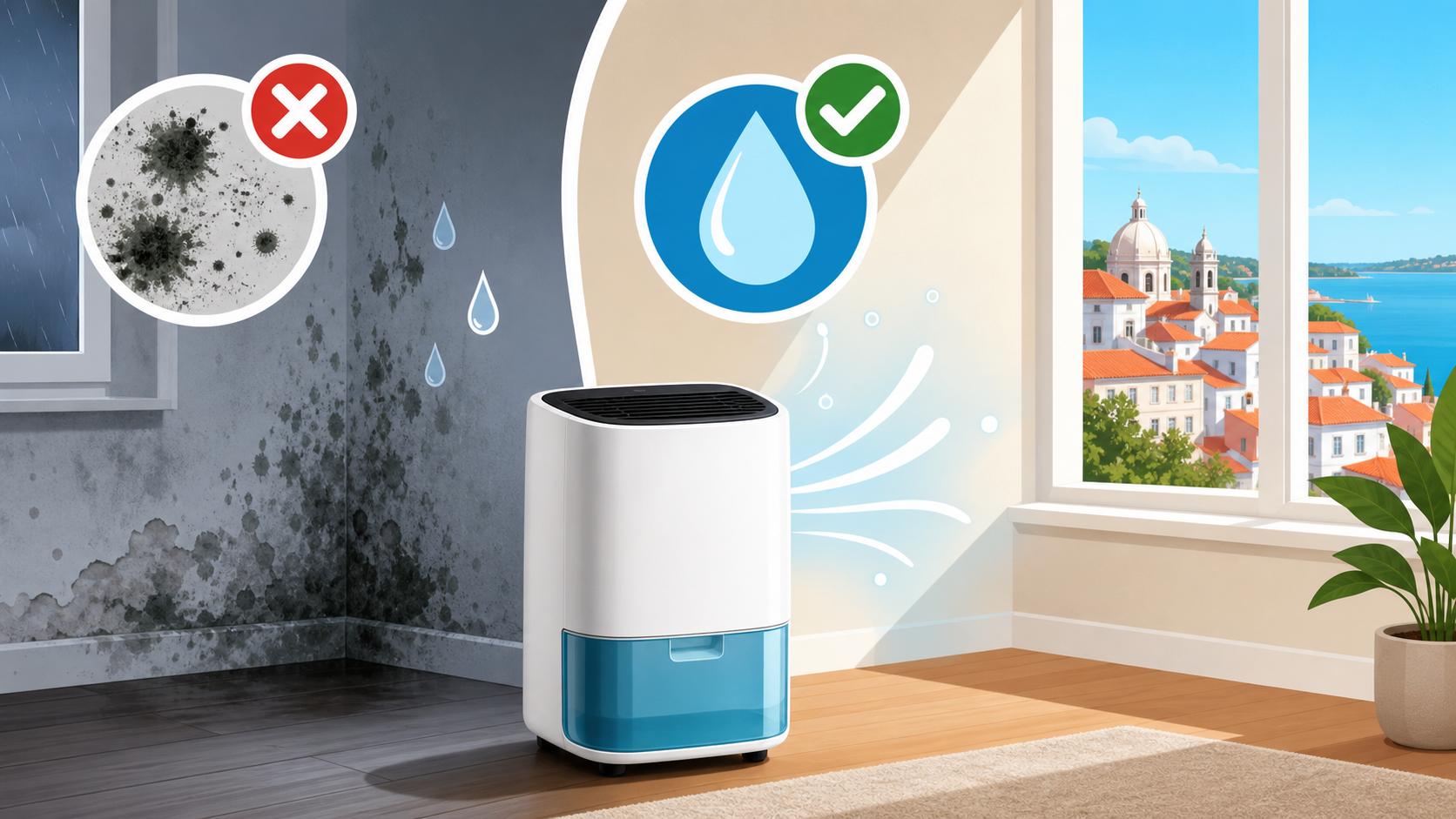
Best dehumidifiers to buy in Portugal to prevent winter wall mold
Disclosure: This article contains affiliate links. If you buy through them, we may earn a commission at no extra cost to you. Read our full disclosure.
Waking up in a beautiful Lisbon apartment only to find a fuzzy green layer of mold growing on the back of your favorite leather jacket is a heartbreaking rite of passage for many newcomers. I remember my first winter in Porto, staring in disbelief at the black spots creeping up my bedroom wall, wondering how a "sunny" country could feel so damp. This guide solves the moisture crisis by helping you choose the right dehumidifier and management strategy to keep your Portuguese home dry and mold-free.
Why Humidity is the Unspoken Expat Struggle in Portugal
If you moved here during the blistering heat of August, the concept of "winter damp" probably wasn't on your radar. However, as soon as the Atlantic rains settle in around November, the reality of Portuguese construction becomes clear. Most older buildings, and even many "renovated" ones you might find on platforms like Uniplaces, are built with thick stone or uninsulated brick. While these materials are fantastic for keeping the heat out during a 40-degree summer, they act like a thermal bridge in the winter, pulling the cold from the outside and meeting the warm, humid air of your living space.
The result is condensation. You’ll see it first as "crying windows"—droplets of water pooling on the glass and wooden frames every morning. If left unchecked, this moisture seeps into the plaster, creating the perfect breeding ground for bolor (mold). This isn't just an aesthetic issue; it’s a health hazard and a threat to your security deposit. Unlike in Northern Europe or North America, central heating is a luxury here, not a standard. Because we often rely on space heaters, the air remains unevenly heated, which only exacerbates the condensation problem on cold external walls.
The Science of the Portuguese Chill
To understand why you need a dehumidifier, you have to understand the "dew point." When the warm air inside your home—moist from cooking, showering, and even breathing—touches a cold wall, it cools down rapidly. Cold air cannot hold as much moisture as warm air, so it "dumps" that water directly onto the surface. In many Portuguese homes, the corners of rooms and the areas behind large wardrobes are the coldest spots because there is no airflow. This is why you often find mold hidden in the places you least expect.
Expatriates often ask Why do Portuguese houses lack central heating? Practical winter solutions are vital because without a consistent ambient temperature, your only line of defense is controlling the humidity level itself. Ideally, you want to keep your home between 45% and 55% humidity. During a rainy week in the Algarve or a misty morning in Sintra, the indoor humidity can easily spike to 80% or 90% without mechanical intervention.
Identifying Different Types of Mold
Not all mold is created equal, but all of it is unwelcome. Surface mildew is common on window frames and can usually be wiped away with a bit of vinegar or a specialized spray like Cillit Bang Bolor. However, the "black mold" (Stachybotrys chartarum) that grows in circular patterns on the ceiling or behind furniture is more stubborn. It feeds on the organic matter in your paint and wallpaper. If you are currently browsing for a long-term home, pay close attention to the smell of a property. If it smells like a wet basement, the building likely has structural humidity issues that a simple machine might struggle to fix.
Understanding Dehumidifier Types: Which One is Right for Your Apartment?
When you walk into a store like Worten or Fnac, you’ll see dozens of machines ranging from €50 to €500. It is tempting to buy the cheapest one, but in the Portuguese climate, a weak machine is essentially a paperweight. Most "mini" dehumidifiers use Peltier technology (thermo-electric cooling). These are fine for a tiny closet, but they will not save a bedroom or a living room. For a real Portuguese winter, you need to choose between a Compressor or a Desiccant model.
Compressor Dehumidifiers: The Powerhouse for Most Rooms
Compressor models are the most common type found in Portugal. They work by creating a cold surface that condenses moisture from the air, much like a refrigerator. They are incredibly efficient when the room temperature is above 15°C. If you are using a heater to keep your living room comfortable, a compressor dehumidifier will be your best friend. They are generally more energy-efficient than desiccant models and can pull massive amounts of water—10, 12, or even 20 liters per day—out of the air.
These are essential if you are living in a larger T2 or T3 apartment. You can check the Cost of Living in Portugal 2026: Detailed Budgets for Singles and Families to see how the electricity cost of running these machines fits into a monthly budget, but generally, a modern compressor unit is relatively affordable to run. Brand names like De'Longhi and Cecotec dominate this space in the local market.
Desiccant Dehumidifiers: The Quiet Solution for Cold Spaces
If you live in an unheated stone cottage in the Alentejo or a particularly cold ground-floor flat in Lisbon, a compressor model might struggle because its internal coils can freeze. This is where desiccant dehumidifiers shine. They use a chemical adsorbent (like silica gel) on a rotating wheel to soak up water. They don't have a noisy compressor, making them much quieter for bedrooms. Crucially, they actually exhaust warm air—usually 2-3 degrees warmer than the room—which provides a tiny bit of supplemental heating. However, they do consume more electricity, which is a factor to consider when Setting Up Utilities in Portugal: Electricity, Gas, Water, and Internet for the first time.
| Feature | Compressor Dehumidifier | Desiccant Dehumidifier |
|---|---|---|
| Best Room Temp | 15°C to 35°C | 1°C to 20°C |
| Noise Level | Moderate (Humming) | Low (Whirring/Fan) |
| Energy Use | Lower | Higher |
| Heat Output | Cool/Neutral air | Warm air |
| Weight | Heavy | Lightweight |
Key Features to Look for Before Buying
Before you head to the checkout, there are a few technical specs that will make your life significantly easier. I made the mistake of buying a machine with a tiny 1.5-liter tank during my first year. I had to wake up at 3 AM to empty it because it would automatically shut off once full, leaving my room to get damp again for the rest of the night.
Capacity and Tank Size
In Portugal, when a machine says "20 Liters," it means it can extract 20 liters of water in a 24-hour period under ideal conditions. It does not mean the tank holds 20 liters. Most consumer units have tanks between 2 and 5 liters. If you are in a high-humidity area like the Silver Coast, look for a unit with a "Continuous Drainage" option. This allows you to attach a small hose and run it directly into a floor drain or a shower, which is a lifesaver if you are traveling for a few days and want to keep the machine running.
Understanding your home's layout is also key. If you are trying to manage a studio, a 10L or 12L unit is plenty. If you are navigating the Understanding the Portuguese Rental Market: T0, T1, T2 Layouts Explained and find yourself in a large T3 with high ceilings, you will likely need two separate 20L units placed at opposite ends of the hallway to be effective.
Laundry Mode: A Must-Have Feature
One of the biggest causes of mold in Portuguese homes is drying laundry indoors. Since most apartments don't have dryers and it’s too rainy to hang clothes on the balcony, expats often drape wet towels over radiators or drying racks in the living room. This releases liters of water into the air. Many modern dehumidifiers have a "Laundry Mode" or "Clothes Drying" setting. This kicks the fan into high gear and aims the dry air specifically at your rack. It can reduce drying time from two days to five hours, preventing that "musty" smell from developing in your clothes.
Top Dehumidifier Recommendations for 2026
While you can find basic models at local supermarkets like Continente, I highly recommend investing in a reputable brand. You can easily order these from Amazon Spain, which usually offers faster delivery and better return policies for electronics than some local retailers. When you first arrive and are still setting up your local SIM with Airalo, using a reliable online marketplace is often the path of least resistance.
Best for Large Living Rooms: De'Longhi Tasciugo AriaDry
De'Longhi is the "Gold Standard" in Portugal. Their AriaDry series is famous for being incredibly robust. The 21L or 25L models are powerhouses that can handle the humidity of an old Lisbon Pombaline building. They feature a high-quality filtration system that also helps remove allergens and dust, which is a bonus if you suffer from respiratory issues during the damp winter months.
Best for Small Studios: Cecotec BigDry 4000 Expert
Cecotec is a Spanish brand that has taken the Portuguese market by storm. They offer sleek, modern designs at a lower price point than the Italian brands. The BigDry 4000 is perfect for a T0 or a small T1. It’s quiet, has a digital display showing the current humidity level, and is small enough to tuck into a corner. It is a frequent best-seller on Amazon Spain because it balances price and performance perfectly for the Iberian climate.
Best for Quiet Bedrooms: MeacoZambezi DD8L
If you are a light sleeper, the MeacoZambezi is a legendary desiccant model. It is specifically designed for colder climates and is exceptionally quiet on its low setting. It also has an "anti-bacterial" filter, which helps kill mold spores as they are pulled through the machine. It’s a bit more of an investment, but for a healthy sleeping environment, it’s worth every cent. After buying your unit, keep the receipt safely, as Buying electronics in Portugal: Fnac, Worten, and Rádio Popular warranties are generally quite good, but you will need your "fatura" if the sensor fails.
Beyond the Machine: Proactive Mold Prevention Strategies
A dehumidifier is a tool, not a magic wand. If you keep your windows closed 24/7 and push your sofa directly against a cold external wall, mold will still find a way to grow. You need a holistic approach to survive the winter.
The Furniture "Gap" Rule
This is the most important tip I can give you: Never push your furniture flush against the wall. Leave at least a 5cm to 10cm gap between your wardrobes, sofas, or beds and the walls. This allows air to circulate. Without this gap, the wall stays cold and wet, and the back of your furniture—which is often made of porous MDF or wood—will start to rot. If you are just moving in, check our Living in Portugal Guide 2027: The Complete Relocation Manual for Expats for more tips on setting up your home layout for the local climate.
Ventilation vs. Humidity
It seems counter-intuitive to open the windows when it’s raining outside, but you must "cross-ventilate" your home for at least 10 minutes every morning. This replaces the humid, CO2-heavy air from the night with fresh oxygen. Once you close the windows, turn your dehumidifier back on. Think of it as a reset for your home’s atmosphere.
Also, pay close attention to your energy consumption during these months. Running a dehumidifier 24/7 can add €20-€40 to your monthly bill. It’s helpful to learn How to read an EDP electricity bill: Taxes, bi-hourly tariffs, and peak hours so you can run your "Laundry Mode" during off-peak hours (typically at night) to save money.
Practical Cleaning Tips for Recurring Mold
If you already have spots appearing, don't just paint over them. The mold will eat through the new paint within weeks. You must kill the spores first.
- Bleach vs. Vinegar: For non-porous surfaces like tiles, a bleach solution is effective. For walls and wood, many experts recommend white vinegar or specialized fungicidal washes found at Leroy Merlin.
- Anti-Damp Paint: If you are repainting, ask for tinta anti-condensação or tinta anti-fungos. These paints contain tiny glass microspheres that help keep the wall surface slightly warmer, reducing the likelihood of condensation.
- Monitor with a Hygrometer: Buy a cheap digital hygrometer (often under €10). It tells you exactly what the humidity percentage is in a room. It takes the guesswork out of when to turn the machine on.
Investing in a high-quality dehumidifier is arguably the most important purchase you will make for your Portuguese home. It protects your health, saves your clothes, and ensures that your experience of living in this beautiful country isn't dampened by the seasonal struggle against the "green fuzz."
Disclaimer
This guide is for informational purposes only. Recommendations are based on typical Portuguese housing conditions and general consumer electronics available in 2026. Always follow the manufacturer’s safety instructions for electronic appliances, especially regarding water disposal and electrical safety in damp environments. We do not provide professional mold remediation advice; if you have extensive structural mold, consult a local specialist.