Understanding the Portuguese Rental Market: T0, T1, T2 Layouts Explained
Disclosure: This article contains affiliate links. If you buy through them, we may earn a commission at no extra cost to you. Read our full disclosure.
Searching for an apartment in Lisbon or Porto often feels like deciphering a secret code where "T" numbers and "Kitchenettes" determine your sanity. When I first moved here, I thought a T1 meant a one-room studio and ended up in a tiny space with no door on the bedroom. This guide simplifies the Portuguese "T" system and rental layouts so you can find a home that actually fits your life.
Decoding the Portuguese T Nomenclature
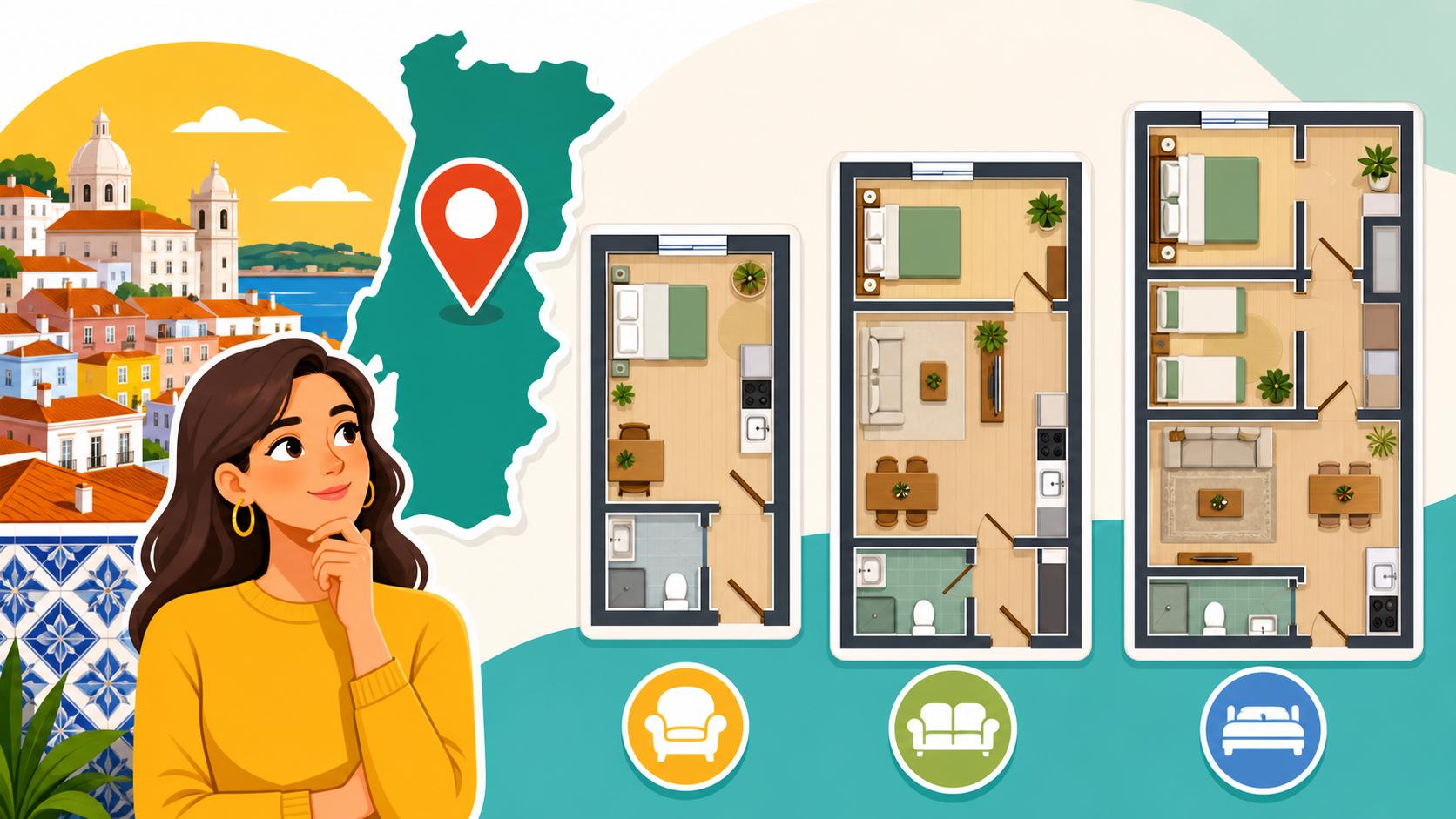
When you first open a rental portal in Portugal, the most prominent label you will see is a letter followed by a number—usually T0, T1, T2, and so on. This "T" stands for "Tipologia" (Typology) and refers specifically to the number of separate bedrooms in the property. It does not include the living room, kitchen, or bathrooms in the count. Understanding this is the first step to ensuring you aren't looking at properties that are far too small for your needs.
What the Numbers Actually Mean
A T0 is what most English speakers would call a studio. In a T0, there is no separate bedroom; your sleeping area, living space, and often the kitchen are all contained within a single main room. A T1, conversely, features one dedicated bedroom that is separated from the living area by a wall and a door. As the number increases, so does the bedroom count. A T2 has two bedrooms, a T3 has three, and it continues upward. This system is standardized across the country, whether you are looking for a sleek apartment in Parque das Nações or a rustic townhouse in the Alentejo.
Common Misconceptions About the Living Room
Newcomers often ask, "If a T1 has one bedroom, where is the living room?" In Portugal, the living room (the sala) is an assumed part of every apartment from T1 upwards. It is not counted in the "T" number. Therefore, a T1 actually consists of at least three distinct areas: a bedroom, a living room, and a kitchen (plus the bathroom). If you see a listing for a "V" (like V2 or V3), this usually refers to a vivenda or a detached house/villa, but the numbering logic remains the same as the "T" system.
Why Tipologia Matters for Your Rental Contract
The typology isn't just a marketing term; it is often legally recorded in the property’s Caderneta Predial (tax record). When you are signing Portuguese Lease Contracts (Contrato de Arrendamento): What to Look For, the T-rating will be explicitly stated. If a landlord tries to rent you a T0 that they have "converted" into a T1 by putting up a flimsy partition, it might not be legally recognized as such. This can affect your ability to register your address for residency or impact the price of your rental insurance.
The Nuances of the T0 and Studio Living
Living in a T0 can be a romantic, minimalist dream or a cramped nightmare, depending on the layout. In cities like Lisbon and Porto, T0s are incredibly popular for students and digital nomads because of their lower price point. However, the term "studio" is often used loosely in marketing. Listings include T0s that were essentially converted garages and others that were luxury open-plan lofts.
T0 vs. Studio: Is There a Difference?
In the Portuguese market, the terms T0 and "Studio" are frequently used interchangeably, but there can be subtle differences. A T0 is the official designation. A "Studio" often implies a more modern, open-plan design where the kitchen is a "kitchenette" integrated into the wall of the living area. If you are browsing platforms like Uniplaces, you will see many T0s tailored for short-to-medium stays. These are often fully furnished and designed to maximize every square centimeter of space, which is vital in high-density neighborhoods like Alfama.
The Mystery of the T0+1
Occasionally, you will stumble upon a listing for a T0+1. This is where the Portuguese rental market gets creative. The "+1" usually refers to an extra interior room that does not have a window or a direct source of natural light. Because it lacks a window, it cannot legally be called a bedroom (which would make the apartment a T1). In a T0+1, you essentially have a studio with a small side room that could serve as a walk-in closet, a very small office, or a storage area.
Assessing the Kitchenette in a T0
In almost all T0 apartments, you will not find a separate, walled-off kitchen. Instead, you will have a kitchenette. This is an important distinction to check when viewing properties. Some kitchenettes are "full," meaning they have a four-burner stove, an oven, and a full-sized fridge. Others are "minimal," featuring only a two-burner electric hob and a small under-counter fridge. If you enjoy cooking, a T0 might feel restrictive. You should also check for a exaustor (extractor fan), as cooking smells in a one-room apartment can linger on your bedsheets for days.
T1 and T2: The Expat Favorites
For most expats moving to Portugal, the T1 and T2 layouts represent the "sweet spot" of the market. They offer enough room for a separate life-work balance without the high costs of larger family homes. However, the layout of these apartments can vary wildly depending on whether the building is "Pombaline" (post-1755 earthquake style), "Art Deco," or modern.
The Standard T1 Layout
A typical T1 is perfect for a single person or a couple. You can expect a dedicated bedroom, a living room, a kitchen, and one bathroom. When viewing T1s, pay close attention to the "circulation." In older Portuguese apartments, it is common to have a long, narrow hallway that eats up a lot of the square footage. More modern T1s tend to favor an open-plan living and kitchen area to make the space feel larger. If you are tracking the Cost of Living in Portugal 2026: Detailed Budgets for Singles and Families, you will find that T1s in city centers are currently the most competitive segment of the market.
T2: Space for a Home Office or Guests
The T2 is the most versatile layout. With two bedrooms, many expats use the second room as a dedicated office—a necessity for those on a D8 Digital Nomad Visa. One thing to watch for in T2s is the size of the bedrooms. Often, there is one "master" bedroom and a much smaller second bedroom. In older buildings, you might encounter quartos de passagem (passing rooms), where you have to walk through one bedroom to get to another. This is a common quirk that can be a dealbreaker if you plan on having roommates.
Traditional vs. Modern T2s
Modern T2s built in the last 20 years often include features like a suite (a bedroom with an attached private bathroom) and a second "social" bathroom for guests. Older T2s rarely have more than one bathroom. If you are looking at Lisbon Neighborhood Guide: Best Areas for Expats and Digital Nomads, you'll see that areas like Avenidas Novas offer modern T2s with parking and elevators, whereas older areas like Graça offer T2s with more "character" (read: slanted floors and tiny bathrooms) but incredible views.
The +1 Room and the Interior Quarto
In your search, you will inevitably see "T1+1," "T2+1," or even "T1 com quarto interior." This is a uniquely Portuguese architectural feature that can be either a bargain or a frustration, depending on your needs.
Defining the +1
The "+1" is a room that does not meet the legal requirements to be called a bedroom, usually because it lacks a window of at least a certain size or has no window at all. In older Lisbon apartments, these were often used as maid's quarters or storage rooms. Today, they are marketed as extra space. A T1+1 is legally a one-bedroom apartment, but it has that extra room. If you are a light sleeper, using an interior room as a bedroom can be great because it is pitch black and quiet, but the lack of ventilation can lead to stuffiness and humidity issues—a common problem in Portugal.
Practical Uses for a +1
Most expats use the +1 as an office, a walk-in wardrobe, or a nursery. Because these rooms are internal, they are often located in the middle of the apartment's layout. If you are working remotely, make sure the +1 has enough electrical outlets; older apartments weren't designed with home offices in mind. When you move in, you might need to head to Amazon Spain to pick up some extra lighting or a small dehumidifier, as these interior rooms are magnets for the winter dampness that plagues many Portuguese homes.
The Quarto Interior Warning
Be wary of listings that describe a "T2" but, upon viewing, you realize one of the bedrooms is actually a quarto interior. Some landlords will try to mask a T1+1 as a T2 to justify a higher rent. Always ask specifically if every bedroom has a window to the outside. A true bedroom in Portugal should have natural light and ventilation. If you are unsure about the legitimacy of a listing, check Avoiding Rental Scams in Lisbon and Porto: Red Flags to Watch to ensure you aren't being misled about the property's true typology.
Kitchens, Bathrooms, and Common Areas
The "T" count tells you about bedrooms, but it says nothing about the kitchen or bathrooms, which are arguably the most important rooms for daily comfort. Portuguese kitchens and bathrooms have their own set of standards and terminology that you need to know.
Kitchenette vs. Independent Kitchen
In your search, you will see cozinha (kitchen) or kitchenette. An independent kitchen is a separate room with a door, which is standard in T2s and larger apartments. A kitchenette is open to the living room. Another crucial term is equipada (equipped). A cozinha equipada usually includes a stove, oven, fridge, and washing machine. A semi-equipada might only have the stove and water heater. If it is not equipped at all, you will be responsible for buying all appliances—a massive headache for a temporary resident.
The Bathroom Count: WC and Suites
Unlike the US or UK, where "1.5 baths" is common terminology, Portugal usually lists the number of casas de banho or WCs.
- WC Social: A small bathroom with just a toilet and sink.
- Casa de Banho Completa: A bathroom with a toilet, sink, and shower or bathtub.
- Suite: A bedroom with its own private full bathroom.
In a T2, having a suite plus a guest bathroom is considered a luxury. If you are Moving to Portugal with Kids: Schools, Childcare, and Family Life, having that second bathroom can be the difference between a smooth morning and total chaos.
Balconies and Marquises
One layout feature you will see everywhere is the marquise. This is a balcony that has been enclosed with glass. While it might look a bit dated, a marquise is incredibly practical. It acts as a laundry drying area (essential since many Portuguese homes don't have clothes dryers) and provides an extra layer of insulation against the wind and rain. Many people also use them as a "sunroom" for plants or a breakfast nook.
Comparison of Common Portuguese Rental Layouts
To help you visualize the market, here is a breakdown of what to typically expect from each typology in terms of space and functionality.
| Typology | Typical Rooms | Best For | Average Size (sqm) |
|---|---|---|---|
| T0 | 1 Main Room + 1 Bathroom | Students, Solo Nomads | 25 – 40 |
| T0+1 | 1 Main Room + 1 Interior Room + 1 Bathroom | Solo workers needing an office | 35 – 50 |
| T1 | 1 Bedroom + 1 Living Room + 1 Kitchen + 1 Bathroom | Couples, Single Professionals | 45 – 70 |
| T1+1 | 1 Bedroom + 1 Living Room + 1 Interior Room + 1 Bathroom | Couples with a small child or office needs | 55 – 80 |
| T2 | 2 Bedrooms + 1 Living Room + 1 Kitchen + 1-2 Bathrooms | Small families, Roommates | 70 – 100 |
| T3 | 3 Bedrooms + 1 Living Room + 1 Kitchen + 2 Bathrooms | Large families, Luxury seekers | 100 – 150 |
Practical Advice for Navigating the Market
Knowing the layouts is only half the battle. The Portuguese rental market moves fast, and you need to be prepared to act quickly when you find a T-layout that works for you.
The Importance of the Visit
Never sign a lease based solely on photos. Real estate photography in Portugal often uses wide-angle lenses that make a T0 look like a ballroom. "Character" features mentioned in ads can often mean "the windows don't close properly." When you visit, check the orientation of the apartment. A south-facing apartment (exposição solar sul) is highly prized because it stays warmer in the winter and helps prevent the mold issues that are common in older buildings.
Paperwork and the Fiador
Once you find a layout you like, you will need to provide your NIF (tax number), proof of income, and often a Fiador (a Portuguese guarantor). If you are a foreigner without a local history, landlords may ask for several months of rent in advance. It is common to be asked for 2 months' rent and 1 or 2 months' deposit. For more on this hurdle, read The Role of the Fiador (Guarantor) and How Expats Can Rent Without One or How much rent should I pay upfront if I don't have a Portuguese Fiador?.
Staying Connected During Your Search
Searching for a home is a full-time job. You will be refreshing Idealista and Imovirtual dozens of times a day. To ensure you don't miss a call from a landlord because of bad Wi-Fi, I recommend getting an eSIM from Airalo as soon as you land. Having a reliable data connection while you are roaming neighborhoods like Campo de Ourique or Bonfim is essential for mapping out viewings and researching local amenities on the fly.
Furnishing Your New Layout
If you choose a Furnished vs Unfurnished Rentals in Portugal: What Is Actually Included? option, you might still find you need some personal touches. Most "furnished" apartments are quite basic. For things like kitchen gadgets, bed linens, or ergonomic office chairs for your new +1 room, Amazon Spain is the go-to for most expats in Portugal. They offer fast delivery to most parts of the country, which is much easier than trying to navigate a trip to IKEA without a car.
Important Disclaimer
The information provided in this guide is for informational purposes only and does not constitute legal or professional real estate advice. Rental laws and market conditions in Portugal can change rapidly. Always consult with a qualified legal professional or a registered real estate agent before signing any contracts or transferring funds. Layout definitions may vary slightly by region and specific building age.