How to Get Mail and Parcels Delivered in Portugal
Disclosure: This article contains affiliate links. If you buy through them, we may earn a commission at no extra cost to you. Read our full disclosure.
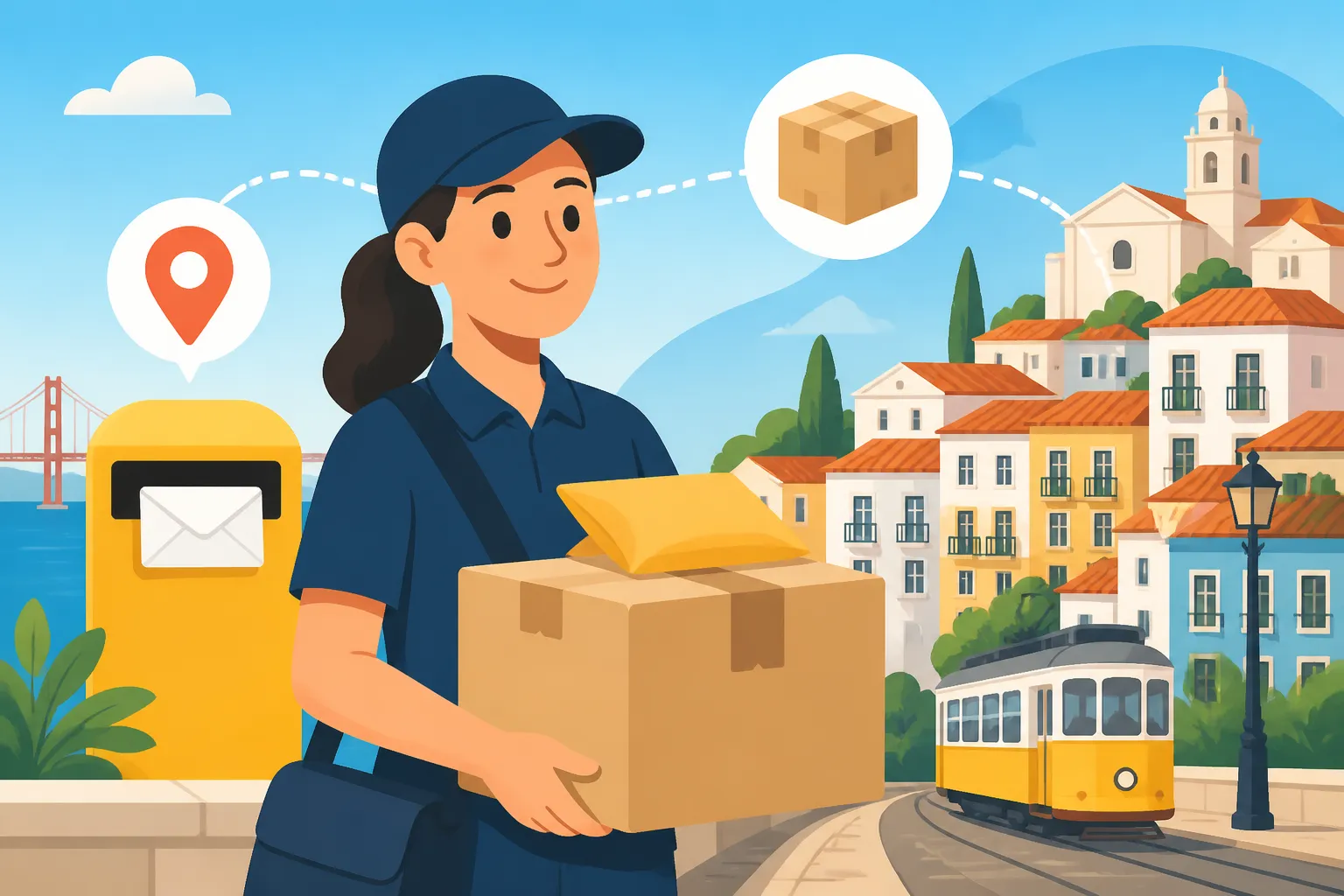
Your landlord’s mailbox has no name on it. The CTT carrier left a yellow slip you can’t read. A courier called a foreign number you never answered, and your parcel went back to the sender. Mail delivery in Portugal frustrates almost every newcomer. This guide covers addresses, couriers, customs, pickup points and official letters so your post actually reaches you.
Getting Your Portuguese Address Right Before Anything Ships
Most failed deliveries in Portugal start before the parcel leaves the warehouse. They begin with an address the carrier cannot interpret. I learned this the hard way in my first month in Lisbon. I ordered a desk lamp, typed my address the way I would back home, and watched the tracking page flip to “destinatário desconhecido,” meaning recipient unknown. The lamp went back to the seller, and I went back to my phone’s flashlight for another week.
Portuguese addresses follow a specific logic. Once you understand it, most of your problems disappear. The order of the parts and the abbreviations matter, and so does a detail newcomers rarely think about: whether your name is physically written anywhere the carrier can see.
Reading and Writing a Portuguese Address
A typical Portuguese address puts the street type first, then the street name, then the building number. After that comes the floor and the side of the landing. The postal code and locality go on the last line. A realistic example looks like this:
- Rua das Flores, 45, 3.º Esq.
- 1200-195 Lisboa
That “3.º Esq.” means third floor, left-hand door as you come up the stairs. In a building with two flats per landing, the left and right doors are “esquerdo” and “direito.” Larger buildings sometimes use “frente” (front) and “trás” (back) instead, or a letter such as “3.º A.” Leave out the floor and side and the carrier has to guess between several identical doors. Most will not guess. They will simply leave a slip, or nothing at all.
The postal code is always four digits, a hyphen, then three digits, followed by the town name in capitals or title case. The full seven-digit code often narrows delivery down to a single street or even one side of a street. Online checkout forms sometimes accept only the first four digits, but always enter all seven if you can. For a deeper walkthrough, see Portugal postal codes (Código Postal): How to read and write them correctly.
| Abbreviation | Portuguese | Meaning |
|---|---|---|
| R. | Rua | Street |
| Av. | Avenida | Avenue |
| Tv. | Travessa | Lane or side street |
| Lg. | Largo | Small square |
| Pç. | Praça | Square |
| R/C | Rés-do-chão | Ground floor |
| Esq. | Esquerdo | Left door |
| Dto. | Direito | Right door |
| Cave | Cave | Basement level |
| S/N | Sem número | Building without a street number |
The “S/N” one is important in rural areas. In villages across the Alentejo or the interior of the Centro region, many houses have no number at all. Postal workers there know families by name, so local knowledge matters more than precision. If you live in a house like this, add a landmark in a second address line, such as “junto à igreja” (next to the church) or “casa amarela” (yellow house). Then introduce yourself to the carrier in person if you ever see them. A friendly “bom dia” and a quick explanation that you are the new resident at the yellow house will do more for your deliveries than any app.
Your Name on the Mailbox Matters More Than You Think
Portuguese apartment buildings almost always have a bank of locked metal mailboxes (“caixas de correio”) in the entrance hall. Each box is marked with the flat number. Ideally it also carries the names of the people who live there. CTT carriers are trained to match the name on the envelope with a name on the box or the doorbell panel. If your name appears nowhere, many carriers will hold the letter or return it. They do this to protect the previous tenant’s privacy, not to annoy you.
The fix is low-tech and costs almost nothing. Print a small label with your full name, or the surname you use on official documents. Stick it on the mailbox and, if possible, next to the buzzer. Ask your landlord first if the mailbox has an official nameplate slot. Some building administrators (“administração do condomínio”) prefer uniform labels. Also ask for the mailbox key on move-in day. You would be amazed how many tenants discover three weeks later that the key never left the landlord’s drawer.
If you share a flat, make sure every tenant’s surname is listed. Couples with different surnames often hit this problem: letters for one partner arrive, while letters for the other bounce. When in doubt, add a small “c/o” line in the address. In Portuguese this is written “a/c” (“ao cuidado de”), followed by the name of the person whose name is on the box.
Temporary Rentals and Mail Before You Have a Lease
Many new arrivals spend their first weeks or months in a short-stay flat while they hunt for something permanent. Platforms like Spotahome are popular for exactly this mid-term window. Before you start ordering things to a temporary address, message the landlord or host and ask three questions. Does the flat have its own mailbox? Can you add your name to it? Is anyone around to receive parcels during the day? Some furnished-rental buildings in central Lisbon and Porto have a doorman (“porteiro”) at a desk called the “portaria,” and that is a huge advantage for parcels. Others share one overflowing mailbox between several short-term units, and letters vanish into it.
If the answers are discouraging, plan to use pickup points and lockers from day one, which I cover below. For more on what to expect from this kind of housing, see How to Find Short-Term Furnished Rentals in Portugal.
How CTT and Private Couriers Actually Deliver
Portugal has one national postal operator, CTT (Correios de Portugal), alongside a crowd of private couriers. They behave quite differently, and knowing which one is carrying your parcel tells you what to expect at your door.
The Aviso Slip and Collecting From the Post Office
CTT handles ordinary letters and many small parcels, especially anything posted through national postal services abroad. If something is too big for your mailbox, or needs a signature, and nobody answers the buzzer, the carrier leaves a small printed card called an “aviso.” It shows a tracking number, the reason delivery failed, and where you can collect the item. Usually that is your nearest CTT shop (“loja CTT”) or a partner counter called a “posto de correio,” often inside a stationery shop, a café or a parish council building.
Here is the routine I follow every time an aviso appears:
- Photograph the slip immediately, front and back, in case it gets lost.
- Check the collection deadline printed on it. Items are held for a limited period before going back to the sender.
- Look up the collection location’s opening hours. Smaller postos often close for lunch and on Saturday afternoons.
- Bring the slip and a photo ID: passport, residence card or Citizen Card. If someone else is collecting for you, they need the slip, their own ID, and usually a signed authorisation from you along with a copy of your ID.
- Ask whether the item can be redelivered or redirected through the CTT app or website if collection is inconvenient. This option is often available for registered items and parcels.
A word of honesty: sometimes the aviso shows up even though you were home all day. Every expat forum has its version of this story, and it is maddening. Carriers on tight routes in older buildings without working buzzers sometimes skip the climb to the fourth floor. If this happens repeatedly, make a polite complaint through CTT’s customer channels. Name the dates and your full address, including floor and side. Persistent, specific complaints do tend to change behaviour on a route.
Private Couriers: DPD, GLS, SEUR, UPS and DHL
Most online retailers in Portugal ship through private couriers. The ones you will meet most often are DPD, GLS, SEUR, CTT Expresso (CTT’s own courier arm), UPS and DHL. Nacex and MRW also appear for some Spanish retailers. Unlike the postal carrier, courier drivers usually call or text before or during delivery. That is great if you have a working Portuguese number and pick up. It is less great if the call comes from an unknown number while you are in a meeting and the driver moves on after one try.
Each courier has its own redelivery logic, so you need to read the notification message carefully. Many send an SMS or email with a link where you can choose a new day, redirect to a pickup point, or leave instructions. Typical instructions include “deixar com o vizinho” (leave with the neighbour) or “deixar na portaria” (leave with the doorman). Couriers also tend to have depots on industrial estates outside city centres. If your parcel ends up at a depot, getting there without a car can mean a long bus ride, so redirecting to a pickup point is almost always smarter.
One cultural note: in traditional neighbourhoods, neighbours really do accept parcels for each other. The elderly lady downstairs who is home all day may become your most reliable delivery partner. A box of pastries from the local pastelaria is the standard currency of thanks.
Pickup Points and Lockers
If you work long hours, travel often, or live somewhere with an unreliable mailbox, pickup points and lockers will change your life. CTT runs parcel lockers in many supermarkets, metro stations and shopping centres. Many couriers also partner with local shops such as newsagents, phone repair shops and small grocers that act as collection points. DPD calls these “Pickup” points, and other couriers use similar networks. Payshop agents, found in many cafés and kiosks, also handle some parcel services alongside bill payments.
When you choose a locker at checkout, you receive a code by SMS or email once the parcel arrives. You type the code at the locker and the door pops open, any time the host location is open, and many in shopping centres are open late. I switched almost entirely to lockers after my second missed delivery. I have not had a failed delivery since.
| Delivery option | Best for | Main drawback | What you need |
|---|---|---|---|
| Home delivery by CTT | Letters, small parcels, official mail | Avisos if nobody answers or name missing | Name on mailbox, full address with floor and side |
| Home delivery by private courier | Online shopping, large items | Phone calls you may miss, depot pickups | Reachable phone number, clear access instructions |
| CTT parcel locker | People out during the day | Size limits for bulky items | Code sent by SMS or email |
| Shop pickup point | Larger parcels, flexible collection | Shop opening hours, lunch closures | Code or tracking number plus ID |
| Doorman or portaria | Buildings with staffed reception | Only available in some buildings | Building rules allowing parcel acceptance |
| Neighbour | Traditional residential streets | Depends on goodwill and availability | Good relations and clear courier instructions |
Ordering Online Without Getting Burned by Customs
Once your address works, the next question is where your parcels come from, because origin decides whether customs gets involved. This is where many expats get a nasty surprise: a notification saying a parcel is held and charges must be paid before release.
EU Versus Non-EU Shipping
Portugal is in the EU customs union, so goods shipped from another EU country move freely, with no customs declaration and no import VAT at the border. VAT is already included in the price you paid. This is why many expats in Portugal shop on Amazon Spain rather than the American or British Amazon sites. Orders fulfilled from Spanish or other EU warehouses arrive without customs paperwork, and delivery to mainland Portugal is usually straightforward. Check carefully, though, that the specific item is sold and shipped from within the EU. Marketplace sellers on any platform can ship from outside it, and then customs rules apply. For the details, see How to receive Amazon packages in Portugal without paying customs fees.
Goods from outside the EU are a different story. That includes the United States, the United Kingdom, China, Brazil and Switzerland. Imported goods are subject to Portuguese VAT regardless of value, and customs duty may apply on top depending on the item and its value. On top of the tax itself, the carrier usually charges a handling or clearance fee for processing the declaration. That fee can feel disproportionate on a cheap item.
Many large non-EU online shops now collect VAT at checkout through the EU’s Import One-Stop Shop scheme. If the checkout shows VAT included and mentions IOSS, the parcel should usually clear without extra charges for you. If the price excludes VAT, assume you will pay at the Portuguese end.
How to Clear a Parcel Held at Customs
If a non-EU parcel arrives by post, CTT normally handles the customs process. You will typically receive an SMS, an email, or a letter asking you to confirm details and pay charges online. Couriers like DHL and UPS run their own clearance and contact you directly. The process usually goes like this:
- Watch for a message saying your parcel is awaiting customs clearance (“desalfandegamento”). Before clicking anything, check that the tracking number matches a real order, because fake customs SMS messages are a common scam.
- Log in through the official CTT website or app, or the courier’s own site. Never use a link from an unexpected message that asks for card details outright.
- Upload the invoice or proof of purchase showing the item’s value. For gifts, upload a short declaration explaining the contents.
- Provide your NIF (tax number) if requested, since import declarations are tied to it.
- Review the calculated VAT, any duty, and the handling fee, then pay online or at a CTT counter.
- Wait for the parcel to be released and delivered, or collect it if it was redirected to a post office.
If you do nothing, the parcel sits in a warehouse for a limited time and then goes back to the sender. You may still be out the shipping costs. If you think the charges are wrong, contact the carrier before paying. For example, they may have valued a used item at full retail price. Have your evidence ready.
Gift Packages From Family Back Home
Care packages from home deserve special mention, because they cause the most emotional frustration. Your mother sends peanut butter, a favourite sweater and some birthday cards from the United States, and you end up paying fees to receive your own presents. Genuine gifts sent between private individuals can qualify for relief from import charges up to a certain value. The parcel must be clearly declared as a gift, sent from one person to another with no payment involved, and of a non-commercial nature. The handling fee may still apply even when the tax does not.
A few practical tips for whoever is packing your box: list every item honestly on the customs form, with a realistic value and a clear description. “Clothing, used” works; “stuff” does not. Do not send food items that face import restrictions, such as meat or dairy products. Split large shipments into smaller ones rather than one heavy box. For more detail, see Do I need to pay customs duties when receiving a gift package from the US?
Staying Reachable and Solving Problems
The last piece of the puzzle is making sure carriers, government offices and shops can actually reach you. You also need to know what to do when something goes wrong anyway.
Why You Need a Phone Number That Receives SMS
Almost everything in Portuguese delivery runs on SMS. Couriers text delivery windows, lockers text collection codes, and CTT texts customs notices. Many newcomers arrive with a travel eSIM from a provider such as Airalo, which is excellent for mobile data in your first days. But these plans are typically data-only, with no local phone number, so they cannot receive Portuguese SMS. Use that data to track parcels on carriers’ websites and apps. As soon as possible, though, get a local Portuguese number from MEO, NOS, Vodafone or one of the low-cost brands, and use that number at every checkout. For step-by-step advice, see Getting a Portuguese SIM Card as a New Arrival.
If you keep a foreign number as well, update your saved addresses on shopping sites so the Portuguese number appears as the delivery contact. Drivers in Portugal are far more likely to call a local number than an international one, and many cannot call abroad at all from their work phones.
Official Letters, Registered Mail and Government Post
Government bodies in Portugal still rely heavily on paper mail. Very important items arrive this way, often as registered post (“correio registado”) that requires a signature. Finanças sends the initial password for its online portal by letter. Notices about taxes and fines come by post. Your residence card from AIMA is delivered by registered CTT mail to the address you gave. If any of these items bounce because your name is missing from the mailbox, the consequences go far beyond a lost lamp.
Make sure every authority has your current Portuguese address. Keep your mailbox labelled the whole time you live there. If a registered letter produces an aviso, collect it promptly. Registered mail in particular has a limited holding period, and some official notices count as delivered even if you never pick them up. For more, see Sending mail via CTT: Registered letters (Correio Registado) explained, NIF password (Senha das Finanças): How to request and activate it by mail, and How to track your AIMA residence card delivery via CTT registered mail.
If your tax number was originally registered with a foreign address, Finanças letters may still be going abroad. Correcting this is one of the first admin jobs worth doing after you settle. The process is described in Changing your NIF address from a foreign country to your Portuguese address.
Lost Parcels, Damaged Items and Making Complaints
Despite your best efforts, parcels sometimes disappear, show up crushed, or get marked “delivered” when they plainly were not. Here is the order I tackle these problems in:
- Check with neighbours, the portaria, and any nearby pickup point. Drivers sometimes leave parcels nearby without updating tracking properly.
- Contact the seller first, not the carrier. The seller has the contract with the courier and can open a claim more quickly. Under EU consumer rules, the seller is generally responsible until the goods reach you.
- If the seller is unhelpful, contact the carrier directly with your tracking number, photos of any damage, and a clear written description.
- Keep packaging from damaged items until the claim is settled, since carriers may ask to inspect it.
- If you get nowhere, use Portugal’s formal complaints system. Every business serving the public, including CTT shops and courier counters, must provide the Livro de Reclamações, and there is an electronic version online. Complaints filed this way are sent to the relevant regulator, and companies are required to respond.
The complaints book carries real weight in Portugal, and businesses take it seriously. See What is the ‘Livro de Reclamações’ and how does it solve consumer disputes? for how to use it well.
Moving House or Leaving for a While
When you move within Portugal, mail keeps flowing to your old address for a surprising amount of time. Banks, insurers, utility companies and old online shops all keep your old details. CTT offers a mail redirection service (“reencaminhamento de correio”). It forwards post from your old address to your new one for a chosen period. Check CTT’s own pages for current terms and pricing. It is worth setting up for a few months after any move, alongside updating your address with Finanças, your bank, your employer, and AIMA where required.
If you are travelling for several weeks, ask a trusted neighbour or friend to empty your mailbox. An overflowing box is an invitation for theft, and important letters can sit unseen past their deadlines. Some people redirect mail temporarily to a friend’s address. Others switch all online orders to lockers until they get back. Before you move, also check whether your new building’s entrance has a working buzzer panel and labelled mailboxes. Then add your name on the very first day. For the wider moving checklist, see How Much Does It Cost to Move Within Portugal?
It takes a few weeks to get the hang of it all: the floor-and-side addresses, the mailbox labels, the avisos, the lockers and the customs messages. Once it clicks, receiving post in Portugal becomes one more small part of everyday life here. It may even give you a reason to chat with the postman over a morning bica.
Disclaimer
This article is for general informational purposes only and does not constitute professional advice. Laws, prices and regulations vary by location and change over time. Consult a qualified professional for guidance on your specific situation.