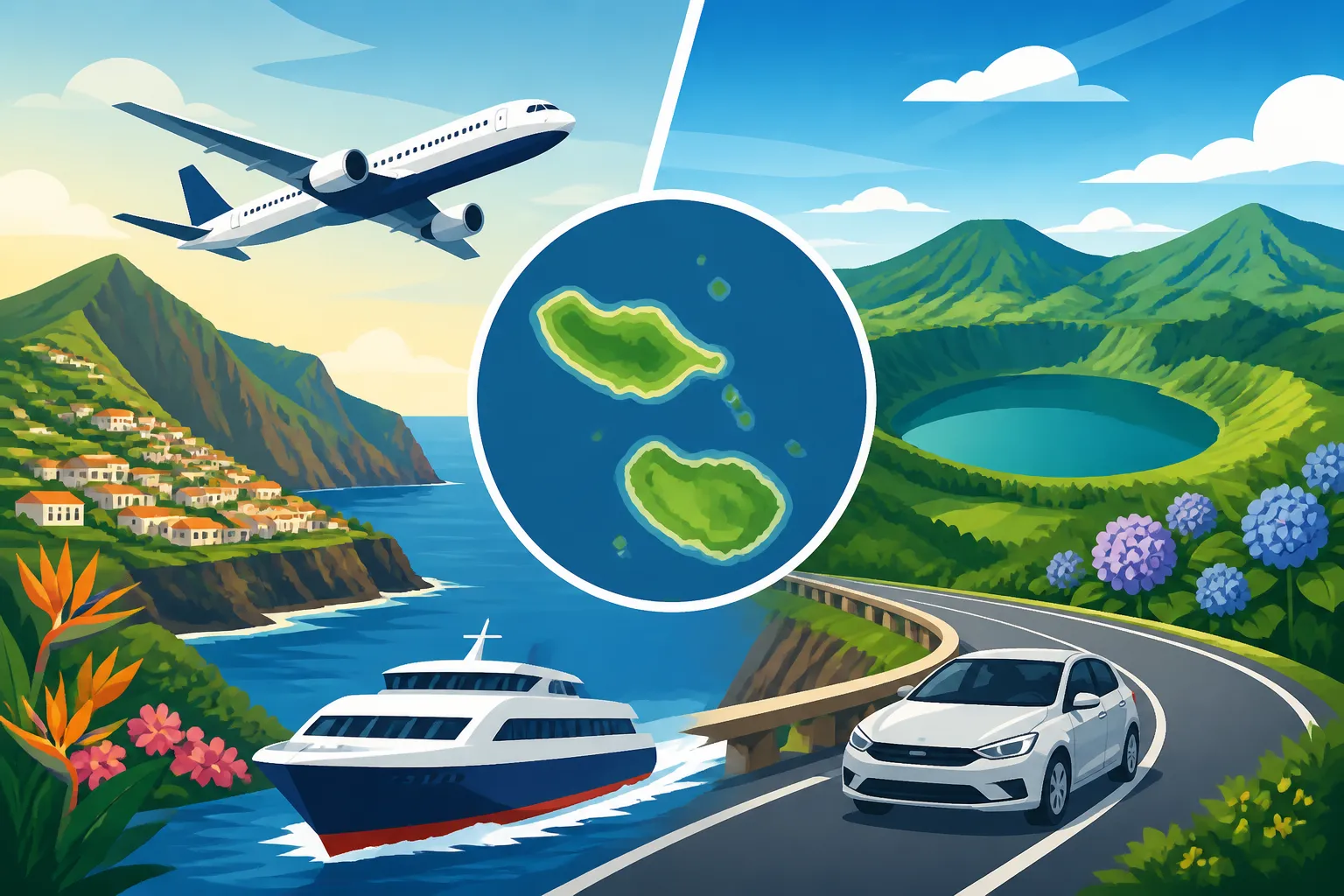
Getting to and Around Madeira and the Azores
Disclosure: This article contains affiliate links. If you buy through them, we may earn a commission at no extra cost to you. Read our full disclosure.
Planning a trip to Madeira or the Azores often feels like solving a complex geographical puzzle because of the sheer isolation of these Atlantic outposts. Many travelers and new residents underestimate the logistical hurdles of moving between islands that look close on a map but are separated by hundreds of miles of volatile ocean. This guide provides a deep, realistic breakdown of flight networks, ferry schedules, and local transit options to ensure your island-hopping experience is seamless.
Getting to the Archipelagos: Flights and Long-Haul Options
The first hurdle any expat or tourist faces is actually reaching these mid-Atlantic gems. While they are part of Portugal, they are far from the mainland—Madeira is roughly 1,000 kilometers from Lisbon, and the Azores sit even further west. Understanding the gateway cities and the airlines that dominate these routes is essential for budgeting and scheduling.
Flying from Mainland Portugal: Lisbon and Porto Connections
Most people begin their journey in either Lisbon or Porto. The national carrier, TAP Air Portugal, operates multiple daily flights to Funchal (Madeira) and Ponta Delgada (São Miguel, Azores). However, the real "local" secret is SATA (marketed as Azores Airlines). SATA is the lifeline of the Azores, and while their service can sometimes be affected by the relaxed "island time" pace, they offer the most comprehensive network. For those watching their budget, low-cost carriers like Ryanair and easyJet have broken the old monopoly, making weekend trips from the mainland much more affordable than they were a decade ago.
When booking, keep in mind that Funchal’s Cristiano Ronaldo International Airport is famous for its short, stilted runway and crosswinds. It is not uncommon for flights to be diverted back to Lisbon or to Porto Santo if the winds are too high. Travelers are generally advised to book your flight to the islands with at least a four-hour buffer if you have a connecting international flight. You do not want to be stuck in Lisbon while your plane to New York or London takes off without you. Check Booking.com for flexible hotel options near Lisbon airport just in case a "wind day" in Funchal ruins your schedule.
Direct International Routes to the Islands
If you are coming from North America or Northern Europe, you might be able to skip the mainland entirely. Ponta Delgada has become a major hub for flights from Boston, New York, and Toronto, largely due to the massive Azorean diaspora in those regions. Madeira also enjoys direct "sun seeker" routes from London, Berlin, and Paris. Using a platform like Omio can help you compare these direct international legs against the cost of connecting through Lisbon, which is often surprisingly cheaper if you book well in advance.
The advantage of a direct flight is obvious: less time in transit. However, the disadvantage is frequency. If an international flight is canceled, you might be waiting three days for the next direct one, whereas flights from Lisbon are a dime a dozen. For those moving here permanently and looking into Madeira and Azores: Island Living, Costs, and Expat Communities, understanding these flight patterns is crucial for planning visits from family back home.
The Myth of the Mainland Ferry
I see this question in expat forums every single week: "Can I take a ferry from Lisbon to Madeira?" The short, frustrating answer is no. There was a brief period where a seasonal ferry operated from Portimão in the Algarve to Funchal, but it has been discontinued for years due to port fees and low demand. Unless you own a private yacht or are booking a cabin on a repositioning cruise, you are flying.
This is a significant pain point for people who want to move with a car or large amounts of furniture. To get a vehicle from the mainland to the islands, you have to use cargo shipping companies like Transinsular or GS Lines. Your car goes in a container, and you go on a plane. If you’re considering Buying a Car in Portugal: IUC Tax, Inspections (IPO), and High Vehicle Costs, factor in that shipping a car to Madeira or the Azores will typically cost between €600 and €1,000 one way.
Island Hopping in the Azores: Navigating the Nine Islands
The Azores is not a single destination; it is an archipelago of nine distinct islands divided into three groups: Eastern, Central, and Western. Moving between them requires a mix of regional aviation and seasonal maritime travel that can be quite daunting for the uninitiated.
SATA Air Açores: The Inter-Island Flight Network
For most of the year, SATA Air Açores is the only way to move between the distant island groups. If you want to go from the Eastern group (São Miguel) to the Western group (Flores), you are looking at a flight on a small turboprop plane. These flights are short, scenic, and—for residents—heavily subsidized. As a foreigner, you will pay the full fare unless you have your residency sorted and have updated your Registering your address with Junta de Freguesia (Atestado de Morada) to prove you live on the islands.
The "SATA Air Pass" is a specialized tool for tourists that allows for multiple island stops at a fixed price, but it requires careful planning and must be booked through an agent or the airline's specific portal. Be warned: these planes are small. If you are used to bringing two large suitcases on international flights, you will likely face hefty over-limit fees on the inter-island hops. The luggage allowance is often strictly 23kg, and they will weigh your carry-on too.
Atlanticoline: Seasonal Ferry Routes and Schedules
During the summer months (usually May through September), the ferry service Atlanticoline expands its operations. In the Central Group—comprising Faial, Pico, São Jorge, Terceira, and Graciosa—ferries are a way of life. The "Triangle" route between Faial, Pico, and São Jorge runs year-round and is very reliable. You can wake up in Horta (Faial), take a 30-minute ferry to Madalena (Pico) for a vineyard tour, and be back by dinner.
However, the "Yellow Line," which connects all nine islands by boat, is a marathon, not a sprint. Taking the ferry from São Miguel to Flores can take over 24 hours and involves crossing some of the roughest waters in the Atlantic. Unless you have a stomach made of iron and a deep love for the sea, it is generally best to fly between the groups and only use the ferry for short hops within the Central Group. You can find tickets and tour packages that include these transfers on GetYourGuide to simplify the booking process.
Logistics of Multi-Island Itineraries
When planning an Azorean itinerary, "less is more" is the golden rule. Travelers who try to see five islands in ten days often spend half their vacation in airport waiting rooms. Weather is the ultimate master here; fog in Flores or high winds in Santa Maria can grounded flights for days.
Always build in a "buffer day" at the end of your trip on the island from which you are flying back to the mainland. If you are staying in the Central Group, use Pico or Faial as your base, as they have the most frequent ferry connections, allowing for last-minute pivots if one mode of transport fails. For those looking at the long-term Cost of Living in Portugal 2026: Detailed Budgets for Singles and Families, remember that inter-island travel costs add up quickly and can significantly inflate a monthly budget.
Moving Between Madeira and Porto Santo
Unlike the sprawling Azores, the Madeira archipelago essentially consists of two inhabited islands: the main island of Madeira and its smaller, golden-sanded sibling, Porto Santo. The connection between these two is much simpler but still requires a bit of foresight.
The Porto Santo Line Ferry Experience
The most popular way to reach Porto Santo is the "Lobo Marinho" ferry. This large ship departs Funchal in the morning and returns in the evening, with the journey taking about two and a half hours. It’s a full-fledged experience with cafes, a cinema, and plenty of deck space to watch the cliffs of Madeira fade away.
For many locals, the Porto Santo ferry is a rite of passage every summer. If you’re visiting during August, you must book weeks in advance. The ferry can also transport cars, which is highly recommended if you plan on exploring the hidden corners of Porto Santo beyond the main beach. If you are a resident, make sure your NIF is linked to your ticket to claim the substantial tax-back discount available for islanders.
Binter Canarias: Short Flights for Quick Transfers
If you don't have the stomach for a two-hour sea voyage, Binter Canarias operates a small "puddle jumper" flight between Funchal and Porto Santo. The flight takes approximately 15 to 20 minutes—you barely have time to reach cruising altitude before the descent begins. It’s efficient, fast, and often used by professionals or those who need to bypass the occasionally rough seas.
While more expensive than the ferry, Binter is a godsend during the winter months when the Atlantic can be unforgiving. The ferry can struggle when swells are heavy, while the plane flies over them. If you’re checking Where to Live in Portugal: Lisbon, Porto, Algarve, and Silver Coast Compared and leaning towards Madeira, having Porto Santo as a quick escape is a major selling point.
Day Trip vs. Overnight Stay Logistics
Is a day trip to Porto Santo worth it? Yes, but it’s exhausting. You’ll leave Funchal around 8:00 AM and won’t get back until nearly 10:30 PM. To truly enjoy the 9 kilometers of therapeutic sand, it is wise to plan an overnight stay. This allows you to experience the island after the "day trippers" have left and the local restaurants in Vila Baleira begin to hum with a more authentic energy.
You can find excellent boutique hotels on Booking.com that cater to those looking for a quieter experience. If you’re considering Living in rural Portugal: How far is the nearest hospital usually?, keep in mind that Porto Santo has limited medical facilities compared to Funchal; for anything serious, residents are medevaced to the main island.
On-the-Ground Transportation: Renting Cars and Public Transit
Once you land or dock, the real challenge begins: getting to your accommodation and exploring the interior. The islands’ topography is vertical, which dictates everything about how people move.
The Essential Need for a Rental Car
In both Madeira and the Azores, a rental car is almost non-negotiable if you want to see anything beyond the city centers of Funchal or Ponta Delgada. These islands are defined by their "Miradouros" (viewpoints) and hiking trails, many of which are not served by any form of public transport.
Be warned: Portugal is a land of manual transmissions. If you can only drive an automatic, you must book months in advance and be prepared to pay a premium. Also, Madeira’s roads are notoriously steep and winding. If you aren't comfortable with hill starts or narrow tunnels, the driving here can be stressful. For those who have just moved and are looking into Driving in Portugal: Exchanging Your Foreign License to a Portuguese One, practice on the flatter coastal roads before attempting the climb to Pico do Arieiro.
| Island / Group | Best Transport Mode | Ease of Use | Cost Factor |
|---|---|---|---|
| São Miguel (Azores) | Rental Car | Moderate | Mid-range |
| Central Group (Azores) | Ferry + Rental Car | High (Summer) | Moderate |
| Madeira (Main) | Rental Car / Bolt | Easy | Affordable |
| Porto Santo | Scooter / Bike | Very Easy | Low |
| Western Group (Azores) | Regional Flight | Low (Weather) | High |
Local Bus Networks: Horários do Funchal and Azorean Alternatives
Madeira actually has a fairly robust bus system called "Horários do Funchal" for the city and "SAM" or "Rodoeste" for the rest of the island. Within Funchal, the buses are frequent and reliable. However, the further you go from the capital, the more the schedule caters to school children and workers rather than tourists. You might find a bus that takes you to a remote village at 7:00 AM, but the only return bus might be at 6:00 PM.
In the Azores, public bus transport is even more sparse. On São Miguel, there are buses that connect the main towns, but they often require a stopover in Ponta Delgada. If you’re relying on Public Transport and Driving in Portugal: Trains, Tolls, and Licenses, you’ll find that the "trains" part of that guide simply doesn't apply to the islands—there isn't a single kilometer of rail in either archipelago.
Taxis, Rideshares, and Private Transfers
In Funchal, Uber and Bolt have become very popular and are quite cheap for short trips. This is a game-changer for getting home after a late dinner without having to navigate the steep hills on foot. In the Azores, however, ridesharing is almost non-existent outside of Ponta Delgada. You will rely on traditional taxis, which are metered in cities but often operate on fixed rates for longer island tours.
Many visitors find that hiring a taxi driver for a full day is actually more cost-effective and certainly less stressful than renting a car and getting lost. These drivers often act as informal tour guides, sharing local legends and taking you to "tascas" you’d never find on a map. You can also pre-book these private transfers through GetYourGuide to avoid the stress of negotiating prices at the airport curb.
Practical Tips for Smooth Island Travel
Traveling in the Atlantic requires a different mindset than traveling on the European mainland. You have to respect the elements and the infrastructure constraints that come with being roughly 1,000 kilometers or more from Lisbon.
Dealing with Weather Cancellations and Wind
The Atlantic is unpredictable. It is quite common for the "Leste" wind in Madeira to ground flights for 48 hours. When this happens, the airport becomes a sea of frustrated travelers. My advice? Always have travel insurance that specifically covers "weather-related delays."
If your flight is canceled, don't just stand in the 500-person line at the airport counter. Use your phone to rebook immediately and then find a hotel on Booking.com before they all fill up. Being proactive is the only way to survive a mass cancellation event. If you have chronic health issues, check Emergency Medical Care in Portugal: Calling 112 and Going to the Hospital to know which pharmacies are open late if you get stuck without your medication.
Booking Timelines and High-Season Surges
The "August Shutdown" is very real in Portugal, and it hits the islands the hardest. During this month, and also during the Christmas/New Year period in Madeira (famous for its fireworks), transport capacity is stretched to the breaking point. If you plan to travel between islands during these times, you need to book your flights and ferries at least 4 to 6 months in advance.
The same applies to rental cars. During the post-pandemic travel boom, the islands literally ran out of cars. Tourists were arriving with hotel bookings but no way to leave the airport. If you are looking at Navigating the Portuguese Toll System: Via Verde and Electronic Tolls, don't worry too much—the islands don't have the same complex toll systems as the mainland "SCUTs," but the car itself is your most valuable asset.
Luggage and Mobility Constraints on Small Planes
Finally, let's talk about those tiny SATA and Binter planes. The overhead bins are microscopic. If you have a "legal" carry-on that fits on a Boeing 737, it likely won't fit on a Dash-8 or an ATR-72. They will take it from you at the steps of the plane and put it in the hold.
If you are carrying expensive camera gear or delicate souvenirs, make sure you have a smaller "under-seat" bag to transfer your essentials into. Also, for those with limited mobility, these smaller planes often don't use jet bridges. You will be walking on the tarmac and climbing stairs. If this is an issue, you must contact the airline 48 hours in advance to arrange for a "PRM" (Persons with Reduced Mobility) lift.
Disclaimer
The information provided in this guide is for general informational purposes only and represents the realities of travel in Portugal as of 2026. Travel schedules, airline routes, and government subsidies for residents are subject to frequent changes by authorities such as AIMA, SATA, and the Regional Governments. Always verify specific transport details, visa requirements, and local laws through official channels before making financial commitments or embarking on your journey.