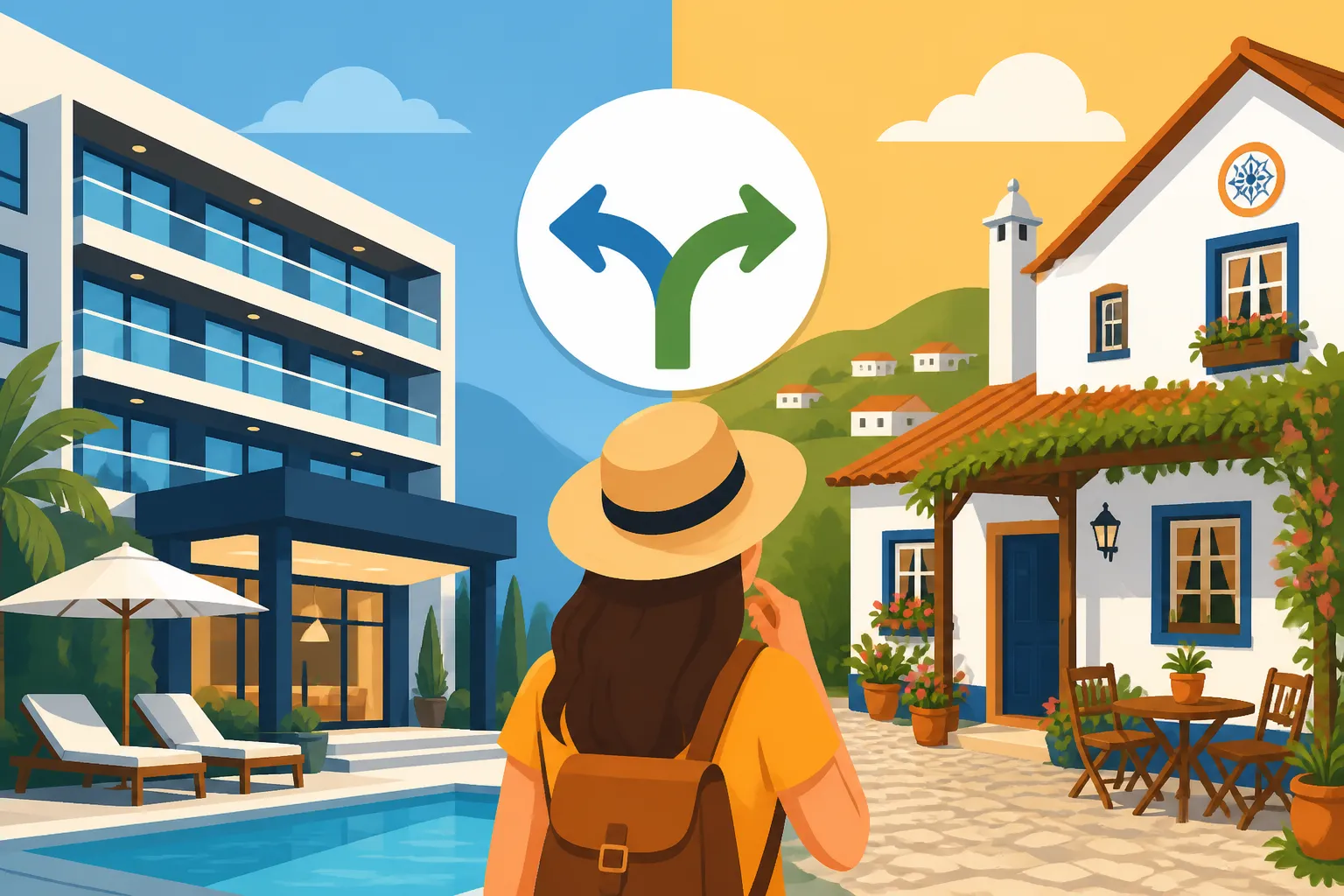
How to Choose Between a Hotel and a Pousada in Portugal
Disclosure: This article contains affiliate links. If you buy through them, we may earn a commission at no extra cost to you. Read our full disclosure.
You’ve found a beautiful pousada inside a medieval castle, but the town is tiny, the reviews mention steep stairs, and a modern hotel twenty minutes away has a pool and a parking garage. Which do you book? This guide covers what a pousada actually is, where each option works best, and how to decide for your trip, budget and travel style.
What a Pousada Actually Is and Why It Is Not Just a Fancy Hotel
The first time I booked a pousada, I thought I was booking a slightly upmarket hotel with a nice view. I arrived at the Pousada Castelo de Óbidos after dark, dragged my suitcase over cobblestones that had seen far worse than my wheels, and climbed a narrow stone staircase to a room inside the castle walls. I loved it. I also understood straight away that I had misread the booking. A pousada is a different kind of stay, and you only get the most from it if you know what you are signing up for.
The Pousadas de Portugal Network Explained
In Portugal, “pousada” usually means a specific network: the Pousadas de Portugal. These are historic properties such as castles, convents, monasteries, palaces and old manor houses that have been converted into hotels. The network began as a state initiative in the mid-twentieth century to protect important buildings and bring travellers into the interior. Today the Pestana group runs it, and you will see the properties branded as Pestana Pousadas.
The portfolio is a few dozen properties spread from the Minho in the far north to the Algarve, with outposts in the Azores. The network sorts them roughly into historic buildings, historic buildings with a contemporary design layer, nature retreats and smaller “charming” properties. That split matters. A night in a converted twelfth-century monastery and a night in a modern lodge near a national park are very different, even though both carry the pousada name.
Some flagship examples will give you a feel for the range:
- The Pousada Convento de Évora sits inside the former Lóios convent, right next to the Roman Temple.
- The Pousada Mosteiro de Guimarães occupies the old Santa Marinha da Costa monastery on a hillside above the town.
- The Pousada Mosteiro de Amares, also known as Santa Maria do Bouro, mixes monastery ruins with minimalist architecture.
- The Pousada Castelo de Estremoz, named for Rainha Santa Isabel, is in a hilltop castle in the Alentejo marble country.
- The Pousada Palácio de Estoi near Faro is a pink rococo palace with formal gardens.
- The Pousada de Lisboa is on Praça do Comércio, and the Pousada do Porto is in the riverside Palácio do Freixo.
The Word Pousada Can Also Mean Something Else
This catches people out. In Brazil, “pousada” is a general word for a guesthouse or small inn. Brazilian booking habits sometimes spill into how Portuguese properties are listed online, and a few independent guesthouses in Portugal use the word in their names.
There is also the Pousadas de Juventude network, which is Portugal’s youth hostel system. If you search for “pousada” in a city like Coimbra or Braga, you may see youth hostel results alongside the historic properties. Hostels can be great value, but they are not the converted castle you had in mind.
Before you book, check that the property is part of the Pousadas de Portugal or Pestana Pousadas network, unless you are deliberately looking for something else. The official network site, or the property description on a platform like Booking.com, will usually say so clearly. If the listing does not mention a historic building, a network affiliation or Pestana, you are probably looking at an ordinary guesthouse.
Why Pousadas Feel So Different From Hotels
A standard hotel is designed around the guest: lifts in the right places, identical rooms, predictable bathrooms and soundproofing. A pousada is designed around a building that existed for centuries before anyone thought of en-suite showers. The building comes first and the hotel fits around it.
So rooms in the same pousada can vary a great deal. In a converted convent, one room might be a former monk’s cell with thick walls and a small window. Another might be a grand suite with a vaulted ceiling. Corridors can be long and hushed, and stairs may be uneven. The atmosphere is quiet and slightly solemn, which some travellers find magical and others find a little eerie at midnight.
The benefit is that you are sleeping inside the history you came to see. You eat breakfast in a cloister, you walk the castle ramparts after the day-trippers leave, and you hear church bells rather than traffic. For an overview of how pousadas sit alongside other accommodation types, see Accommodation in Portugal: Hotels, Guesthouses, and Pousadas.
Hotel vs Pousada: The Practical Comparison That Actually Matters
Every time someone in my circle plans a Portugal trip, they ask me the same thing: “Is the pousada worth it?” My honest answer is that it depends less on the pousada and more on what that night of your trip needs to do. A pousada makes a wonderful destination night. It can be a frustrating logistics night.
Side-by-Side Comparison Table
| Factor | Pousada | Standard Hotel |
|---|---|---|
| Building | Historic castle, convent, monastery or palace; some modern nature lodges | Purpose-built or renovated; designed for guests |
| Room consistency | Varies widely, even within one category | Generally uniform within a room category |
| Location | Often in small towns, walled villages or countryside | Usually central in cities or near transport hubs |
| Car needed | Often yes, or very helpful | Usually no in Lisbon, Porto and larger towns |
| Accessibility | Can involve stairs, uneven floors and limited lifts | Usually better step-free access |
| Atmosphere | Quiet, historic, romantic, slower pace | Practical, social, predictable |
| Dining | On-site restaurant with regional cooking is a highlight | Varies; many guests eat out |
| Best for | Special occasions, road trips, slow travel | City breaks, early departures, families needing convenience |
| Price shape | Usually priced above mid-range hotels in the same area, with large seasonal swings | Wide range from budget to luxury |
| Booking flexibility | Popular properties fill early in peak months | More choice and more last-minute availability |
Location and Getting There
This is where most of my “I wish I’d known” stories come from. Many of the best pousadas sit where historic buildings tend to be: on hilltops, in walled villages, in the middle of the countryside, or a few kilometres outside a town centre. The Pousada Mosteiro de Amares is in a rural valley near Braga. The Pousada Serra da Estrela, in a former sanatorium above Covilhã, is up a mountain road. The Pousada de Marvão sits in one of Portugal’s most dramatic hilltop villages, and getting there by public transport is a project in itself.
With a car, this is part of the fun. You wind through cork oaks, park, and walk into a castle. Without one, you may end up relying on infrequent regional buses or taxis that cost more than you expected. If you are driving, Renting a Car in Portugal: Tolls, Insurance, and Driving Tips covers the electronic toll system, which is the other thing that catches first-timers out.
If you are not driving, choose pousadas in places that rail or intercity coach serves well. Évora, Guimarães, Tavira, Lisbon and Porto all work. When I plan car-free trips for visiting friends, I use Omio to compare CP trains and Rede Expressos coaches side by side. It shows quickly whether a pousada town is a simple journey or a two-change slog. For more on this, see How to Get Around Portugal Without a Car.
Comfort, Accessibility and Room Surprises
I want to be gentle but honest here. If anyone in your group has mobility issues, a historic pousada needs careful research. Some have lifts and adapted rooms. Others have stone staircases, raised thresholds and bathrooms tucked into awkward corners. Walled villages like Óbidos and Marvão have steep cobbled streets, and the parking is often outside the walls.
A friend of mine booked the castle pousada in Óbidos for her parents’ anniversary. It was a lovely gesture, but her father uses a cane. Nobody had asked about stairs, so the evening began with a slow climb and some tense family silence. The fix was simple: an email to the property beforehand, asking for a ground-floor or lift-accessible room. Pousada staff are generally helpful about this, but they can only help if you ask. How to Find Wheelchair-Accessible Travel in Portugal goes deeper into accessible planning.
Other comfort points to check:
- Heating and cooling. Thick stone walls keep rooms cool in an Alentejo summer, but some older buildings can feel chilly in winter.
- Room size. “Standard” in a converted convent can mean small, so read the room description, not just the category name.
- Noise. Pousadas are usually very quiet. A pousada in a town centre, such as Lisbon’s on Praça do Comércio, is a different story on a busy evening.
- Wi-Fi. Thick medieval walls are not friendly to wireless signals, so mention it if you need to work.
Food, Atmosphere and the Experience Factor
The pousada restaurant is often a highlight, and I would not skip it. Many focus on regional dishes made with local produce: Alentejo pork and migas in Évora or Estremoz, Minho dishes and vinho verde near Guimarães and Amares, and seafood in the Algarve properties. Eating in a former refectory under a vaulted ceiling is something you remember for years. For ideas on what to order, see Portuguese Regional Dishes Every Visitor Should Try.
Hotels are good at different things. A modern hotel in Porto’s Baixa or Lisbon’s Avenida da Liberdade puts you a short walk from dozens of restaurants, bars and tram stops. You do not need the hotel to be the experience, because the city is. That is why I rarely suggest a pousada for a classic two-night city break unless it is a special occasion.
Matching the Choice to Your Trip Style
Over the years, I have found that the question is rarely “pousada or hotel” for a whole trip. It is “which nights deserve a pousada.” Most of my favourite itineraries mix the two.
Road Trippers and Slow Travellers
If you are driving through the Alentejo, Central Portugal or the Minho, pousadas are a natural fit. Imagine a loop from Lisbon to Évora, then Estremoz, then Marvão, then Crato or Flor da Rosa, and back towards the coast. Each stop has a historic property, the driving distances are manageable, and the towns are at their best in the early evening when the tour buses have gone.
A sensible pattern is two nights in a pousada at your scenic stops, then a practical hotel near a motorway or city before an early flight. You get the magic without paying for atmosphere when all you need is a bed and a quick getaway. How to Plan a Portugal Road Trip Itinerary goes into routing, and Castles and Fortresses of Portugal and Monasteries and Churches of Portugal can help you build stops around the buildings themselves.
One realistic warning: stays of a single night in pousadas can feel rushed. You arrive tired, have dinner, sleep and leave after breakfast without exploring. Wherever possible, I give each pousada two nights.
City Breakers and First-Time Visitors
For Lisbon and Porto, it is usually best to book a well-located hotel or boutique guesthouse. You will be walking a lot, using the metro, catching early trains and coming home late after fado. A central hotel saves energy and taxi money. The Pousada de Lisboa and the Pousada do Porto are both lovely, but neither is the only way to experience those cities.
The exception is a celebration. If it is your honeymoon or a big birthday, and the pousada’s location suits your plans, go for it. The Palácio do Freixo in Porto sits by the Douro to the east of the historic centre. That is beautiful, but a bit removed if you want to bar-hop in Ribeira every night.
City breakers also tend to fill their days with tours. If you are basing yourself in a central Lisbon hotel and want to see Sintra or Évora without driving, booking a guided day trip through GetYourGuide is often easier than piecing together trains and local buses. It also leaves you free to choose your hotel purely on location.
Families, Budget Travellers and Special Occasions
Families with young children often find hotels easier. They have connecting rooms, pools, kids’ menus and room to be noisy without disturbing a hushed cloister. Some pousadas welcome families warmly and have gardens or pools, so it is worth checking. In general, though, the quiet, antique-filled setting suits couples and older travellers better than toddlers.
If you are watching your budget, think of a pousada as a treat rather than your default. Book one or two memorable nights and choose guesthouses, rural tourism properties or mid-range hotels for the rest. Portugal’s turismo rural and manor house stays can give you some of the same historic charm for a different price. How to Travel Portugal on a Budget has more strategies.
For special occasions, pousadas really shine. An anniversary dinner in the Évora convent, or a sunset on the Estremoz castle terrace looking over the plains, is the kind of memory people talk about for decades. Mention the occasion when you book. Staff often go out of their way for celebrations.
How to Decide and Book: A Step-by-Step Process
When friends ask me to help plan their trip, I walk them through the same sequence. It takes about twenty minutes and saves a lot of disappointment.
Step-by-Step Decision Process
- List every overnight stop on your route. Write down each town and the number of nights, and mark which nights are “destination nights” where you will relax and which are “logistics nights” before an early departure.
- Check whether a pousada exists in or near each stop. Not every town has one, and some are outside the centre, so note the distance from the sights you want to see.
- Confirm how you will reach it. If you are driving, check parking. If not, look up trains and coaches for the town and the taxi distance from the station.
- Read the room descriptions, not just the category. Look for size, views, stairs, lift access and whether the room sits in the historic wing or a newer extension.
- Consider who is travelling. Factor in mobility, young children, light sleepers and anyone who needs reliable Wi-Fi for work.
- Compare against a central hotel in the same town. Weigh the atmosphere against convenience, especially for one-night stops.
- Compare the price and the cancellation terms. Check what is included, such as breakfast, parking or dinner packages, and how flexible the rate is.
- Contact the property directly with specific requests. Ask for a ground-floor room, a quieter corner or a particular view, and mention any celebration.
- Book your pousada nights first in peak season. The most famous properties have limited rooms and fill early, while hotels in larger towns usually have more availability later.
Booking Channels and Cancellation Terms
You can book pousadas directly through the Pestana Pousadas website, by phone, or through online travel agents. I usually check both. Booking.com is handy for seeing pousadas, hotels and guesthouses in the same town on one map, which makes the comparison very visual. I also look at the direct booking page, because chains sometimes offer member rates, packages that include dinner, or more flexible terms when you book direct. These offers change, so check the provider’s own page for current conditions before you commit.
Whichever channel you use, read the cancellation policy carefully. Non-refundable rates can look tempting, but historic properties in rural areas are exactly where plans go wrong. A missed train, a car rental delay or a change in the weather can easily mean you arrive a day late. For a pousada booked months ahead, I lean towards flexible rates.
Keep in mind that a third-party booking can sometimes make special requests harder. Requests generally reach the property, but I always follow up with a short, polite email to the pousada itself. Write in English, or add a line in Portuguese if you can manage it. “Obrigado” or “obrigada” at the end never hurts.
Timing Your Stay Around Seasons and Crowds
Summer is the busy season across Portugal, especially along the coast and in the Algarve. Inland pousadas in the Alentejo can be intensely hot in high summer. The thick walls help, but the afternoons are for siestas and pools, not for exploring. Spring and autumn are the sweet spot for most pousadas in the interior. The countryside is green or golden, the temperatures are pleasant, and the rates tend to be gentler.
Winter has its own charm in the north and in the mountains. Picture a fireplace in a converted monastery near Braga or a misty morning in the Serra da Estrela. Just pack layers, because historic buildings and Portuguese winters are not always warm partners indoors. If you are flexible with dates, When Is the Cheapest Time to Visit Portugal? and How to Avoid the Crowds in Portugal’s Peak Season will help you pick a window.
If you have left it late and the pousada you wanted is full, do not panic. Look for turismo rural properties, small boutique hotels inside the old town, or a manor house nearby. You can still visit the pousada for dinner or a drink on the terrace without staying there. How to Find Last-Minute Accommodation in Portugal has practical tactics for that situation.
My Honest Rules of Thumb
After many years of hosting visiting friends and family and taking my own long weekends around the country, these are the rules I keep coming back to:
- Book a pousada when the building is the reason you are there. Évora, Estremoz, Guimarães, Amares, Óbidos and Marvão are the obvious cases. Start with Évora City Guide: Roman Ruins and Alentejo Charm if the Alentejo is on your list.
- Book a hotel when the city is the reason you are there. Lisbon and Porto usually fall into this group, unless it is a special occasion.
- Never put a pousada on a night before a dawn flight. Choose something near the airport or the centre instead.
- Plan two nights wherever possible. The magic happens in the evening and the slow morning.
- Ask questions before you pay. A two-line email about stairs, room location or parking can change your whole stay.
Choosing between a hotel and a pousada is not about which is better. It is about which suits the night in front of you. Mix them thoughtfully, and you get both the easy convenience of a city hotel and the feeling of falling asleep inside a castle.
Disclaimer
This article is for general informational purposes only and does not constitute professional advice. Laws, prices and regulations vary by location and change over time. Consult a qualified professional for guidance on your specific situation.