Daily Life in Portugal: Supermarkets, Language, and Cultural Etiquette
Disclosure: This article contains affiliate links. If you buy through them, we may earn a commission at no extra cost to you. Read our full disclosure.
The first time I stood in a Pingo Doce and was asked for my NIF, I panicked, thinking I was being audited on the spot by the tax authorities. I have spent years decoding the subtle, often unwritten rules of Portuguese daily life, from the specific way you greet your neighbor to the complex dance of the supermarket checkout line. This guide bridges the gap between being a confused visitor and a confident local resident by solving the administrative and cultural puzzles you will face every single day.
Mastering the Supermarket Maze
Navigating a Portuguese supermarket is an art form that requires more than just a shopping list. It is a sensory experience that combines modern retail convenience with deeply traditional habits. When you first arrive, the sheer variety of olive oils and the wall of dried salt cod (bacalhau) can be overwhelming. You will quickly learn that "doing the groceries" is not just a chore; it is a fundamental part of the Portuguese lifestyle that emphasizes fresh ingredients and local sourcing.
The Major Supermarket Chains and Their Personalities
In Portugal, your choice of supermarket often dictates your monthly budget and the quality of your fresh produce. Continente is the undisputed giant, offering massive hypermarkets where you can buy everything from a loaf of bread to a bicycle. They are reliable and have a vast selection of international goods, which is a lifesaver when you are craving a specific brand from home. Pingo Doce, on the other hand, feels more like a neighborhood hub. They are famous for their private-label products, which are often of higher quality than the name brands, and their deli counters are usually top-tier.
For those watching their wallet, Lidl and Aldi have a massive presence here and have moved away from their "discount" reputation to become favorites for organic produce and specialty European items. If you are looking for high-end or imported luxury goods, El Corte Inglés in Lisbon or Porto is your sanctuary, though your bill will reflect that premium experience. Understanding the local expenses is key, so check our Cost of Living in Portugal 2026: Detailed Budgets for Singles and Families for a full breakdown of what you should expect to spend at these different tiers.
The NIF Routine and Loyalty Programs
One of the most distinct aspects of shopping in Portugal is the inevitable question: "Contribuinte?" (Taxpayer number?). The cashier is asking if you want your NIF (Número de Identificação Fiscal) on the receipt. As an expat, you should almost always say yes. Adding your NIF to your supermarket receipts allows you to deduct a portion of your general family expenses from your annual IRS tax return. It might seem like pennies at first, but over a year, it adds up to a significant refund. For a deep dive into the brands and how to navigate these stores, see Grocery Shopping in Portugal: Continente, Pingo Doce, Auchan, and Mercados.
Beyond the NIF, loyalty cards are king. The Continente "Cartão Continente" is a must-have; it provides "saldo" (balance) that you can use as cash on future purchases. Pingo Doce uses the "Poupa Mais" card, which is often linked to BP gas stations, giving you discounts on fuel. If you are just starting out, don't be afraid to ask the cashier for a form to sign up. They are used to foreigners fumbling with the process, and having these cards can easily shave 10-15% off your monthly grocery bill.
Weighing Produce and the Deli Counter Etiquette
A common mistake for newcomers is arriving at the checkout with a bag of unlabelled apples. In most Portuguese supermarkets (except for Lidl and Aldi), you must weigh your fruit and vegetables in the produce section. You find the number on the shelf tag, place your item on the scale, press the corresponding button, and stick the printed barcode on the bag. If you forget, the cashier will have to send someone to weigh it for you, and you will feel the weight of a dozen impatient Portuguese eyes on the back of your head.
The "Charcutaria" (deli) and "Peixaria" (fish counter) also have their own rules. You must almost always take a "senha" (numbered ticket) from a red or yellow plastic dispenser. Do not just stand in line; the staff will ignore you until your number is called on the digital screen. When it is your turn at the fish counter, remember that they will clean and scale the fish for you for free. Just tell them how you plan to cook it—"para grelhar" (to grill) or "para cozer" (to boil)—and they will handle the rest with surgical precision.
Decoding Language and Local Communication
Language is perhaps the biggest hurdle to feeling truly "at home" in Portugal. While English is widely spoken in tourist hubs and by the younger generation in cities, daily life—dealing with a plumber, talking to the lady at the bakery, or navigating a government office—requires a grasp of European Portuguese. It is important to note that this is distinct from Brazilian Portuguese, with different pronunciations and formal address rules that are crucial for social integration.
The Myth of Universal English
There is a common misconception that you can "get by" forever with just English. While this might be true if you never leave the "Expat Bubble" in Cascais or the Algarve, it limits your experience significantly. In smaller towns or "bairros" (neighborhoods), the local economy runs on Portuguese. If you need to call a technician to fix a leak, they will likely speak very little English. Mastering the tongue is vital, and Learning European Portuguese: Top Apps, Tutors, and Free Government Classes is the best place to start your journey.
In professional settings, the lack of Portuguese can be seen as a lack of commitment to the country. Portuguese people are incredibly patient and will appreciate any effort you make, even if you butcher the grammar. Start with the basics: "Bom dia" (Good morning), "Obrigado/a" (Thank you), and "Se faz favor" (Please). These three phrases will open doors that would otherwise remain firmly shut.
Understanding Formal vs. Informal Address
Portuguese has a complex hierarchy of address that can be a minefield for English speakers. In English, everyone is "you." In Portugal, you have "Tu" (informal) and "Você" (formal, though often avoided by using the person's name or title). As a rule of thumb, always use the formal address until someone explicitly asks you to use "tu." This is especially true when speaking to older people or those in positions of authority, like doctors or government officials.
Addressing a professional as "Tu" can be perceived as disrespectful. You will often hear people addressed by their titles, such as "Senhor Doutor" or "Senhora Engenheira," even in relatively casual conversations. It feels stiff at first, but it is a sign of "educação" (good manners). When in doubt, a simple "O Senhor/A Senhora" followed by the verb in the third person is your safest bet.
High-Context Communication and Body Language
Portuguese communication is "high-context," meaning a lot of the message is conveyed through tone, relationship, and body language rather than just the words spoken. People are generally indirect; they may not say "no" directly to your face to avoid being rude, instead saying "it's difficult" or "we will see." You have to learn to read between the lines.
Physical touch and proximity are also different here. Conversations happen at a closer distance than in Northern Europe or North America. A light touch on the arm during a conversation is common and friendly. If you pull away, you might seem cold or "distante." Embracing these nuances will help you move from being a "residente" to a "vizinho" (neighbor).
Cultural Etiquette and Social Norms
The rhythm of life in Portugal is governed by a set of social norms that prioritize family, food, and a slower pace. Understanding these rules is the difference between feeling like a frustrated outsider and someone who "gets it." The Portuguese are generally reserved but deeply warm once the initial "ice" is broken.
The Art of the Portuguese Greeting
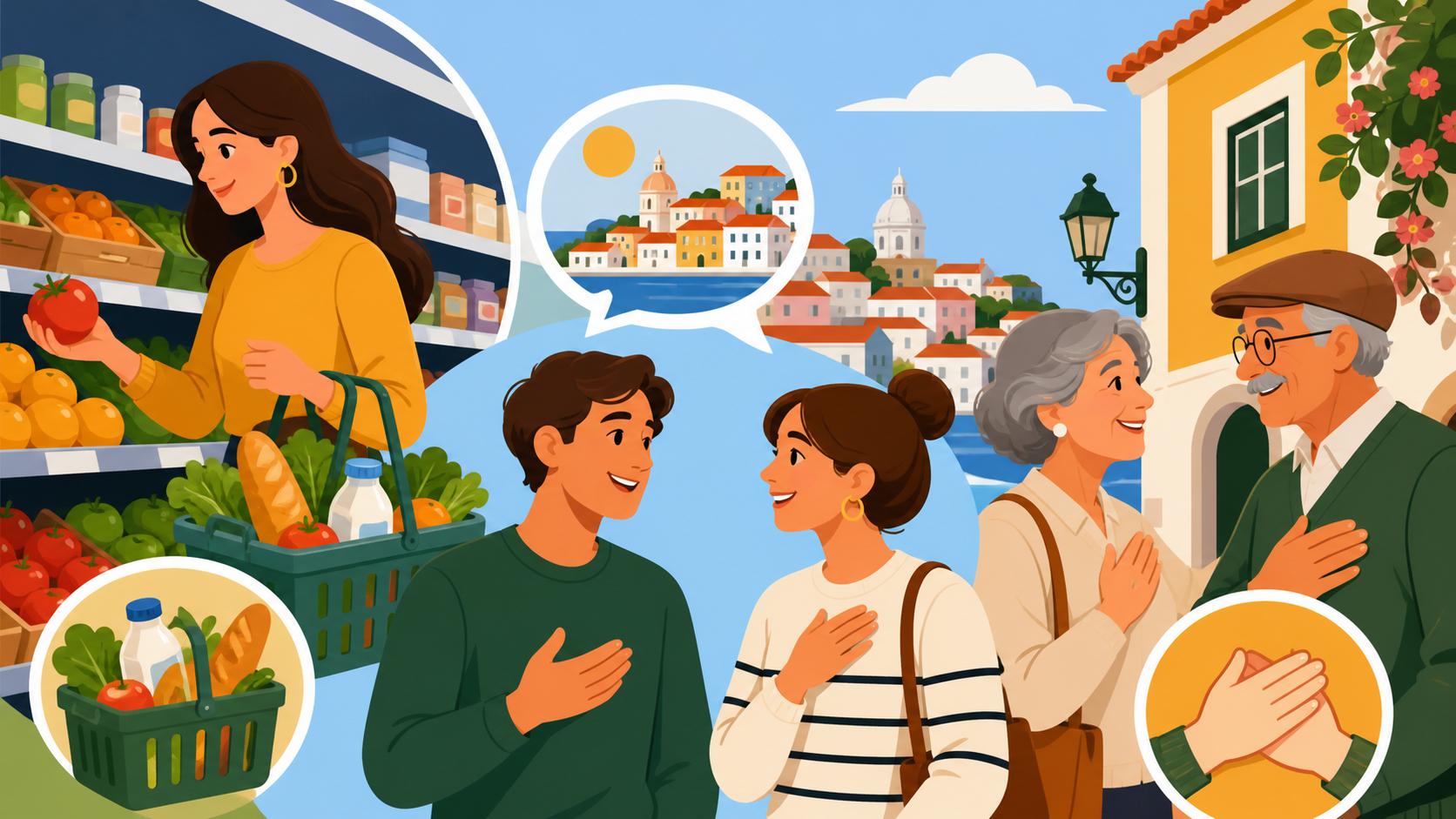
Greetings are non-negotiable. When you walk into a small shop, a waiting room, or even an elevator, it is expected that you say "Bom dia" or "Boa tarde." Silence is seen as incredibly rude. Socializing has its own rules; check Portuguese greeting etiquette: When to use Beijinhos vs Handshakes to avoid the awkward "should-I-or-shouldn't-I" moment when meeting friends.
In social settings, women generally greet both men and women with two kisses (starting with the right cheek). Men usually shake hands with other men, though close friends will go for a "braço" (a one-armed hug with a few back slaps). If you are in a business meeting, stick to a firm handshake regardless of gender until a more personal relationship is established.
Dining Out: The Couvert and Tipping Culture
Eating out is a national pastime, but the protocol is specific. When you sit down, a waiter will often bring small plates of bread, butter, olives, cheese, or even shrimp. This is the "couvert." It is not free. If you eat it, you pay for it. If you don't want it, simply say "Não, obrigado" and they will take it away. You will need a guide to the beans and the brews; read Portuguese Coffee Culture and Restaurant Etiquette: Ordering Like a Local for the specifics of how to navigate a traditional "tasca."
Tipping is not mandatory or expected in the same way it is in the US, but it is appreciated. In a casual cafe, rounding up to the nearest Euro is plenty. In a sit-down restaurant, a 5-10% tip is considered very generous and is usually reserved for exceptional service. The Portuguese generally don't tip for "average" service, as waitstaff are paid a living wage, though in tourist areas, expectations are shifting.
The Pace of Life and the "Amanhã" Philosophy
You will inevitably encounter the "Amanhã" (tomorrow) phenomenon. Whether it is a furniture delivery or a residency permit, things in Portugal often take longer than expected. The culture is not lazy; it simply values the present moment over rigid adherence to a clock. Rushing a waiter or a bureaucrat will only slow them down further.
Patience is your most valuable asset. The "August Shutdown" is a real thing; the entire country effectively goes on holiday for the month of August. Trying to get anything administrative done during this time is an exercise in futility. Learn to plan your life around these seasonal ebbs and flows.
Logistics of Home and Connectivity
Setting up your daily life in a new country requires a digital and physical infrastructure. From getting a SIM card to receiving packages, the logistics of Portugal can be unique. You want to avoid being the person who pays triple for "roaming" or loses their Amazon order to a confusing customs warehouse.
Managing the Digital Life and Mobile Data
When you first land, you need data immediately to navigate to your accommodation or translate signs. It is worth considering using a service like Airalo for an instant eSIM. It saves you the hassle of finding a shop at the airport while you are jet-lagged. Once you are settled, you will want a local SIM from MEO, Vodafone, or NOS. These providers offer "bundles" that include home internet, mobile data, and even streaming services.
Connectivity isn't just about your phone; it's about how you pay for things. If you want to pay like a local, Using the MB Way app: Why it’s better than carrying cash in Portugal is mandatory reading. MB Way is the national payment system that allows you to send money to friends, pay at the supermarket with a QR code, and even withdraw cash from an ATM using just your phone. It is arguably the most efficient part of Portuguese daily life.
Getting Goods Delivered and E-commerce
While Portugal has many local shops, you will eventually need something you can't find nearby. Amazon Spain is the de facto Amazon for Portugal. Most items offer free shipping to Portugal for Prime members, and delivery usually takes 2-4 days. It is a lifeline for expats who need specific kitchen gadgets, electronics, or English-language books.
Logistics can be tricky when it comes to the local post office, CTT. If you are not home, they will leave a "bilhete" (note) in your mailbox, and you will have to wait until the next day to pick it up at the local branch. To avoid this, many people use "Point Pack" locations—local shops or lockers where your package can be dropped off securely. See How to receive Amazon packages in Portugal without paying customs fees to ensure you don't get hit with unexpected import duties from non-EU sellers.
Finding Housing and Local Living
Selecting your base is a big decision that impacts your daily life quality. Look at Where to Live in Portugal: Lisbon, Porto, Algarve, and Silver Coast Compared to find the neighborhood that fits your vibe. If you are looking for mid-term housing or a "landing pad" while you search for a long-term lease, Uniplaces is a fantastic resource. They specialize in verified apartments that are ideal for digital nomads or students who need a place for 3 to 11 months without the extreme bureaucracy of a traditional long-term rental contract.
| Feature | Traditional Rental | Uniplaces | Alojamento Local (AL) |
|---|---|---|---|
| Contract Length | Typically 1-2 years+ | 1-11 months | Days to weeks |
| Documentation | NIF, Fiador, Income proof | Basic ID/Passport | Passport only |
| Utilities | Usually separate | Often included | Always included |
| Furnishings | Often unfurnished | Fully furnished | Fully furnished |
Transportation and Daily Mobility
How you get around will define your daily routine. Portugal’s cities are incredibly walkable, but they are also famous for their "calçada" (limestone mosaic) sidewalks, which can be slippery when wet and hard on the knees. Outside the major cities, a car is almost a necessity.
The Public Transit System
Lisbon and Porto have excellent metro and bus systems. In Lisbon, the "Navegante" card is your golden ticket, offering unlimited travel for a fixed monthly price (currently €30 for the city or €40 for the entire metropolitan area). Using the Comboios de Portugal (CP) trains is the best way to travel between cities. Pro tip: book your long-distance Alfa Pendular or Intercidades tickets at least 5-8 days in advance to get "Promo" discounts of up to 50%.
Safety first: while Portugal is generally very safe, you should be aware of Common tourist scams in Lisbon: Pickpockets on Tram 28 and fake hash sellers. These don't usually target residents, but it's good to know the patterns so you can avoid the high-traffic areas during peak tourist season.
Driving and Tolls
Driving in Portugal is straightforward, but the toll system is complex. Most highways use "electronic tolls" (SCUTs) where there are no booths to pay with cash. Instead, cameras read your license plate. I highly recommend getting a "Via Verde" transponder for your car. It automatically bills your bank account for tolls and parking, saving you from the nightmare of trying to pay at a CTT office five days later.
Walking and Local Neighborhood Life
The "bairro" life is one of the joys of living in Portugal. Most neighborhoods have a "Quiosque" (kiosk) in a central square where locals gather for a morning coffee or an evening "imperial" (small draft beer). Engaging with these micro-communities is how you find the best plumber, the freshest bread, and the true heartbeat of the city.
Health and Emergency Basics in Daily Life
Even in your daily routine, you need to know what to do when things go wrong. The healthcare system in Portugal is a mix of public (SNS) and private providers. As a resident, you have access to both, but they function very differently.
Pharmacies and the Green Cross
Pharmacies (Farmácias) are much more than just shops for medicine. They are primary health hubs. A Portuguese pharmacist can give medical advice for minor ailments, administer vaccines, and even perform basic tests like blood pressure or glucose checks. Look for the illuminated green cross; at least one pharmacy in every area is open 24/7 on a rotation known as "Farmácia de Serviço."
Staying Safe and Informed
Portugal is one of the safest countries in the world, ranking consistently in the top 10 of the Global Peace Index. However, daily life involves being prepared for natural elements like the intense summer sun or the winter dampness. Schooling is also a major factor for parents moving here; read Public Schools vs International Schools in Portugal: Costs and Curriculums to understand the options for your children’s daily routine and social integration.
The "Livro de Reclamações"
If you ever feel you have been treated unfairly by a business, you have a powerful tool at your disposal: the "Livro de Reclamações" (Complaints Book). Every business is legally required to have one. Asking for it often miraculously resolves "unsolvable" problems, as every entry must be reviewed by a government regulator. It is the ultimate "Karen" tool, used sparingly but effectively by locals and expats alike.
Daily Life in Portugal Summary Table
| Category | Key Advice | Essential Tool/Brand |
|---|---|---|
| Shopping | Always weigh produce; use your NIF | Continente / Pingo Doce |
| Connectivity | Get a local SIM and MB Way | Airalo / MB Way |
| Etiquette | Always greet people; pay for the couvert | "Bom dia" / "Obrigado" |
| Housing | Use verified platforms for mid-term | Uniplaces |
| Logistics | Order from Spain to avoid customs | Amazon Spain |
| Transport | Get a Via Verde for tolls | Via Verde / Navegante |
Disclaimer
The information provided in this guide is for informational purposes only and does not constitute legal, financial, or professional advice. Laws, visa requirements, and local regulations in Portugal are subject to change. Always verify current rules with official government sources or qualified professionals before making significant life decisions.