Common tourist scams in Lisbon: Pickpockets on Tram 28 and fake hash sellers
Disclosure: This article contains affiliate links. If you buy through them, we may earn a commission at no extra cost to you. Read our full disclosure.
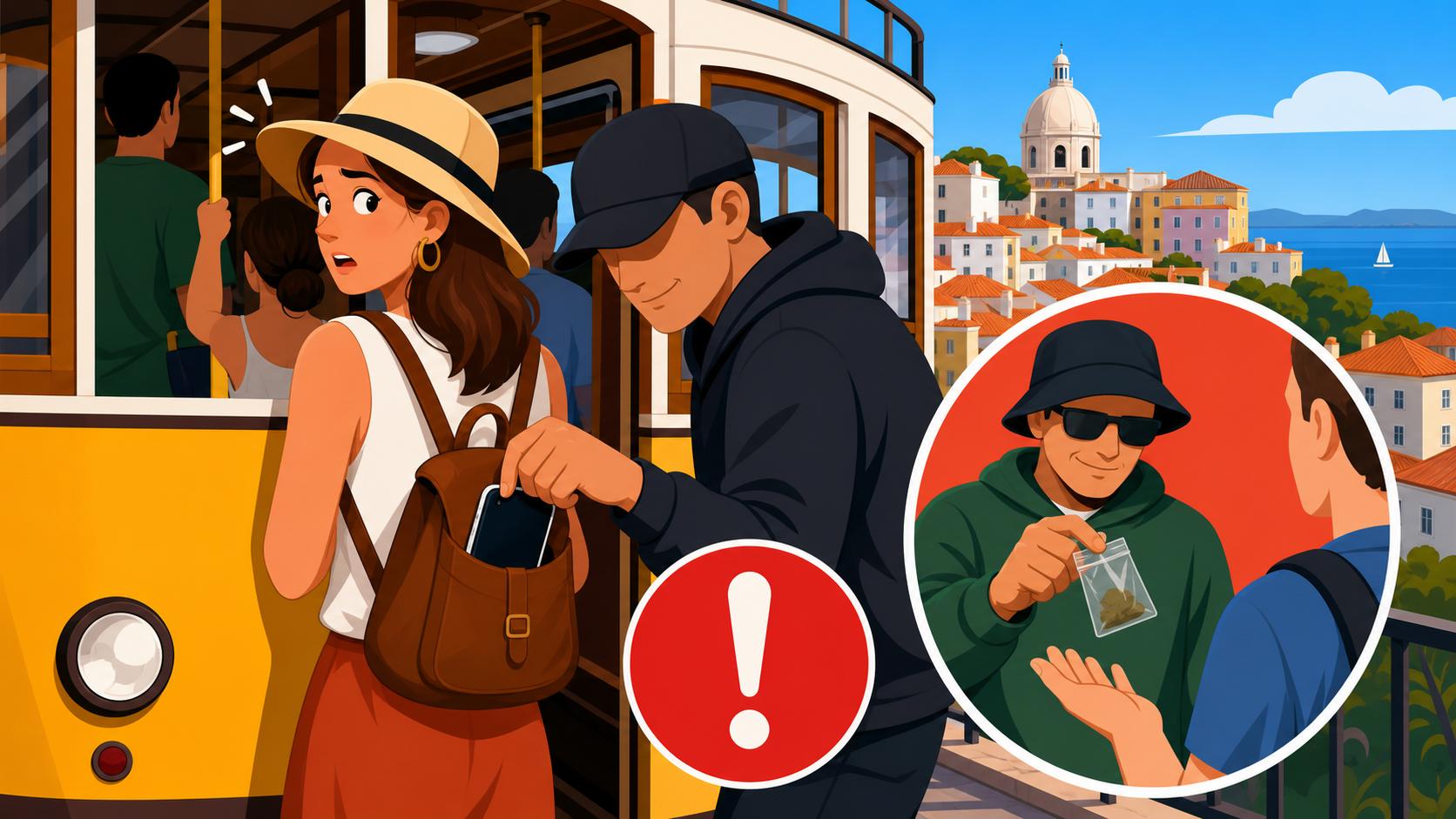
You step off Tram 28 at Graça, reach for your phone to photograph the view, and your pocket is empty. A few streets later, someone offers you “hash” that turns out to be pressed bay leaves. Both happen to visitors in Lisbon every day. This guide explains how these scams work, where they happen, and how to avoid them.
I have lived in Lisbon long enough to have watched these tricks from every angle. I have been the person who nearly lost a wallet on the 28, the friend who took the late-night call from a panicked cousin whose passport had vanished, and the neighbour who explained to a tourist that his “chocolate” was a stock cube. None of this means Lisbon is dangerous. It is one of the calmer capitals in Europe, and violent crime against visitors is rare. Petty theft and small cons are a different matter, and they cluster around the places you most want to see.
Pickpockets on Tram 28: How the Theft Actually Happens
Tram 28 is the famous yellow wooden tram that rattles from Martim Moniz up through Graça, down past the Sé cathedral, across Baixa and Chiado, and on towards Estrela and Campo de Ourique. It is beautiful, it is cheap compared with a guided tour, and it is packed for most of the day. Packed trams with narrow aisles, sharp corners and people holding phones up to the window are perfect conditions for pickpockets. Lisbon residents half joke that the 28 has more professional thieves per square metre than any other spot in the city.
The pickpockets here are rarely the shifty-looking character from a film. They tend to be well dressed, often working in pairs or small groups, and some look exactly like tourists, complete with a guidebook or a camera. They choose their targets at the stop, not on the tram. If you are standing in the Martim Moniz queue counting euros, checking your phone with a wallet in your back pocket, or wearing a backpack with an open front pouch, you have been noticed before the tram arrives.
The Crush at the Door
The most common moment for theft is boarding and exiting. When the tram pulls in, the crowd surges forward and people push to get on. A thief positions themselves directly in front of or behind you, creating a brief jam at the narrow door. In that two-second squeeze, a hand goes into your jacket or bag. You feel the pressure of bodies, which is normal on the 28, so you do not register the lighter touch.
The exit version is even cleaner. The thief stands near the door, waits until the tram is about to depart, lifts your phone or wallet, and steps off just as the doors close. By the time you check your pocket, the tram is already moving, and you are left watching from inside as the thief walks calmly away along the pavement. On the steep curves around Graça and São Tomé, the tram cannot simply stop for you, and that is exactly why these stops are favoured.
The Distraction Team
Group thieves use distraction. One person bumps into you, apologises loudly, or drops something at your feet. Another asks you for directions while holding a folded map or newspaper at chest height. That map is a shield: it hides the hand moving underneath it towards your bag or phone. They only realised at the next stop.
Another version targets people sitting down. Someone stands very close, pressing against your shoulder with a jacket draped over their arm. Under that jacket, their hand is working on the bag on your lap or the phone you placed on the seat beside you. The rocking motion of the tram hides any movement.
Practical Ways to Ride the 28 Without Losing Anything
You do not need to skip the 28. You need to ride it smarter. Here is what I tell every friend who visits:
- Ride early in the morning or later in the evening, when the queues are shorter. The guide How to Ride Tram 28 in Lisbon Without the Crowds goes deeper into timing and alternative boarding points.
- Board at a less popular stop rather than at Martim Moniz or Praça da Figueira, where crowds and thieves both concentrate.
- Keep nothing in your back pockets. Front pockets with a zip, or an inside jacket pocket, are much safer.
- Wear your backpack on your front while on board. Locals do this without embarrassment.
- Hold your phone with a wrist strap or lanyard when taking photos from the window.
- Be alert at every stop, not only your own. Most theft happens in the seconds before the doors close.
- If someone creates a sudden fuss next to you, put your hand on your valuables first and look around second.
If you would rather avoid the crowds entirely, the 12E covers part of the same historic area around the cathedral and the Alfama edges with fewer people, and the 24E is worth exploring too. The Getting Around Lisbon: Metro, Trams, and the Famous 28 guide lays out how these routes fit together with the metro.
For gear, a crossbody bag with zips that sit against your body and a slash-resistant strap makes a real difference. Expats living here often order these from Amazon Spain, which delivers to mainland Portugal, so you can have one waiting at your accommodation if you are staying for a while.
Fake Hash Sellers in Baixa, Bairro Alto and the Riverfront
If you walk down Rua Augusta, around Rossio, or through Bairro Alto in the evening, someone will almost certainly lean in and murmur, “Hashish? Cocaine? Marijuana?” For many visitors this is genuinely shocking. They assume drugs must be legal in Portugal because sellers are so open. The truth is stranger and, for the buyer, more embarrassing.
What They Are Actually Selling
These street sellers almost never have real drugs. What they offer is typically pressed bay leaves, oregano, stock cubes, bits of brown wax, crushed paracetamol, or flour wrapped in plastic. The “hash” might be dark and crumbly and even smell faintly herbal. The “cocaine” might be a fine white powder that is little more than household filler. It is a theatre performance designed to get money from curious tourists, often late at night when judgement is weaker.
Because the products are not illegal substances, police have historically found it difficult to prosecute the sellers for drug trafficking, which is part of why they remain so visible. That visibility is the trap. It creates the impression that the trade is tolerated and safe, when it is really just a scam operating in a legal grey area.
The Real Risks of Buying
The obvious risk is that you lose your money and get a bag of herbs. But there are other problems. Some sellers use the transaction to see where you keep your wallet. Some will follow you briefly or try to pressure you into paying more. And occasionally a seller will hand over something that is not just kitchen herbs but a mix with unknown additives, which is a genuine health risk.
There is also a legal point visitors misunderstand. Portugal decriminalised personal possession of small quantities of drugs, but it did not legalise them. Possession is still prohibited and treated as an administrative matter, which can mean being referred to a regional commission that deals with drug use, and selling remains a crime. A holiday is not the moment to test how that process works with your limited Portuguese.
How to Handle the Approach
The sellers rely on engagement. A smile, a question, or even a joke keeps them walking alongside you. Here is the approach that works:
- Do not stop walking or make prolonged eye contact.
- Say a firm “Não, obrigado” or “Não, obrigada,” depending on your gender, and keep moving.
- Do not argue, mock, or ask what is in the bag.
- If someone follows you, walk into a shop, café or busy hotel lobby.
- Keep your phone and wallet secured while passing through Rua Augusta and Rossio in particular, because the same crowded areas attract pickpockets.
Most of the time, a single clear refusal ends the interaction. The sellers are not usually aggressive. They simply move on to the next person who looks curious.
Other Common Lisbon Tourist Scams to Recognise
Tram 28 and the hash sellers are the headline acts, but they are not the only problems. These are the others I hear about most from visitors and new arrivals.
Restaurant Touts, the Couvert and Inflated Bills
In Baixa, especially on Rua Augusta and the streets running off it, waiters stand outside with menus and invite you in. Not all of these restaurants are scams, but the touting areas have a higher rate of overpriced, mediocre food, and occasionally bills with items you did not order.
The couvert is the classic confusion. Bread, olives, butter, cheese or small pastes arrive on your table without being asked for. In Portugal, these are not free. If you eat them, you pay for them. If you do not want them, you can politely send them back, and you should not be charged. Dishonest places will charge you anyway or add a cheese plate you never touched. What Is the Couvert on a Portuguese Restaurant Bill? explains the rules in detail. Always check your bill line by line before paying, and do not be shy about asking for something to be removed.
Tuk-Tuks, Taxis and Ride Pricing
Tuk-tuks are everywhere around Alfama, the Castelo de São Jorge and the Praça do Comércio. Some drivers are excellent guides. Others quote a price for a “tour” and then claim it was per person, or extend the route without asking. Agree the total price, the duration and the exact route before you sit down, and confirm whether it is for the whole group.
Taxi issues usually happen at Lisbon Airport or near cruise terminals. Unmetered fares, very long routes, or “luggage supplements” that do not seem right are the typical complaints. Ride-hailing apps remove most of that uncertainty because the fare is set in the app. See Using Bolt vs Uber in Portugal: Which ride-hailing app is cheaper? for how the two compare in practice. If you take a regular taxi, ask the driver to use the meter and keep the receipt.
ATMs, Card Readers and Currency Conversion
Standalone ATMs in tourist zones, often branded Euronet, can charge heavy fees and offer to “convert” your withdrawal into your home currency. That conversion offer is called dynamic currency conversion, and it almost always works in the machine’s favour. Use ATMs attached to Portuguese banks, the Multibanco network, and always choose to be charged in euros. The guide How to avoid ATM withdrawal fees from Euronet machines in tourist areas walks you through spotting the right machines. The same rule applies in shops and restaurants: when a card terminal asks whether you want to pay in your home currency, decline and choose euros.
Petitions, Fake Charity Collectors and Bracelet Tricks
Around Rossio, Praça do Comércio and the Miradouro de Santa Luzia, you may meet people with clipboards asking you to sign a petition for a deaf or disabled charity. Once you sign, they ask for a “donation,” and while you are focused on the clipboard, an accomplice may go through your bag. Just walk past. Genuine charities in Portugal do not operate like this.
Similarly, anyone who tries to tie a bracelet on your wrist, hand you a sprig of rosemary, or place a “gift” in your hand is setting up a demand for money. Keep your hands to yourself and keep moving.
Fake Rentals and Accommodation Scams
This is the scam that does the most financial damage, and it targets people planning longer stays, students and new expats more than holidaymakers. Fake listings appear on Facebook groups and classified sites with beautiful photos of Chiado or Príncipe Real apartments at suspiciously reasonable prices. The “landlord” is always abroad, cannot show you the flat, and asks for a deposit by bank transfer to secure it before anyone else does.
Never transfer money for a property you have not seen or verified. For students and people relocating for a semester or a year, Uniplaces is one of the established platforms in Lisbon where listings and payments go through a structured system rather than a private transfer to a stranger. For longer leases, see Avoiding Rental Scams in Lisbon and Porto: Red Flags to Watch before you send a single euro.
Quick Reference: Common Lisbon Scams at a Glance
| Scam | Where It Usually Happens | Warning Sign | Best Defence |
|---|---|---|---|
| Tram pickpocketing | Tram 28, especially Martim Moniz, Graça, Baixa stops | Sudden crush at the door, someone pressing close | Front pockets with zips, backpack on front, alert at every stop |
| Map or newspaper distraction | Crowded trams, viewpoints, Santa Justa lift queue | Stranger holding paper at chest height near you | Step back, hand on valuables, do not engage |
| Fake hash or cocaine | Rua Augusta, Rossio, Bairro Alto at night | Quiet offers of drugs on busy streets | Firm “Não, obrigado” and keep walking |
| Couvert overcharging | Touting restaurants in Baixa | Unrequested bread, olives, cheese on the table | Send it back or check the bill carefully |
| Tuk-tuk price switch | Alfama, castle area, Praça do Comércio | Vague price, no clear route | Agree total price, route and duration first |
| ATM conversion fees | Standalone ATMs in tourist zones | Offer to charge in your home currency | Use Multibanco bank ATMs and always pay in euros |
| Petition and charity trick | Rossio, Praça do Comércio, viewpoints | Clipboard pushed towards you | Decline and walk on |
| Fake rental listings | Social media groups, classified sites | Landlord abroad, deposit before viewing | Use structured platforms and never pay before verification |
What to Do If You Get Scammed or Robbed in Lisbon
Even careful people get caught. I know long-term residents with excellent street sense who have lost phones on the 28. If it happens to you, do not waste energy on embarrassment. Focus on reducing the damage.
Immediate Steps After a Theft
- Check calmly that the item is actually gone and not in another pocket or bag compartment.
- Call your bank or use your banking app to freeze cards immediately. Most banks let you do this in seconds.
- If your phone is stolen, use another device to lock it remotely and change key passwords, especially email and banking.
- Call 112 if you are in danger, injured, or the theft involved violence or threats. Operators can connect you to the police.
- Report the theft to the PSP, the Polícia de Segurança Pública. In central Lisbon, there is a tourism police station at Palácio Foz on Praça dos Restauradores that is used to dealing with visitors.
- Ask for a copy of the police report. You will need it for travel insurance claims and for replacing documents.
- If your passport was taken, contact your embassy or consulate. The guide What to Do If You Lose Your Passport in Portugal explains the replacement process.
Some minor crimes can also be reported online through the PSP’s electronic complaint system, which is useful if your Portuguese is limited, though going to the tourism police station in person is often simpler for visitors.
Staying Connected So You Can Respond Quickly
One overlooked part of scam protection is simply having working mobile data the moment you land. When your phone works, you can freeze a card in seconds, call a ride rather than accepting a dodgy taxi, check a restaurant’s reviews before sitting down, and send your location to a friend. Many visitors set up an eSIM before flying. Airalo is a popular option for short stays because you can activate it before you reach Lisbon Airport. For longer stays, see Best unlimited data eSIMs for digital nomads arriving in Portugal.
It also helps to keep a backup card separate from your main wallet, a photocopy or photo of your passport stored securely, and a list of emergency numbers somewhere other than your phone.
Keeping Perspective
After a theft, it is easy to decide the whole city is out to get you. It is not. The same tram where someone lost a phone carries thousands of people a day without incident, and the people of Lisbon are overwhelmingly warm, honest and helpful. Shopkeepers will let you use their phone, café owners will point you to the police station, and neighbours will often go out of their way to help. The thieves are a small, organised group who concentrate on a handful of predictable places.
If you want a broader picture of where risks really sit, Crime Rates and Neighborhood Safety in Portugal’s Major Cities breaks down the difference between tourist-heavy zones and residential areas. For a wider look at petty crime tactics around the country, Avoiding Pickpockets and Scams in Portugal and How to Avoid Pickpockets in Lisbon and Porto are both worth reading before your trip.
My honest advice after years of living here: ride the 28, walk Rua Augusta, enjoy the miradouros, and eat in Baixa if you want to. Just do it with your front pockets zipped, your bag in front, your “Não, obrigado” ready, and your bill checked before you pay.
Disclaimer
This article is for general informational purposes only and does not constitute professional advice. Laws, prices and regulations vary by location and change over time. Consult a qualified professional for guidance on your specific situation.