Splitting the bill at a restaurant: Do Portuguese places accept multiple cards?
Disclosure: This article contains affiliate links. If you buy through them, we may earn a commission at no extra cost to you. Read our full disclosure.
Four of you finish a long lunch in a Lisbon tasca, the waiter arrives with one paper bill, and you realise nobody has cash. Can the restaurant run four separate cards, or will the owner sigh and point at the “Multibanco” sticker by the till? This guide explains how bill splitting really works in Portugal, what to say, and how to avoid awkward moments.
Do Portuguese Restaurants Accept Multiple Cards When Splitting the Bill?
The short answer is yes, most of the time. The more useful answer is that it depends on the type of place, how busy it is, and how you ask. I have lived here long enough to see both outcomes. A café owner in Alfama has happily run five contactless payments for a group of us. A tiny family restaurant in a village outside Viseu has also told me, politely but firmly, that cards were “só para a conta toda”, only for the whole bill.
Card terminals in Portugal are everywhere, so the hardware is rarely the problem. The friction comes from habit, staffing, and how the restaurant handles its invoicing. Once you understand those three things, splitting stops being stressful.
How the Card Terminal Works at Your Table
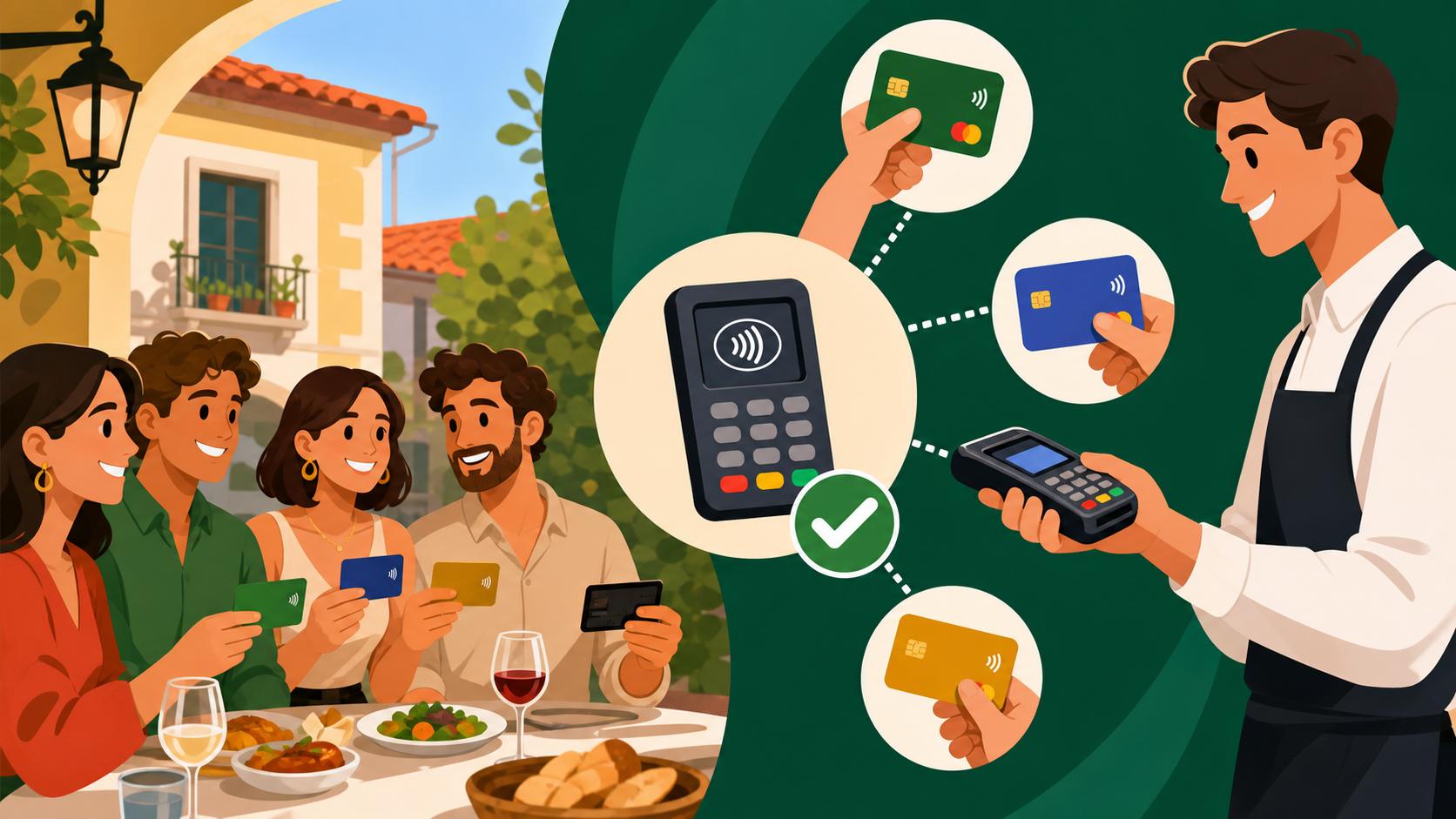
In most mid-range and city-centre restaurants, the waiter brings a portable card machine, usually called the TPA or simply “o Multibanco”, to your table. Locals use “Multibanco” to mean card payment in general, not just the ATM network. When you ask to pay with a card, you will often hear “Multibanco?” in reply, and the correct answer is just “sim”.
With a portable terminal, splitting is easy. The waiter types in the first amount, you tap your card or phone, and they type in the next amount for the next person. Contactless payments with cards, Apple Pay and Google Pay are widely accepted in cities and tourist areas. In my experience, a group of four paying separately on a portable terminal takes a minute or two, and most waiters in Lisbon, Porto and the Algarve do it without blinking.
Smaller places often have a fixed terminal beside the till. In that case, you go to the counter, the “balcão”, one by one. This is normal and not a sign of rudeness. Just get up, tell the person at the till which table you were at, and pay your share.
For a fuller picture of how the national card network fits into daily life here, see The Multibanco System and MB Way: Portugal’s Unique Payment Network.
Where Splitting Gets Complicated
The places where you are most likely to hit resistance share a few traits. They are small, family-run, busy at lunch, and serve the cheap set menu, the “prato do dia”, to workers on a tight break. At the peak of the lunch rush, a single person might be cooking, serving and running the till. Asking them to itemise eight separate bills at that moment is asking a lot, and you may get a tired shrug.
Some very small cafés and snack bars also set a minimum amount for card payments, or prefer cash for small sums. You will sometimes see a handwritten sign near the till. If you are splitting a round of coffees and pastries, your share might fall below that threshold, and the owner may ask that one person pays the lot by card.
Finally, a few traditional tascas and rural restaurants are still cash-first. They may have a terminal, but it might be “avariado” (broken), which is a phrase you will hear more often than seems statistically likely. Carrying a little cash as backup saves a lot of grief, and How Much Cash Should You Carry When Traveling in Portugal? covers sensible amounts to have on you.
Venue Types and What to Expect
Here is how I would set expectations based on the kind of place you are eating in.
| Venue type | Card splitting usually accepted? | Typical setup | Best approach |
|---|---|---|---|
| City-centre restaurant in Lisbon or Porto | Almost always | Portable terminal brought to the table | Ask when ordering the bill, tap one by one |
| Tourist-area restaurant in the Algarve | Almost always | Portable terminal, staff used to groups | Say how many ways to split up front |
| Neighbourhood tasca at lunch rush | Sometimes, with reluctance | Fixed terminal at the till | Have one person pay, settle up afterwards |
| Small café or pastelaria | Often, but small amounts can be refused | Fixed terminal, possible card minimum | Pay together or use cash for small shares |
| Rural or village restaurant | Varies a lot | Fixed terminal, sometimes cash only | Ask “Aceitam cartão?” before sitting down |
| Upscale or hotel restaurant | Always | Portable terminal, itemised bills on request | Ask for separate bills if you need invoices |
How to Ask for a Split Bill in Portuguese Without Causing Chaos
Timing and phrasing matter more than people expect. Portuguese restaurant culture is relaxed, and the waiter will not bring the bill until you ask for it. Wave them over, make eye contact, and ask clearly. If you want the full etiquette of catching a waiter’s attention, see How to Ask for the Bill in a Portuguese Restaurant.
Useful Phrases for Splitting the Bill
You do not need fluent Portuguese. A few short phrases go a long way, and staff appreciate the effort even if they switch to English.
- “A conta, por favor.” The bill, please.
- “Podemos pagar separado?” Can we pay separately?
- “Pode dividir a conta por (number of people)?” Can you split the bill between (number of people)?
- “Cada um paga o seu.” Each person pays for their own.
- “Aceitam cartão?” Do you accept cards?
- “Pago com cartão.” I will pay by card.
- “Com contribuinte, por favor.” With my tax number on the receipt, please.
There is an important difference between “dividir a conta” and “cada um paga o seu”. The first means splitting the total equally. The second means each person pays for what they ordered. Equal splitting is far easier for the waiter, because they simply divide the total and key in the same amount several times. Item-by-item splitting requires them to work out who had the grilled sea bass and who had the second glass of vinho verde, which takes longer and is more likely to get pushback during a busy service.
A Step-by-Step Approach That Works
After years of group dinners with friends, colleagues and visiting family, this is the routine I now follow.
- Before ordering, if the place looks small or traditional, ask “Aceitam cartão?” so nobody is caught out later.
- When you are ready to leave, ask for the bill and immediately say how you want to pay, for example “Podemos dividir por quatro, com cartão?”
- If you are paying item by item, agree inside your group who had what before the waiter returns, so you are not debating at the terminal.
- Mention the tax number request now if anyone needs it, because it must be printed when the invoice is issued.
- Let the waiter key in each amount, and check the screen shows the right figure in euros before you tap.
- If the waiter refuses to split, nominate one person to pay and settle up among yourselves straight away.
This order of operations avoids the most common mess, which is the waiter printing a single invoice, processing one card, and then being asked to undo everything.
Handling the Couvert and Shared Dishes
The couvert, the bread, olives, butter and small starters placed on your table when you sit down, often confuses item-by-item splitting. It appears as its own line on the bill, and it is charged only if you eat it. When splitting, I find the fairest approach is to treat the couvert like a shared dish and divide it equally, rather than trying to work out who ate the last olive. For more on what you are actually paying for, see What Is the Couvert on a Portuguese Restaurant Bill?.
Shared plates are similar. If your group ordered several petiscos to share, item-by-item splitting becomes meaningless, and an equal split is the obvious answer. Sharing small plates is very much part of eating out here, and Petiscos: Portugal’s Answer to Tapas explains how to order them like a regular.
Invoices, Tax Numbers and Why Splitting Affects Your Receipt
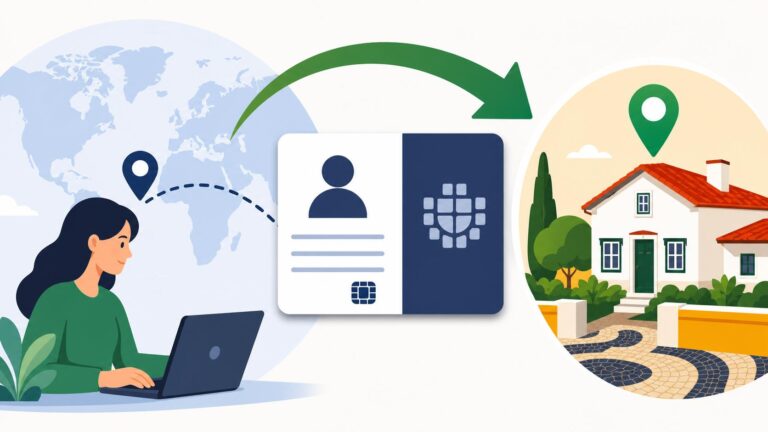
This is the part of bill splitting that surprises almost every new resident. In Portugal, restaurants issue an invoice, the “fatura”, for every sale. Waiters will often ask “Quer contribuinte?” or “Fatura com contribuinte?”, which means: do you want your tax number, the NIF, printed on it?
Why Residents Care About the NIF on Restaurant Bills
If you are a tax resident with a Portuguese NIF, restaurant spending recorded against your tax number on the e-Fatura system can count towards certain deductions on your annual tax return. Restaurants fall into a category where part of the VAT can be credited back to you. For tourists, it makes no difference. For residents, it is a small but real benefit that adds up over a year of eating out.
To understand why cashiers and waiters constantly ask for your number, see e-Fatura guide: Why cashiers ask for your NIF at the supermarket.
How Splitting Changes Who Gets the Invoice
When one person pays the whole bill, the restaurant usually issues a single invoice with one NIF. Everyone else in the group gets nothing on their tax record. If you are a group of residents who all care about this, you need separate invoices, and that means asking for them before the bill is printed.
Here is a realistic scenario. Ana, Tom and Priya, all residents in Porto, have dinner together. If Tom pays everything by card and then collects money from the others, only Tom’s NIF gets the invoice. If instead they ask “Podemos pagar separado, cada um com o seu contribuinte?”, the restaurant can, in principle, issue three invoices, each with its own NIF and amount.
In practice, larger restaurants handle this smoothly. Small tascas may find it a nuisance, especially when the system has already printed the single invoice. If they say no, do not push too hard. It is a modest tax benefit, not worth souring your relationship with your local lunch spot.
Splitting Methods Compared
| Method | Speed at the table | Tax invoice per person | Works for tourists | Main drawback |
|---|---|---|---|---|
| Equal split by card on the terminal | Fast | Possible if requested before printing | Yes | Unfair if orders differ a lot |
| Item-by-item split by card | Slower | Possible if requested before printing | Yes | Can be refused at busy times |
| One person pays, others repay via MB Way | Very fast | Only the payer’s NIF | Usually not | Needs Portuguese bank and phone setup |
| One person pays, others repay by app transfer | Very fast | Only the payer’s NIF | Yes | Relies on group members repaying |
| Everyone pays in cash | Fast if you have change | Possible if requested | Yes | Change and small notes can be a problem |
| Mix of cash and card | Medium | Possible if requested | Yes | Waiter must track several payments |
Smart Alternatives When the Restaurant Will Not Split
Sometimes the answer will simply be “não dá”, it is not possible. Rather than arguing, it is easier to have a backup plan. Most Portuguese groups solve this themselves, and you will quickly see how locals do it.
Paying Each Other Back With MB Way
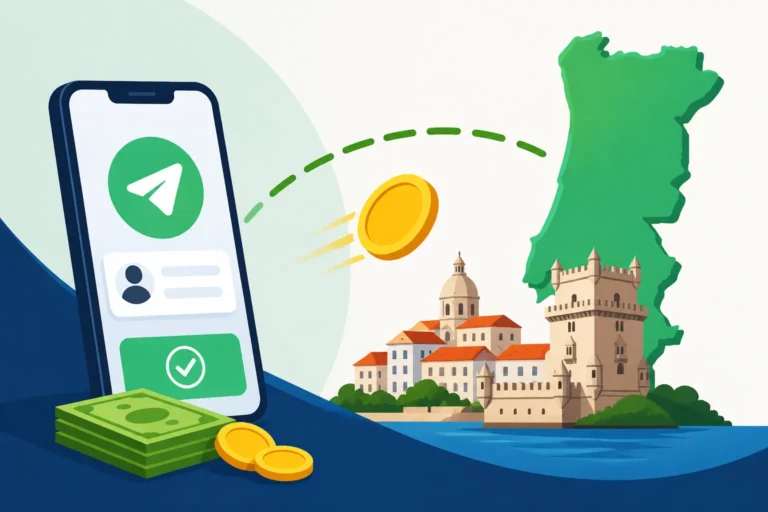
Among Portuguese friends, the standard solution is simple. One person pays the whole bill by card, and everyone else sends their share instantly through MB Way, the mobile payment app linked to Portuguese bank accounts and phone numbers. It takes seconds and is so common that “faz-me um MB Way” (send me an MB Way) is part of everyday vocabulary.
The catch for newcomers is that MB Way generally needs a Portuguese bank account and often a Portuguese phone number. If you have just arrived, you may not be able to use it yet. For a practical explanation of why the app is worth setting up, see Using the MB Way app: Why it’s better than carrying cash in Portugal. If you have tried to register with your foreign number and hit a wall, Linking your foreign phone number to MB Way (and why it usually fails) explains what is going on.
Using International Cards and Apps Without Losing Money
Visitors and new arrivals often pay with foreign cards, and that brings a hidden trap. When you tap a non-euro card, the terminal may offer to charge you in your home currency instead of euros. This is called dynamic currency conversion, and the exchange rate applied is usually worse than what your own card provider would give you. Always choose to pay in euros. If the waiter asks “Euros ou (your currency)?”, answer “euros”.
A multi-currency card such as the one from Wise is useful here, because you can hold euros in the account and pay in euros directly, which keeps the conversion transparent. When a group of mixed nationalities splits the bill and one person pays, Wise also makes it easy for friends abroad or with foreign accounts to send their share back in euros without a messy bank transfer. Check the provider’s own page for current fees and limits before relying on it.
Some residents use a card from a European investment app such as Trade Republic for everyday spending, and it works at Portuguese terminals like any other Visa or Mastercard. If you hold crypto through a platform such as Binance, note that restaurants accept euros, not crypto, so any conversion has to happen on your side before the payment, through whatever card or account you have set up.
On the question of cards versus cash more broadly, and why debit is still the default here, see Credit cards in Portugal: Why debit cards (Cartão de Débito) are preferred.
Cash as the Universal Fallback
When all else fails, cash still settles everything. Each person puts their share in notes and coins on the little tray the bill arrives on, and the waiter brings back the change. The only problem is small change. Waiters at busy cafés are not always thrilled to break large notes for a small sum, so try to carry smaller notes and coins.
Tips are another reason to keep coins handy. Tipping on card terminals is not a strong habit in Portugal, and many terminals do not even prompt for it. If your group wants to leave something extra for good service, leaving a few coins on the table is the normal way. Whether you should tip at all is covered in Is It Rude Not to Tip in Portugal?.
A Quick Checklist Before Your Next Group Meal
Before a group meal, especially with people new to Portugal, I run through this short list.
- Check whether the venue accepts cards, especially in rural areas or very small cafés.
- Agree in advance whether you will split equally or item by item.
- Make sure at least one person has a card that works reliably in Portugal.
- Decide who wants their NIF on an invoice and say so before the bill is printed.
- Carry some cash and coins as a backup and for tips.
- Always choose to pay in euros if the terminal offers a currency choice.
- If the restaurant refuses to split, let one person pay and settle up straight away through an app or cash.
Once you have done this a few times, splitting the bill in Portugal becomes second nature. Waiters in cities are used to it, smaller places will usually meet you halfway if you ask nicely and avoid the lunch rush, and your group can always sort things out among yourselves afterwards. The relaxed pace of a Portuguese meal is one of the best things about living here, so do not let the bill be the part that stresses you out.
Disclaimer
This article is for general informational purposes only and does not constitute professional advice. Laws, prices and regulations vary by location and change over time. Consult a qualified professional for guidance on your specific situation.