Driving in Portugal: Exchanging Your Foreign License to a Portuguese One
Disclosure: This article contains affiliate links. If you buy through them, we may earn a commission at no extra cost to you. Read our full disclosure.
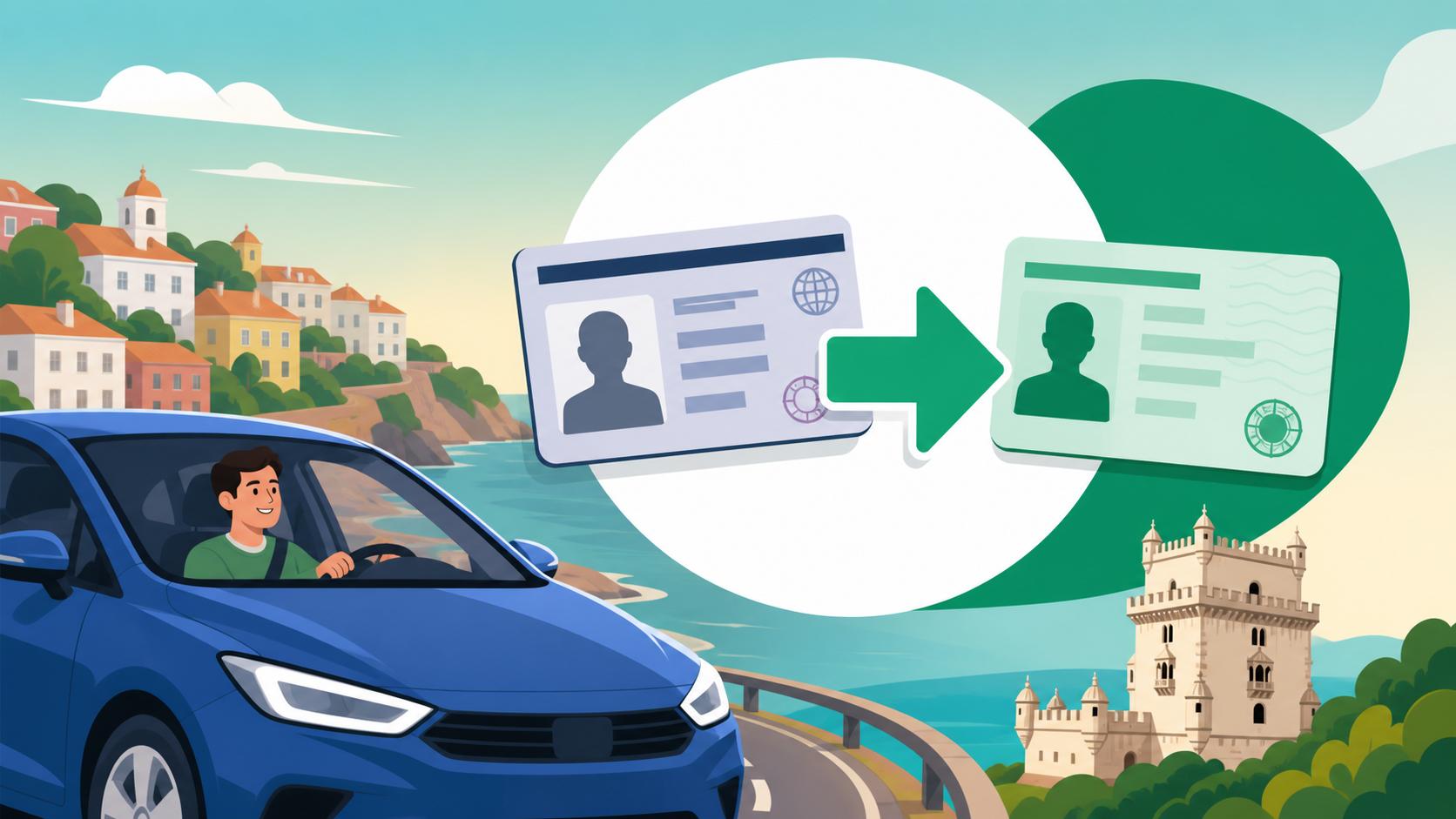
The sudden realization that your foreign driver’s license might not be valid after a few months in Portugal is a common source of panic for many of us. I remember the cold sweat I felt during my first winter in Porto, staring at a government website that seemed to contradict itself every other paragraph. This guide solves the confusion by detailing exactly when, where, and how to exchange your license before the legal deadlines catch up with you.
Understanding the Legal Deadlines for License Exchange
When you first arrive in Portugal, your foreign license feels like a symbol of freedom. However, the Portuguese authorities at the Instituto da Mobilidade e dos Transportes (IMT) have very specific timelines that dictate when that symbol of freedom becomes a legal liability. Navigating these rules is often the first major hurdle in your Living in Portugal Guide 2027: The Complete Relocation Manual for Expats.
The 90-Day vs. Two-Year Rule
For most non-EU residents, there are two critical dates you need to tattoo on your brain: 90 days and two years. From the moment you obtain your residency permit, you have 90 days to officially start the exchange process if you want to continue driving legally. You aren't "losing" your license after 90 days, but your right to use the foreign one expires in the eyes of the GNR (Guarda Nacional Republicana).
If you wait longer than 90 days but less than two years, you can still exchange your license without taking a new driving test, but you are technically driving illegally in the interim. If you pass the two-year mark without initiating the exchange, the IMT will likely require you to sit for both a theoretical and practical driving exam in Portuguese. Expert drivers from abroad can fail these tests simply due to the language barrier and the notoriously strict Portuguese examiners.
Residency and the IMT Trigger
The clock doesn’t start the day you drive across the border or land at Lisbon airport. It starts the day you are granted residency. For many, this is the date printed on your card issued by AIMA Portugal: Navigating the New Immigration Agency and Residence Permits. It is vital to coordinate your NIF and NISS: How to Get Your Portuguese Tax and Social Security Numbers before approaching the IMT, as you cannot even open an application without your Portuguese tax number linked to a local address.
If you are still searching for a permanent home through platforms like Uniplaces, make sure you have a reliable way to receive mail. The IMT will send your physical license to the address registered in their system, and "lost in the mail" is a bureaucratic nightmare you want to avoid. While you are sorting out your permanent housing and waiting for home internet, using a travel eSIM from Airalo can keep you connected to the IMT’s online portal so you can track your application status on the go.
Consequences of Missing the Deadline
Driving with an "expired" foreign license (expired in the context of Portuguese residency) is treated similarly to driving without a license at all. If you are pulled over, the fines are substantial, often starting at several hundred euros. More importantly, your insurance company will likely use the invalid license as a reason to deny any claims in the event of an accident. This is a risk no expat should take, especially when you are already dealing with the high Cost of Living in Portugal 2026: Detailed Budgets for Singles and Families.
Eligibility and the Global Agreement Landscape
Not all licenses are treated equally in Portugal. The ease of your exchange process depends entirely on which country issued your original permit and whether that country has a reciprocal agreement with the Portuguese Republic.
EU and EEA Citizens
If you hold a license from an EU member state or an EEA country (Iceland, Liechtenstein, Norway), you are in the "lucky" group. You can generally drive on your original license until it expires. However, once you become a resident, you are legally required to inform the IMT of your residency within 60 days. They won't take your license away; they will simply register you in the national database. Failing to do this simple registration can result in a fine if you are stopped by the police.
Countries with Bilateral Agreements
Portugal has signed specific agreements with several non-EU countries to simplify the exchange process. This list includes the United Kingdom, Brazil, the United States, Canada, Australia, and members of the CPLP (Community of Portuguese Language Countries). For these nationals, the process is mostly administrative. You will need to provide proof that your license is authentic, but you won't have to step foot in a driving school.
If you are coming from the US, you will likely need to follow the specific steps outlined in How to convert a US driver's license to a Portuguese license (IMT process). Each US state has its own DMV, which complicates things, as the IMT requires a "Certificate of Authenticity" that many US states don't standardly produce.
Non-Agreement Countries
If your country does not have a bilateral agreement with Portugal, the process is significantly more arduous. You will likely be required to take a practical driving test. In some cases, you may even need to attend a set number of mandatory lessons at a local "Escola de Condução." This is why many expats choose to hire a lawyer or a relocation agent. If you are in this position, Finding an English-speaking real estate lawyer for property closing in Portugal might lead you to a firm that also handles administrative immigration tasks like driver's license exchanges.
| Origin Country Category | Driving Test Required? | Deadline to Start | Key Document Needed |
|---|---|---|---|
| EU / EEA | No | Before expiry | Registration of Residence |
| UK, US, Brazil, CPLP | No | 90 Days | Certificate of Authenticity |
| OECD (Non-EU/UK/US) | No | 90 Days | Apostilled License Copy |
| Other Non-EU | Yes (Usually) | 90 Days | Medical Certificate & Test |
The Step-by-Step Exchange Process
The IMT has moved much of its initial application process online, which is a blessing compared to the days of standing in line at 6:00 AM. However, the digital portal can be finicky and often requires a specific set of scanned documents to move past the first screen.
Gathering the Required Documentation
Before you even log into the IMT portal, you need a digital folder ready with the following:
- A scan of your current, valid driver's license (both sides).
- Your residency permit or visa.
- Your NIF (Tax Identification Number).
- A Certificate of Authenticity from your home country’s licensing authority.
- A psychological assessment (only for certain categories like heavy vehicles or instructors).
The "Certificate of Authenticity" is the most common sticking point. For UK drivers, this is often a DVLA check code. For Americans, it’s usually a notarized and apostilled driving record from your state's DMV. For others, it might be a letter from your embassy in Lisbon. If you need to order mandatory car safety equipment like a reflective vest or warning triangle to pass a future inspection, you can find these easily on Amazon Spain and have them shipped directly to your new home.
The Medical Certificate (Atestado Médico)
Every license exchange requires a Portuguese medical certificate. You cannot get this from your doctor back home. You must visit a doctor registered in Portugal. You can do this through the public system, but given the wait times, most expats go to a private clinic.
The doctor will perform a basic eye exam, check your blood pressure, and ask about your medical history. The "Atestado Médico" is now electronic. The doctor will upload it directly to the IMT database using your NIF. Make sure you receive a paper copy for your own records just in case the digital sync fails—a common occurrence in Portuguese bureaucracy. This is also a good time to ask your doctor about other local health requirements, such as those found in the Expat Guide to Portuguese Vaccinations: Flu Shots and Travel Vaccines.
Navigating the IMT Online Portal
Once your medical certificate is in the system, you head to the "IMT Online" website. You will log in using your NIF and your "Senha das Finanças" (the password you use for tax filings). You fill out the exchange request form, upload your documents, and pay the fee (usually around €30).
After submitting, you enter the "waiting phase." You will eventually receive an email asking you to visit an IMT office in person to capture your biometric data (photo and signature) and surrender your foreign license. Yes, they will take your physical card. In exchange, they will give you a temporary paper document (Guia) that allows you to drive only within Portugal.
Practical Realities of Driving in Portugal
Once you have your "Guia" or your new Portuguese plastic card, the real learning begins. Driving in Portugal is not just about the rules on the paper; it’s about the cultural "flow" of the road.
Via Verde and Electronic Tolls
Portugal has one of the most advanced, and sometimes confusing, toll systems in Europe. Many motorways have "electronic-only" tolls (SCUTs) where there are no booths to pay with cash or card. Instead, cameras read your license plate.
If you are driving a car with foreign plates or a newly purchased Portuguese vehicle, you absolutely must get a Via Verde device. This small transponder sits on your windshield and automatically bills your bank account. Without it, you’ll find yourself constantly visiting CTT (post office) locations to pay tolls a few days after you drive. For a deeper dive into this system, read our guide on Navigating the Portuguese Toll System: Via Verde and Electronic Tolls.
Portuguese Driving Culture and Etiquette
Portuguese drivers are generally skilled but can be aggressive and impatient. One of the most important rules to understand is the "Right Hand Rule" (Prioridade à Direita). In an unmarked intersection or roundabout, the person coming from the right has the right of way. However, in practice, the person with the most confidence often takes it.
Roundabouts are another area of confusion. In Portugal, if you are not taking the very first exit, you should not stay in the outer lane. You must move to the inner lanes and only move to the outer lane after you pass the exit immediately preceding your own. The GNR loves to hand out fines for "incorrect lane usage" in roundabouts, especially in tourist areas like the Algarve.
Insurance and Vehicle Maintenance
Once you have your Portuguese license, you must ensure your insurance policy is updated. Some insurers offer lower rates for those with a Portuguese permit because it proves you have integrated into the local legal system. You should also be aware of the mandatory annual or biennial inspection known as the IPO (Inspeção Periódica Obrigatória).
Missing an IPO is a serious offense. If you are currently looking for a vehicle, be sure to check the Buying a Car in Portugal: IUC Tax, Inspections (IPO), and High Vehicle Costs guide to understand the ongoing taxes and maintenance requirements that come with ownership.
Costs and Timeframes: What to Really Expect
The official line from the IMT is that a license exchange takes a few weeks. The reality is often measured in months.
The Financial Breakdown
While the actual fee to the IMT is relatively low, the hidden costs add up quickly.
- IMT Exchange Fee: ~€30
- Private Medical Consultation: €30 – €60
- Certificate of Authenticity/Apostilles: €50 – €150 (varies by country)
- Translation Fees: €20 – €50 per page (if your license is not in a Latin script)
If you are on a tight budget, plan these expenses carefully alongside your other Public Transport and Driving in Portugal: Trains, Tolls, and Licenses costs.
Dealing with Bureaucratic Delays
It is not uncommon for the exchange process to take six months or even a year during periods of high immigration. During this time, your temporary "Guia" will likely expire. You must keep a close eye on the expiration date of this paper document. Usually, you can renew it online or at an IMT branch, but it requires proactive management.
If you plan to travel outside of Portugal, remember that the temporary paper "Guia" is not valid for driving in Spain, France, or any other country. If you need to drive abroad while your exchange is processing, you are effectively stuck unless you still have a valid international driving permit that hasn't been "voided" by your Portuguese residency status.
Safety and Mandatory Equipment
The Portuguese police are very strict about the equipment you carry inside your vehicle. If you are stopped and found missing any of these items, the fine is immediate and non-negotiable.
The Mandatory Kit
You are legally required to have:
- A reflective warning triangle.
- A high-visibility reflective vest (which must be kept in the cabin, not the trunk, so you can put it on before exiting the car).
- A valid spare tire and the tools to change it (or a certified repair kit).
- Your "Documento Único Automóvel" (DUA) and proof of insurance.
It is wise to buy a high-quality kit from Amazon Spain as soon as you get your car. The cheap versions sold at some gas stations often don't meet the specific EU "E-mark" requirements that a pedantic officer might look for.
Child Safety and Pets
Portugal has strict laws regarding child seats (cadeirinhas). Children under 12 years old or under 135cm in height must sit in the back in an approved child restraint system. As for pets, they cannot be loose in the car. They must be in a carrier, behind a solid grill, or secured with a special seatbelt harness. Failing to secure your dog is one of the quickest ways to get a "heavy" fine during a routine highway check.
Disclaimer
The information provided in this guide is for educational purposes only and does not constitute legal advice. Immigration laws and driving regulations in Portugal are subject to frequent changes. Always verify the latest requirements with the official Instituto da Mobilidade e dos Transportes (IMT) or a qualified legal professional before making decisions regarding your driving privileges.