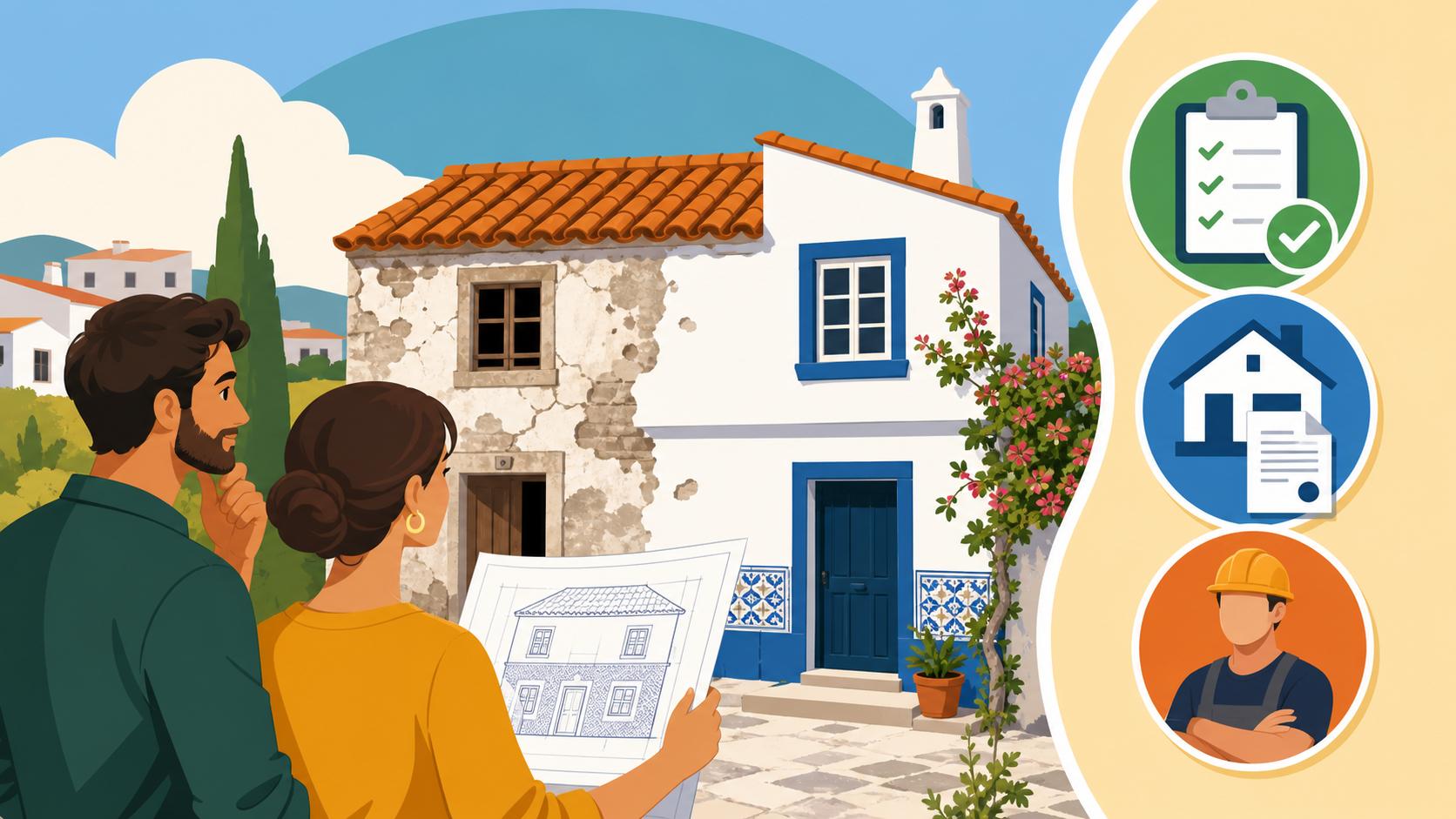
Renovating an old Portuguese house: Approvals, licenses, and finding contractors
Disclosure: This article contains affiliate links. If you buy through them, we may earn a commission at no extra cost to you. Read our full disclosure.
Staring at a crumbling stone wall in the Alentejo or a peeling "pombalino" facade in Lisbon, you might feel a rush of romantic inspiration, followed immediately by the crushing weight of Portuguese bureaucracy. I remember standing in my first "ruína" with a notebook full of dreams, only to realize I didn't even know how to ask for a skip bin. This guide solves the mystery of the Portuguese renovation process, from the first permit to the final coat of paint.
The Reality of Renovating a Heritage Property in Portugal
The dream of restoring a house with "traça antiga" (old character) is a common one among the expat community, but the bridge between a Pinterest board and a livable home is built on patience. In Portugal, an "old" house isn't just fifty years old; it could be two hundred. These structures were built with techniques like "tabique" (timber and clay) or thick stone that require specialized knowledge to preserve. If you try to apply modern, quick-fix solutions to these ancient materials, you often end up with dampness issues that are nearly impossible to reverse.
When I first started my renovation journey, I underestimated the "amanhã" culture. It isn't necessarily laziness; it is a different rhythm of life. You will find that Cost of Living in Portugal 2026: Detailed Budgets for Singles and Families often fluctuates because renovation costs are rarely fixed. Materials might be delayed, or your "empreiteiro" (contractor) might disappear for two weeks to help with the grape harvest. Validating this frustration is the first step toward sanity. You are not alone in feeling like the process is moving through molasses.
Understanding the Structural Integrity and Hidden Defects
Before you even think about aesthetics, you have to look at the bones. Many old Portuguese houses suffer from rising damp because they were built without modern foundations. During my first winter in a semi-renovated cottage, I watched mold bloom across a wall I had just painted. It was a heartbreaking lesson in why you must prioritize drainage and ventilation over new kitchen cabinets.
Electrical systems are another major hurdle. Many older homes still have 15-amp service which will trip the moment you turn on a space heater and a kettle simultaneously. You will likely need to upgrade the entire system and apply for an increase in "potência contratada" from the energy provider. This is why Setting Up Utilities in Portugal: Electricity, Gas, Water, and Internet is a task that should happen parallel to your renovation, not after it.
The Importance of a Detailed Survey
Never rely on the "Caderneta Predial" (the tax document) to tell you the true state of the house. These documents are often decades out of date. There are cases where expats buy a "two-bedroom" house only to find out during the renovation that one room was never legally registered as a living space. You need a "técnico" or an architect to perform a structural survey. They will check for woodworm (bicho da madeira), which is rampant in the pine beams used in many older Portuguese roofs. Replacing a roof can easily add €20,000 to your budget, so knowing this upfront is vital for your Personal loans in Portugal: Getting financing for home renovations as an expat applications.
Navigating the Câmara Municipal and Licensing Requirements
This is where most expats lose their enthusiasm. Every municipality (Câmara Municipal) in Portugal operates like its own little kingdom. What works in Porto might be strictly forbidden in a small village in Central Portugal. The licensing process is divided into two main categories: "Comunicação Prévia" (prior notification) and "Licenciamento" (full licensing).
If you are only doing interior work that doesn't affect the structure, the facade, or the plumbing/gas systems, you might get away with a "Comunicação Prévia." This is essentially telling the council what you are doing and starting work after a short waiting period. However, the moment you want to change a window size, add a bathroom, or tear down a load-bearing wall, you enter the realm of full licensing. This requires an architect to submit a project, followed by approvals from various departments.
Dealing with Historical Zones and the DGPC
If your dream home is in a protected historical zone, such as the Alfama in Lisbon or the old center of Évora, you have another layer of oversight: the DGPC (Direção-Geral do Património Cultural). They are the guardians of Portugal’s visual history. They might dictate the exact shade of yellow you can paint your door or forbid the use of PVC window frames.
During these long waiting periods, staying connected is essential for managing your team and checking updates. Using an eSIM from Airalo can ensure you always have data to email your architect or search for legal precedents while you are sitting in a waiting room at the Câmara. It’s also a good idea to keep your documentation organized digitally, as Portuguese officials love a paper trail, but they are increasingly moving toward digital portals.
The Role of the Fiscal de Obra
During a major renovation, the Câmara may send a "fiscal" (inspector) to check that the work matches the approved plans. If they find you have added a balcony that wasn't in the project, they can shut down the site and fine you heavily. This is why you must have a "livro de obra" (site logbook) present at all times. Being proactive and friendly with the local council can go a long way. In small villages, a "bom dia" and a little respect for the local rules can make the difference between a smooth process and a bureaucratic nightmare.
Finding and Managing Reliable Contractors
Finding a good "empreiteiro" in Portugal is like finding a needle in a haystack—if the haystack was also competing for the same needle. Because of the construction boom, the best workers are often booked out for a year. You might find yourself tempted to hire the first person who says they are available, but this is a dangerous game.
The most reliable way to find workers is through word of mouth. Ask the locals at the "café" or post in expat groups. If you are looking for specialists, Finding English-speaking plumbers and electricians using the Fixando app can be a great starting point for smaller tasks. Always check if the contractor has an "Alvará" (a license to operate in construction). If they don't have this, your home insurance may be void, and you will have no legal recourse if the work is shoddy.
The Importance of the Orçamento
Never accept a verbal quote. You need a detailed "orçamento" that breaks down costs for labor and materials separately. Be wary of quotes that seem too low; they often lead to "surprises" halfway through the job. It is standard practice in Portugal to pay in stages: a deposit for materials, and then payments based on "autos de medição" (milestones achieved).
| Renovation Stage | Estimated Cost (Mid-Range) | Typical Duration |
|---|---|---|
| Roof Replacement | €120 – €180 per sqm | 3 – 5 Weeks |
| New Electrical System | €3,500 – €6,000 | 1 – 2 Weeks |
| Plumbing (Entire House) | €4,000 – €7,500 | 2 Weeks |
| Plastering & Painting | €25 – €40 per sqm | 3 – 4 Weeks |
| Tiling (Labor only) | €15 – €25 per sqm | 1 Week |
When managing these costs, remember that many items like light fixtures, high-quality tools, or even specific hardware can be sourced more affordably online. I often used Amazon Spain to order items that were either out of stock locally or significantly marked up in the boutique hardware stores in the city. Having these items delivered directly to the site can save you hours of driving between various "lojas de bricolage."
Managing the Project from Afar
If you are not in Portugal full-time during the renovation, you need a project manager. This could be your architect or a dedicated "fiscalizador." Do not trust a contractor to self-regulate. You will need regular photos and video calls. This is another area where having a reliable data connection through Airalo is a lifesaver, especially if your renovation is in a rural area where the Wi-Fi hasn't been set up yet.
Logistical Challenges: Living and Sourcing During Construction
One of the biggest mistakes I made was trying to live in the house during the "obras." The dust is inescapable, and living without a kitchen for three months tests even the strongest marriage. It is much better to find a short-term rental nearby. Services like Uniplaces are excellent for finding mid-term accommodation that allows you to be close enough to the site to check in daily without having to sleep in a construction zone. Uniplaces offers verified listings which is crucial when you need a reliable place to stay for three to six months.
Sourcing Materials and Waste Management
You will produce an incredible amount of "entulho" (rubble). You cannot simply dump this in the communal bins. You must hire "big bags" or a container from a licensed waste management company. Failure to do so can result in massive fines from the local "GNR" (police). You can often find information on Booking large trash pickup (Monstros) for old furniture via your local Camara which might help with some of the non-construction waste.
When it comes to the "acabamentos" (finishes), Portugal has world-class tiles and stone, but modern fixtures like smart home devices or specific kitchen gadgets are often cheaper on Amazon Spain. I found that combining local materials for the "bones" of the house with savvy online shopping for the "jewelry" (handles, taps, lights) helped keep the budget under control.
The Finishing Touches and Legalization
Once the dust settles, you aren't quite finished. You need to update the "Caderneta Predial" and the "Registo Predial" to reflect the new state of the house. This is important for future resale value and for ensuring your property taxes (IMI) are calculated correctly. If you have done work through a company, check if there are Corporate tax deductions in Portugal: Can I expense my car or home office? that might apply if you are working as a freelancer.
Don't forget the neighbors. A long renovation is noisy and disruptive. Following the Quiet hours in Portuguese apartments (Lei do Ruído): Handling noisy neighbors rules is not just a legal requirement but a social one. A bottle of wine or a bag of oranges for the neighbors can go a long way in smoothing over the months of drilling and hammering. Once the work is done, you might even find great deals on Second-hand furniture in Portugal: Using OLX, Vinted, and Facebook Marketplace to fill your newly renovated space without breaking the bank.
Practical Advice for Your First 100 Days of Construction
The first few months are the hardest. You will likely uncover issues you didn't see during the purchase. I found a hidden well under my kitchen floor that wasn't on any map!
- Over-Budget by 30%: Whatever your architect says, add 30%. Between the rising cost of materials and "hidden surprises," you will need it. This is a standard reality when Buying Real Estate: IMT Tax, Stamp Duty, and Closing Costs Explained—the costs always creep up.
- Verify the License: Ensure the "Alvará de Construção" is displayed prominently at the entrance. It's the law.
- Secure Your Financing: If you are relying on a bank, make sure your Building Credit in Portugal: Do Credit Scores Matter for Mortgages? is in top shape, as banks are very strict about releasing funds for renovations.
- Stay Patient: There will be days when no one shows up. Use those days to explore your new neighborhood or practice your Portuguese.
Renovating in Portugal is a marathon, not a sprint. It will test your patience, your budget, and your sanity. But the moment you sit on your terrace, looking at the sunset over walls that have stood for centuries—walls that you helped save—you’ll realize it was all worth it.
Disclaimer
This guide is based on personal experience and general research into Portuguese property laws as of 2026. Regulations can change frequently and vary significantly between municipalities. Always consult with a qualified architect, lawyer, and certified contractor before starting any construction project in Portugal. Any financial or legal decisions should be made with professional guidance tailored to your specific situation.