AIMA Portugal: Navigating the New Immigration Agency and Residence Permits
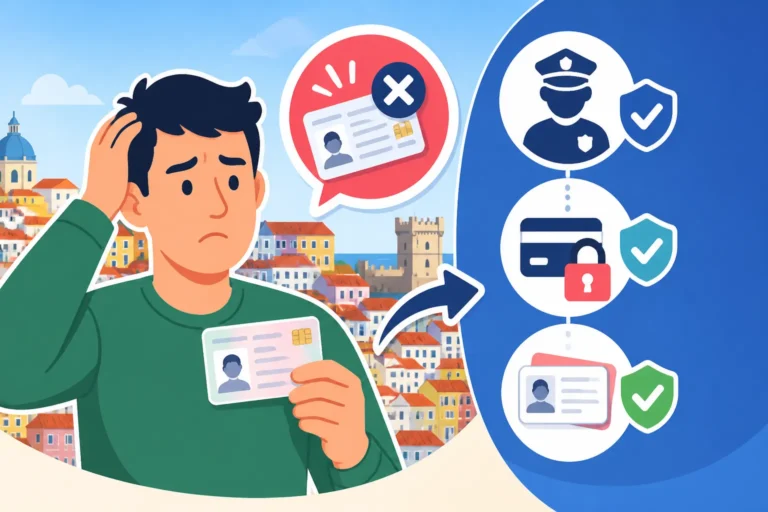
If you have ever stood in a Lisbon queue clutching a residence card that expires next week, refreshing a portal that will not load, you know how stressful Portuguese immigration can feel. This guide explains how AIMA works, how residence permits move from first appointment to renewal, and what protects you legally when your card has expired.
What AIMA Is and Why It Replaced SEF
From SEF to AIMA
For years, every foreigner’s life in Portugal ran through SEF, the Serviço de Estrangeiros e Fronteiras. SEF combined immigration paperwork with a police role at the borders. When the government dissolved it, those two jobs were split. The administrative side, including residence permits, renewals, family reunification and integration services, moved to a new body: AIMA, the Agência para a Integração, Migrações e Asilo.
On paper, the split made sense. A civilian agency would handle people building lives here, and police forces would handle borders and criminal matters. In practice, AIMA inherited a mountain of pending files, a strained appointment system and staff learning new processes while the queue grew. I remember the transition clearly. Nobody in my expat circle knew which emails were still monitored, which phone lines worked or whether an old SEF appointment would be honoured.
If you want the detailed before-and-after picture, see AIMA vs SEF: What Changed for Foreigners in Portugal After the Transition. The short version is that the forms, the logic and many of the legal articles are familiar. The agency name, the portals and the way extensions work have changed.
What AIMA Handles and What It Does Not
Knowing which office owns which problem will save you entire mornings. AIMA deals with your right to reside: first residence permits after a national visa, renewals, changes of status, permanent residence applications and family reunification. It also issues the physical card, which is produced centrally and posted to you.
AIMA does not issue your tax number, register you with Social Security or confirm your address. Those belong to other parts of the Portuguese state, and AIMA will expect you to arrive with them already sorted. Border checks at airports are carried out by police, not AIMA. That matters because the officer looking at your card at Lisbon airport works under a different chain of command from the person who approved it.
| Task | Responsible body | What you usually need |
|---|---|---|
| Residence permit, renewal, card issue | AIMA | Passport, current or expired card, supporting documents |
| Tax number or NIF | Autoridade Tributária, known as Finanças | Passport, address, sometimes a fiscal representative |
| Social Security number or NISS | Segurança Social | Passport, NIF, often an employment contract |
| Proof of address | Junta de Freguesia | Lease or witnesses, depending on the parish |
| EU citizen registration or CRUE | Câmara Municipal | EU ID, proof of means or work |
| Border control at airports | Police forces | Passport and valid residence document |
| National visa before arrival | Portuguese consulate or visa centre | Full visa application file |
The Residence Permit Lifecycle in Portugal
Arriving on a National Visa
Most non-EU residents start with a national visa issued by a consulate abroad, such as the D7, D8 or a work visa. That visa is a doorway, not a destination. It lets you enter and stay for a limited period while AIMA converts you into a residence permit holder. Many consulates now book the AIMA appointment as part of the visa process, so check your visa paperwork carefully for a date, time and office.
If your visa came without an appointment, AIMA’s booking channels become your main task in your first weeks. Expect to try repeatedly, and keep a written log of every attempt, call and email. That log has real value later if you ever need to show you acted in good faith.
People who arrived under the old route of declaring an expression of interest from inside Portugal are on a different track. For background on that route and why it closed, see What was the Manifestação de Interesse and why was it abolished in 2024?.
The Biometrics Appointment
The appointment itself is usually shorter than the anxiety leading up to it. An officer checks your documents, takes your photograph and fingerprints, confirms your address and may ask a few simple questions about why you are in Portugal and how you support yourself. Bring originals and copies of everything, organised in the same order as the checklist you were given.
Picture a retired couple from Ohio at the Lisbon office. They bring a neat folder with passports, visas, bank statements, health insurance certificates, their lease and their NIF printouts. The officer asks for proof of address, they pass it across within seconds, and the meeting is over quickly. Now picture someone digging through a phone for a PDF while the officer waits. The difference in outcome can be real, because a missing paper can mean a follow-up request that adds weeks.
For a full checklist, see Attending Your AIMA Appointment: Required Documents and Interview Process. For dress and behaviour on the day, see What to wear and how to properly behave at your AIMA biometrics interview.
Receiving Your Card
After approval, the card is printed and posted to the address you gave. This is where many people lose sleep, because the gap between approval and delivery can stretch out. My own first card arrived months after my biometrics appointment, and I checked the mailbox every single day.
Make sure your name is clearly visible on your mailbox, and tell your building’s porter or neighbours you are expecting official post. If a delivery fails, CTT usually leaves a notice so you can collect the letter at a post office, and uncollected registered post can be returned. To follow the parcel, see How to track your AIMA residence card delivery via CTT registered mail. For status checks before the card ships, see AIMA Residence Permit Processing Times and How to Check Your Status.
Renewing Your Residence Permit
When to Start
Renewal is where long-term residents most often get caught out, not because the process is hard but because life gets busy. Your card shows an expiry date. The safest habit is to put a reminder in your calendar well before that date and treat it with the same weight as a tax deadline.
Starting early matters because renewal depends on documents that themselves take time. You may need fresh bank statements, a renewed lease, an updated criminal record certificate or proof of ongoing income. If your passport is close to expiring, renew that first, since a card cannot reasonably be tied to a passport that is about to lapse.
AIMA sets the exact renewal window and the documents required for each permit type, and these details are published on AIMA’s official website. Check them there before you begin rather than relying on what a friend did with a different visa category.
The Online Renewal Step by Step
Many renewals now begin online through AIMA’s portal. The flow below reflects the general shape of the process; screens and labels shift over time.
- Gather your passport, current card, NIF, proof of address and any category-specific documents, such as income evidence or an employment contract.
- Log in to the AIMA renewal portal using the credentials or authentication method it requests.
- Select the renewal option that matches your permit type and confirm your personal details.
- Upload scanned documents in the formats the portal accepts, checking each file opens correctly.
- Submit the request and generate the payment reference.
- Pay the fee using the reference provided.
- Download and save the receipt confirming that your renewal request has been submitted and paid.
- Watch your email and the portal for requests for further documents or a biometrics appointment.
For screen-by-screen guidance, see How to Renew Your Portuguese Residence Permit Online via the AIMA Portal.
Paying and Keeping the Receipt
Payment usually runs through a DUC, a government payment document with a reference you can pay at a Multibanco ATM or through your banking app. The fee amount depends on the permit type and is set officially, so check the amount on the payment document and on AIMA’s website. For the ATM process, see How to pay the AIMA residence permit issuance fee (DUC) at a Multibanco ATM.
The single most important output of the entire renewal is the receipt showing your paid renewal request. Under the current rules, that document is what keeps an expired card usable. Save it as a PDF, print several copies, store one in your email and one in a cloud folder, and keep a paper copy with your expired card.
What Happens When Your Card Expires
The End of Automatic Extensions
For several years, Portugal relied on blanket decrees that automatically extended the validity of expired residence documents. That practice began in 2020 and became something many residents counted on. According to AIMA’s own announcement, automatic, decree-based extensions of expired residence permits ended on 15 October 2025. No extension runs into 2026.
As of October 2026, an expired residence permit is accepted only together with AIMA’s receipt for a paid renewal request. That receipt is valid for 180 days from the date it is issued, under article 2 of Decreto-Lei n.º 85-B/2025. In plain terms, an expired card on its own is not enough. An expired card plus a valid paid renewal receipt is what you need.
This is why I nag friends about filing renewals on time. The receipt is now the bridge between your old card and your new one, and you only get it by submitting and paying for the renewal.
The 180-Day Renewal Receipt
Think of the receipt as a temporary companion document with its own clock. The 180 days run from the date the receipt is issued, not from your card’s expiry date. So if you renew early, the receipt’s clock may start before your card even expires, which is worth noting on your calendar.
Here is a realistic scenario. Ana, a Brazilian designer in Porto, submits and pays her renewal online. She prints the receipt, staples it to a photocopy of her card and keeps the original receipt in her wallet next to the card itself. When her card’s printed date passes, she keeps living normally, carrying both documents together. She also notes the receipt’s 180-day end date and checks her renewal status regularly well before that point.
If your receipt is approaching the end of its 180 days and your new card still has not arrived, act early. Contact AIMA through its official channels, keep records of every attempt and consider the options in Dealing with AIMA Backlogs: What to Do If Your Card Expires.
The Six-Month Right of Residence Rule
A separate rule sits alongside the receipt system. In a clarification published on 17 October 2025, AIMA confirmed that a non-EU national’s right of residence continues for 6 months after the card’s expiry date, under article 63, n.º 14, of Decreto Regulamentar 84/2007. For cards that had expired by 30 June 2025, that six-month period ran from 15 October 2025 to 15 April 2026, a window that has now closed.
The practical lesson is that your legal right to reside and the document you show to prove it are related but not identical. The regulation protects your status for a period after expiry. The receipt is the paper that proves you asked to renew. AIMA’s guidance is that people who have applied to renew should carry the expired card together with the receipt proving the renewal request.
| Your situation | What you carry | Practical standing |
|---|---|---|
| Card still valid | Valid residence card and passport | Full proof of residence |
| Card expired, renewal paid, receipt issued within the last 180 days | Expired card plus AIMA receipt for the paid renewal request | Expired card accepted together with the receipt |
| Card expired, renewal paid, receipt older than 180 days | Expired card, old receipt, records of contact with AIMA | Receipt no longer covers you; seek AIMA guidance or legal help promptly |
| Card expired, no renewal filed | Expired card only | Expired card alone is not accepted; file the renewal immediately |
Living Day to Day While AIMA Processes
Employers, Banks and Landlords
The hardest part of waiting is often not the government, it is everyone else. HR departments, bank compliance teams and letting agents may not know the current rules, and some will simply see an old date on a card and panic. Your job is to make their decision easy.
Prepare a small proof-of-status pack. Include a copy of your expired card, the AIMA receipt for your paid renewal request showing its issue date, and a printed copy of AIMA’s own published announcement on the end of automatic extensions and the receipt rule. Presenting an official source tends to calm a nervous clerk faster than any explanation you can offer.
For employer-specific situations, see AIMA appointment delayed: How to prove legal status to Portuguese employers. Banks sometimes restrict accounts when an ID on file expires, so update your bank with the receipt as soon as you have it rather than waiting for a freeze. See What to do if your bank freezes your account because your residence card expired if that has already happened to you.
Travel and the Schengen Area
Travel is where caution pays off most. A valid Portuguese residence card generally lets you move within the Schengen Area and return to Portugal, within the rules that apply to residence permit holders. The background is covered in Traveling in the Schengen Area with a Portuguese Residence Permit.
An expired card paired with a renewal receipt is a different case. The receipt system is a Portuguese domestic rule, and border officers or airline staff in another country may not recognise it. Before booking any trip while your card is expired, check AIMA’s official guidance on travel, ask your airline what documents it accepts and, if the trip is important, speak to an immigration lawyer.
Some families cancel holidays because they cannot get a clear answer, while others travel and spend a tense hour at a border desk. Neither is pleasant. If you can, plan renewals so that a valid card is in your hand before major travel. For a specific worry about transit hubs, see Can I fly through Frankfurt if my Portuguese residence permit is currently expired?.
Address Changes and Life Events
Life does not pause for AIMA. You might move flats, marry, have a child or change jobs while a renewal is pending. Each of these can affect your file, and each should be reported through the proper channel rather than mentioned casually at a later appointment.
If you move, update your address with AIMA so your new card is not posted to an empty flat, and update Finanças at the same time. For the process, see Changing your address on your Residence Card: The new online AIMA process. If you change jobs on a work-based permit, check whether the change affects the basis of your residence before you resign.
Keep copies of every notification you send. A clear paper trail is often the deciding factor when a file is reviewed later.
Preparing Documents That Survive AIMA Scrutiny
NIF, NISS and Address
Your NIF is the foundation of everything. You need it to sign a lease, open a bank account and pay most fees. Non-EU citizens applying from abroad usually need a fiscal representative to obtain one. Services such as Bordr can arrange a NIF remotely and act as your representative, which is handy if you are still abroad finalising your visa. Check the provider’s own page for current pricing and what is included.
Your NISS, the Social Security number, matters if you work in Portugal or contribute as a freelancer. Proof of address often comes as an atestado from your Junta de Freguesia, and requirements differ by parish. See NIF and NISS: How to Get Your Portuguese Tax and Social Security Numbers and Registering Your Address with Junta de Freguesia (Atestado de Morada) for the details.
A small but common snag: make sure the address on your NIF record matches the address you give AIMA. Mismatches between government systems can trigger requests for clarification and slow things down.
Translations and Apostilles
Foreign documents such as marriage certificates, birth certificates and criminal record checks generally need an apostille from the issuing country and, if not in Portuguese, a certified translation. AIMA officers are trained to check stamps, seals and translator certifications, so a casual translation will not do.
Online services such as RushTranslate offer certified translations of civil documents, which can be faster than finding a local translator when you are still overseas. Whatever service you use, confirm that its certification format is accepted for Portuguese immigration, since requirements can differ by document type. Check the provider’s own page for current turnaround options and pricing.
Order apostilles before translations, because the apostille itself often needs translating too. For the full sequence, see Translating and Certifying Documents for Portuguese Immigration.
Insurance and Proof of Means
Many permit categories require evidence that you can support yourself and that you have health coverage. For first applications, consulates and AIMA often ask for a health insurance certificate that clearly states coverage in Portugal and the policy dates. International expat plans such as Cigna Global are a common choice for people arriving before they have access to the public health system. Check the insurer’s own pages for current plan options, and make sure the certificate wording meets the requirements listed for your permit type.
Proof of means usually means bank statements, pension letters, employment contracts or client invoices, depending on your visa. Keep these current. A statement that was fine at your visa interview may be too old by the time of your AIMA appointment or renewal. The required amounts and evidence formats are set officially for each permit type, so check them on AIMA’s website or with your consulate before you assemble the file.
When Things Go Wrong
Chasing a Stuck Application
If your application seems frozen, start with the official channels. Use AIMA’s online contact forms, phone lines and email addresses as published on its website. Record the date, time and reference of every contact. Polite persistence works better than angry messages, and a calm, factual email with your file number and receipt attached gives the reader everything needed to help you.
If you have a legitimate grievance about service, you can also submit a formal complaint. See How to file a formal complaint against AIMA on the Livro de Reclamações for how that works. A complaint does not guarantee a faster outcome, but it creates an official record.
Meanwhile, keep your renewal receipt dates in view. The 180-day window is the reason not to wait passively for months before escalating.
When a Lawyer Makes Sense
Plenty of people handle their residence permits alone, and simple renewals rarely need professional help. A lawyer becomes worth considering when your file is complex, such as a change of status, a refusal, a family case with several dependants or a receipt that is about to run out with no decision in sight.
Portuguese lawyers can file administrative actions asking a court to order AIMA to decide on a pending case, known as an intimação. Whether that route suits you depends on your circumstances, and fees vary widely between firms, so ask for a written quote before you commit. For a balanced view, see Hiring an Immigration Lawyer in Portugal: When Is It Actually Necessary?.
Choose a lawyer registered with the Ordem dos Advogados, ask how they will communicate with you and in which language, and make sure you understand exactly what they will file and when.
Avoiding Appointment Scams
Wherever appointments are scarce, scammers appear. You may see offers on social media to sell AIMA appointment slots, guaranteed approvals or fast-tracked cards. Treat these with deep suspicion. Appointments booked through unofficial intermediaries can be cancelled, and money paid to anonymous sellers is rarely recovered.
Legitimate help comes from registered lawyers, recognised relocation agencies and AIMA itself. Never share your portal login details with anyone you have not vetted, and never pay a fee through a reference you did not generate yourself on an official system. If something sounds too easy, it almost certainly is. For common patterns to watch for, see Immigration Scams in Portugal: Fake Contracts and Appointment Sellers.
The system can feel slow, but it is navigable. File early, keep your paid renewal receipt with your card, watch its 180-day clock and lean on official sources whenever someone questions your status.
Disclaimer
This article is for general informational purposes only and does not constitute professional advice. Laws, prices and regulations vary by location and change over time. Consult a qualified professional for guidance on your specific situation.