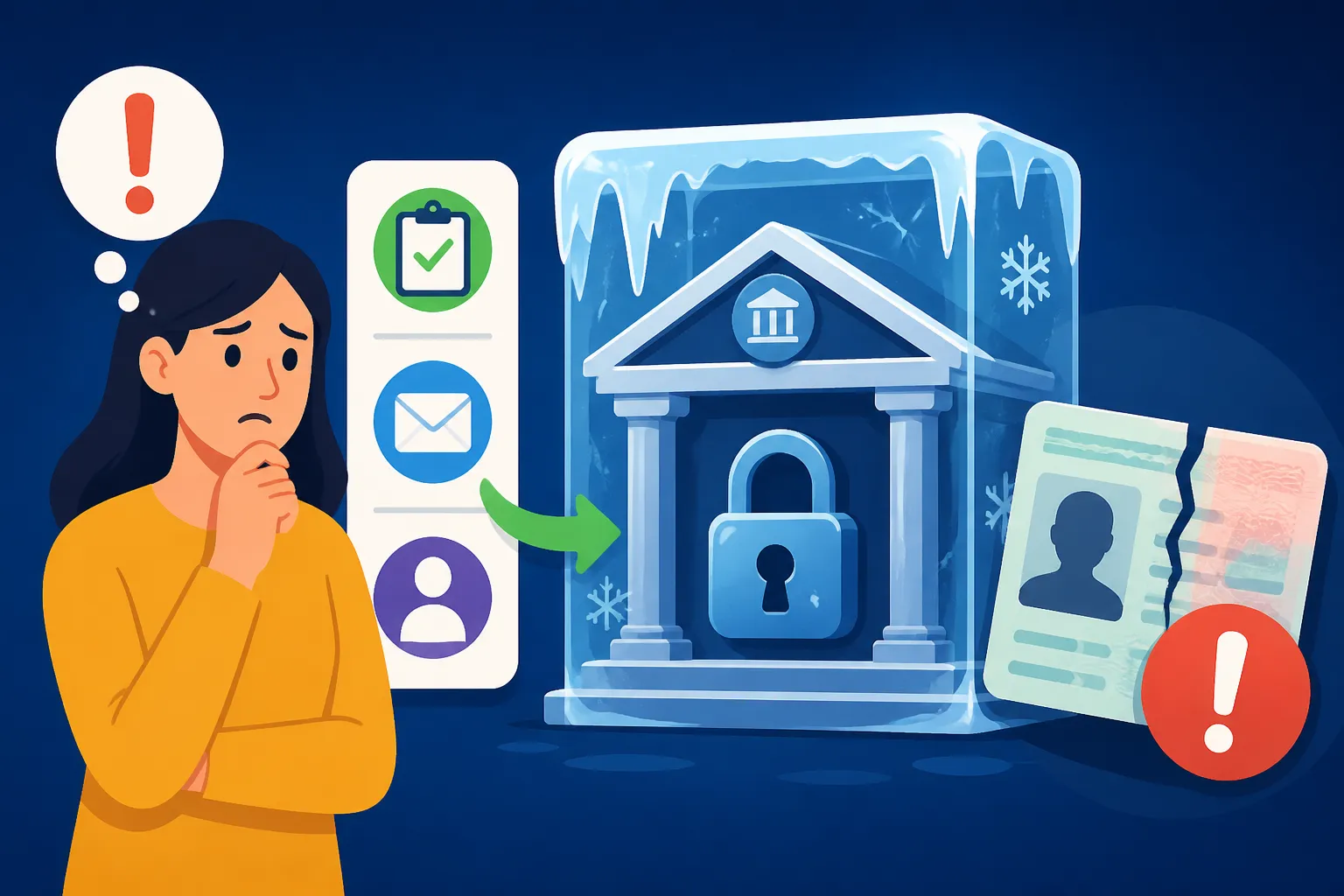
What to do if your bank freezes your account because your residence card expired
Your salary has landed, but your card is declined at Pingo Doce. You open the banking app and see a red banner telling you to update your identification documents. The cause is your residence card, which expired while AIMA still has your renewal. This guide explains why Portuguese banks do this, what to bring to the branch, and how to get your money flowing again.
Why Portuguese Banks Freeze Accounts When Your Residence Card Expires
I remember standing at a Multibanco machine in Arroios, staring at an error message. I had done everything right. I had submitted my renewal on time and kept every confirmation email. My legal right to live here had not changed. My bank’s compliance system did not care. It saw an expiry date in its database, that date had passed, and it restricted my account automatically.
If this is happening to you, you have not done anything wrong. You are caught between an immigration agency that is slow and a banking sector that is strict. Understanding both sides is the first step to fixing it.
The Know Your Customer Obligation Banks Cannot Ignore
Portuguese banks operate under strict anti-money-laundering rules, which Banco de Portugal enforces. One core requirement is that banks keep a valid, current identification document on file for every account holder. For EU citizens that is usually a national ID card or passport. For non-EU residents, banks usually treat the residence card as the key document, because it proves both identity and legal residence.
When that card expires, the bank’s records show an “invalid” document. Most banks run automated checks. You usually get a warning by letter, email, or app notification some weeks before the expiry date. If nothing new is uploaded, the system applies a restriction. The branch staff often did not choose to freeze you. The software did it, and they need specific documents before they can lift it.
The Gap Between Legal Status and Bank Records
This is the frustrating part. For several years the Portuguese government passed decree-laws that kept expired residence documents valid while renewals were pending at AIMA, but those automatic extensions ended on 15 October 2025. An expired card is no longer covered by a general extension, so what matters now is proof that your renewal was submitted and is pending. For a full explanation of where you stand, see My Portugal residence permit expired: Am I considered an illegal immigrant?
Banks, however, run on documents, not on legal nuance. A compliance officer in a Lisbon headquarters wants paperwork that fits a checkbox. If you walk in and say “my renewal is pending,” you may get a sympathetic nod and nothing more. If you walk in with the right papers, the conversation changes. For the wider picture of how the backlog creates these situations, see Dealing with AIMA Backlogs: What to Do If Your Card Expires.
Partial Restriction vs Full Freeze
Not every “frozen” account is frozen in the same way. Before you panic, work out which type of restriction you are facing. It affects how urgent the problem is and what you can still do in the meantime.
| Restriction Type | What You Typically Notice | What Usually Still Works | Urgency |
|---|---|---|---|
| Warning stage | App banner or letter asking for document update | Everything | Low, but act now |
| Debit restriction | Card declined, transfers out blocked | Incoming salary, sometimes direct debits | High |
| Online access restriction | Cannot log in to app or homebanking | Card at ATMs in some cases | Medium to high |
| Full block | No movements in or out | Very little | Urgent |
A debit restriction is the most common version. Money can come in, but you cannot spend it. That is maddening when your rent is due on the eighth, but your funds are safe. Nobody has seized anything. The bank simply needs updated paperwork. For other causes of blocked accounts and how they differ, see What to do if your Portuguese bank account is blocked or frozen unexpectedly.
Step-by-Step: Getting Your Account Unfrozen
This is the part you came for. The process is similar at Millennium bcp, Caixa Geral de Depósitos, Novobanco, and Santander. The details vary slightly between banks, but the pattern is the same.
Gather Your Proof of Pending Renewal
Your goal is to show the bank that your residence status is valid and that the renewal is in progress. The more official the document, the better. Here is what to collect before you go anywhere near a branch.
| Document | What It Proves | Where to Get It |
|---|---|---|
| Valid passport | Your identity | Your own records |
| Expired residence card | Your original residence title | Your wallet |
| AIMA renewal receipt or appointment confirmation | Renewal is pending | AIMA portal or email confirmation |
| Any other AIMA letter or email about your case | Where your renewal stands | AIMA portal or your email inbox |
| Proof of address | Your residence in Portugal | Atestado de residência from your Junta, or a utility bill |
| NIF document | Your tax identity matches bank records | Portal das Finanças |
The AIMA document is the most important item. If you renewed online, download the confirmation or receipt from your portal account. If your renewal is stuck and you are not sure what stage it has reached, see How to Track Your AIMA Residency Application Status to find the right confirmation to print. If you have not started the renewal at all, do that first, because no bank will accept “I am about to apply.” How to Renew Your Portuguese Residence Permit Online via the AIMA Portal walks through the process.
Visit the Branch With the Right Script
Online document upload sometimes works. In my experience, though, an expired card with only a renewal receipt behind it confuses automated systems, so the upload gets rejected. Go to your branch in person, ideally the one where you opened the account, and go early on a weekday morning.
Follow these steps:
- Ask for an “atualização de documentos de identificação” (identity document update) at the front desk. Do not just say “my account is blocked,” because you may be sent to a general queue.
- Hand over your passport first so they can confirm your identity.
- Present the expired card together with the AIMA renewal receipt, and explain that the renewal is pending.
- Show any other AIMA email or letter about your case, such as an appointment confirmation.
- Ask them to record the AIMA receipt as a supporting document and to lift the debit restriction.
- Before you leave, request written confirmation or a reference number for the update.
- Check your app within a day or two. If the restriction is still there, call the branch directly with your reference number.
A useful phrase if you are not confident in Portuguese: “A minha autorização de residência está em renovação na AIMA e tenho aqui o comprovativo do pedido.” It means “My residence permit is being renewed at AIMA and I have the receipt for my application here.” Saying it calmly and politely, with documents in hand, works far better than frustration. Portuguese bureaucracy responds to patience and paper.
When the Branch Says No
Sometimes a branch employee will insist that only a valid physical card will do. Do not give up and do not argue at the counter. Ask whether the decision comes from the branch or from the central compliance department, and request that your documents be forwarded to compliance for review. Refusals are sometimes reversed at that level, where staff have more discretion than the front desk.
If you still get nowhere, file a complaint. Every bank must have a complaints book, and there is an electronic version too. What is the ‘Livro de Reclamações’ and how does it solve consumer disputes? explains how it works. You can also submit a complaint through Banco de Portugal’s Portal do Cliente Bancário. That route tends to get a bank’s attention, because the regulator sees it.
If AIMA is the real bottleneck and your renewal has stalled for an unreasonable time, some residents turn to legal action to force a decision. Using a lawyer for AIMA delays: Does filing a lawsuit (intimação) actually work? covers whether that route makes sense.
Protecting Yourself While the Account Is Restricted
Even when you do everything right, unfreezing can take days or weeks. In the meantime, rent, bills, and insurance premiums still come due. Here is how to limit the damage.
Keep a Backup Account Ready
The single best lesson I learned is never to rely on one Portuguese bank account. A second account with a different provider, ideally an EU-licensed digital bank, gives you a lifeline when your main bank’s compliance system flags you. Digital banks run their own document checks too, so they are not immune. Two institutions are still unlikely to restrict you on the same day.
For a comparison of the options, see Online and Neobanks in Portugal: ActivoBank, Moey!, Revolut, and N26. If you open a backup account, upload your passport as your primary ID where the provider allows it. A passport usually has a longer validity than a residence card, which makes it less likely to trigger the same problem again.
Redirect Salary, Rent, and Direct Debits
If you have a debit restriction, your salary may still arrive, but you cannot reach it. Ask your employer’s HR or payroll team to send your next payment to your backup account. Most employers in Portugal handle this quickly with just a new IBAN. If your employer questions your status because of the expired card, see AIMA appointment delayed: How to prove legal status to Portuguese employers.
Direct debits can fail silently, and a failed debit can lead to late fees or service cuts. Electricity, water, internet, and mobile contracts can usually be switched to a new IBAN through the provider’s app or customer area. The steps for setting up new mandates are covered in Paying utility bills automatically: Setting up SEPA Direct Debits on your bank app.
Your health insurance needs attention too. If you pay an international insurer such as Cigna Global by direct debit or card from the frozen account, a failed payment could put your coverage at risk at the worst possible time. Contact the insurer, explain the situation, and update your payment method before the next premium date. For your landlord, a short, honest message with a manual transfer from your backup account goes a long way. Most Portuguese landlords will accept a few days’ delay if you tell them up front rather than going silent.
Watch for Linked Data Problems
Sometimes an expired card is not the only issue the bank flags. During a document review, the bank may notice that your address or NIF details do not match its records. A common example is a NIF still registered with a foreign address from your early days. Fixing it now prevents a second round of trouble later. Changing your NIF address from a foreign country to your Portuguese address explains how to update it. If you are abroad or would rather not deal with the Finanças portal yourself, Bordr is one service that handles NIF updates and related tax-number administration for foreigners.
The bank may also ask for supporting documents from your home country, such as a foreign tax residency certificate or proof of income. Those often need a certified translation before a Portuguese compliance team will accept them. A certified translation service like RushTranslate can turn these around quickly. For what makes a translation acceptable to Portuguese institutions, see How to Get a Certified Translation for Portuguese Immigration.
Preventing the Next Freeze
Once your account is working again, put a few habits in place so this does not catch you out at the next renewal cycle.
Update Documents Before Expiry, Not After
Set a calendar reminder a couple of months before your card expires. As soon as you have an AIMA renewal receipt, take it to the bank proactively, before the expiry date passes. Banks are far more flexible when you arrive early with documents than when their system has already restricted you. When your new card finally arrives, upload or present it immediately, even if the bank has not asked.
Make Your Passport the Anchor Document
Ask your bank whether it can record your passport as your main identity document, with the residence card as a supporting proof of residence. Not every bank will agree, but some do. Passports usually last longer than residence cards, so this reduces how often expiry checks catch you. Keep your passport renewed well ahead of time as well, because an expired passport on top of an expired card is the combination that leads to full blocks.
Keep a Digital Folder of Proof
I keep one folder on my phone, mirrored in cloud storage, with:
- A scan of my passport
- Both sides of my current and previous residence cards
- Every AIMA confirmation, receipt, and appointment email
- The bank’s written confirmation or reference number from your last document update
- A recent atestado de residência from my Junta de Freguesia
- My NIF certificate from the Finanças portal
When a bank, employer, landlord, or clinic asks for proof, I can send it in under a minute. Living in Portugal as a non-EU resident means you will be asked to prove who you are more often than you would like. Having everything ready turns a panic into a minor errand.
Being locked out of your own money is one of the most stressful parts of expat life here. It stings even more when the delay is entirely on the administration’s side. The fix, though, is nearly always the same: the right papers, presented calmly, at the right desk, with a complaint ready if the first answer is no. You will get through it. Most of us who have lived here a while have done it at least once.
Disclaimer
This article is for general informational purposes only and does not constitute professional advice. Laws, prices and regulations vary by location and change over time. Consult a qualified professional for guidance on your specific situation.