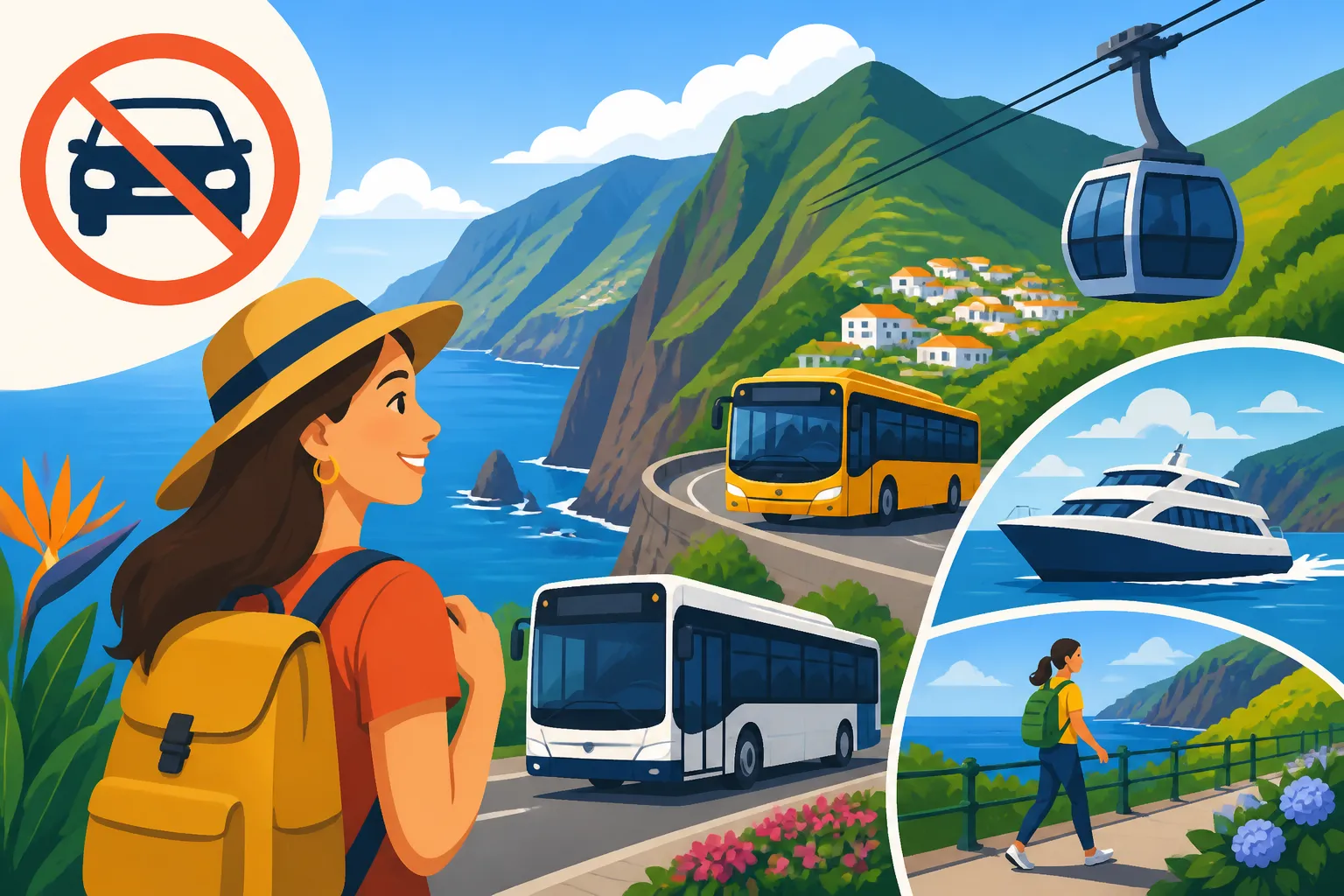
How to Get Around Madeira Without a Car
Disclosure: This article contains affiliate links. If you buy through them, we may earn a commission at no extra cost to you. Read our full disclosure.
The first time I tried to get from Funchal to the trailhead at Pico do Arieiro without a car, I stood at a bus stop on Avenida do Mar for forty minutes. Then I learned that no regular bus goes up there at all. This guide covers how to get around Madeira without a car: buses, cable cars, taxis, tours, ferries and walking, and how to combine them.
Madeira has a reputation as a “you must rent a car” island, and I understand why. The roads twist through tunnels and clinging hairpins, the villages sit far apart, and the best viewpoints are perched on ridges that look unreachable. But plenty of visitors and residents live here, or holiday here, without ever touching a steering wheel. Some don’t drive. Some don’t want to tackle 25% gradients on a manual hire car. Others have watched a rental car scrape a stone wall in Curral das Freiras and decided they’d rather be a passenger.
The truth is somewhere in the middle. You can see most of Madeira without a car, but you have to plan a little more and accept some trade-offs. You might ride a bus that takes two hours to reach somewhere a car would get to in fifty minutes. You might hand the hardest days over to a tour or a taxi. I’ve done it every way possible, and here is what works.
Understanding Madeira’s Public Bus Network
Madeira’s public transport is built around buses. There is no train, no metro and no tram. Several operators split the island between them, which is the first thing that confuses newcomers. The bus that takes you around Funchal is not the same company as the one that takes you to Machico or Porto Moniz, and their timetables, stops and ticketing don’t always line up neatly.
The Yellow City Buses of Funchal
Inside Funchal and its immediate surroundings, the yellow buses of Horários do Funchal do most of the work. They cover the hotel zone along Estrada Monumental and the Lido. They also climb up to Monte and into the hillside neighbourhoods above the city, which are steep enough that walking up them in summer is a genuine test of character. Some routes reach further, toward Câmara de Lobos, Curral das Freiras and even across the island to the north coast.
For regular use, Horários do Funchal offers a rechargeable card called the Giro. You load it with trips or passes and tap on as you board. You can also buy a single ticket from the driver, but that usually costs more per ride than the card, so anyone staying more than a couple of days should pick up a Giro at the company’s ticket kiosk on Avenida do Mar. Check the operator’s own site or kiosk for current ticket types and pass options, because these get revised.
In practice, Funchal has no single grand bus terminal. Most routes depart from stops strung along Avenida do Mar, the seafront road, and from nearby streets in the centre. The stops are signposted with route numbers, but on my first week I still boarded a bus going the wrong direction up the hill, because the same number runs both ways from slightly different stops. Before you board, ask the driver your destination by name. “Vai para Monte?” works perfectly well, and drivers are used to it.
A scenario I see often: a couple staying in the Lido hotel area wants dinner in the Zona Velha, the old town. They don’t need a taxi. A frequent city bus runs along Estrada Monumental into the centre, and from Avenida do Mar it’s a flat ten-minute walk east to Rua de Santa Maria, with its painted doors. Coming back late, the buses thin out, and that’s where a taxi or ride-hailing app earns its keep.
Regional Buses Across the Island
Beyond Funchal, the island is divided among regional operators. SAM generally covers the east, including the airport area, Santa Cruz, Machico and Caniçal. Rodoeste runs much of the west, out to Ribeira Brava, Ponta do Sol, Calheta and around to São Vicente and Porto Moniz. Other routes toward Camacha and the interior uplands have historically been run by Companhia dos Carros de São Gonçalo. These arrangements and route numbers get reorganised from time to time, so always check the current timetable with the operator itself, either at the kiosks near Avenida do Mar or on their published schedules.
The regional buses are reliable, cheap by any standard, and filled with locals heading to work, school and the market. They are also slow. A bus to the north coast might wind through every village in between, stopping at tiny shelters on hairpin bends. I’ve taken the long route to Porto Moniz. It eats most of the day, so build that in. Treat it as a scenic ride, because the views over the cliffs of the west coast are honestly part of the attraction.
Frequency is the real catch. Some rural routes run only a handful of times per day, with reduced service on weekends and public holidays. If you miss the last bus back from São Vicente, your options shrink to a taxi or a very long wait. My rule: before you leave Funchal, find out what time the last return departure leaves from your destination, and plan to catch the one before it.
Getting From Madeira Airport to Funchal
Madeira’s airport, near Santa Cruz on the east coast, sits about half an hour’s drive from central Funchal. That’s a short hop, but plenty of people get stuck here on arrival, tired, holding a suitcase and staring at the taxi queue.
You have three car-free options. First, SAM’s regular buses connect the airport area with Funchal. Second, an airport shuttle service has operated between the terminal and the Funchal hotel zone, with luggage space, making stops along the main hotel strip. Confirm current departures before you fly, because airport shuttle schedules often follow flight patterns. Third, the official taxi rank outside arrivals, where taxis to Funchal typically work on set fares by destination zone rather than a surprise meter total.
If you are still choosing how to get to the island in the first place, I’d point you to Domestic Flights and Ferries to Portugal’s Islands. The short version is that flying is the standard way in. Most people coming from the mainland fly Lisbon or Porto to Funchal, and a search platform like Omio is useful for comparing flight times side by side so you can pick an arrival in daylight. That matters more than people think. Landing at midday means buses are running and you have energy to work out the ticket kiosk. Landing at midnight means a taxi, full stop.
Cable Cars, Taxis, Ride-Hailing and Tours
The buses are the backbone, but they won’t get you everywhere. Madeira fills the gaps with a mix of cable cars, cheap and plentiful taxis, ride-hailing in the Funchal area, and a huge range of organised tours. Learning when to switch between them is what makes a car-free trip feel easy rather than exhausting.
Funchal’s Cable Cars and the Monte Toboggans
The Teleférico do Funchal runs from the seafront in the Zona Velha up to Monte, rising over the rooftops and terraced gardens in a long, gentle ride. It’s one of the most practical car-free experiences on the island, not just a tourist novelty, because it replaces a brutal uphill climb. From Monte, a second cable car links across the valley to the Jardim Botânico, the botanical garden, so you can make a loop without ever going back down to sea level.
Once you’re in Monte, you can come down the traditional way, in a wicker toboggan steered by two men in white called carreiros, wearing straw boater hats and rubber-soled boots. The ride covers part of the descent toward Livramento. It doesn’t drop you back in the centre, so you’ll need a bus, a taxi, or a downhill walk to finish the trip. Plenty of first-timers don’t realise this and end up halfway down a hill with no plan, so know your next step before you climb in.
Outside Funchal, there are smaller cable cars that exist purely because the land is too steep for anything else. The Teleférico do Garajau drops to a pebble beach beneath the cliffs east of Funchal. On the north-west coast, a cable car at Achadas da Cruz, near Porto Moniz, descends to farmed terraces at sea level, and the lift at Fajã dos Padres near Quinta Grande lowers visitors to a tiny coastal strip of vines and a restaurant. Check opening days before you set off, because some of these run on limited or seasonal schedules, and reaching the top station without a car usually means a bus plus a walk, or a taxi.
Taxis and Ride-Hailing Apps
Madeira’s taxis are yellow with a blue stripe, and in Funchal they’re easy to find at ranks near the marina, the cathedral, the Mercado dos Lavradores and the main hotel areas. For a car-free visitor, taxis are not a luxury. They are a normal tool. A short taxi hop across Funchal, or up to a viewpoint the bus doesn’t reach, often costs less than you’d expect, and splitting it between two or three people makes it even more reasonable.
Many taxi drivers also offer half-day and full-day island tours at set prices. These are often displayed on a card at the rank or in the car. This is an underused option. Instead of a big coach tour with forty strangers, you get a private driver who knows every miradouro, lets you stop where you want, and will happily recommend a poncha bar in Serra de Água. Agree on the price, the route and the duration before you set off, and you’ll avoid any misunderstandings.
Ride-hailing apps operate in Madeira, mainly around Funchal and the busier coastal towns. They’re handy for late evenings and for getting back from restaurants in Câmara de Lobos when buses have stopped. Out in the rural north and west, coverage drops sharply, so don’t count on summoning a ride from the Rabaçal car park at dusk. For a detailed look at how the two main apps compare on the mainland and islands, see Using Bolt vs Uber in Portugal: Which ride-hailing app is cheaper? To make apps and bus timetables work at all, you need reliable data, and Mobile Data and eSIMs for Travel in Portugal covers how to stay connected from the moment you land.
If your Portuguese is shaky, a few phrases go a long way with drivers, especially in rural areas where English is less common. “Pode levar-me a…” (place name) means “Can you take me to…” “Quanto custa até…” (place name) asks how much it costs to get there. “Pode parar aqui, por favor” means “Can you stop here, please”. How to Ask for Directions in Portuguese (Simple Phrases) has many more of these, and they work just as well in the back of a taxi as on the street.
Organised Tours and Hiking Transfers
Here’s the honest truth that took me a while to accept. For a few of Madeira’s headline experiences, an organised tour or transfer is simply the best car-free option. Sunrise at Pico do Arieiro is the classic example. There is no regular public bus to the summit. The road climbs to over 1,800 metres, and for sunrise you’d need to be there before the first bus of the day even leaves Funchal.
Tour operators fill exactly this gap. Many offer sunrise trips to Arieiro, jeep tours through the interior, and one-way hiking transfers. A transfer drops you at the start of a linear trail like PR1 from Arieiro to Pico Ruivo and picks you up at the other end, which is something even people with rental cars struggle to arrange. Booking platforms such as GetYourGuide make it easy to compare these options, read recent reviews, and see what pickup points are included. That last detail matters if you’re staying outside the main hotel zone.
Not all tours suit everyone. Big coach tours do a whirlwind loop of the island, with fixed stops at Cabo Girão, Porto Moniz and Santana. They’re efficient if you have only a few days, but you’ll spend a lot of time in a seat. Small-group jeep or minibus tours go further off-road and stop more flexibly. Private taxi tours cost more per person unless you’re a group, but give you full control. It often works well to mix them: one full-day island tour to get your bearings, then buses and short taxi hops for everything else.
Reaching Madeira’s Best Hikes and Viewpoints Without a Car
This is where most car-free travellers worry, because hiking is the main reason many people come to Madeira. The good news is that a surprising number of the famous trails and viewpoints can be reached by bus, at least partly. The bad news is that the most famous one, the Arieiro summit, can’t. Here’s how the main destinations work in practice.
Levada Walks You Can Reach by Bus
Some levada walks start close enough to a bus route that you can get to them without any special arrangements. Around Funchal, several levadas run along the hillsides above the city and can be joined from city bus stops in neighbourhoods like Monte and the areas leading toward Camacha. The Levada dos Tornos, for instance, can be walked in sections from stops in the hills above Funchal.
The eastern tip of the island, Ponta de São Lourenço, is one of the easiest major hikes to reach car-free. SAM’s buses run east toward Caniçal, and some departures continue to the car park at Baía d’Abra where the PR8 trail begins. The landscape is completely different from the green interior: dry, wind-blasted, red and ochre cliffs falling into a very blue Atlantic. Go early, because there’s almost no shade on the trail, and confirm the return times before you start walking.
The Levada do Caldeirão Verde starts at Queimadas, above Santana on the north coast. Buses reach Santana from Funchal, but the trailhead is a climb above the village, so most car-free hikers either take a taxi from Santana for the last stretch or join a guided walk with transport. For full trail detail, difficulty ratings and what to pack, How to Hike the Levadas of Madeira goes much deeper than I can here.
Pico do Arieiro, Pico Ruivo and the High Interior
As I mentioned at the start, Pico do Arieiro has no regular bus. Your realistic choices are a taxi, a tour or a hiking transfer. The PR1 from Arieiro to Pico Ruivo is a linear walk, so a one-way transfer works especially well. Many hikers are dropped at Arieiro, walk the stone stairways and tunnels to Ruivo, then descend to Achada do Teixeira, where a pre-arranged driver collects them.
Pico Ruivo can also be approached from Achada do Teixeira on its own, a shorter and gentler route to the island’s highest point, but again there’s no public bus to the car park. A taxi from Santana is the usual car-free solution. If you’re doing this, take your driver’s phone number and agree on a pickup time, as mobile signal can be patchy in the mountains.
The Paul da Serra plateau and Rabaçal, home to the famous PR6 Twenty-Five Fountains walk and the Risco waterfall, are similarly out of reach by regular bus. When the trails are open, a shuttle bus has operated between the Rabaçal car park on the main road and the start of the levada path, which saves you a dull walk down a tarmac road. But you still need to reach that main-road car park, which means a tour or a taxi. Weather up here changes fast, and trails occasionally close after storms or rockfalls, so check the official trail status on the regional government’s notices before you go.
Coastal Viewpoints, Villages and the Natural Pools
Many of Madeira’s most photographed places are coastal and connected by bus. Câmara de Lobos, the fishing village where Churchill painted, is reachable by bus from Funchal, and also on foot along the seafront promenade from the Lido and Praia Formosa. That walk is one of my favourite low-effort outings. The Cabo Girão skywalk, a glass platform on one of Europe’s highest sea cliffs, sits along the western routes and can be reached by bus, with a short walk from the stop.
Porto Moniz, with its natural lava rock swimming pools, is on Rodoeste’s routes, but it’s a long journey from Funchal, and departures are limited. Doing Porto Moniz by bus is entirely possible, but it is a full-day commitment, and you’ll have only a few hours there before the return journey. Plenty of visitors decide that Porto Moniz, along with Seixal and São Vicente, is better covered on a single island tour.
On the north-east coast, Santana’s triangular thatched houses are reachable by bus, as is Machico in the east, with its sheltered bay and its golden-sand beach shipped in from Morocco. The Miradouro do Guindaste near Faial and the Ponta do Rosto viewpoint, both near the coast, are trickier. They’re often easier as stops on a taxi tour.
To help you decide quickly, here’s how I’d rank the main options:
| Destination | Public bus access | Best car-free option | Notes |
|---|---|---|---|
| Funchal centre, Lido, Zona Velha | Excellent, frequent city buses | City bus or walking | Giro card makes regular trips cheaper |
| Monte and Botanical Garden | Good | Cable car up, toboggan or bus down | Toboggan ends partway, plan onward travel |
| Câmara de Lobos | Good | Bus or seafront walk from the Lido | Easy half-day trip |
| Cabo Girão skywalk | Moderate | Western regional bus plus short walk | Check return times |
| Ponta de São Lourenço PR8 | Moderate | SAM bus toward Caniçal | Little shade, start early |
| Santana and Caldeirão Verde | Moderate for Santana, poor for trailhead | Bus to Santana, taxi to Queimadas | Agree pickup with taxi |
| Porto Moniz natural pools | Limited, long journey | Island tour or full-day bus trip | Few departures, full-day commitment |
| Pico do Arieiro and PR1 | None | Tour, taxi or hiking transfer | Essential for sunrise visits |
| Rabaçal and Twenty-Five Fountains | None to main car park | Tour or taxi, then local shuttle | Check trail status first |
| Porto Santo island | Not applicable | Ferry or short flight from Funchal | Compact island, buses and bikes |
Planning a Car-Free Madeira Trip Step by Step
Knowing that a bus exists is one thing. Building a trip around it is another. These are the habits that made car-free life on Madeira painless for residents and visitors alike.
Choosing Where to Stay
Your accommodation choice matters more than anything else. If you stay in central Funchal or in the Lido hotel zone, you’ll be within walking distance of frequent city buses, most taxi ranks, the cable car, restaurants and the departure points for regional routes and tours. Staying in a charming quinta high above the city, or in a remote cottage on the north coast, can be wonderful. But without a car, you’ll rely on taxis for almost every move.
When I help friends pick accommodation, I tell them to check the map before they look at the photos. On Booking.com, for example, you can view properties on a map and check how far each one is from Avenida do Mar or the main bus corridor along Estrada Monumental. Also pay attention to gradient. A place that’s “800 metres from the centre” might be 800 metres straight uphill, and Funchal’s hills are steep enough to make that a daily ordeal with shopping bags.
If you want a quieter base, Câmara de Lobos, Machico and Ponta do Sol all have regular bus links to Funchal and their own local life. They’re good compromises. Ponta do Sol, on the sunny south-west coast, has become popular with remote workers. If you’re thinking of a longer stay, Madeira and Azores: Island Living, Costs, and Expat Communities looks at what day-to-day life is like for residents.
A Sample Car-Free Itinerary
Here’s a realistic five-day plan that has worked for many first-time visitors who don’t want to drive:
- Day one: arrive at the airport, take the shuttle or bus into Funchal, buy a Giro card at the kiosk on Avenida do Mar, and spend the afternoon walking the Zona Velha and the Mercado dos Lavradores.
- Day two: take the cable car from the old town up to Monte, visit the Monte Palace gardens, ride the second cable car to the Botanical Garden and back, then come down from Monte by toboggan and finish by bus in the afternoon.
- Day three: book a sunrise trip to Pico do Arieiro with a hiking transfer, walk PR1 to Pico Ruivo, and get collected at Achada do Teixeira. You’ll be back in Funchal by the afternoon to rest your legs.
- Day four: take SAM’s bus east toward Caniçal for the Ponta de São Lourenço hike, returning in the afternoon, with an evening walk along the seafront.
- Day five: join a full-day island tour covering Cabo Girão, Porto Moniz, Seixal and São Vicente, or take the morning bus to Câmara de Lobos and walk back to Funchal along the coast for a slower day.
If you have more time, add a day trip or overnight to Porto Santo. The ferry from Funchal’s harbour, operated by Porto Santo Line, takes a couple of hours, and short flights also connect the two islands. Porto Santo is small and flat, with a long golden beach. Its local buses, taxis and bicycles cover nearly everything, which makes it one of the easiest places in Portugal to enjoy car-free. For deciding how many days to give each part of the island, How Many Days Do You Need in Madeira? is a useful companion, and How to Plan a First Trip to Madeira covers the bigger picture, including seasons and packing.
Practical Tips for Buses, Payments and Timing
Some small details make a big difference on the ground:
- Check timetables the night before, especially for weekends and public holidays, when many regional routes run reduced services.
- Carry some coins and small notes. Many rural cafés and some drivers selling single tickets prefer cash, even though cards are widely accepted in Funchal.
- Board early at the first stop for long routes, because north and west coast buses can fill up with school children and workers at peak times.
- Sit on the sea side of the bus when heading west from Funchal for the cliff views, and expect a lot of curves if you’re prone to motion sickness.
- Always confirm the last return departure from your destination before you set off, and aim for the one before it.
- Save a taxi company’s phone number in your phone for emergencies in rural areas where ride-hailing apps don’t reach.
On payments more broadly, Cash vs Card in Portugal and Using Multibanco explains when you’ll want cash and how to avoid unnecessary ATM charges, which is handy when you’re topping up a bus card or paying a rural taxi.
Timing also affects how easy car-free travel feels. In the busy summer months and over the famous New Year’s Eve fireworks period, buses and taxis in Funchal get much busier and tours sell out early. If you’re coming for the fireworks, How to Spend New Year’s Eve in Lisbon or Madeira has practical advice on where to watch and how to get home through the crowds. In the quieter months, everything is calmer, but some seasonal cable cars and services may run reduced hours, so double-check before you rely on them.
Finally, accept that mountain weather will occasionally overrule your plans. A day that’s sunny in Funchal can be wrapped in cloud at Arieiro or drenched on the north coast. Without a car, you can’t simply drive to the other side of the island to chase the sun, so leave a flexible day in your schedule. Many tours and transfers offer rescheduling if the weather is bad. Read the cancellation terms when you book, and keep one easy Funchal-based day in reserve to swap in.
Disclaimer
This article is for general informational purposes only and does not constitute professional advice. Laws, prices and regulations vary by location and change over time. Consult a qualified professional for guidance on your specific situation.