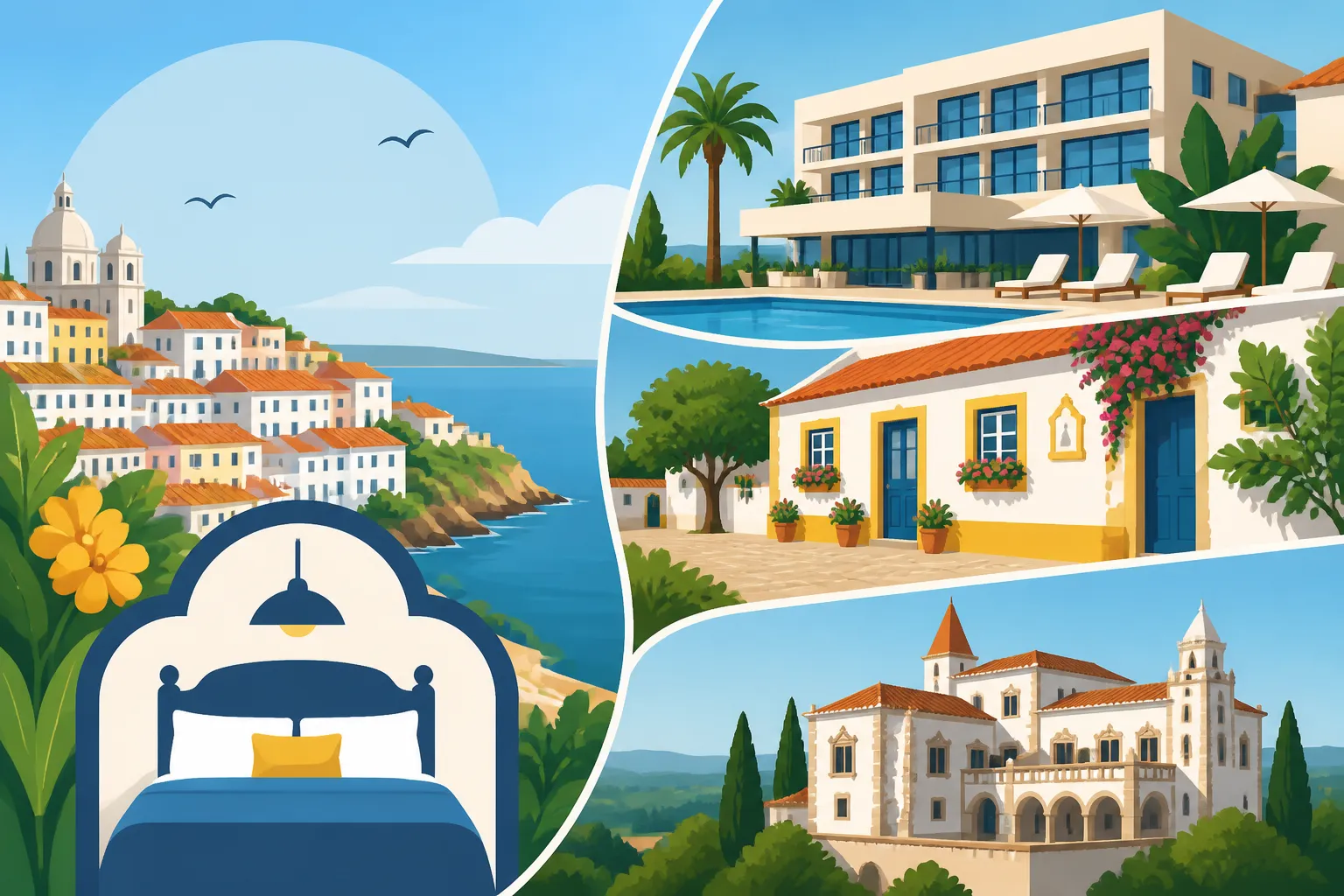
Accommodation in Portugal: Hotels, Guesthouses, and Pousadas
Disclosure: This article contains affiliate links. If you buy through them, we may earn a commission at no extra cost to you. Read our full disclosure.
Picture yourself dragging a suitcase up a cobbled Alfama lane at 11 PM, only to find the “charming guesthouse” you booked is a fourth-floor walk-up with no reception and a key box you can’t open. Portugal has wonderful places to stay, but the categories, licensing terms and local habits confuse visitors. This guide explains hotels, guesthouses, pousadas and everything in between so you can book well.
Understanding Portugal’s Accommodation Categories
When I first started travelling around Portugal, before I moved here permanently, I assumed the words on booking sites were interchangeable. A “residencial” sounded like a hotel. An “AL” sounded like an abbreviation for something I should already know. A “quinta” sounded like a winery, and sometimes it is, but sometimes it is a farmhouse with three rooms and a dog that adopts you for the weekend. Portugal regulates its tourist accommodation through a national framework run by Turismo de Portugal, and once you understand the main categories, the whole market makes far more sense.
The broad split is between “empreendimentos turísticos”, which covers hotels, aparthotels, pousadas, tourist villages and rural tourism properties, and “Alojamento Local”, the licensed short-term rental category that covers guesthouses, hostels, apartments and rooms in private homes. That legal distinction matters more than you’d think, because it shapes what services you can expect, whether anyone will be at a front desk, and how disputes are handled.
Hotels and the Star Rating System
Portuguese hotels are classified from one to five stars, and the ratings are tied to official criteria covering things like room size, reception hours, bathroom standards and on-site services. In practice, a four-star hotel in Lisbon and a four-star hotel in a small Alentejo town will both meet the same baseline, but they can feel completely different. The Lisbon property might be a sleek renovated building on Avenida da Liberdade with a rooftop bar, while the Alentejo one might be a family-run place with enormous rooms, a pool, and a breakfast of local cheese and bread that puts any city buffet to shame.
Here’s something I learned the hard way: stars measure facilities, not character or location. A three-star hotel in Porto’s Baixa, a short walk from São Bento station, can be a far better base than a five-star hotel on the outskirts that requires a taxi every time you want dinner. Three-star properties in Portugal are often perfectly comfortable, clean and well run, especially the older family hotels that have been modernised room by room over the decades. Don’t dismiss them.
At the top end, Portugal has a strong luxury scene. Lisbon and Porto have international chains alongside independent boutique hotels that occupy restored palaces and merchant houses. The Algarve has large resort hotels around Vilamoura, Albufeira and the Lagoa coastline, many with spas and golf access. If you want full service, meaning a 24-hour reception, room service, a concierge who will book restaurants and arrange transfers, and a proper bar, four and five-star hotels are where you’ll find it.
Aparthotels deserve a quick mention. These are hotels in which every unit has a kitchenette, and they are especially common in the Algarve and Madeira. They work brilliantly for families and longer stays because you get hotel services like cleaning and reception while being able to cook your own breakfast and store snacks in a proper fridge.
Guesthouses, Pensões and Alojamento Local
This is where things get interesting, and where most of the confusion lives. Older Portuguese terms like “pensão”, “residencial” and “hospedaria” referred to simpler lodgings, often family-run, sometimes with shared bathrooms, usually with a breakfast room and a front desk staffed by someone’s aunt. Many of these old-school places still exist and still use those names on their signs, even though the legal categories have been reorganised. Some are wonderfully atmospheric, with tiled stairwells and creaky wooden floors. Others are tired and overdue for renovation. Reviews and recent photos are your friends here.
Alojamento Local, usually shortened to AL, is the licensing category for short-term rentals. Every legal AL property must be registered and has a registration number, which hosts are supposed to display in their listings and at the property. Within AL there are a few types: entire apartments, entire houses or “moradias”, “estabelecimentos de hospedagem” which are essentially guesthouses with multiple rooms, and hostels. A guesthouse operating under AL might have a small reception for a few hours a day, or it might have none at all, relying on self check-in with a key code.
That self check-in model is the source of many late-night panics. The host had sent instructions by message, but the message went to an email address they hadn’t checked since leaving home. Always confirm check-in arrangements before you travel, and save the host’s phone number somewhere you can reach it offline.
Hostels in Portugal, particularly in Lisbon and Porto, are genuinely excellent and have won international awards over the years. Many offer private double rooms alongside dorms, so they aren’t just for backpackers in their twenties. If you’re travelling solo and want social contact, family-style dinners and walking tours organised by staff, a well-reviewed Lisbon hostel can be more fun than any hotel.
Manor Houses, Quintas and Rural Tourism
This is the category that most visitors never discover, and it is one of the best reasons to venture beyond the cities. “Turismo de Habitação” refers to stays in historic manor houses, solares and palaces, usually still owned by the families who have lived there for generations. You sleep in a room with antique furniture, often eat breakfast at a long table with the hosts, and get a glimpse of Portuguese aristocratic and rural life that no hotel can offer. These are concentrated in the north, especially the Minho region around Ponte de Lima, which pioneered the concept.
“Turismo no Espaço Rural” is the broader rural tourism umbrella. It includes “Casas de Campo”, which are country houses in villages or countryside, and “Agroturismo”, where the property is part of a working farm. In agroturismo stays, you might wake up to the sound of goats, help with a grape harvest in September, or buy olive oil pressed from the trees outside your window. The Alentejo also has “herdades”, large estates that sometimes operate as luxury rural hotels with vineyards, cork oak forests and horseback riding.
A word of realism: rural stays usually require a car. Bus connections to remote quintas range from infrequent to nonexistent, and taxis can be hard to summon in villages. Breakfast is usually included, but dinner may only be available if you arrange it ahead, and the nearest restaurant might close at 10 PM or not open at all on Mondays. When booking, it is worth asking hosts about dinner options, as some offer a home-cooked meal such as açorda or migas.
To pull these categories together, here’s how they compare:
| Category | Typical Setting | Front Desk | Breakfast | Best For |
|---|---|---|---|---|
| Hotel, 3 stars | City centres and towns | Usually extended hours | Often included | Practical travellers wanting reliability |
| Hotel, 4 to 5 stars | Cities, Algarve resorts, restored palaces | 24 hours | Usually included or optional | Full service and comfort |
| Aparthotel | Algarve, Madeira, larger cities | Usually staffed | Optional | Families and longer stays |
| Guesthouse under AL | Historic city neighbourhoods | Limited hours or self check-in | Sometimes | Character on a moderate budget |
| AL apartment | Everywhere, especially Lisbon and Porto | None, host meets you or key box | Rarely | Independence and self-catering |
| Hostel | Lisbon, Porto, Lagos, Coimbra | Usually 24 hours | Often available | Solo travellers and social stays |
| Pousada | Castles, convents, monasteries, palaces | 24 hours | Usually included | History and atmosphere |
| Turismo de Habitação | Manor houses, mostly in the north | Host on site | Included, often shared table | Cultural immersion |
| Agroturismo and Casas de Campo | Farms and villages | Host on site | Usually included | Rural slow travel |
Pousadas of Portugal: Sleeping Inside History
If there is one accommodation experience I push every visitor to try at least once, it is a night in a pousada. I still remember my first one: the Pousada Convento de Évora, inside a fifteenth-century convent right beside the Roman Temple. My room had been a monk’s cell, with thick stone walls that kept it cool in the July heat, and breakfast was served in a cloister where swallows darted between the arches. It felt less like a hotel and more like being trusted with a piece of the country’s history for a night.
What a Pousada Actually Is
Pousadas de Portugal is a network of historic hotels that began as a state initiative in the mid-twentieth century. The original idea was to create comfortable lodgings in regions with few hotels, inspired partly by Spain’s paradores. Over time the network shifted towards restoring significant historic buildings, including castles, monasteries, convents and palaces, and converting them into hotels. Today the network is operated by the Pestana hotel group under the Pestana Pousadas brand, while many of the buildings remain part of the national heritage.
Not every pousada is in a monument. The network has a few broad styles: “Historic” pousadas in landmark buildings, “Historic Design” pousadas that pair old structures with contemporary architecture, “Nature” pousadas in scenic settings like mountains or coastlines, and “Charm” pousadas in smaller, characterful buildings. A nature pousada might be a modern building with spectacular views rather than a medieval fortress, so read the description if the castle-stay fantasy is what you’re after.
What ties them together is a particular style of service. Pousadas typically have restaurants focused on regional cooking, so in the Alentejo you’ll find dishes like porco preto and sopa de cação, while in the Minho you might be offered bacalhau or roasted kid. Staff tend to be knowledgeable about the local area, and the pace is slower and more formal than a city hotel. They suit travellers who want to linger, not those who want a crash pad.
Standout Pousadas by Region
Every pousada has its fans, but some are particularly memorable for first-time visitors because of their setting, their history or their position along popular routes. Here’s a regional overview to help with planning:
| Pousada | Region | Building Type | Why It Stands Out |
|---|---|---|---|
| Pousada de Lisboa | Lisbon | Former government building on Praça do Comércio | Central location by the river, steps from Baixa |
| Pousada do Porto, Palácio do Freixo | Porto | Baroque riverside palace | Grand interiors on the Douro, east of the centre |
| Pousada Palácio de Queluz | Greater Lisbon | Royal palace complex | Easy base for Sintra without staying in Sintra |
| Pousada Castelo de Óbidos | Silver Coast | Medieval castle | Sleep inside the walls of a fortified village |
| Pousada Convento de Évora | Alentejo | Fifteenth-century convent | Beside the Roman Temple in a UNESCO city |
| Pousada Castelo de Estremoz | Alentejo | Royal castle | Linked to Queen Saint Isabel, sweeping plains views |
| Pousada Mosteiro do Crato | Alentejo | Fortified monastery | Remote, atmospheric, near the Spanish border |
| Pousada Mosteiro de Amares | Minho | Cistercian monastery | Gateway to Peneda-Gerês National Park |
| Pousada Mosteiro de Guimarães | Minho | Augustinian monastery | Hilltop views over the birthplace of Portugal |
| Pousada de Viana do Castelo | Minho | Hilltop hotel near Santa Luzia | Ocean and river views over the Lima estuary |
| Pousada Serra da Estrela | Central Portugal | Former sanatorium | Mountain setting, good for winter and hiking |
| Pousada Palácio de Estoi | Algarve | Nineteenth-century palace | Ornate gardens near Faro, away from beach crowds |
| Pousada Convento de Tavira | Algarve | Former convent | Historic centre of one of the prettiest Algarve towns |
The Alentejo pousadas in particular reward a road trip. You can string together Évora, Estremoz, Arraiolos and Crato over a few nights, driving through cork oak landscapes and stopping at hilltop towns along the way. For route ideas and what to see between stops, see The Alentejo: Plains, Wine, and Hilltop Towns.
Is a Pousada Worth It for Your Trip?
Here’s the honest answer: it depends on how you travel. Pousadas generally sit at the upper end of the price range, and some, especially those in castles, have only a small number of rooms, which means they book out early around holidays and summer weekends. Because the buildings are historic, room sizes and layouts vary enormously. One room might have a vaulted ceiling and a window overlooking a cloister, while another down the corridor is smaller with a view of the car park. When booking, it’s worth asking about room types or paying a little extra for a room with a view, because in a pousada the setting is half of what you’re paying for.
Historic buildings also come with practical quirks. Lifts may be limited or absent in certain wings. Stone walls can block mobile signal and Wi-Fi. Monastery corridors can be long, and some pousadas sit outside town centres, requiring a car or a taxi.
My advice is to treat a pousada as a highlight rather than your default. Spend one or two nights in one as the centrepiece of a regional trip, and balance it with simpler guesthouses or hotels elsewhere. If you’re weighing this decision for a specific itinerary, see How to Choose Between a Hotel and a Pousada in Portugal. The Pestana group runs its own loyalty and direct-booking offers, so it’s worth comparing the pousada website with booking platforms before committing.
Where to Stay: A Regional Strategy
The same type of accommodation works very differently depending on where you are. A self-catering apartment is perfect in an Algarve beach town and a liability on a steep Lisbon hill with no lift. A hotel near the train station is ideal in Porto and pointless on a rural Douro estate. Location choices derail more trips than bad rooms do, so let’s go region by region.
Lisbon and Porto: Neighbourhood Matters More Than Stars
Lisbon is built on hills, and that single fact should shape your booking. The postcard neighbourhoods of Alfama, Mouraria and Graça are steep, cobbled and full of stairs. Taxis and ride-hailing cars often can’t reach the door, and the cobbles, called “calçada portuguesa”, become slippery after rain. If you’re travelling with heavy luggage, young children or anyone with mobility issues, a base in Baixa, Chiado, or along Avenida da Liberdade will make life far easier. These areas are flatter, well connected by metro, and still within walking distance of the major sights.
Noise is the other Lisbon variable. Bairro Alto and Cais do Sodré are the nightlife hubs, and on weekends the street parties can continue well past 2 AM. Staying there is fun if you plan to join in and miserable if you want to be asleep by 11. In June, the Santos Populares festivals take over the old neighbourhoods, with the biggest night being Santo António on the eve of 13 June, when Alfama turns into one enormous street party with grilled sardines and music until dawn. Príncipe Real, Campo de Ourique and Estrela are calmer residential alternatives with good restaurants. For a full breakdown of the city’s districts, see What’s the Best Neighborhood to Stay in Lisbon? and for a broader introduction to the city, Lisbon for First-Time Visitors: Neighborhoods and Highlights.
Porto has its own hill problem, especially around Ribeira, the riverside district that tumbles down to the Douro. Ribeira is stunning, but many guesthouses there are in narrow townhouses with steep staircases and no lift. Baixa, around Avenida dos Aliados and Rua de Santa Catarina, offers a central and slightly flatter base close to São Bento station and the metro. Cedofeita and Bonfim are good for a more local feel, while Foz do Douro, out by the ocean, suits travellers who prefer seaside walks over city bustle. Staying across the river in Vila Nova de Gaia puts you beside the Port wine lodges and gives you the famous view of Porto rather than a view from it. Porto’s biggest party night is São João, on the night of 23 to 24 June, when the whole city takes to the streets until sunrise, so expect noise and high demand that week. For a deeper look, see What’s the Best Neighborhood to Stay in Porto?.
One more city tip: in both Lisbon and Porto, many guesthouses and apartments occupy historic buildings with tiny lifts or none at all. A listing that says “third floor” in Portugal may mean the fourth level from the street, because the ground floor is “rés-do-chão” and numbering starts above it. Ask directly whether there’s a lift and whether it fits a suitcase.
The Algarve and the Coast: Resort, Town or Village?
The Algarve splits into distinct zones, and your accommodation choice should match the experience you want. The central Algarve, including Albufeira, Vilamoura and the stretch around Armação de Pêra, is the heartland of big resort hotels, aparthotels and holiday complexes. These are practical for families who want pools, kids’ clubs and beach access in one place. The western Algarve, around Lagos and Sagres, has a younger, more outdoorsy feel, with surf schools, cliff walks and plenty of guesthouses and hostels. The eastern Algarve, including Tavira and the towns towards the Spanish border, is quieter and more traditional, with sandbar island beaches reached by ferry.
Many Algarve visitors also consider holiday villas, especially for larger groups or multi-generational families. A villa with a private pool in the hills behind Loulé or near Carvoeiro can be a superb base for a week, offering space and privacy that no hotel matches, but it almost always requires a rental car and means you’ll be self-catering most of the time.
Seasonality hits the Algarve harder than anywhere else in Portugal. In winter, many beach restaurants and some hotels close entirely, and certain resort towns feel almost deserted. That’s wonderful if you want long empty beaches and golf, but disappointing if you expected summer energy. Conversely, in August the region fills with Portuguese families on holiday, along with visitors from the rest of Europe, and minimum-stay requirements of several nights become common. For coastal regions beyond the Algarve, such as the Silver Coast towns of Nazaré, Peniche and Ericeira, surf camps and guesthouses dominate, and many cater to longer stays.
The Interior: Alentejo, Douro and Central Portugal
The interior is where Portugal’s accommodation becomes genuinely special, and where the rural tourism categories really shine. In the Alentejo, you can stay in a whitewashed townhouse inside the walls of Monsaraz, a herdade surrounded by vineyards near Reguengos de Monsaraz, or a converted convent in Évora. Summers here are seriously hot, regularly far hotter than the coast, so air conditioning and a pool move from luxury to near-necessity between June and September. Winters are cool and quiet, and a fireplace in your room is a gift.
The Douro Valley is wine country, and many of its quintas, the wine estates that terrace the river slopes, offer rooms. Some are luxurious, others are simple family operations where the owner will pour you a glass of their own tawny after dinner. Staying in the valley rather than visiting on a day trip from Porto lets you see the terraces at sunrise and sunset, which is when they’re most beautiful. Harvest season in late September is spectacular but busy. Plan routes and tastings with Douro Valley Wine Tours and Quintas, and if you’d rather not drive the winding valley roads after tastings, GetYourGuide lists guided Douro day tours that handle transport, which can be combined with a night or two at a quinta.
Central Portugal, including Coimbra, Tomar, the Serra da Estrela mountains and the schist villages, offers a mix of city hotels and mountain lodges. Coimbra has good-value hotels and guesthouses near the university and the old town. The Serra da Estrela has mountain hotels and the pousada at Penhas da Saúde, and it’s one of the few places in Portugal where you might see snow in winter. Many of the region’s smaller villages have Casas de Campo run by local families, which are ideal bases for hiking.
Getting between these regions without a car is very doable for the main cities. The Alfa Pendular and Intercidades trains link Lisbon, Coimbra and Porto, and regional services reach the Douro line. For trains and buses on a single search, Omio compares routes and times across CP and long-distance coach operators, which helps when you’re working out whether a particular guesthouse is reachable by public transport. For more on the rail network, see Trains in Portugal: CP Routes, Alfa Pendular, and Booking.
Booking Smart: Timing, Platforms and Budget
I’ve booked accommodation in Portugal every possible way, through platforms, by phone in my rusty early Portuguese, by email, and in person at reception desks after a long day of driving. Each method has strengths, and knowing when to use which one saves both money and stress.
Seasons, Demand and Relative Costs
Portuguese accommodation pricing follows the seasons closely, with a few local twists. July and August are the peak months nationwide, driven by both international visitors and Portuguese domestic tourism. Easter, the June festivals in Lisbon and Porto, and long weekends around public holidays also create spikes. Major events can affect prices too: when large conferences or concerts come to Lisbon, central hotels fill quickly.
The shoulder months of April, May, late September and October are, in my opinion, the sweet spot for most travellers. Weather is warm enough for the beach in the south, the countryside is green in spring or golden at harvest, and availability opens up. Winter, from November to February, brings the lowest demand outside Christmas and New Year, particularly in the Algarve and the interior, though rain is more likely and heating in older buildings can be inadequate. For a detailed month-by-month view of costs, see When Is the Cheapest Time to Visit Portugal? and for strategies to dodge the busiest periods, see How to Avoid the Crowds in Portugal’s Peak Season.
Rather than exact figures, which change constantly and vary by property, here’s how the main accommodation types tend to compare in relative cost and in how strongly they react to peak season:
| Accommodation Type | Relative Nightly Cost | Peak Season Pressure | What Is Typically Included |
|---|---|---|---|
| Hostel dorm bed | Lowest | Moderate, fills fast in summer | Shared bathroom, communal kitchen, often social events |
| Hostel private room | Low to moderate | Moderate | Private room, sometimes private bathroom |
| Traditional pensão or residencial | Low to moderate | Moderate | Basic room, often simple breakfast |
| AL guesthouse | Moderate | High in Lisbon, Porto and the Algarve | Private room, limited reception, sometimes breakfast |
| AL apartment | Moderate, better value per person for groups | High, minimum stays common in summer | Kitchen, no daily cleaning, cleaning fee often added |
| Three-star hotel | Moderate | Moderate to high | Reception, daily cleaning, breakfast often included |
| Rural tourism house | Moderate to upper-moderate | High on summer weekends and at harvest | Breakfast, host on site, countryside setting |
| Four-star hotel | Upper-moderate | High | Full services, breakfast, often a pool or bar |
| Pousada | Upper-moderate to high | Very high for small castle pousadas | Historic building, regional restaurant, breakfast |
| Five-star or luxury estate | Highest | High | Full luxury services, spa, fine dining |
Remember that the advertised nightly rate is not always the final figure. Apartments often carry a separate cleaning fee, and municipal tourist taxes are added on top in many places, a point we’ll come back to in the check-in section.
Platforms Versus Booking Direct
Booking.com is by far the most widely used platform in Portugal, and almost every hotel, guesthouse and many AL apartments list on it. Its biggest advantages for visitors are the volume of reviews, the ability to filter by flexible cancellation, and having all your reservations in one app. When I’m planning a multi-stop trip, I usually start there to map out availability and get a sense of which properties have consistently good feedback.
That said, booking direct can pay off, especially with smaller family-run places. Many guesthouses and rural properties will match or beat platform rates if you contact them by email or phone, because they avoid paying the platform commission. Direct bookings also tend to make hosts more flexible about early check-in, late check-out or dinner requests. I’ve had owners of Minho manor houses offer room upgrades simply because I emailed them directly and asked a few questions about the area. Pousadas and chain hotels often run their own direct-booking promotions and loyalty perks as well.
The trade-off is protection and convenience. A platform booking gives you a standardised cancellation policy and a customer service channel if things go wrong. A direct booking relies on the property’s own policy, which might require a bank transfer deposit and have stricter cancellation terms. My personal rule: for large, well-known hotels, compare both and take the better deal. For small properties I’ve never heard of, I usually book through a platform the first time, then book direct on return visits once I trust them.
If you find yourself without a bed at the last minute, whether because of a cancelled flight or a spontaneous detour, the strategies differ from advance planning. For that situation, see How to Find Last-Minute Accommodation in Portugal.
Checking Licences and Avoiding Booking Problems
Every legal Alojamento Local property must have a registration number, and it should appear in the listing. You can look this up on Turismo de Portugal’s public National Tourism Registry, known as the RNT, which also covers hotels and other tourist accommodation. If a host advertising a short-term apartment cannot provide a registration number, treat that as a red flag. Unlicensed rentals can be cancelled abruptly if authorities intervene, and you have far less recourse if something goes wrong.
The most common scams target travellers booking apartments outside established platforms. Typical warning signs include a host asking you to move the conversation off the platform and pay by bank transfer, prices well below comparable properties in the same area, stock-looking photos, and pressure to pay immediately because “another guest is interested”. Never pay by a method that bypasses the platform’s payment system if you booked through a platform. If you’re booking direct with a small property, check that it has a real web presence, recent reviews on more than one site, and a verifiable licence.
Read the fine print on cancellation and payment carefully. Non-refundable rates are tempting but risky in a country where trains occasionally run late, strikes in transport sectors can happen, and weather can disrupt island flights to Madeira and the Azores. For longer stays where you want an apartment for several weeks or months, the rules and options differ from regular holiday bookings, which are covered in Short-Term and Furnished Rentals in Portugal.
Check-In to Check-Out: What to Expect on the Ground
Even the best-booked stay can stumble on unfamiliar procedures at arrival. None of these things are difficult once you know about them, but they catch visitors out constantly.
Passports, Tourist Taxes and Deposits
When you check in anywhere in Portugal, from a five-star hotel to a two-room guesthouse, expect to be asked for your passport or national ID card. Accommodation providers are legally required to record the identity details of foreign guests and communicate them to the authorities. This is standard procedure, not suspicion. Some hosts of self check-in apartments will ask you to upload a photo of your ID through a secure online form before arrival. That’s legitimate when the request comes through the platform or a recognisable check-in system, but be cautious about sending passport images by unsecured channels to unverified contacts.
Tourist taxes, called “taxa turística”, apply in Lisbon, Porto and a growing number of other municipalities, including several in the Algarve and elsewhere. The tax is charged per person per night, is usually capped at a maximum number of nights per stay, and typically exempts younger children. The key thing to know is that it’s often collected separately on arrival, even if you prepaid your room online. Don’t be alarmed when the receptionist asks for an additional small payment; it goes to the city council, not the hotel. Rules and rates are set by each municipality, so check the property’s listing or the local council’s information for the details that apply to your stay.
Security deposits are common for apartments and some guesthouses, either taken as a card pre-authorisation or requested in cash. Hotels sometimes put a hold on your card for incidentals like the minibar. Ask about it at check-in so you know what to expect, and photograph the condition of an apartment when you arrive. When paying, cards are widely accepted in hotels, but some small guesthouses and rural properties still prefer cash or the Portuguese MB Way app, which visitors with foreign bank accounts generally can’t use. Having some cash on hand for tourist taxes and small guesthouses is sensible.
Check-in times usually fall in the mid-afternoon, with check-out around late morning. Most properties will store luggage if you arrive early or leave late, which is invaluable when you have a train to catch in the evening. Ask politely, and you’ll almost always be accommodated.
Room Realities: Heating, Cooling, Noise and Stairs
This is the section I wish someone had given me before my first winter trip. Portugal’s mild climate means many older buildings were never designed for serious heating. In a modern hotel, you’ll have proper climate control. In a historic guesthouse or a converted townhouse apartment in January, you may find stone walls, single glazing, high ceilings and a small portable heater. The cold inside can be more uncomfortable than the cold outside. If you’re travelling between November and March, look for listings that specifically mention heating or air conditioning with a heat function, and read recent winter reviews.
Summer flips the problem around. In the Alentejo and the Douro, temperatures can be fierce, and a room without air conditioning becomes an oven. Even in Lisbon and Porto, top-floor rooms in older buildings can trap heat. Many Portuguese homes rely on heavy external shutters, called “estores”, to block the sun during the day. If your room has them, close them in the morning and open the windows at night once it cools down; that’s how locals keep homes bearable without air conditioning.
Noise deserves realistic expectations. Portuguese life happens late. Dinner often starts around 8 or 9 PM, and in summer people stay out on terraces and squares well past midnight. Rooms facing a busy street or a square with cafés will hear it. Trams in Lisbon rattle along early in the morning. Church bells ring on the hour in many towns. Light sleepers should request a room facing an interior courtyard or away from the street, and pack earplugs regardless.
Bathrooms can surprise you as well. Some older properties have bidets alongside toilets, bathtubs with handheld showers and half-glass screens, or showers with limited hot water if many guests use them at once. Water pressure on upper floors can be modest. None of this ruins a stay, but knowing it in advance helps you choose properties where it matters to you.
Breakfast, Tipping and Communicating With Hosts
Breakfast, “pequeno-almoço”, is frequently included in hotels, pousadas and rural properties, and it varies from a modest continental spread to elaborate buffets. In guesthouses, expect bread, cheese, ham, fruit, yoghurt, cake and coffee. In rural tourism houses, you’ll often get homemade jams, local cheeses and fresh bread from the village bakery. Portuguese breakfasts are not traditionally large, so don’t expect cooked dishes everywhere, though hotels catering to international guests usually offer eggs and bacon. Breakfast hours often finish earlier than visitors expect, so check the times the night before.
Tipping in accommodation is appreciated but not obligatory. Leaving a small amount for housekeeping at the end of a stay is a kind gesture, and tipping porters who carry luggage up a long staircase is common courtesy. Exceptional service from a concierge or host, such as securing a hard-to-get restaurant booking, might merit a small thank you. For the wider picture on restaurants, cafés and taxis, see Tipping in Portugal: When, Where, and How Much.
Communication is easy in most tourist accommodation. Staff in Lisbon, Porto, the Algarve and Madeira almost always speak good English, and many speak French and Spanish too. In rural areas and family-run places in the interior, English may be more limited, but hosts are generally patient and creative communicators. A few words of Portuguese, such as “bom dia”, “obrigado” if you’re a man or “obrigada” if you’re a woman, and “por favor”, go a very long way and are received warmly. Portuguese hospitality tends to be gentle and slightly reserved at first, then wonderfully generous once a rapport is built.
If something goes wrong, raise it calmly with reception or the host first; most problems get solved quickly. If they aren’t, every accommodation provider in Portugal must have a “Livro de Reclamações”, the official complaints book, available on request, and there’s also an electronic version online. Asking for it is a serious step, and the mere request often prompts a fast resolution.
Matching Accommodation to Your Travel Style
The final step in choosing well is matching the property to the way you actually travel, not the way a glossy listing suggests you should. Over many years of hosting visiting friends and family, I’ve noticed that the most satisfying trips come from mixing accommodation types across a single itinerary rather than staying in the same kind of place throughout.
Families, Couples and Solo Travellers
Families with young children usually do best with space and practicality. In cities, an apartment with two bedrooms and a kitchen in a flat, central area like Baixa in Lisbon or the Baixa in Porto is often more comfortable than two adjoining hotel rooms. In the Algarve, aparthotels and resort hotels with pools and kids’ clubs reduce the daily logistics. Portuguese culture is very welcoming towards children, and staff in hotels and restaurants will often go out of their way to help with cots, high chairs and warmed milk. Confirm cot availability in advance, and check whether the pool is fenced if you have toddlers.
Couples have the most freedom to indulge in Portugal’s characterful options. A night in a castle pousada, a few days in a Douro quinta, or a boutique hotel in a restored Lisbon palace can make a trip feel special without a wildly extravagant budget. Romantic weekend options often recommended include Óbidos with its walled village, Sintra’s surrounding estates, Monsaraz for its sunsets over the Alqueva reservoir, and the Minho manor houses for quiet green countryside.
Solo travellers have excellent choices at every level. Portugal is generally considered a safe and friendly country for solo travel, and the hostels described earlier make meeting people easy. Guesthouses with a small breakfast room also foster conversation among guests. If you want activities without the planning, GetYourGuide offers walking tours, food tours and day trips from Lisbon and Porto that pair nicely with a solo stay and help structure your days.
Accessibility, Long Stays and Slow Travel
Accessibility requires extra research in Portugal, mainly because of the terrain and the age of many buildings. Modern hotels in city centres and resort areas generally offer accessible rooms and lifts, but historic guesthouses, pousadas in castles and townhouse apartments often have steps at the entrance, narrow staircases and small lifts. When booking, ask specific questions: how many steps to the entrance, the dimensions of the lift, whether the bathroom has a step-free shower, and how close a car can get to the door. Photos rarely show these details, and a direct email to the property is the fastest way to get clear answers.
For longer stays of a few weeks, the balance shifts towards apartments and aparthotels. Having a kitchen and a washing machine makes a huge difference over time, and weekly or monthly rates on apartments are often better value than nightly hotel rates. Look for properties with good Wi-Fi and a proper desk if you’ll be working remotely, and consider staying in a neighbourhood with a local market and a good “pastelaria” so you can settle into a daily rhythm. Campo de Ourique in Lisbon and Bonfim in Porto are areas I recommend for this kind of slow, lived-in experience.
Slow travellers moving through the country over a month or more can build an itinerary that uses each accommodation type at its best. Here’s an example of how I’d structure a two to three-week trip that mixes styles:
- Start with three or four nights in a centrally located hotel or guesthouse in Lisbon, close to the metro, to recover from the journey and see the main sights.
- Move to a rural tourism house or herdade in the Alentejo for two or three nights, exploring Évora, Monsaraz and the wine estates by car.
- Spend one night in an Alentejo pousada such as Estremoz or Crato as the historic highlight of the trip.
- Head north to the Douro Valley for two nights in a quinta, timing the stay to enjoy sunset on the terraces.
- Finish with three or four nights in Porto, staying in Baixa or across the river in Vila Nova de Gaia, with easy access to the airport.
This kind of rotation gives you city convenience, countryside calm and one or two genuinely memorable nights, while keeping overall costs balanced. It also keeps the trip from feeling like a series of identical hotel rooms, which is the quickest way to lose the texture that makes Portugal so special.
Whatever you choose, the right accommodation in Portugal is the one that fits your route, your energy levels and the season you’re visiting. Pick your neighbourhood before your hotel, ask hosts direct questions about stairs, heating and check-in, and leave room in your itinerary for at least one stay that feels like stepping into the country’s history. You’ll come home with stories about the places you slept, not just the places you saw.
Disclaimer
This article is for general informational purposes only and does not constitute professional advice. Laws, prices and regulations vary by location and change over time. Consult a qualified professional for guidance on your specific situation.