Portuguese Social Etiquette for Visitors: Greetings and Warmth
Disclosure: This article contains affiliate links. If you buy through them, we may earn a commission at no extra cost to you. Read our full disclosure.
Standing awkwardly in a doorway while a local approaches you with an ambiguous facial expression is a rite of passage for every newcomer in Portugal. Whether you are wondering if you should lean in for a kiss or offer a stiff handshake, these social nuances can make or break your initial connections. This guide deciphers the unspoken rules of Portuguese warmth, ensuring you navigate everything from cafe culture to formal introductions with the grace of a seasoned local.
The Subtle Language of Respect and Formality
One of the first things you will notice upon arriving in Lisbon or Porto is that the Portuguese language is built on a scaffolding of hierarchy and respect. Unlike the more egalitarian social structures found in North America or Northern Europe, Portugal maintains a tradition of using titles and specific pronouns to denote status and distance. This is not about being "stuck up," but rather about showing that you value the person standing in front of you. Navigating this can be tricky for English speakers who are used to the universal "you."
Understanding Titles and the Doutor Culture
In many countries, you only call someone "Doctor" if they are literally performing surgery on you. In Portugal, the title Doutor (or Doutora for women) is much more expansive. Historically, anyone with a university degree was addressed this way. While the younger generation is moving away from this, it is still very common in professional settings, banks, or even when dealing with your landlord. You might also hear Engenheiro (Engineer) or Arquiteto (Architect) used as a prefix to a surname.
When you are booking a stay through a platform like Booking.com and interacting with a property manager, or perhaps meeting a lawyer for the first time, err on the side of formality. Using Senhor (Mr.) or Senhora (Ms.) followed by their surname is the safest bet. If they want you to be more casual, they will tell you. To understand more about these dynamics in a professional setting, you might want to look into Boss-employee dynamics in Portugal: Navigating hierarchy and titles (Doutor/Engenheiro).
The Nuance of Personal Pronouns
The Portuguese language has several ways to say "you," and choosing the wrong one can lead to some awkward side-eyes. Tu is reserved for close friends, family, and children. For everyone else, especially people older than you or in positions of authority, the standard is to use the third-person singular or a formal variation of você.
However, a quirk of Portuguese social etiquette is that actually saying the word "você" can sometimes be seen as slightly aggressive or "too direct" in certain regions. Most locals prefer to omit the pronoun entirely and just conjugate the verb in the third person. It sounds complicated, but it shows a level of social awareness that the Portuguese deeply appreciate. If you are serious about mastering these verbal cues, I highly recommend looking into Learning European Portuguese: Top Apps, Tutors, and Free Government Classes to get the hang of the grammar before you land.
Greeting Everyone in Every Space
There is a beautiful, albeit sometimes exhausting, habit in Portugal: you must greet everyone. When you walk into a small grocery store, a waiting room, or even an elevator, a simple Bom dia (Good morning) or Boa tarde (Good afternoon) is mandatory. Silence is often interpreted as coldness or a lack of manners.
If you’ve just hopped off a train you booked through Omio and are entering a local guesthouse, make sure to acknowledge the staff and even the other guests in the lobby. This small gesture opens doors—literally and figuratively. The Portuguese are famously "closed" at first glance but incredibly warm once the ice is broken. A simple greeting is the most effective icebreaker in the country.
The Art of the Portuguese Greeting
Once you’ve mastered the words, you have to master the physical movement. This is where most visitors feel the most anxiety. Physical touch is a major part of Portuguese social life, but it is governed by very specific "lanes." You don't want to be the person who goes for a hug when a handshake was expected, or vice versa.
The Double Cheek Kiss (Beijinhos)
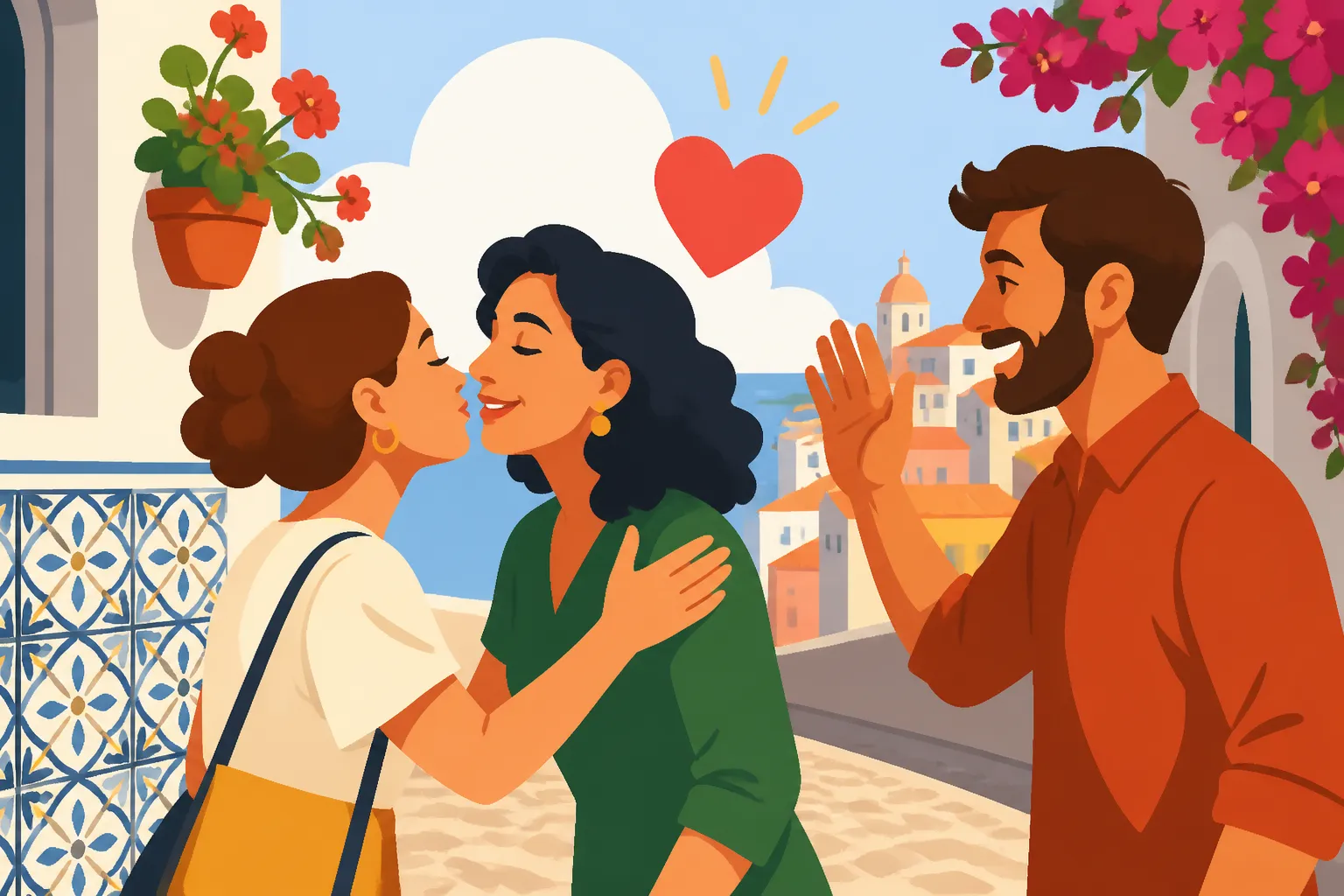
The beijinho is the standard greeting between women, and between men and women, once a basic level of acquaintance is established. It is rarely a "wet" kiss on the cheek; it’s more of an "air kiss" where your cheeks touch lightly. In Portugal, the standard is two kisses—starting with the right cheek and then the left.
Note that men usually do not kiss other men unless they are very close family members or extremely dear friends. Instead, men typically opt for a firm handshake or, among closer friends, a "bro-hug" accompanied by a few vigorous pats on the back. For a deeper dive into the mechanics of this, check out Portuguese greeting etiquette: When to use Beijinhos vs Handshakes. It's a nuanced dance, and getting the order right (right then left) prevents that dreaded head-bump.
Handshakes and Eye Contact
In formal or first-time meetings, the handshake is king. It should be firm but not bone-crushing. One of the most important aspects of a Portuguese greeting is maintaining direct eye contact. Looking away or glancing at your phone while shaking someone's hand is considered quite disrespectful.
This applies whether you are meeting a guide for a tour you found on GetYourGuide or checking into your hotel. It signals that you are present and that you value the interaction. Even if your Portuguese is limited to three words, a firm handshake and a sincere look in the eyes will go a long way in establishing trust.
Personal Space and Body Language
Compared to North Europeans or Americans, the Portuguese have a smaller bubble of personal space. People will stand closer to you in line, and conversations often involve a light touch on the arm or shoulder. This isn't an invitation for intimacy; it’s just how warmth is communicated.
If you find yourself feeling crowded in a busy market or on a crowded tram, try to remember that it isn't an intentional intrusion. However, while they are physically close, the Portuguese are often quite private about their personal lives during initial meetings. It is a culture of "polite proximity." To understand more about navigating crowded areas safely, you should read about Common tourist scams in Lisbon: Pickpockets on Tram 28 and fake hash sellers so you can distinguish between friendly closeness and something more suspicious.
| Situation | Greeting Type | Level of Formality |
|---|---|---|
| First-time business meeting | Firm handshake + Title (Sr./Sra.) | High |
| Meeting a friend's female friend | Two kisses (Right then Left) | Informal |
| Entering a small shop | Verbal "Bom dia" or "Boa tarde" | Mandatory Politeness |
| Male friends meeting after a year | Handshake + Back-patting hug | Semi-formal/Warm |
| Meeting an older neighbor | Verbal greeting + Naming (Sr. João) | High Respect |
The Gastronomic Social Contract
Food is the "social glue" of Portugal. If you are invited to someone’s home or even just out for a coffee, there are several layers of etiquette you need to understand. Meals are not just about nutrition; they are long, drawn-out affairs designed for conversation. Rushing through a meal is seen as a sign that you aren't enjoying the company.
The Couvert Confusion
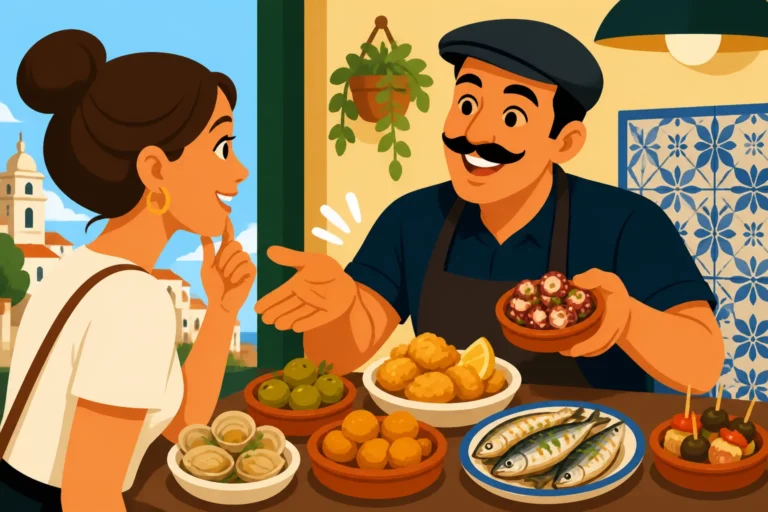
One of the biggest "frustrations" for visitors is the couvert. When you sit down at a restaurant, the waiter will almost immediately bring bread, butter, olives, cheese, and sometimes even small appetizers like octopus salad. Many tourists think these are a "gift" from the house. They are not. If you eat them, you will be charged for them on the final bill.
If you don't want them, simply say "No, thank you" (Não, obrigado) and the waiter will take them away. It is not considered rude to refuse the couvert, but it is considered "un-Portuguese" to complain about the charge if you've already tucked into the cheese. For more on how to handle restaurant bills and cultural expectations, see Tipping culture in Portugal: Do you leave 10% or just round up the bill?.
Coffee Culture as a Social Anchor
You cannot understand Portuguese social etiquette without understanding the café. For locals, the "espresso break" happens multiple times a day. It is the setting for business deals, gossip, and afternoon catch-ups. Ordering a "coffee to go" is almost unheard of in traditional spots; you sit, you drink your bica (espresso), and you talk.
There is a specific vocabulary for ordering coffee that will instantly make you look like an "insider." Whether you want a meia de leite or a galão, knowing the names shows respect for the local culture. I've spent hours in these cafes just people-watching, and it's the best way to learn the rhythm of the town. Check out our guide on Portuguese Coffee Culture and Restaurant Etiquette: Ordering Like a Local to make sure you're ordering the right cup at the right time.
The Importance of the "Long Lunch"
If a Portuguese person invites you for lunch at 1:00 PM, do not expect to be done by 2:00 PM. Lunch is the main event of the day. It usually involves a soup, a main course (often fish or meat), dessert, and of course, coffee. It is during these long lunches that real friendships are forged.
If you are a guest in someone’s home, it is customary to bring a small gift—a bottle of wine or a box of good pastries (like pastéis de nata) is always appreciated. Do not bring 13 flowers (superstition) and try to avoid lilies, which are for funerals. These small details show that you've done your homework. If you're looking to meet people and get invited to these types of gatherings, Making Friends and Networking in Portugal: Expat Groups and Meetups is a great place to start.
Public Manners and the Community Spirit
Living in Portugal means being part of a community, even if you are just passing through. The way you behave in public spaces reflects on you more than you might think. There is a strong sense of "right and wrong" in public behavior, though it is often enforced with a sigh rather than a shout.
Navigating "Portuguese Time"
Punctuality in Portugal is a flexible concept. If you are meeting friends for a drink or a casual dinner, being 15 to 20 minutes late is generally acceptable—and often expected. However, for formal appointments, doctor visits, or business meetings, you should aim to be on time.
If you are using public transport like the trains via Omio, those generally run on a strict schedule. But for social gatherings, the "soft start" is the norm. Don't be offended if your local friends aren't there the minute the clock strikes the hour. It’s part of the relaxed pace of life that makes the country so charming.
The Quiet Hours and Noise Etiquette
Despite the warmth and the late-night dinners, the Portuguese value their peace and quiet, especially in residential buildings. There are strict "quiet hours" (Lei do Ruído) usually between 11:00 PM and 7:00 AM. If you are staying in an apartment booked through Booking.com, be very mindful of your volume.
Slamming doors, wearing heels on wooden floors late at night, or playing loud music will quickly earn you a reputation as the "difficult neighbor." If you do run into issues with noise or have a dispute, it’s helpful to know the local rules. You can find more info here: Quiet hours in Portuguese apartments (Lei do Ruído): Handling noisy neighbors.
Handling Complaints with the Yellow Book
If you feel you’ve been mistreated in a shop or restaurant, the Portuguese don't usually engage in a "shouting match." Instead, every legal business is required to have a Livro de Reclamações (Complaints Book). Asking for this book is a serious move; the business must provide it, and the complaint goes directly to the regulatory authorities.
It is a very effective tool for consumer rights, but it should be used as a last resort. Most issues can be resolved with a polite conversation. If you want to know exactly how to use this system if things go south, read What is the 'Livro de Reclamações' and how does it solve consumer disputes?.
Etiquette for Families and Pet Owners
Portugal is incredibly family-oriented and increasingly pet-friendly, but there are still specific social expectations you should follow to ensure you are welcomed.
Children in Social Settings
In Portugal, children are welcome almost everywhere. It is not uncommon to see toddlers at a restaurant table at 10:00 PM or babies in strollers at a local festival. The Portuguese are generally very patient with children, and you’ll find that strangers might even stop to play with your baby or offer a compliment.
However, children are also expected to be relatively well-behaved in formal settings. If you’re traveling with kids, you’ll find that the country is a playground of warmth. If you’re taking tours via GetYourGuide, many are specifically designed to be family-friendly.
Traveling with Pets
While the culture is becoming more pet-friendly, there are still rules about where dogs can go. Many restaurants now allow dogs on patios, and some even inside, but you should always ask first. On public transport, there are specific rules about muzzles and tickets.
If you’re planning to bring your furry friend along on a day trip, make sure you know the logistical hurdles. Bringing your dog on public transport in Portugal: Muzzles and half-tickets covers everything you need to know to avoid a fine or being denied entry to a train or bus. For shorter trips around the city, you might also want to compare services like Using Bolt vs Uber in Portugal: Which ride-hailing app is cheaper? to see which ones are more accommodating for pets.
Cultural Sensitivity and the "Not Spain" Rule
Finally, the most important piece of social etiquette: Portugal is not Spain. This might seem obvious, but many visitors make the mistake of assuming the cultures and languages are interchangeable.
Language Sensitivity
Do not assume that everyone speaks Spanish. While the two languages are related, they are distinct. Many Portuguese people understand Spanish, but they may find it disrespectful if you address them in Spanish as a default. If you don't speak Portuguese, it is much better to ask "Do you speak English?" (Fala inglês?) or even "Do you speak French?" before resorting to Spanish.
The Portuguese are very proud of their linguistic heritage. Even learning the most basic phrases shows that you recognize Portugal as its own sovereign cultural entity.
Respecting Tradition and Religion
Portugal is a country with deep Catholic roots. Even if you aren't religious, it is important to be respectful when visiting churches or attending local festivals (festas). Dress modestly in religious buildings (cover your shoulders and knees) and maintain a quiet demeanor.
These traditions are the heartbeat of many small towns. Participating in a local procession or watching a Fado performance with the proper reverence will earn you a lot of respect from the locals.
Disclaimer
The information provided in this guide is based on cultural norms and personal experiences as of 2026. Social etiquette can vary significantly between urban centers like Lisbon and rural villages in the Alentejo. This guide is intended for informational purposes and does not constitute legal or professional advice. Always observe local signs and follow the specific rules of the establishments you visit.