Trains in Portugal: CP Routes, Alfa Pendular, and Booking
Disclosure: This article contains affiliate links. If you buy through them, we may earn a commission at no extra cost to you. Read our full disclosure.
Navigating the Portuguese rail system can be a significant hurdle for newcomers who find the national carrier’s website interface frustrating and the distinction between various train categories confusing. This guide meticulously breaks down every major route, train type, and booking strategy to ensure you never miss a connection or overpay for your journey. We solve the common mysteries of Comboios de Portugal (CP) so you can travel with the confidence of a seasoned local.
Understanding the CP Network: An Overview for New Arrivals
When you first arrive in Portugal, the railway system—operated almost exclusively by Comboios de Portugal (CP)—can feel like a relic of a different era mixed with flashes of modern brilliance. Unlike the sprawling, ultra-dense networks of Germany or France, the Portuguese rail system is more like a sturdy spine with several vital ribs reaching out to the coast and the Spanish border. For expats, understanding this layout is the first step toward reclaiming your weekends and exploring the country without the stress of navigating narrow toll roads.
The Different Types of Trains in Portugal
The Portuguese rail system is divided into four main categories, each serving a very specific purpose and offering a different level of comfort. At the top of the hierarchy is the Alfa Pendular (AP), the high-speed "tilting" train that connects the far north to the far south. Below that is the Intercidades (IC), or InterCity service, which is slightly slower but reaches more medium-sized towns. For shorter hops between neighboring cities, you will find the Regional (R) and InterRegional (IR) services. Finally, the Urbanos (U) serve the metropolitan areas of Lisbon, Porto, and Coimbra.
It is crucial to know that the ticketing systems for these are not always interchangeable. If you are living in the capital and have already secured your Navegante Pass Lisbon: How to get the €40 monthly unlimited transit card, you should be aware that while it covers Urbanos within the metropolitan zone, it will not grant you access to the Alfa Pendular or Intercidades without a separate, specific ticket. Misunderstanding this distinction is a common reason for fines among new residents who assume a general transit pass covers all rails.
Regional vs. Long-Distance Services
The experience of a long-distance journey is vastly different from a regional one. On the AP and IC lines, seats are reserved, and you are guaranteed a place. On Regional and InterRegional lines, it is a first-come, first-served free-for-all. This distinction is vital during the busy summer months or around Christmas. Many expats end up standing in the aisles of a Regional train for three hours because they didn't realize the "guaranteed seat" rule only applies to the premier lines.
Regional trains are often older, lack air conditioning in some carriages, and stop at every small village. However, they are also significantly cheaper and offer a window into "the real Portugal" that the high-speed lines bypass. If you are moving to a smaller town, you will likely become intimately familiar with these slower services as part of your Public Transport and Driving in Portugal: Trains, Tolls, and Licenses experience.
Why the Trains Are Better than Driving
While Portugal has an excellent highway network, the costs of fuel and tolls (Portagens) can be astronomical. A drive from Lisbon to Porto can easily cost €60 to €80 once you factor in the A1 tolls and the current price of gasoline. In contrast, if you book in advance, a train ticket can be as low as €9.50. Beyond the cost, the train allows you to avoid the aggressive driving culture often found on the highways and provides a much more relaxing environment to work or enjoy the scenery.
For those who are just starting their life here and perhaps staying in a temporary rental found via Booking.com, using the train is often the most logical way to scout different regions before committing to a long-term lease. It allows you to see the transition from the industrial north to the rolling plains of the Alentejo without having to keep your eyes glued to a GPS.
The Alfa Pendular: Portugal’s High-Speed Flagship
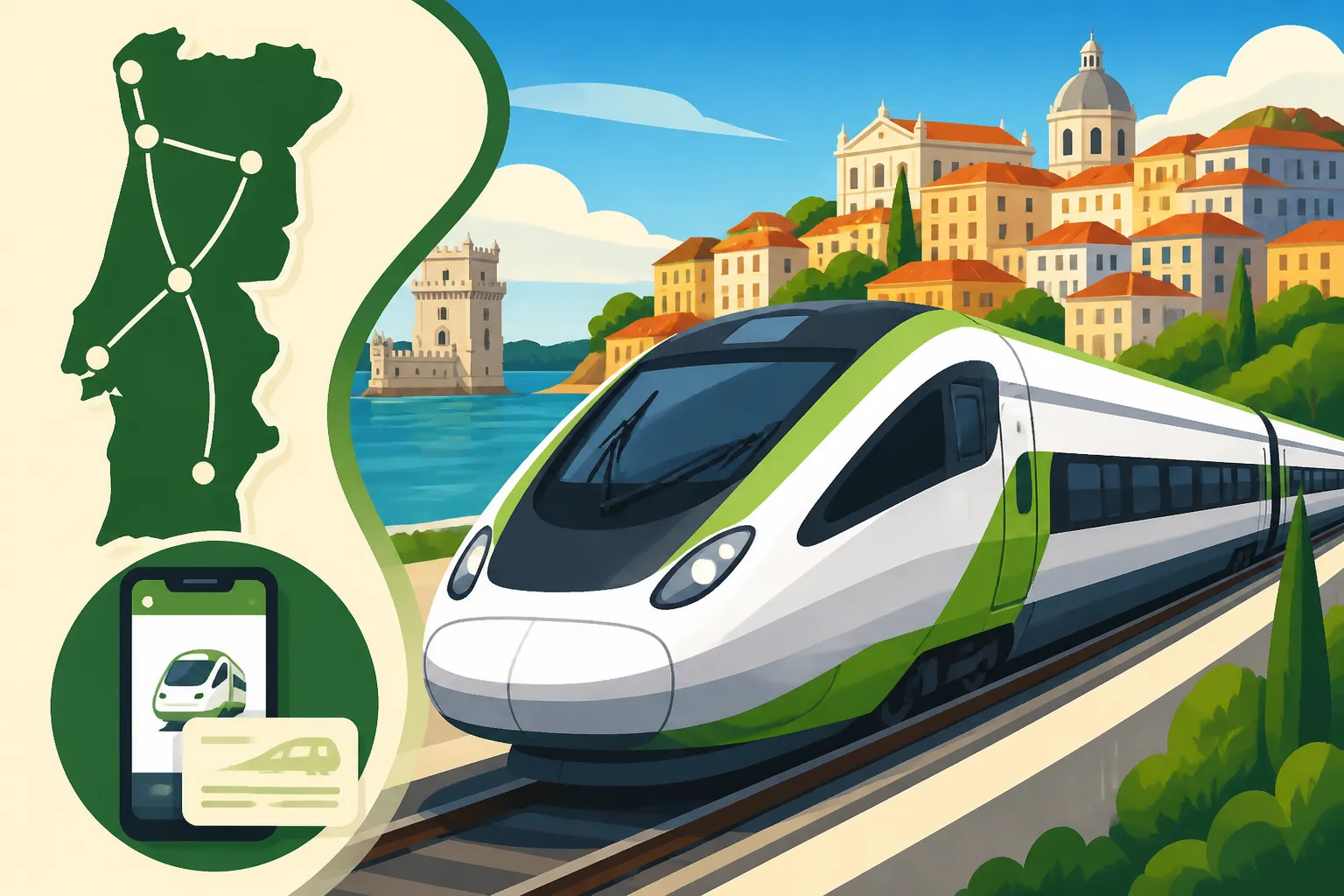
The Alfa Pendular is the pride of the Portuguese rail network. Using Italian tilting technology, these trains can maintain high speeds even on the curvy tracks of the Linha do Norte. It is the fastest way to travel between the major hubs of Braga, Porto, Coimbra, Lisbon, and Faro. If you value time and comfort above all else, this is your go-to option.
Routes and Major Hubs
The primary route for the AP runs from Braga or Guimarães in the north, through Porto (Campanhã station), down to Lisbon (Oriente and Santa Apolónia stations), and eventually terminates in Faro in the Algarve. The journey from Porto to Lisbon takes roughly 2 hours and 40 minutes, which is competitive with driving.
When arriving at these hubs, it is important to know which station you need. In Porto, long-distance trains always use Campanhã, not the beautiful, tile-covered São Bento. In Lisbon, most AP trains stop at Oriente (near the airport) and then continue to Santa Apolónia in the city center. If you are staying in the city center, perhaps in an area mentioned in our Lisbon Neighborhood Guide: Best Areas for Expats and Digital Nomads, Santa Apolónia is your most convenient terminus.
Comfort Classes: Conforto vs. Turística
The AP offers two classes: Conforto (First Class) and Turística (Second Class). Conforto provides wider seats, more legroom, and access to power outlets at every seat. You also get a complimentary drink and a newspaper on certain morning journeys. Turística is perfectly adequate—it’s clean, air-conditioned, and has decent legroom—but it can feel a bit cramped during peak hours.
For many expats, the extra €10 to €15 for Conforto is well worth it, especially if you need to get work done. The stability of the tilting train means you can actually type on a laptop without feeling nauseous, though the "tilting" sensation can be a bit disorienting for your first few minutes on board.
Onboard Amenities and Wi-Fi Reality
Each Alfa Pendular features a cafeteria car where you can buy coffee, sandwiches, and small snacks. While the food isn't gourmet, there is something quintessentially Portuguese about standing at the bar, drinking a "bica" (espresso) while the countryside blurs past at 220 km/h.
A word of warning regarding the onboard Wi-Fi: it is notoriously spotty. While the train is technically equipped with free internet, the signal often drops in the tunnels and rural stretches between Coimbra and Santarém. If you have a critical Zoom call, do not rely on the train's Wi-Fi. It is much safer to use a local SIM card with a generous data plan or an Airalo eSIM if you haven't set up your local contract yet.
| Feature | Alfa Pendular (AP) | Intercidades (IC) | Regional (R) |
|---|---|---|---|
| Speed | High (Up to 220 km/h) | Medium (Up to 160 km/h) | Low (Stops at all stations) |
| Reservations | Mandatory | Mandatory | Not Available |
| Power Outlets | All seats (Conforto) | Limited / None | None |
| Cafeteria | Full Bar/Café | Bar/Café or Vending | None |
| Best For | Business/Fast Travel | Budget Long-Distance | Short Hops/Scenic Views |
Intercidades and Regional Trains: Reaching the Heart of the Country
While the AP gets all the glory, the Intercidades and Regional lines are the workhorses that actually connect the smaller communities where many expats are now finding more affordable housing. If you are living on the Silver Coast or in the heart of the Alentejo, these lines will be your lifeline.
Navigating the Intercidades Network
The Intercidades network is more extensive than the AP. It reaches cities like Évora, Beja, Guarda, and Covilhã. These trains are slightly older and don't tilt, meaning the journey times are longer. For example, Lisbon to Évora is a pleasant 1 hour and 30-minute trip on an IC train.
The carriages are divided into first and second class, and like the AP, you must have a reserved seat. The price point is lower than the AP, making it a favorite for students and budget-conscious retirees. If you are heading south to start your new life as described in The Algarve for Expats: Lagos, Faro, and Tavira Compared, the IC is a very reliable way to reach the hub of Tunes, where you then switch to a regional train for the coastal towns.
The Charm (and Slowness) of Regional and InterRegional Lines
Regional trains are where you experience the slower pace of Portuguese life. You will see grandmothers with shopping bags, surfers heading to the coast, and students commuting to university. There is no seat reservation, and the rolling stock varies from modern suburban trains to decades-old carriages with windows that actually open.
The InterRegional (IR) is a "limited stop" version of the Regional service. It’s a great middle-ground that skips the smallest hamlets but remains cheaper than the IC. If you are traveling between Porto and Viana do Castelo, the IR is often your best bet. Be prepared for a lack of amenities; bring your own water and snacks, as these trains rarely have a bar car.
Scenic Routes You Shouldn't Miss
Some Regional lines exist as much for the view as for transportation. The Linha do Oeste, which runs along the western coast, offers glimpses of the Atlantic and rolling vineyards. However, the true star is the Linha do Douro. While you can book organized tours via GetYourGuide, taking the regular CP Regional train from Porto to Pocinho is one of the most cost-effective and stunning ways to see the UNESCO-listed wine region. The tracks often hug the riverbank so closely that you feel you could reach out and touch the water.
How to Book Tickets Like a Veteran Expat
Booking a train ticket in Portugal can be a smooth process or a total nightmare depending on the platform you use. Many newcomers make the mistake of waiting until they are at the station, only to find that the "Promo" fares have vanished or the train is sold out.
Using the CP App and Website
The official way to book is via the CP.pt website or the CP app. While the app has improved significantly, it can still be finicky with foreign credit cards. A pro tip: if the website keeps rejecting your card, try using a digital bank like Revolut or Wise, which usually bypasses the 3D-secure issues common with US-based cards.
When Buying train tickets online with Comboios de Portugal (CP) app, you will need to enter a valid ID number (passport or NIF). Don't worry—the ticket collectors rarely check the ID, but the system requires it to issue the digital ticket. You don't need to print your ticket; showing the PDF on your phone is standard practice across all lines.
Advanced Booking and "Promo" Discounts
This is the single most important piece of advice for saving money: buy your tickets early. CP offers "Promo" tickets for AP and IC lines if you book at least 5 to 8 days in advance. These discounts can be as high as 65% off the base price. I have frequently traveled from Lisbon to Porto for €9.50 instead of the usual €31 simply by planning a week ahead.
These tickets are limited in number and are non-refundable, though they can usually be exchanged for a different time for a small fee. If you are planning a weekend getaway and have already booked your accommodation through Booking.com, make the train ticket your very next purchase to lock in those savings.
Third-Party Platforms: When to Use Omio or Booking.com
Sometimes, the CP website is simply down for maintenance, or its English translation fails at a critical moment. In these cases, using a third-party aggregator like Omio is a lifesaver. Omio allows you to compare train, bus (Rede Expressos), and even flight options in a single interface that is much more user-friendly for English speakers.
While there might be a tiny booking fee, the peace of mind and the ability to use Apple Pay or PayPal often outweigh the cost. Additionally, for those who are still getting their bearings, Booking.com has started integrating transport options in certain regions, making it easier to coordinate your stay with your arrival time at the station.
Practical Tips for Station Navigation and Onboard Etiquette
Once you have your ticket, the actual day of travel presents its own set of cultural nuances. Portuguese stations can be beautiful, but they aren't always the most intuitive in terms of signage.
Decoding Portuguese Train Stations
In major stations like Lisbon Oriente, the departure boards (Partidas) will list the destination, the train type (AP, IC, R), and the platform (Linha). Be careful: platforms can change at the last minute. Keep an ear out for announcements, though they are usually only in Portuguese in smaller stations.
If you are in Porto and need to get from the main Campanhã hub to the central São Bento station, your long-distance ticket actually includes the short 5-minute "Urbano" hop for free. You don’t need a separate ticket for this transfer; just show your AP or IC ticket if there is a ticket barrier. This is a handy trick that many expats miss, often spending unnecessary money on an Uber or a separate Using the Andante card in Porto: Zones, top-ups, and ticket validation fines ticket.
Luggage, Pets, and Bicycles on Board
One of the great joys of Portuguese trains is the lack of strict luggage weight limits. As long as you can carry it and it fits in the overhead racks or the luggage areas at the end of the carriages, you are fine. On the AP and IC, there are dedicated spaces for larger suitcases.
For pet owners, small animals in carriers travel for free. Larger dogs are allowed on most trains but must be muzzled, on a short leash, and require a half-price ticket. Bicycles are generally allowed for free on Regional and Urban trains, but on the AP and IC, you must check if the specific train has a bike rack, and you usually need to "book" the bike spot in advance.
What to Do During Strikes (Greves)
Welcome to Portugal! Strikes, or "Greves," are a semi-regular occurrence, especially in the spring. They can be frustrating, but they are rarely total. Usually, "minimum services" (serviços mínimos) are guaranteed, meaning about 25% of trains will still run.
If a strike is announced, CP will post a list of guaranteed trains on their website. If your train is canceled, you are entitled to a full refund or a free exchange. During these times, I highly recommend checking Omio for bus alternatives, as bus companies like Rede Expressos or FlixBus often add extra capacity when the trains are down.
Regional Highlights: The Linha do Douro and the Algarve Line
To truly appreciate why people fall in love with this country, you need to leave the high-speed corridors and head for the scenic routes.
The Douro Valley: A Bucket List Journey
The Linha do Douro is widely considered one of the most beautiful rail journeys in the world. Starting from Porto's São Bento station, the train winds its way east. After about an hour, the urban landscape gives way to dramatic terraced vineyards and the shimmering Douro River.
The best part of the trip is between Régua and Pocinho. Here, the train is often the only way to see certain parts of the valley that aren't accessible by road. For a special experience, look for the "Historical Steam Train" (Comboio Histórico) which runs during the summer and autumn harvest seasons. If you want a more structured day, you can find many combined train and boat tours on GetYourGuide that handle all the logistics for you.
Crossing the South: The Algarve Regional Line
The Algarve line is a single track that runs from Vila Real de Santo António (on the Spanish border) to Lagos in the west. It is a slow, charming way to hop between beach towns. If you are staying in Faro, you can easily take a day trip to the picturesque town of Tavira or the rocky cliffs of Lagos.
Note that the trains here are often just two carriages long and can get very hot in the summer. However, they are incredibly cheap and avoid the nightmare of parking in busy coastal towns. It’s the perfect way to spend a Saturday exploring the region as part of your research into The Algarve for Expats: Lagos, Faro, and Tavira Compared.
Making the Most of Day Trips with GetYourGuide
If the idea of navigating the CP website and local schedules feels too daunting for your first few weeks, don't be afraid to use a service like GetYourGuide. They offer many "rail-and-experience" packages where a guide meets you at the station or provides the tickets as part of a larger tour of places like Sintra or Cascais. This can be a great "bridge" while you are still building your confidence in using the local system independently.
Disclaimer
The information provided in this guide is based on the current rail regulations and schedules in Portugal as of 2026. While we strive for absolute accuracy, CP frequently updates its pricing, strike schedules, and route availability. This content is for informational purposes only and does not constitute official legal or travel advice. Always verify your specific travel times and requirements on the official Comboios de Portugal website before your journey.